







Solar Garden Lights for Parks, Paths and Commercial Projects
Written by the Inlux Solar Engineering Team.
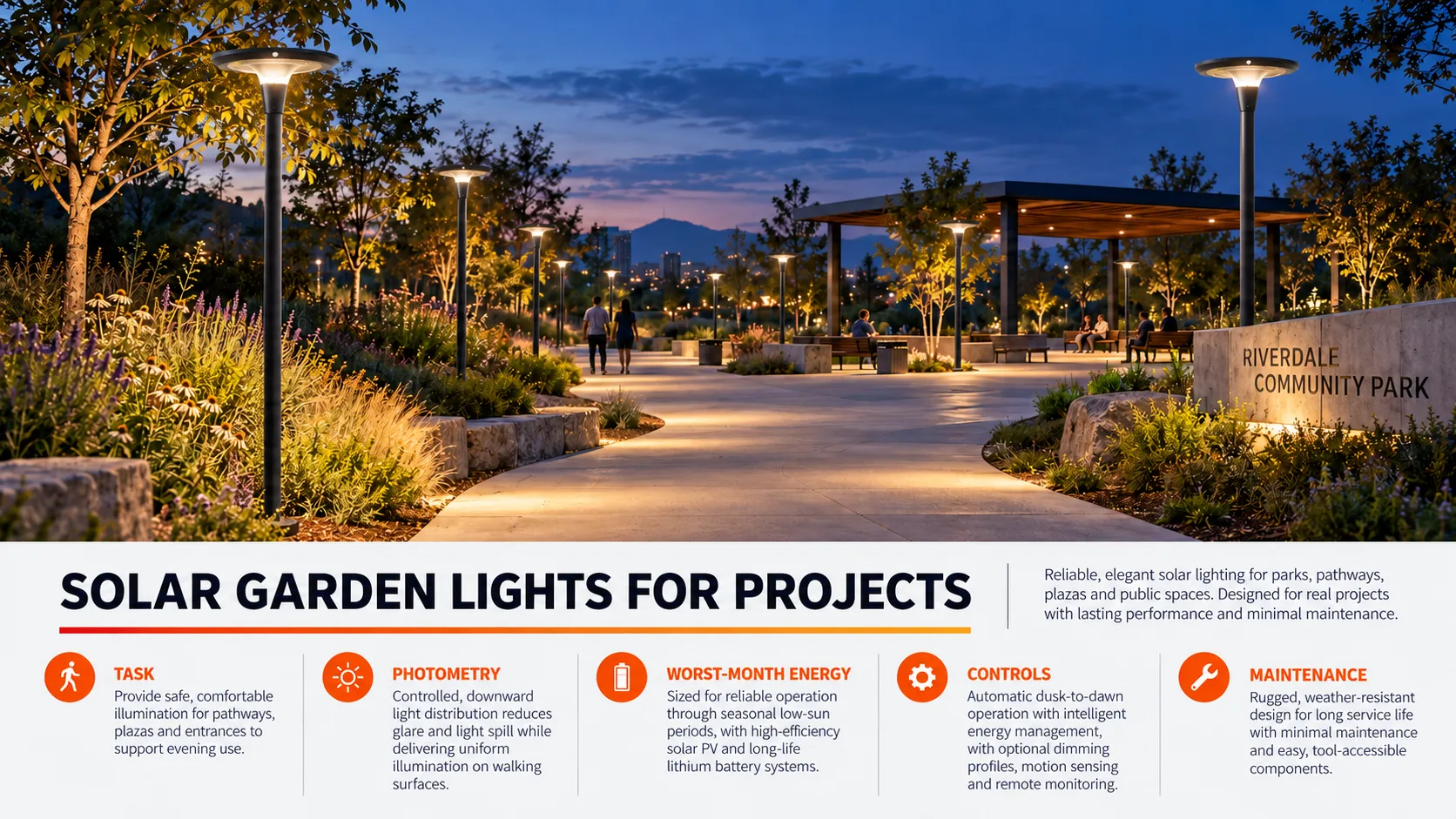
Jawaban cepat: Solar garden lights for a public park, resort, campus or residential community should be selected as a lighting system—not as isolated decorative objects. Start with the route and visual task, required operating hours, acceptable light spill, local solar resource, mounting form and maintenance plan. Then verify a model-level photometric file, battery/solar calculation, structural details, controls and replaceable components before approving a sample or tender.
The phrase “garden light” covers two very different purchases. A homeowner may want a small stake light that marks a flower bed for a few evening hours. A commercial buyer may need dozens or hundreds of repeatable fixtures that support pedestrian movement, entrances, seating areas and landscape identity throughout the year. The second job needs drawings, calculations, spares and acceptance records—not a brighter-looking product photo.
On this page
- What counts as a commercial solar garden light?
- Consumer garden lights and project-grade systems are not interchangeable
- Choose the lighting task before the fixture style
- How to compare solar garden lights by system architecture
- Size the system for the worst operating period
- Photometry decides spacing, not the product photo
- Control glare, uplight and spill from the first layout
- Specify durability and serviceability by component
- Where the Inlux EOS fits
- A 12-step commercial selection workflow
- Copy-paste RFQ checklist
- Pertanyaan yang Sering Diajukan
- The procurement decision in one sentence
What counts as a commercial solar garden light?
A commercial solar garden light is an outdoor, solar-powered fixture used at pedestrian scale in landscaped public or shared spaces. It may be a post-top, low pole light, bollard, wall-mounted fixture or a decorative luminaire with a separate PV module. The defining issue is not shape. It is whether the system can meet a documented lighting task and operating schedule at the actual site.
Typical project areas include:
- park and campus paths;
- courtyards and residential-community walkways;
- resort gardens and outdoor seating approaches;
- plazas, entrances and drop-off edges;
- low-speed internal roads and bicycle routes;
- landscaped commercial districts;
- trailheads, rest areas and wayfinding nodes.
The U.S. Federal Highway Administration’s 2023 Lighting Handbook discusses pedestrian visibility, visual tasks and the fact that more light is not automatically the best solution. A garden-light schedule should therefore begin with the people, conflicts and surfaces that need to be seen—not with a universal lumen target.
Consumer garden lights and project-grade systems are not interchangeable
| Decision | Small consumer/decorative light | Commercial project system |
|---|---|---|
| Main task | Accent, mood or edge marking | Repeatable pedestrian, route or area lighting |
| Purchase unit | One or a small pack | Coordinated fixture, pole, solar, battery and control package |
| Design evidence | Package claim or visual impression | IES/LDT file, layout, operating schedule and energy balance |
| Night duration | Often short or variable | Defined full-night or scheduled operation |
| Weather basis | Generic outdoor claim | Site climate, ingress, impact, corrosion and wind requirements |
| Pemeliharaan | Replace the whole item | Access, diagnostics, replaceable parts, spares and records |
| Controls | Simple automatic on/off | Dusk-to-dawn, staged dimming, optional occupancy logic and override |
| Penerimaan | It turns on | Measured, documented criteria at agreed test points |
A high-volume search result may mix both classes. Inlux should not imply that one project-grade fixture is a substitute for every stake, fairy, mushroom, string or seasonal garden light. This page is for durable exterior projects and connects to a specific product only where its form and photometry fit.
Choose the lighting task before the fixture style
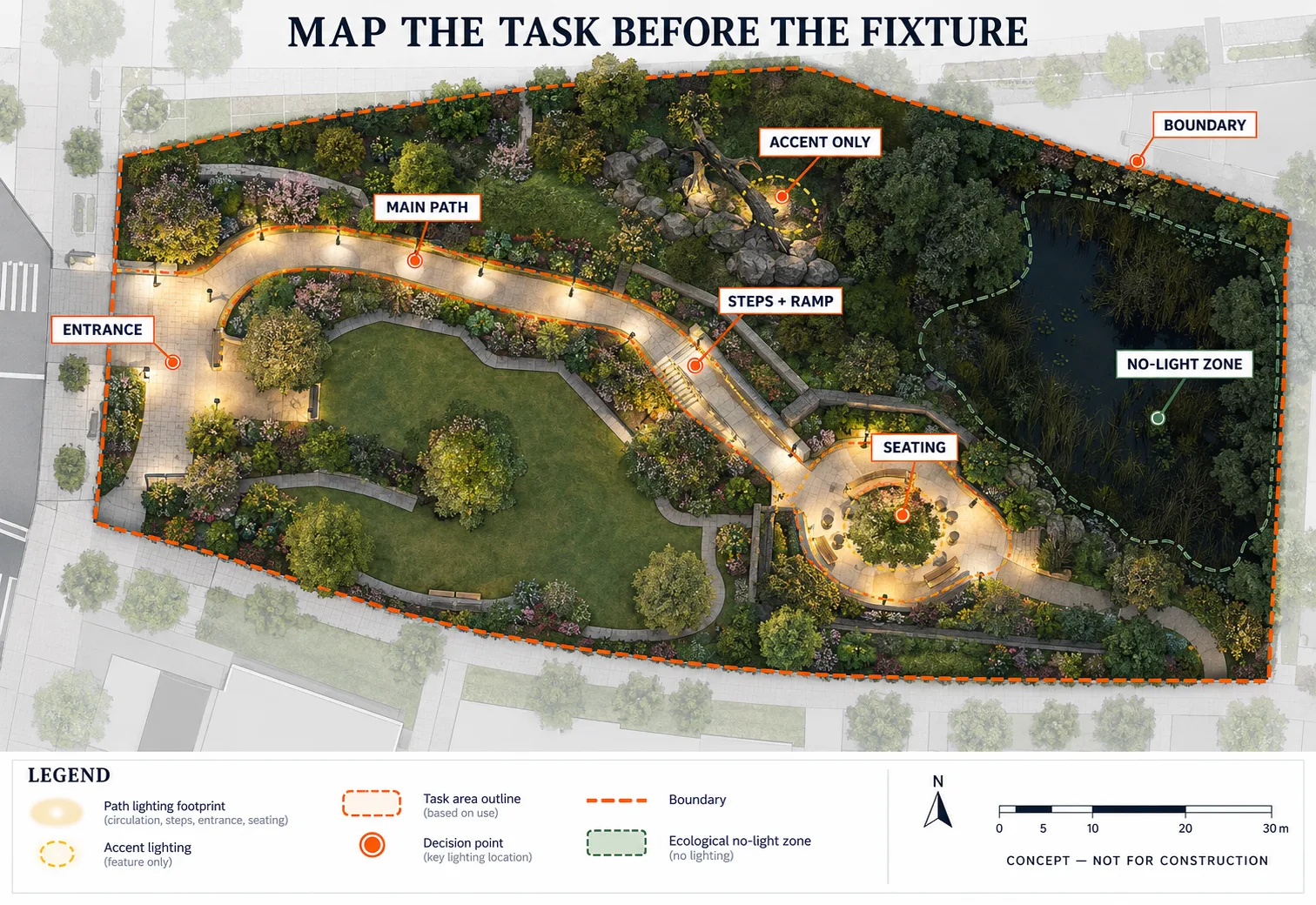
Garden projects often begin with an architectural mood board. That is useful, but it does not define where people need light or what must remain dark. Divide the site into task zones before choosing the product family.
| Zone | Primary visual task | Design question |
|---|---|---|
| Main pedestrian path | See route direction, surface changes and other users | Is horizontal and vertical visibility continuous at decision points? |
| Steps and ramps | Detect level changes and edges | Are transitions visible without glare into approaching eyes? |
| Entrance or gate | Find destination and identify people | Does light support recognition without washing nearby windows? |
| Seating area | Move safely and maintain visual comfort | Can brightness be lower after peak use? |
| Landscape feature | Reveal form or identity | Is decorative light necessary, targeted and limited in time? |
| Boundary | Orientation and controlled security visibility | Does the beam remain inside the project boundary? |
| Ecological/no-light zone | Preserve darkness | Can the layout avoid the zone rather than “fix” spill later? |
The Inlux solar pathway lighting page focuses on routes through parks, campuses and public walkways. The park and recreation lighting page addresses the broader application. Those pages own application design; this page owns the solar garden-light family and procurement decision.
How to compare solar garden lights by system architecture
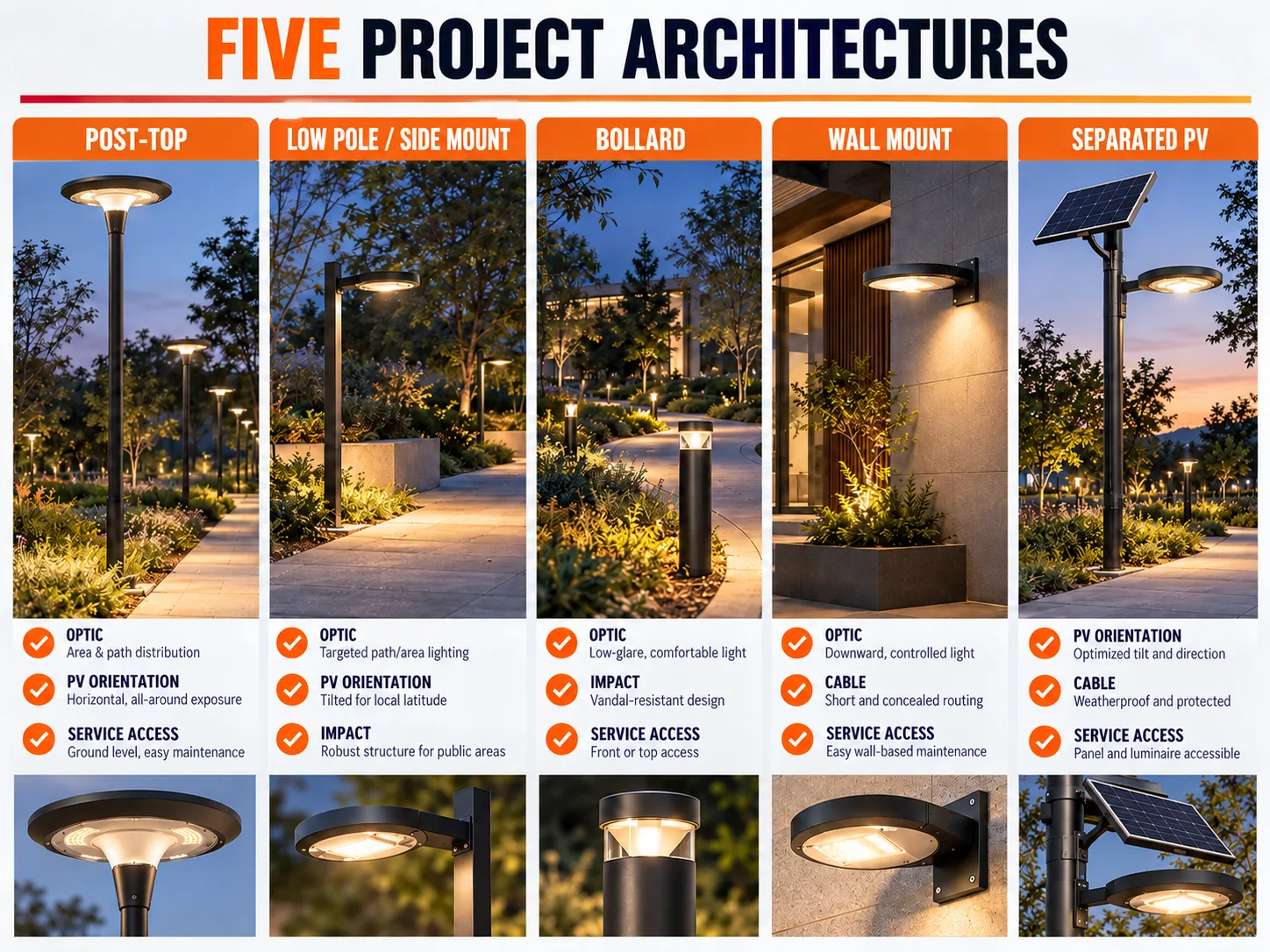
Post-top solar garden light
A post-top form can give a recognisable daytime identity and broad pedestrian-scale distribution. Check whether the optical system limits glare and uplight while still placing useful light on the route. A decorative shape alone says nothing about the maintained result.
Low pole or side-mounted luminaire
A low pole can support paths and small plazas with better optical control than a purely glowing decorative globe. Pole spacing, mounting height, distribution and shielding must be evaluated together.
Solar bollard
Bollards can mark route edges at low mounting heights, but they are more exposed to impact, vandalism, vegetation and snow or debris. A very bright source near eye level can become uncomfortable even when total lumens are modest.
Wall-mounted solar light
Wall mounting may suit entrances, service routes and courtyards where a façade is available. Confirm that the PV module receives a viable charging window and that the wall optic does not create glare or spill into rooms. Keep wall-mounted task lighting separate from pole-top route lighting in the equipment schedule.
Integrated versus separated PV
An integrated panel can simplify equipment count but ties charging orientation to fixture orientation and available surface area. A separated panel offers more freedom to orient the PV module and can move it away from tree shade, while adding cable, bracket and visual-coordination requirements. The correct architecture depends on the site—not on a blanket claim that one format is always more advanced.
Size the system for the worst operating period
An attractive summer demonstration does not prove year-round operation. Trees, buildings and seasonal sun angles can shorten the charging window, while longer winter nights and cloudy periods can increase energy demand. The calculation should use the project’s critical month and verified losses.
At minimum, record:
- coordinates and applicable weather/solar dataset;
- panel orientation and horizon/shade profile;
- nightly operating hours for each dimming stage;
- actual luminaire input power in each stage;
- controller and wiring losses;
- battery usable-energy boundary and temperature assumptions;
- module energy after temperature, dirt, mismatch and other agreed losses;
- recovery behavior after poor-weather days;
- battery and controller voltage/current limits;
- the acceptance margin required by the contract.
For a schedule with multiple stages, calculate nightly load energy instead of multiplying peak watts by the whole night. A fictional example illustrates the method:
| Operating stage | Input power | Duration | Energy |
|---|---|---|---|
| Early evening | 18 W | 4 h | 72 Wh |
| Late-night dim | 6 W | 6 h | 36 Wh |
| Morning return | 12 W | 2 h | 24 Wh |
| Illustrative total | — | 12 h | 132 Wh/night |
These are not Inlux product settings or a universal garden-light schedule. They show why “18 W × 12 h = 216 Wh” would overstate the load when staged controls are actually approved. Conversely, an optimistic motion assumption can understate the load if occupancy is frequent.
Gunakan tombol worst-month solar resource method dan battery sizing guide for the underlying calculations. A supplier should state the dataset, loss chain, usable battery boundary and operating profile—not only “rainy days.”
Photometry decides spacing, not the product photo
Two fixtures with the same lumen output can create different path results because mounting height, optical distribution, tilt and surrounding surfaces change where the light goes. Request the exact IES or LDT file for the proposed configuration and keep the filename/revision in the submittal.
A useful layout records:
- scaled boundaries, paths, steps, entrances, seating and nearby windows;
- pole coordinates, mounting heights, setbacks and fixture orientation;
- exact luminaire, optic, CCT, input power and control scene;
- calculation grid, calculation plane and exclusion rules;
- maintained-light assumptions and depreciation factors;
- minimum, average, maximum and uniformity where the authority requires them;
- vertical or face-level checks at conflict points where relevant;
- boundary spill and sensitive-receptor checks;
- the source photometric filename and report revision.
Do not copy a road-lighting criterion onto every garden path. The governing authority, owner and qualified designer must set the criteria for the project type and location. The street-light design guide explains the broader layout workflow; a rendered picture still must not be confused with a calculation.
Control glare, uplight and spill from the first layout
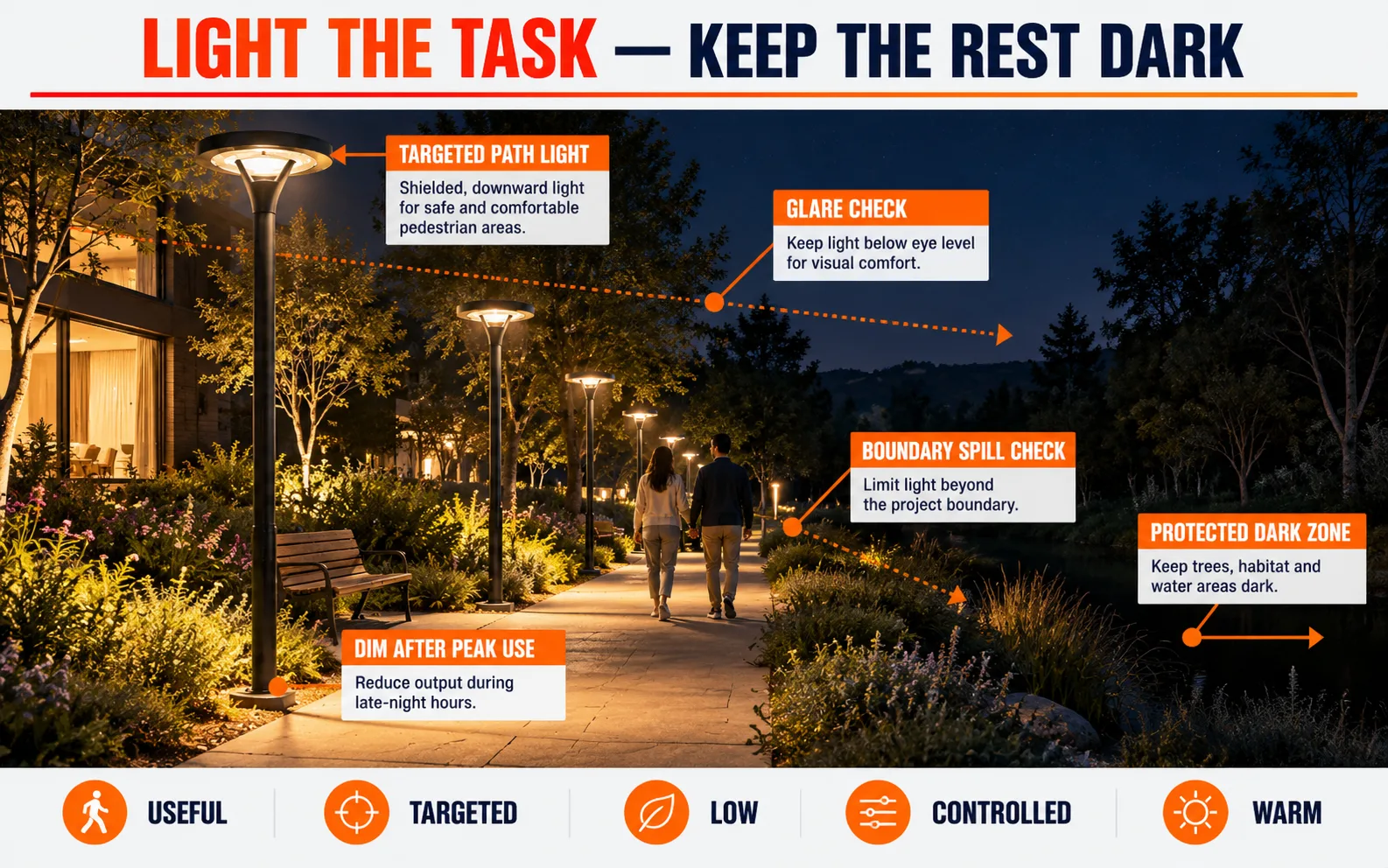
The jointly published Five Principles for Responsible Outdoor Lighting describe useful, targeted, low-level, controlled and warm-coloured lighting. The U.S. Department of Energy’s Light at Night resource likewise points to thoughtful deployment, optical control, minimum necessary light, controls and colour selection.
For a garden project, convert those principles into drawing checks:
- show the useful area and the no-light area;
- aim and shield light toward the task;
- check the pedestrian’s likely viewing direction;
- avoid exposed high-luminance sources near eye level;
- use a lower approved scene after activity declines;
- keep light out of bedrooms, neighbouring property, habitat and sky;
- choose CCT and spectrum for the task and local environmental policy;
- commission the final result at night.
CIE 150:2017 is a guide for limiting the effects of obtrusive light in outdoor installations (CIE publication record). It is not a single global pass/fail number for every site. The project team must identify the applicable environmental zone, authority and criteria.
Specify durability and serviceability by component
“Outdoor” and “commercial grade” are not complete specifications. Break the system into serviceable components and require evidence for each relevant boundary.
| Komponen | Submittal evidence | Field question |
|---|---|---|
| Luminer | Photometric file, construction, ingress/impact ratings, finish | Can the optic and cover be cleaned or replaced? |
| Modul PV | Model, rating conditions, mechanical/electrical limits, bracket | Is it shaded, reachable and correctly oriented? |
| Baterai | Chemistry, usable-energy basis, BMS limits, temperature range | Can it be isolated and replaced without dismantling the whole asset? |
| Pengontrol | Voltage/current limits, profile, protections, logs and interfaces | Can settings and alarms be exported for handover? |
| Pole/bracket | Material, geometry, fasteners, foundation/interface and wind basis | Are cable routes, doors and anti-tamper details maintainable? |
| Connectors/cables | Type, polarity, UV/environmental suitability and support | Are connectors compatible, sealed and strain-relieved? |
| Controls/sensor | Detection zone, timeout, override and fallback state | Does vegetation or adjacent traffic cause false triggering? |
An ingress rating belongs to the component or assembly that was tested. Do not transfer a controller’s rating to the full luminaire or assume that a high IP code resolves corrosion, condensation, UV exposure, impact, drainage or maintenance access.
Inlux Solar’s standard warranty is 5 years. Project acceptance should still define spare quantities, replaceable parts, tool access, documentation, software/remote-control ownership where applicable and the response expected for a failed unit.
Where the Inlux EOS fits
The current Inlux EOS solar garden light is the specific SKU page for a disc-form decorative system intended for parks, pathways and residential environments. Use that page to request the current model configuration, IES/LDT file, solar/battery calculation, pole interface, finish, controls and quotation.
Do not copy older isolated numbers from a web page into a tender without a revision-controlled submittal. The live EOS page currently contains inconsistent historical component statements, so this category page deliberately does not repeat cycle-life, controller-efficiency, ingress or autonomy values as tender facts. The approved proposal should state one coherent configuration and evidence set.
For taller, vertical-PV or street-oriented systems, compare the solar pole light family dan decorative solar street-light family. The parent commercial solar street-light page remains the main route to the broader product architecture.
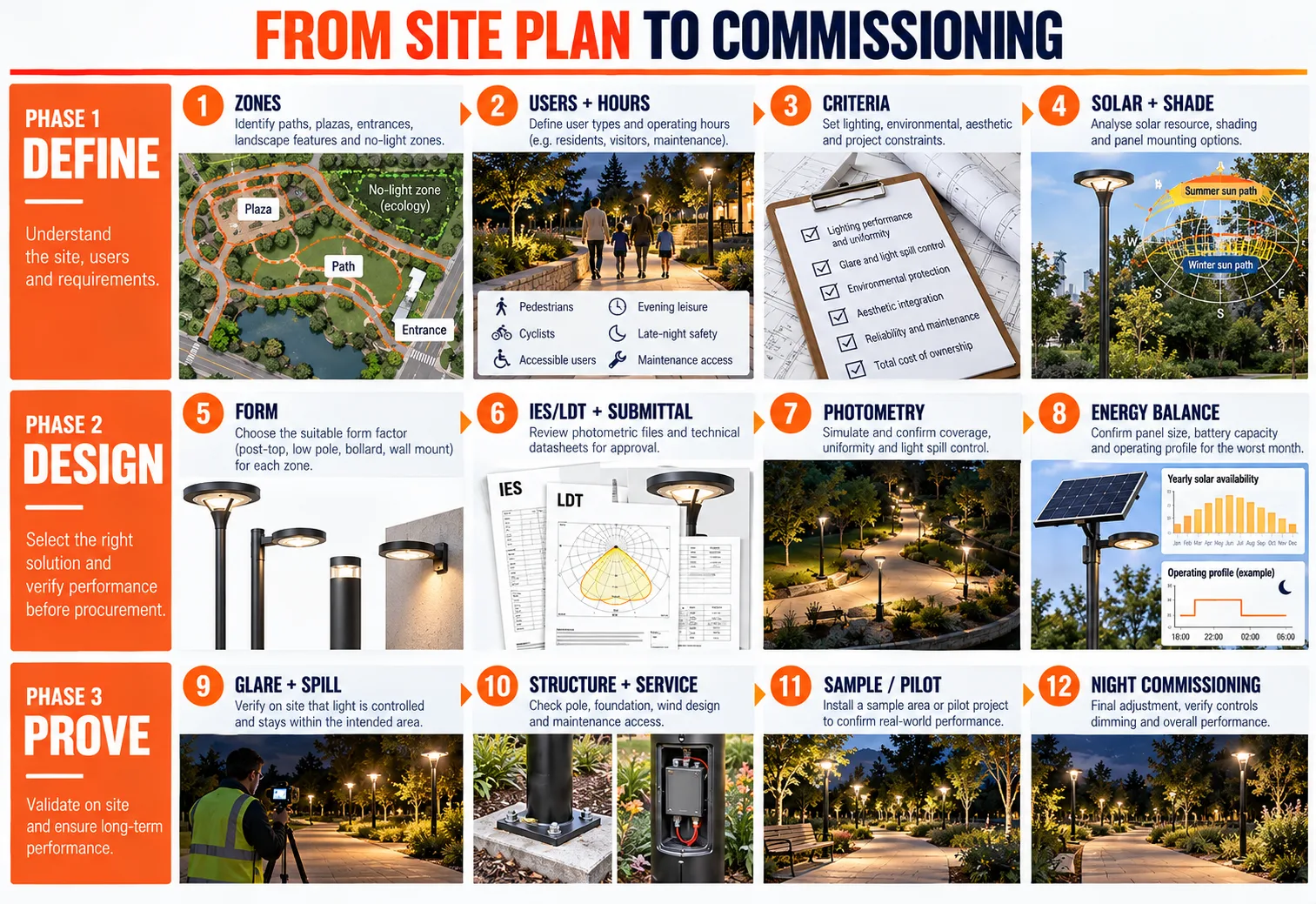
A 12-step commercial selection workflow
- Mark every path, step, entrance, seating area, boundary and no-light zone.
- State the user group, operating hours and visual task for each zone.
- Confirm the applicable authority, owner criteria and environmental restrictions.
- Record coordinates, critical-month solar data and a shade/horizon survey.
- Shortlist fixture forms that fit mounting, architecture, maintenance and vandal risk.
- Obtain exact IES/LDT files and model-level electrical submittals.
- Build a photometric layout with controlled scenes and maintained assumptions.
- Calculate nightly load energy and worst-period solar/battery balance.
- Review glare, uplight, boundary spill, CCT and sensitive receptors.
- Review structure, foundation, cable, access, corrosion and replaceable parts.
- Approve a sample or pilot against written daytime and nighttime criteria.
- Commission, photograph and sign off every pole group and control profile.
A project-defined pilot can preserve evidence at four checkpoints: Day 0 factory/configuration record, Night 1 photometric and control check, Day 7 charging/runtime review and Day 30 defect/maintenance review. These dates are an illustrative acceptance sequence, not a universal standard. Keep the same pole IDs, firmware/profile revision, instrument IDs and photo viewpoints so a change between checkpoint 1 and checkpoint 4 can be traced instead of guessed.
Copy-paste RFQ checklist
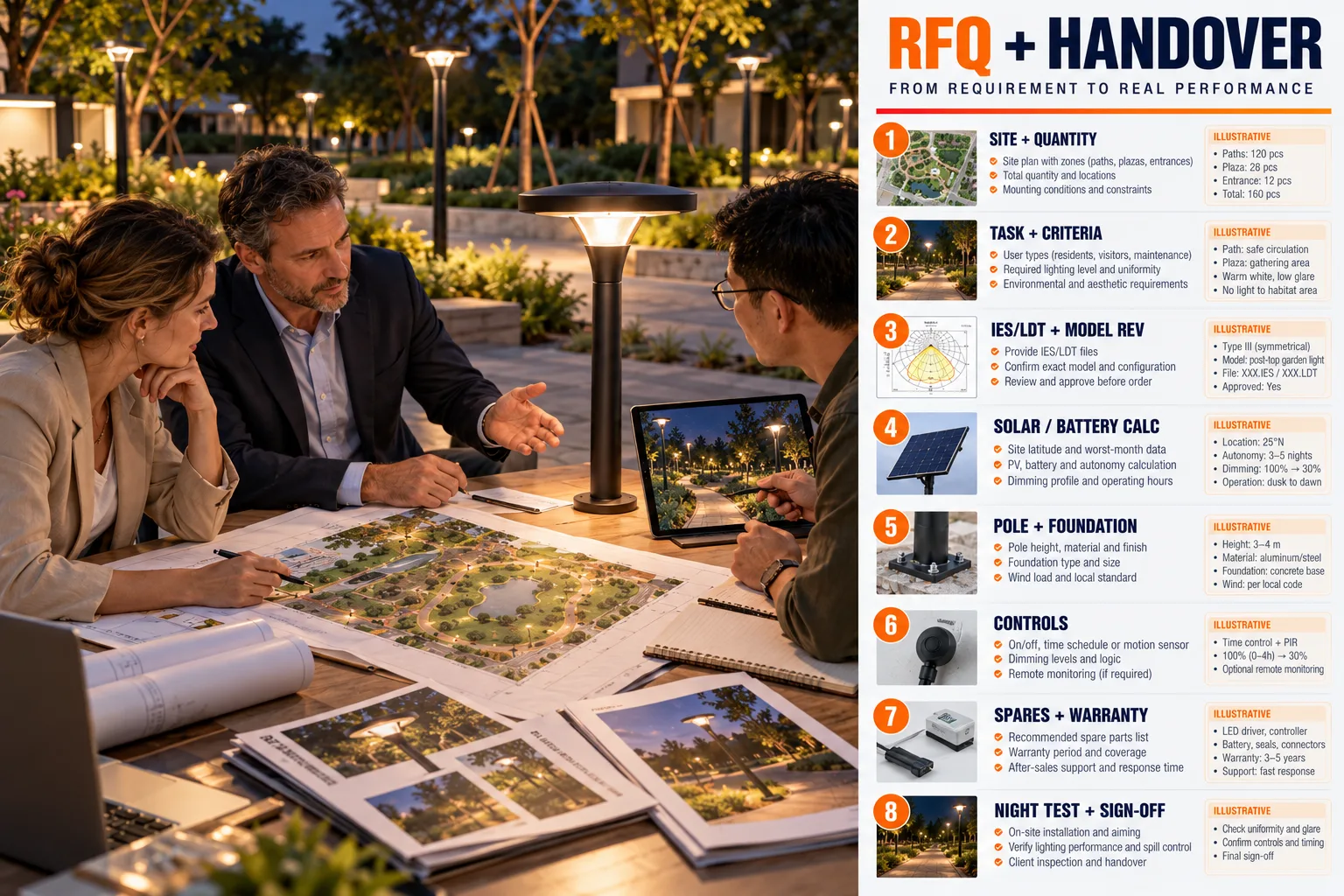
Send the following with a commercial solar garden-light enquiry:
| RFQ field | Required input |
|---|---|
| Project | Country, city, site type, client and delivery stage |
| Site plan | Scaled CAD/PDF, boundaries, paths, steps, entrances and north arrow |
| Quantity | Estimated fixtures and any phased delivery |
| Lighting task | Wayfinding, pedestrian recognition, steps, seating, landscape accent or boundary |
| Kriteria | Authority/owner document, calculation plane, maintained values and spill limits |
| Operation | Sunset-to-sunrise hours, dimming scenes, occupancy logic and overrides |
| Solar input | Coordinates, shade/horizon data and approved weather dataset if specified |
| Penampilan | Fixture form, pole height range, finish, architectural reference and daytime constraints |
| Lingkungan | Temperature, rain, flooding, dust, salt/corrosion, wind and vandal exposure |
| Controls | Standalone, remote, grouped or monitored operation; required data ownership |
| Hasil kerja | IES/LDT, layout, energy calculation, drawings, manuals, test records and certificates |
| Commercial | Incoterm, destination, schedule, spares, warranty and acceptance process |
Inlux Solar has delivered more than 300,000 lighting units across 60+ countries. That scale does not make one garden-light configuration universal. It supports a disciplined review process: send the site, task, schedule and criteria through the project enquiry page so the proposal can be tied to a real location.
Pertanyaan yang Sering Diajukan
Are solar garden lights suitable for public parks?
Yes, when the system is designed for the actual route, operating schedule, solar resource, environment and maintenance plan. A small consumer stake light should not be treated as a substitute for a project-grade post-top, pole light, bollard or controlled wall fixture. Request photometric and energy calculations before choosing spacing or quantity.
How many lumens should a solar garden light have?
There is no universal lumen number. Useful light depends on distribution, mounting height, spacing, surfaces, glare, maintained output and the task. Start with the required condition on the path or area, then use the exact photometric file to select output and spacing.
How far apart should solar garden lights be?
Spacing cannot be determined from watts or lumens alone. It depends on mounting height, optic, orientation, path width, target uniformity, adjacent light and obstructions. Use an IES/LDT-based layout and verify the installed result at night.
Do solar garden lights work all night?
They can be configured for a defined full-night or staged schedule when the panel, battery and controller are sized for the critical site conditions. A summer demonstration or “up to” runtime claim is not enough. Review worst-month energy, usable battery limits, losses and recovery after poor weather.
Should a garden light use a motion sensor or dusk-to-dawn control?
It depends on the task. Main paths may need a continuous low scene with a controlled increase, while low-use secondary zones may allow stronger occupancy-based savings. Document the detection area, delay, false-trigger risks, fallback state and accessibility/security requirements before relying on motion for the energy calculation.
What should a commercial buyer request before ordering?
Request the exact model and optic, IES/LDT file, photometric layout, solar/battery calculation, operating profile, component ratings, structural interface, drawings, manuals, test evidence, spares, warranty and commissioning criteria. Keep revision identifiers so the delivered configuration matches the approved design.
The procurement decision in one sentence
Choose solar garden lights by proving that the proposed system delivers the required pedestrian-scale light, through the critical operating period, without unacceptable glare or spill—and that it can be installed, controlled, maintained and verified across the whole project.