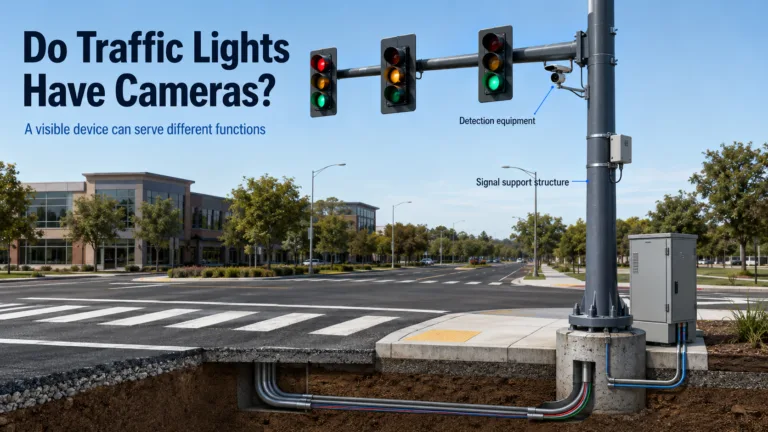
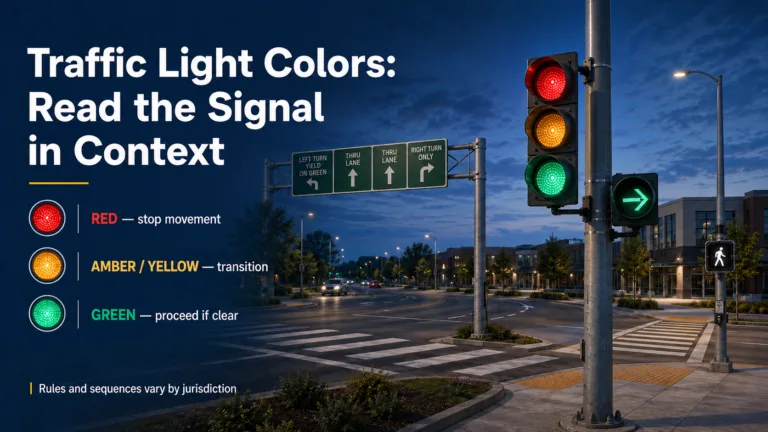
Traffic lights are not one single product category. A road junction may use vehicle signal heads, protected-turn arrows, pedestrian signals, bicycle signals, lane-control signals, flashing beacons, or temporary portable units—often on different support structures and under a locally defined control plan.
For a public-works, EPC, or site-infrastructure team, the useful first question is not simply “Which color means what?” It is: what movement must the signal control, who uses that movement, and what pole, arm, foundation, power, communications, and clearance requirements support it?
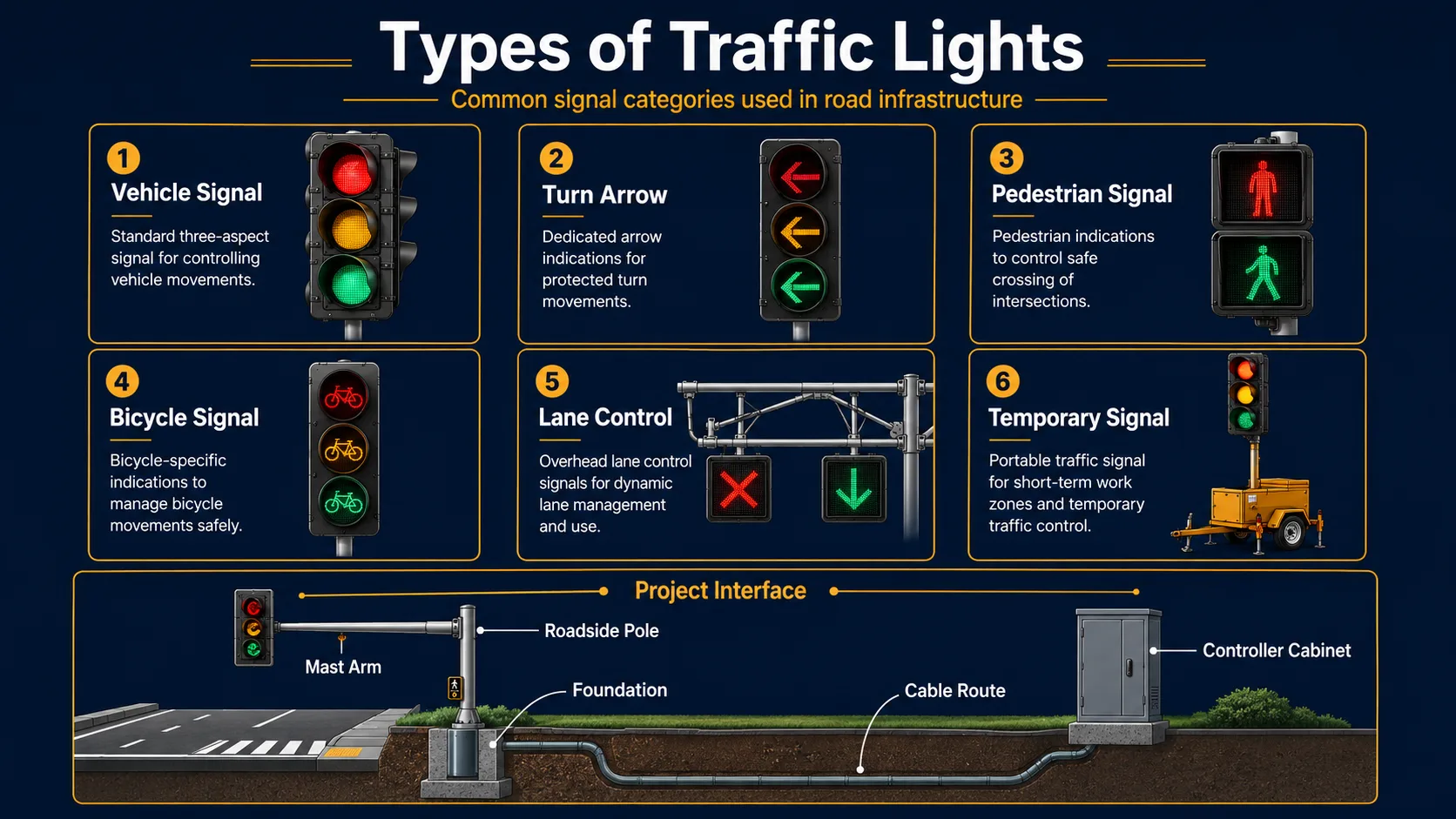
Scope note: This guide explains common traffic-signal categories for project scoping. Signal meanings, installation rules, and approvals are jurisdiction-specific; the road authority and applicable local standard control. Inlux Solar’s relevant supply scope is traffic-light pole and outdoor-infrastructure support—not a claim to supply signal heads, controllers, detection hardware, or traffic-law advice.
1. Standard vehicle traffic lights
The familiar red, amber/yellow, and green signal head controls vehicle movements at intersections, crossings, and access points. Its appearance varies by country, road class, mounting position, and local standard, but it normally forms the base layer of an intersection control plan.
Project teams should separate the signal head from the support system. The head communicates the movement indication. The support system may include a roadside pole, mast arm, gantry, brackets, underground conduits, cabinets, foundations, and access provisions.
For the broader operating logic behind fixed-time and demand-responsive signals, see How Traffic Signals Work. If the project team is also coordinating road lighting, use the Penerangan Jalan & Jalan solution path rather than treating intersection signals and street lighting as the same equipment package.
2. Directional and protected-turn signals
Directional signal heads use arrows to control a specific turn or lane movement. They are common where a left- or right-turn phase must be separated from through traffic, pedestrian movements, or opposing vehicles.
For a procurement brief, record:
- which approach and movement the signal serves;
- whether the arm/structure is roadside, overhead, or gantry-mounted;
- signal-head quantity, orientation, visors, backplates, and brackets supplied by the signal package;
- clearance, wind-load, corrosion, and foundation requirements for the supporting structure; and
- the governing drawing and road-authority approval route.
Those inputs keep a pole quotation from being based on an undefined “traffic light” load.
3. Pedestrian and bicycle signals
Pedestrian signals are designed for people crossing the roadway; bicycle signals serve a cycle movement or cycle crossing. They may be mounted near the crossing, on a shared support, or as part of a larger intersection assembly.
Do not assume a vehicle signal’s timing, height, visibility rules, or accessibility requirements apply unchanged to a pedestrian or bicycle signal. The responsible traffic engineer and local authority determine the signal sequence, accessible features, sight lines, and installation standard.
4. Lane-control and overhead signals
Lane-control signals are placed above lanes to manage reversible lanes, tunnels, toll approaches, managed lanes, or complex junction approaches. They can display a lane-use indication, closure symbol, arrow, or other operation-specific message.
Their project implication is structural: overhead mounting often changes the required arm reach, mast or gantry arrangement, wind exposure, maintenance access, and foundation design. Treat them as a separate engineered assembly, not as an enlarged roadside signal pole.
5. Flashing beacons and warning signals
Flashing beacons are used to draw attention to a crossing, school zone, work area, hazard, emergency access, or another location defined by the local road authority. They may be standalone or work with signs and markings.
The important distinction is functional: a warning beacon is not automatically a full intersection control system. Its power, activation logic, legal meaning, visibility requirements, and approval path must come from the project specification and local rules.
6. Temporary and portable traffic lights
Temporary traffic lights are used for roadworks, lane closures, alternating one-way flow, and short-duration site changes. Their operating method, permitted placement, and safety controls are highly local.
They should not be specified from a generic product article alone. A temporary-traffic plan normally needs the road authority’s requirements, work-zone geometry, expected traffic volume, visibility conditions, power/runtime approach, and a responsible traffic-management contractor.
7. Smart and adaptive traffic signals
Smart or adaptive systems use field inputs and a controller strategy to adjust operation. Depending on the authority and project, inputs may include loops, cameras, radar, communications networks, transit priority, pedestrian calls, or other approved detection methods.
The key project boundary is this: a smart-signal strategy is a control-and-communications scope, while the supporting pole or mast is a structural scope. If a project also includes connected outdoor infrastructure, review the separate Sistem Penerangan Jalan Pintar path; it should not be represented as a replacement for an authority-approved traffic-signal system.
How traffic signal types affect pole selection
The same intersection can require several support configurations. Before specifying a tiang lampu lalu lintas, submit the actual project inputs:
Relevant Inlux scope: the current Inlux public catalog includes a Tiang Lampu Lalu Lintas product page. This article uses that verified structural-support scope only; it does not imply that Inlux supplies the signal heads, controller, detector, or jurisdictional approval package.
| Project input | Why it changes the support design |
|---|---|
| Signal type and number of heads | Affects projected area, brackets, and arrangement. |
| Mounting method | Roadside, mast arm, suspended, and gantry mounting have different structural demands. |
| Arm length and pole height | Affect geometry, clearance, loads, and foundation design. |
| Local wind, corrosion, and environmental conditions | Affect structural and protective-coating requirements. |
| Cable, cabinet, and access route | Affect internal routing, base details, access, and coordination. |
| Authority drawings and applicable standard | Define what can be approved; they override generic guidance. |
For physical size context, see How Big Are Traffic Lights?. That guide describes dimensions; it does not replace a structural loading schedule or a jurisdiction-specific signal drawing.
A clearer procurement split
To reduce scope gaps, split the RFQ into the following packages:
- Traffic-control package: signal heads, controllers, detection, timing, communications, and authority compliance.
- Structural support package: poles, mast arms, brackets, foundations, coatings, anchor arrangements, and load confirmation.
- Road-lighting package: luminaires, photometric layout, electrical/solar sizing, poles, and lighting controls.
This split helps avoid a common failure: asking a pole supplier to infer the load of unspecified signal hardware, or asking a lighting supplier to approve a traffic-control sequence.
FAQs about traffic light types
What are the main types of traffic lights?
Common categories include vehicle signal heads, directional-arrow signals, pedestrian signals, bicycle signals, lane-control signals, flashing beacons, and temporary portable signals. The exact categories and legal meanings depend on the jurisdiction.
Are traffic lights and traffic signals the same thing?
In everyday use, the terms often overlap. In a project specification, “traffic signal” can refer to the wider controlled system—including signal heads, controller, detection, communications, supports, and the operating plan—so clarify the package scope.
Does a traffic light pole include the signal head and controller?
Not necessarily. A pole is normally one part of a larger system. Confirm the bill of quantities, responsibility matrix, drawings, mounting hardware, and approval requirements before asking for a quotation.
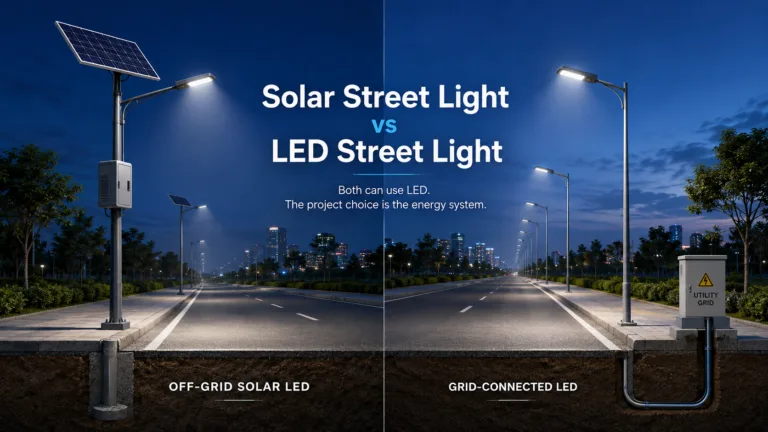
Can a solar street light replace a traffic signal?
No. Solar street lighting and traffic signals have different safety functions, controls, approvals, and engineering inputs. A project may use both, but each system needs its own design and responsible scope.
What should be included in a traffic light pole RFQ?
Include approved drawings, pole height, arm length, signal-head/support loads, mounting arrangement, wind and corrosion conditions, foundation/anchor requirements, cable route, finish, destination, quantity, and required delivery date.
Need a traffic-light pole quotation for a road project?
Send your approved drawings, support-load schedule, pole/arm geometry, installation country, corrosion environment, quantities, and required delivery date. The Inlux engineering team can review the structural support scope for a tiang lampu lalu lintas and coordinate it with the road-lighting package where relevant.
Editorial sources and limitations
This article intentionally does not reproduce a country-specific traffic code. For signal meanings and installation requirements, use the applicable authority standard for the installation location. SERP validation for this page found public road-authority explainers as the dominant result type, including the UK Highway Code signal guidance dan City of Toronto traffic-signal overview.