







Inlux Solar Guide
All-in-One vs. Split Type Solar Street Lights: Which Inlux Series Fits Your Project?
All-in-One series like Sirius dan Galaxy minimize installation time and labor with integrated design, while split-type systems like Mars dan Apollo handle higher wattage, harsh climates, and demanding highway or industrial applications with flexible, oversized solar panels.
For professional buyers, the real question isn’t “What is all-in-one vs. split type?”—you already know that. The real question is: When should you specify Inlux All-In-One series (Sirius / Galaxy / Alien / Polaris), and when do your conditions demand Split Type series (Mars / Apollo)?
Inlux All-In-One Solar Street Lights integrate the LED module, LiFePO₄ battery, controller, and solar panel into a single housing, minimizing on-site work and standardizing installation across multiple sites. The Sirius series, for example, combines ultra-bright 5050 LEDs, a 10-year LiFePO₄ battery, and an intelligent controller in a compact, high-efficiency form factor suitable for municipal roads and residential areas.
By contrast, Mars dan Apollo Split Type systems separate the solar panel, LED lamp, and battery box. This architecture allows larger solar arrays, 360° adjustable panel orientation, and higher wattage LED engines (up to ~200W) for highways, interchanges, industrial zones, and high-heat regions where energy demand and thermal stress are both critical.
Before diving into applications and model-by-model recommendations, the matrix below gives a quick top-level view of how Inlux All-In-One and Split Type series differ in installation method, adjustability, power range, and maintenance approach.
All-In-One vs. Split Type – High-Level Comparison
| Key Aspect | All-in-One (e.g., Sirius / Galaxy) | Split Type (e.g., Mars / Apollo) |
|---|---|---|
| Instalasi | Plug & play on dedicated poles. Integrated lamp, panel, battery, and controller in one housing, minimizing on-site wiring and installation time. | Wiring required between separate LED lamp, solar panel, and battery box. More components to mount, but higher flexibility for complex sites and existing poles. |
| Panel Adjustability | Panel angle is generally fixed or only lightly adjustable once the integrated head is mounted, optimized for standard road alignments. | Independent solar panel bracket with up to 360° horizontal adjustability and wide tilt range, allowing precise orientation for maximum solar yield in any road or site layout. |
| Max Wattage Range | Medium power: typically up to ~120W per luminaire, covering most municipal streets, local roads, and park applications (with some Sirius configurations extending into higher wattage brackets). | High power: up to ~200W+ using LED engines paired with Mars / Apollo systems, suitable for highways, wide carriageways, and large industrial yards requiring higher illuminance levels. |
| Battery Maintenance Concept | Integrated LiFePO₄ battery within the all-in-one housing, using modular / detachable internal components for simplified servicing when required. | External IP65–IP67 battery box (gel or LiFePO₄) mounted on the pole or buried at the base, allowing easier battery replacement and thermal management in harsh environments. |
In the next sections, we’ll map these architectural differences directly to real project scenarios—from decorative city boulevards (Galaxy / Polaris) to heavy-duty highways and industrial zones (Mars / Apollo)—so you can choose the exact Inlux series that fits your lumen package, environment, and budget constraints.
The All-in-One Solution: Efficiency Meets Design
Inlux All-In-One series such as Sirius, Galaxy, Alien, and Polaris integrate the LED module, LiFePO₄ battery, solar controller, and solar panel into a single, compact head. This means one product to mount on the pole, no separate battery boxes, and no extra panel frames. For multi-site rollouts, that translates directly into shorter installation time, lower labor cost, and fewer wiring errors.
Across these four series, the core architecture is similar:
- Adjustable solar panel and lighting module to optimize both solar capture and road illumination
- Ultra-bright 5050 LED chips with very high efficacy (up to around 220 lm/W in the SIRIUS series)
- Long-life LiFePO₄ battery packs engineered for 10+ years of service life under deep cycling
- Smart controllers with multiple protection modes and options such as motion sensors, CCTV, and remote monitoring.
Where they differ is how they present that technology to the city—either as a design object (Galaxy / Alien) or as a workhorse (Sirius / Polaris).
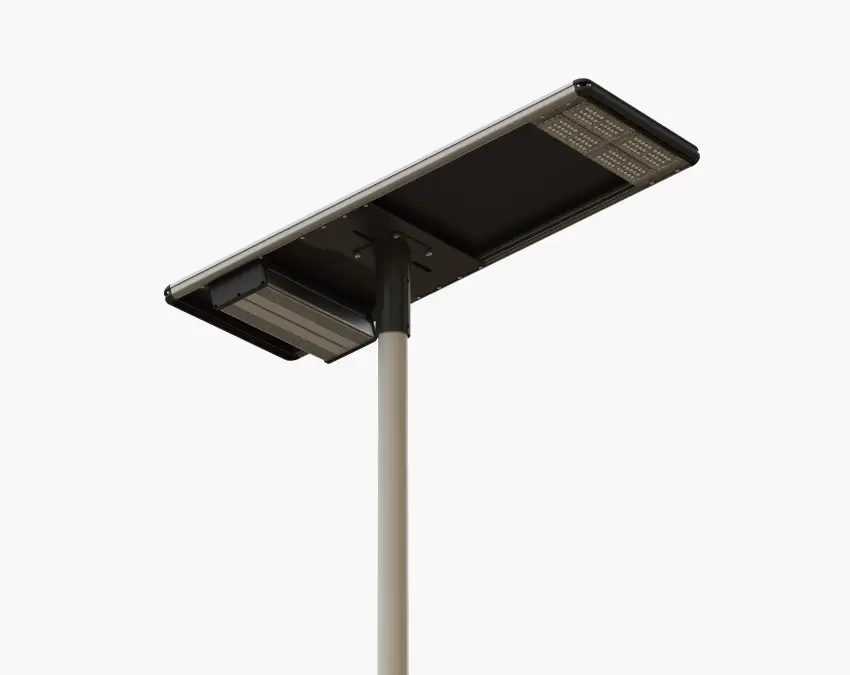
SIRIUS (INL-AIO9)
AIO output tinggi dengan head yang dapat disesuaikan, optik Tipe II/III, 5050 LED, dan LiFePO4-dibangun untuk jalan raya dan jalan raya dua arah.
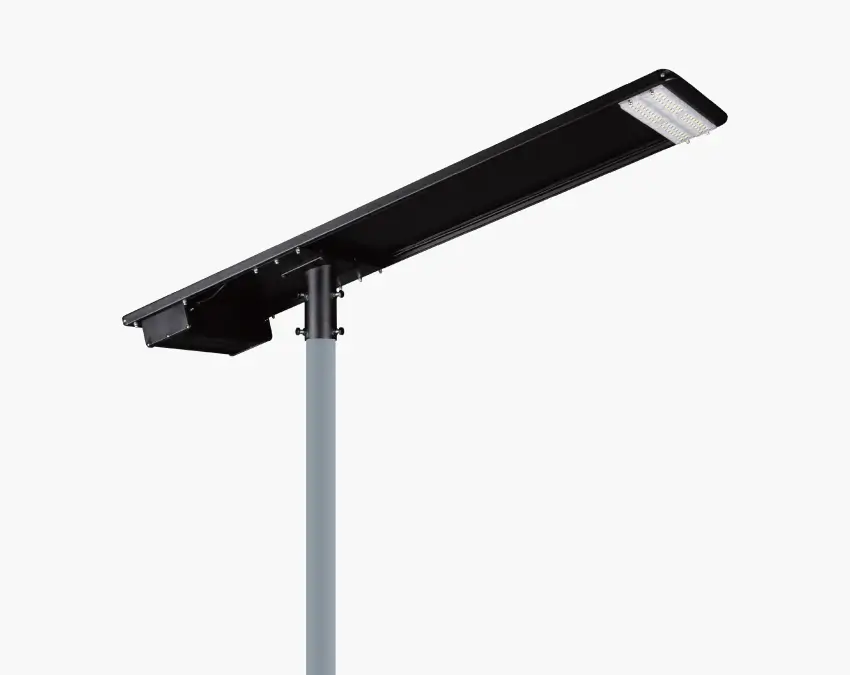
GALAXY (INL-AIO6)
AIO modular untuk output kecil hingga sedang; 5050 LED, LiFePO4, dan gerakan opsional/IoT-perawatan yang mudah untuk jalan, jalan setapak, parkir.
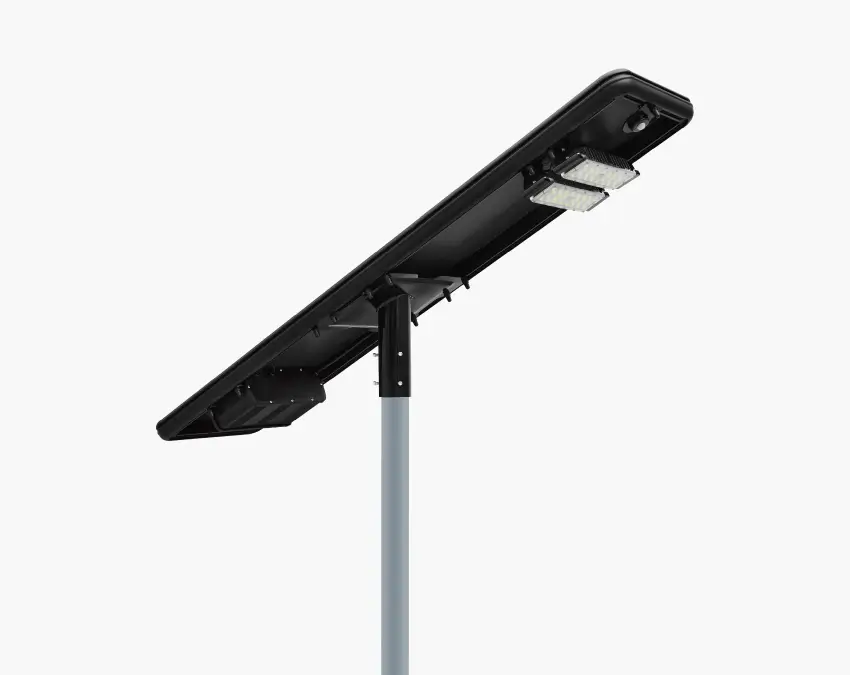
ALIEN (INL-AIO5)
AIO lengan ganda dengan penyesuaian vertikal/horizontal dan optik presisi-ideal untuk jalan yang kompleks, kampus, dan kawasan industri.
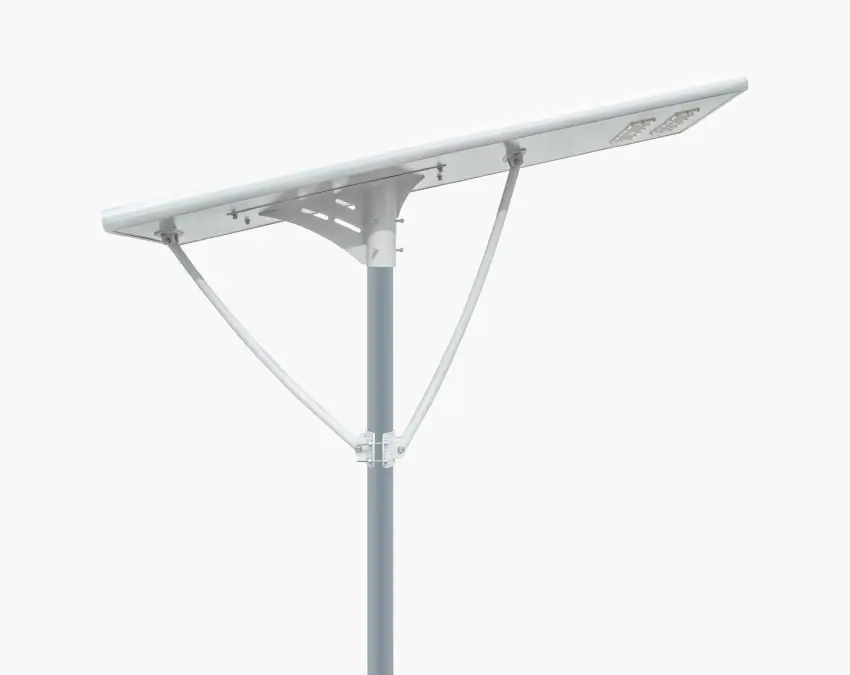
POLARIS (INL-AIO2)
AIO yang ringkas dan hemat biaya menggunakan panel efisiensi tinggi, 5050 LED dan LiFePO4 yang dapat diandalkan untuk jalan perumahan, taman, dan trotoar.
Case Study (Design): Galaxy & Alien for Architect-Led Urban Projects
When the project is a park, waterfront, business district, or modern boulevard, the lighting package is part of the urban design. Planners want a clean skyline and minimal “visual noise” from hardware.
For these scenarios, Inlux clients often standardize on the Galaxy or Alien series:
- Both Galaxy dan Alien keep the panel, optics, and battery in one streamlined head, so architects only see a single, unified form factor instead of a panel frame plus separate lamp and battery box.
- The adjustable lighting source and solar panel holder allow the design team to keep a consistent visual line along the street or park path, while the installer can still fine-tune the panel tilt for performance.
- The same integrated head works across streets, park paths, plazas, and residential communities, so the city can keep a coherent design language throughout a district.
In practical terms: if your municipality is upgrading a city park loop road and pedestrian paths, the Galaxy or Alien series lets you satisfy both the architect (aesthetic integration) dan the engineer (performance & autonomy) without moving to a more complex split-type architecture.
Case Study (Performance): Sirius & Polaris for Fast, High-Brightness Rollouts
When your brief is more about output, uniformity, and speed of deployment—for example, a large residential community, ring road, or secondary highway—the Sirius and Polaris series become the natural all-in-one choices.
Technically, Sirius is one of Inlux’s most advanced all-in-one engines:
- Adjustable solar panel and LED modules that can be independently aimed: the panel is tilted for maximum solar gain while the LED module is aimed at the carriageway. This can deliver up to ~40 % more solar power compared with traditional fixed-head all-in-one designs, maintaining performance even in winter and at higher latitudes.
- High-efficacy 5050 LED modules with luminous flux up to ~21,600 lm for 150 W configurations, enough for 9–12 m mounting heights on wider roads.
- IP66/IP67 protection and robust thermal design, enabling operation in hot, dusty, or humid climates with >10-year system lifetimes.
Polaris shares the same philosophy: high-efficiency 5050 LEDs, LiFePO₄ battery, and adjustable solar panel holder, focused on reliability and classic robustness over “futuristic” looks.
From a project-management point of view:
- A two-person crew can usually mount Sirius or Polaris heads on pre-installed poles in minutes, because there is no separate battery box or panel frame to align.
- For a 200–300-pole scheme on local streets and feeder roads, that creates significant savings on installation hours, lifting equipment time, and commissioning complexity versus split-type systems.
If your priority is “maximum lumen per hour of installation time” and the wattage needs fall in the Sirius/Polaris window, the all-in-one route is normally the most efficient choice.
The Split Type Solution: Power Without Compromise
Inlux Mars and Apollo split-type systems separate the key components:
- A dedicated LED street light head on the outreach arm
- One or more solar panels on an independent bracket
- A battery box (gel or LiFePO₄) mounted on the pole or buried underground
This architecture unlocks three things that are difficult to achieve with any integrated head:
- Larger solar arrays (higher wattage panels)
- Bigger storage capacity in the battery box
- Higher LED lamp wattage—with Mars / Apollo systems driving LED engines up to ~200 W, delivering as much as ~27,000 lm for high-mast poles and wide roads.
For highways, large industrial yards, interchanges, and high-pole applications that need high illuminance levels and long backup autonomy, this is where the split type series clearly outperforms all-in-one.
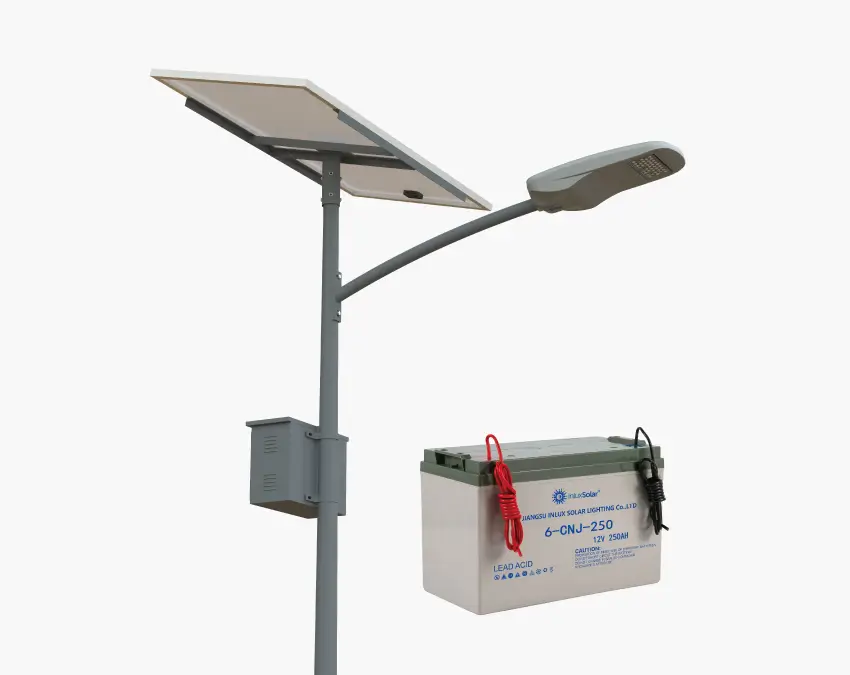
Baterai Gel MARS
Sistem tipe terpisah menggunakan baterai gel yang tahan lama; orientasi PV terpisah untuk pengisian daya yang lebih kuat, akses servis yang mudah, dan otonomi malam hari yang dapat diandalkan untuk jalan kota dan area komunitas.
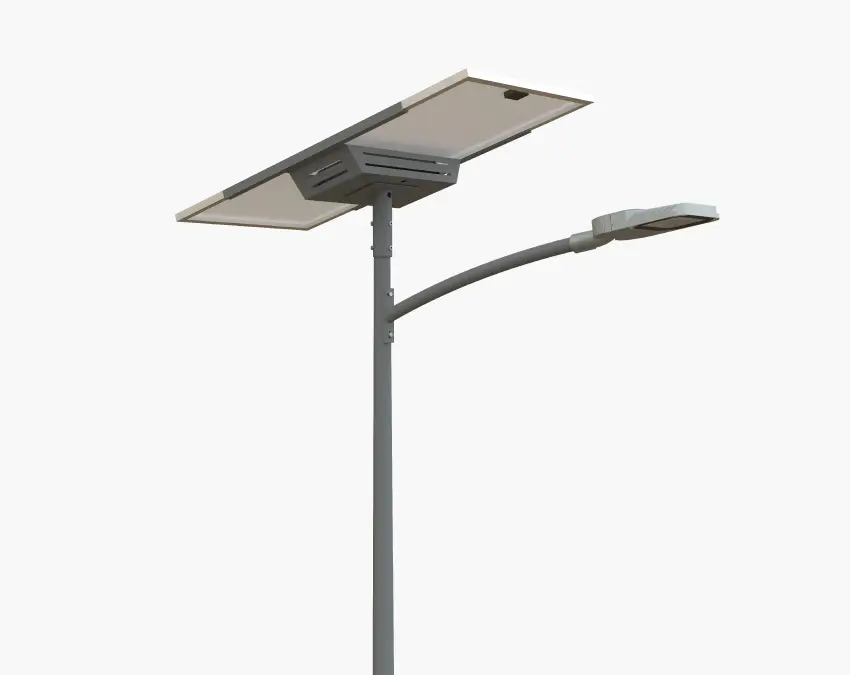
Baterai Lithium APOLLO
Sistem tipe terpisah dengan penyimpanan LiFePO4, 5050 LED, telemetri gerak/pintar opsional; panel fleksibel dan sudut lampu untuk memaksimalkan hasil dan cakupan untuk jalan, jalan setapak, dan tempat parkir.
The “Angle” Advantage: Mars & Apollo in High-Latitude or Complex Sites
Both Mars dan Apollo leverage an independent solar panel design:
- The panel is mounted on its own bracket, not locked to the luminaire aiming angle.
- On Mars, the system offers a 360° adjustable horizontal angle plus tilt adjustment, so installers can orient the panel exactly toward true south (or north in the Southern Hemisphere) independent of road alignment.
- The datasheets note that by adjusting the panel direction, you can achieve around 15 % higher charging efficiency, which directly supports higher-power LED operation all night.
This “angle freedom” is particularly valuable when:
- You are designing in Northern Europe or Canada, where the sun is at a low altitude and optimum tilt angles are steeper.
- Your road runs northwest–southeast (or any non-ideal bearing), making it impossible for an integrated head to face both the road and the sun optimally at the same time.
- You need to squeeze maximum energy yield out of limited daylight in winter while still running 150–200 W LED luminaires.
In these cases, specifying Mars or Apollo gives your installer the mechanical degrees of freedom to tune the solar geometry, instead of accepting the compromise inherent in a fixed-panel all-in-one.
Heavy Duty Industrial Choice: Mars for Rugged Environments
Within the split-type family, Mars is positioned as the industrial / heavy-duty workhorse:
- Uses deep-cycled gel battery or LiFePO₄ in an IP66 battery box that can be pole-mounted or buried, which improves thermal stability and vandalism resistance in industrial compounds.
- Rated for harsh environments, with system IP66, high-temperature-tolerant batteries, and smart temperature adjustment in the controller to maintain operation up to about 65 °C ambient.
- Designed to drive high-efficacy 5050 LED modules across a 20–150 W+ range, with luminous flux up to roughly 27,000 lm and suggested mounting heights from 3–15 m, allowing you to cover everything from internal plant roads to large loading yards.
For industrial zones, factories, logistics centers, and perimeter/security fencing, Mars is the default choice when:
- You need maximum uptime and long life in dusty, hot, or corrosive environments.
- You want easier battery replacement after 8–10 years without disturbing the luminaire or panel.
- The project owner prefers oversized energy storage (larger gel or LiFePO₄ banks in the box) for extended autonomy.
By contrast, Apollo takes the same split-type philosophy and pushes it toward high-pole, highway and large-road applications, pairing adjustable high-power panels with LED engines up to ~200 W on tall poles for primary highways and large interchanges.
Together, Mars and Apollo give you a split-type toolkit that covers rugged industrial yards all the way up to high-speed roads, for those situations where all-in-one convenience simply cannot deliver the required wattage, autonomy, or mechanical flexibility.
How to Choose the Right Inlux Model for Your Project?
When you’re specifying for a real project, the fastest way to choose is to start from the scenario, then lock in the Inlux series that matches it.
Scenario: Urban Roads & Residential Areas (Cost & Speed Focus)
Recommended Series: Sirius atau Polaris
Why these models work:
- Minimal installation labor – Sirius and Polaris are all-in-one systems, so there’s no separate battery box or long DC runs on the pole. Crews mount the head, connect, and move to the next pole.
- Sufficient brightness for 6–10 m poles – Their high-efficacy LED engines comfortably cover typical municipal streets, ring roads, and residential access roads without overspecifying power.
- Clean, standardized look – Integrated heads keep streets visually tidy and help city authorities maintain a consistent appearance across entire neighborhoods.
Gunakan Sirius when you need the most advanced optics and performance; use Polaris when you want a robust, classic all-in-one for large-scale rollouts.
Scenario: Tourist Resorts, Parks & Villas (Aesthetic Focus)
Recommended Series: Galaxy atau Alien
Why these models work:
- Design-led housings – Galaxy and Alien are all-in-one systems with a more distinctive, architectural look. They read as part of the landscape, not as technical equipment.
- Premium visual impression – Their slim, integrated form factor and modern geometry match resorts, coastal promenades, villa compounds, golf courses, and park walkways, where aesthetics are part of the value proposition.
- No visible extra hardware – With no external battery box and minimal brackets, there’s less “visual noise” for architects and landscape designers to worry about.
Pilih Galaxy for a sleek, contemporary profile, dan Alien when you want a more futuristic, eye-catching presence in high-end environments.
Scenario: Highways, Main Roads & High Latitude Regions (Performance Focus)
Recommended Series: Apollo atau Mars
Why these models work:
- Split architecture for maximum solar input – Apollo and Mars separate the solar panel from the lamp and battery box, allowing the use of larger panel arrays than typical all-in-one heads.
- Optimized tilt for short winter days – Installers can tilt and orient the panels independently from the road, which is critical in high-latitude regions where low sun angles and short days demand precise positioning.
- Supports higher poles and higher wattages – These series are designed to drive higher-power LED engines on 8–12 m (and above) poles, making them suitable for primary highways, trunk roads, and major interchanges.
Gunakan Apollo when the priority is main-road and highway-class lighting, dan Mars when you need similar power but in more varied site conditions.
Scenario: Windy / Coastal Areas
Recommended Series: Mars
Why this model works:
- Rugged structural design – Mars is engineered as a heavy-duty split-type system, with a robust bracket and battery box architecture suitable for strong, frequent winds.
- Better load distribution – The separation of panel, lamp, and battery box allows the structural engineer to distribute loads along the pole instead of concentrating everything at the top, which is beneficial in coastal zones.
- Flexible panel positioning – The adjustable panel bracket helps align the panel for both wind and solar performance, reducing stress while still capturing maximum energy.
For ports, coastal highways, seaside resorts with strong winds, and exposed industrial yards, Mars is the go-to choice when structural safety and long-term durability are non-negotiable.
Conclusion: Match Each Road to the Right Inlux Series
All-in-one vs. split type is not an abstract debate at Inlux Solar—it’s a practical selection framework built around real projects and real products.
- For fast rollouts on urban roads and residential areas, all-in-one series like Sirius dan Polaris minimize installation time and labor while delivering stable, efficient lighting.
- For design-driven projects in parks, resorts, and villa communities, Galaxy dan Alien offer aesthetic integration that city planners, architects, and hotel operators actually want to look at.
- For highways, main roads, high-latitude regions, and industrial zones, split-type systems like Mars dan Apollo provide higher wattage, larger solar arrays, and fully adjustable panel angles to maintain performance in the toughest conditions.
Inlux Solar’s portfolio is intentionally structured so that you can cover every major scenario—from decorative waterfront promenades to high-speed expressways—without mixing brands or compromising on engineering quality.
Pertanyaan Umum
Ready to See It on Your Road?
Still not sure if you need the sleek Sirius or the powerful Apollo? Download our full 2026 Product Catalog or request a Free Dialux Simulation to see the difference on your road.