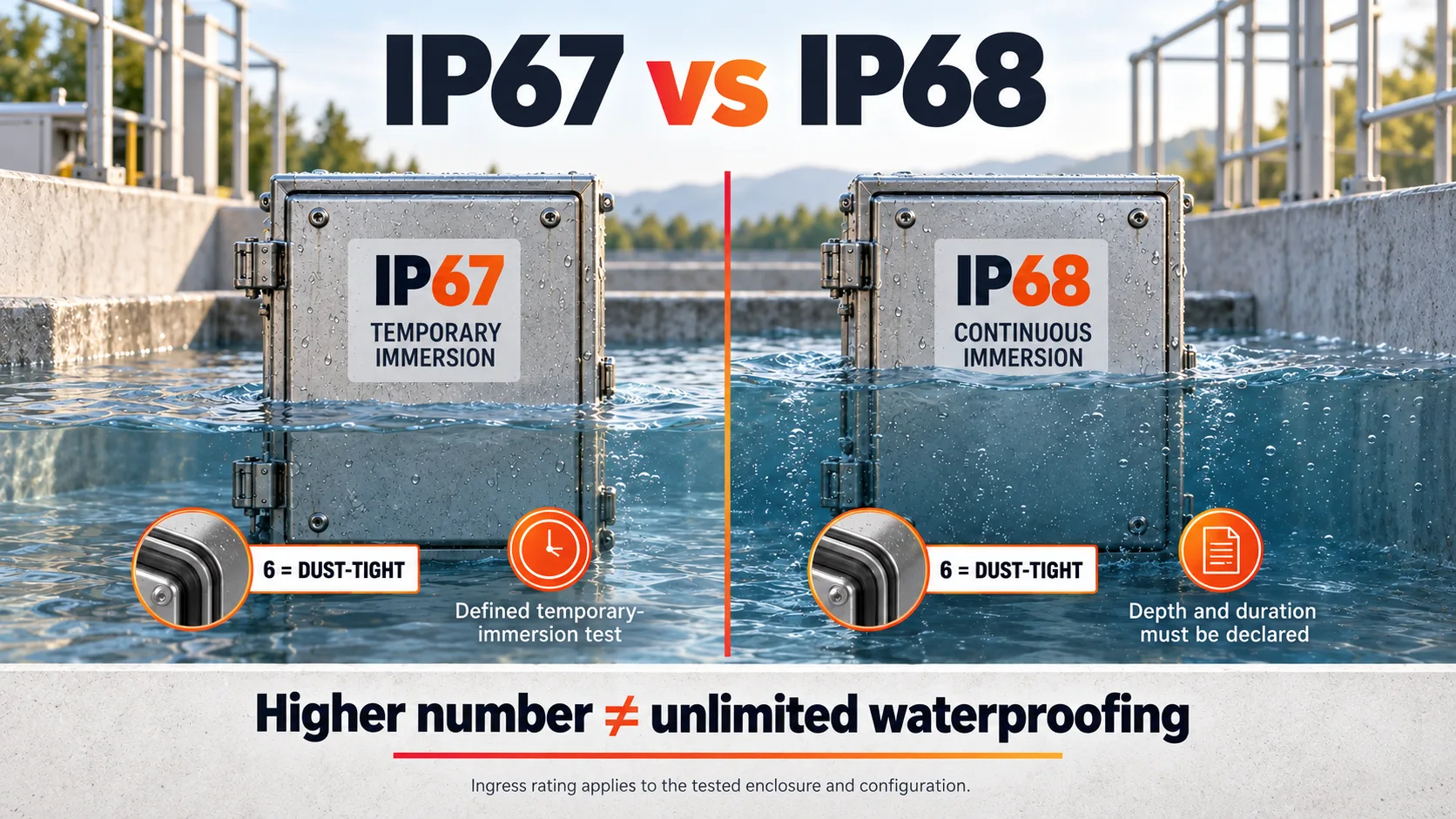
IP67 vs IP68 comes down to the water test, not the dust test. Both ratings use 6 as the first digit, meaning the enclosure is dust-tight. The second digit is different: IPX7 covers temporary immersion, while IPX8 covers continuous immersion under conditions that must be defined for the product. IP68 is not a promise that a device can survive any depth, any duration, salt water, pressure washing, or years of outdoor exposure.
That last sentence is where many specifications go wrong. Buyers often treat the larger number as a complete quality grade. In reality, an IP code describes a tested enclosure condition. It does not tell you whether every connector, cable entry, controller, battery box, optical chamber, or field-made joint in the installed system has the same protection.
Jawaban cepat: Choose IP67 when the credible hazard is temporary accidental immersion and the stated test matches the installation. Choose IP68 when a named component must tolerate continuous immersion under clearly stated depth, duration, orientation, and operating conditions. For an outdoor lighting project, specify the exposure first and the rating second.
In this guide
- IP67 vs IP68 at a glance
- What does IP67 mean?
- What does IP68 mean?
- Is IP68 always better than IP67?
- How to choose IP67 vs IP68 for outdoor lighting
- One lighting system can legitimately contain different IP ratings
- IP ratings do not predict the service life of an outdoor light
- How to audit an IP test report in two minutes
- A copy-paste RFQ checklist for IP67 vs IP68
- Pertanyaan yang Sering Diajukan
- The practical conclusion
- Sources
IP67 vs IP68 at a glance
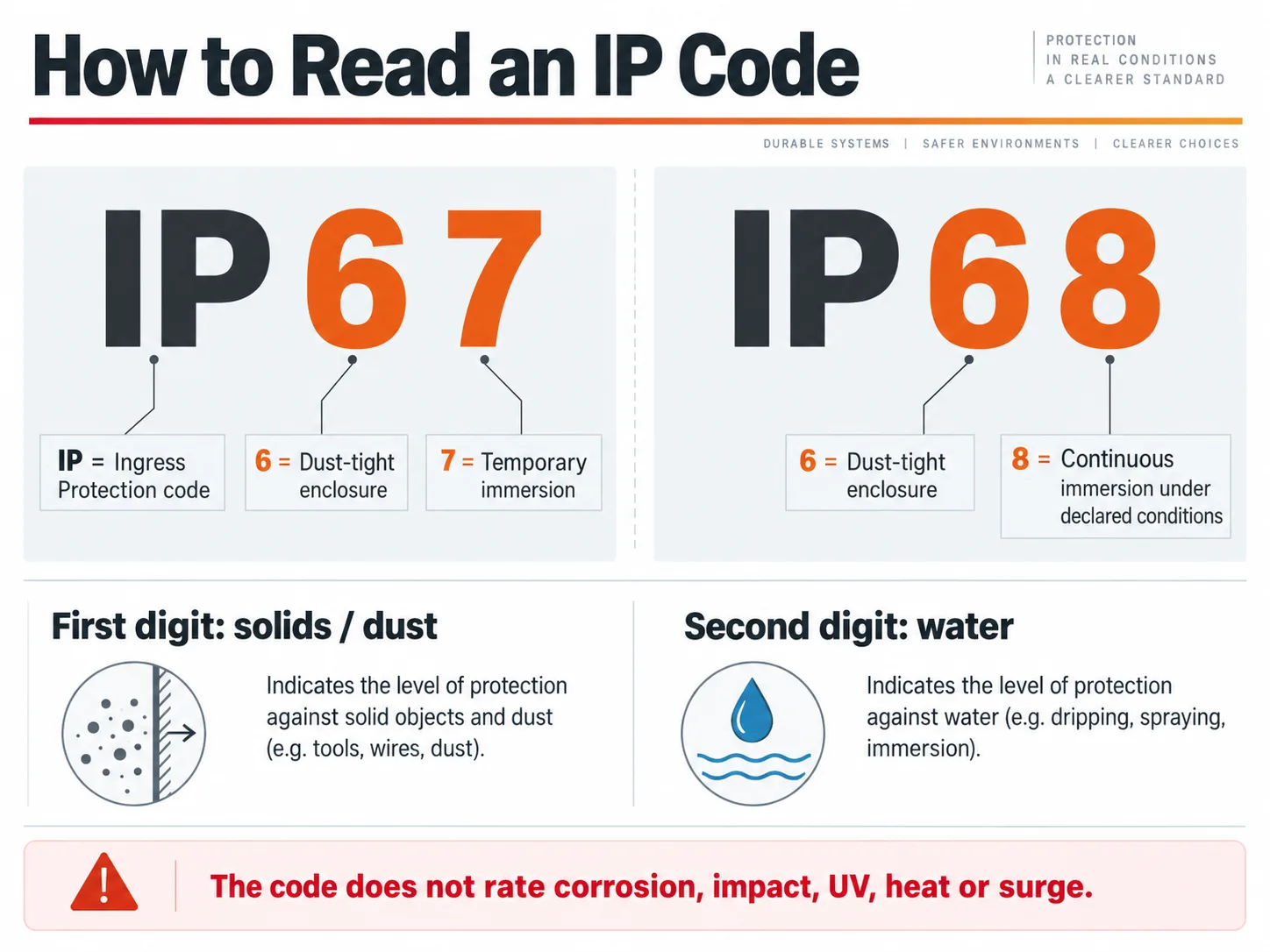
The International Electrotechnical Commission publishes IEC 60529, the standard behind the IP Code for electrical enclosures. The first numeral classifies protection against access and solid foreign objects. The second numeral classifies protection against harmful water ingress.
| Rating | First digit | Second digit | Plain-English meaning | What the label does not prove |
|---|---|---|---|---|
| IP67 | 6: dust-tight | 7: temporary immersion | The tested enclosure resisted harmful ingress during the specified temporary-immersion test | Continuous submersion, salt-water resistance, pressure washing, corrosion resistance, or whole-system protection |
| IP68 | 6: dust-tight | 8: continuous immersion | The tested enclosure resisted harmful ingress under the IPX8 conditions declared for that product | Unlimited depth or time, every water exposure, every installation orientation, or protection of unlisted connected parts |
The IP67 vs IP68 comparison is therefore not “water resistant versus waterproof.” Both are ingress-protection classifications. The meaningful procurement question is whether the test evidence matches the exposure of the exact enclosure being purchased.
What does IP67 mean?
For anyone comparing IP67 vs IP68, IP67 is the temporary-immersion side of the decision. It combines two classifications:
- 6 means dust-tight protection for the enclosure.
- 7 means protection against the effects of temporary immersion.
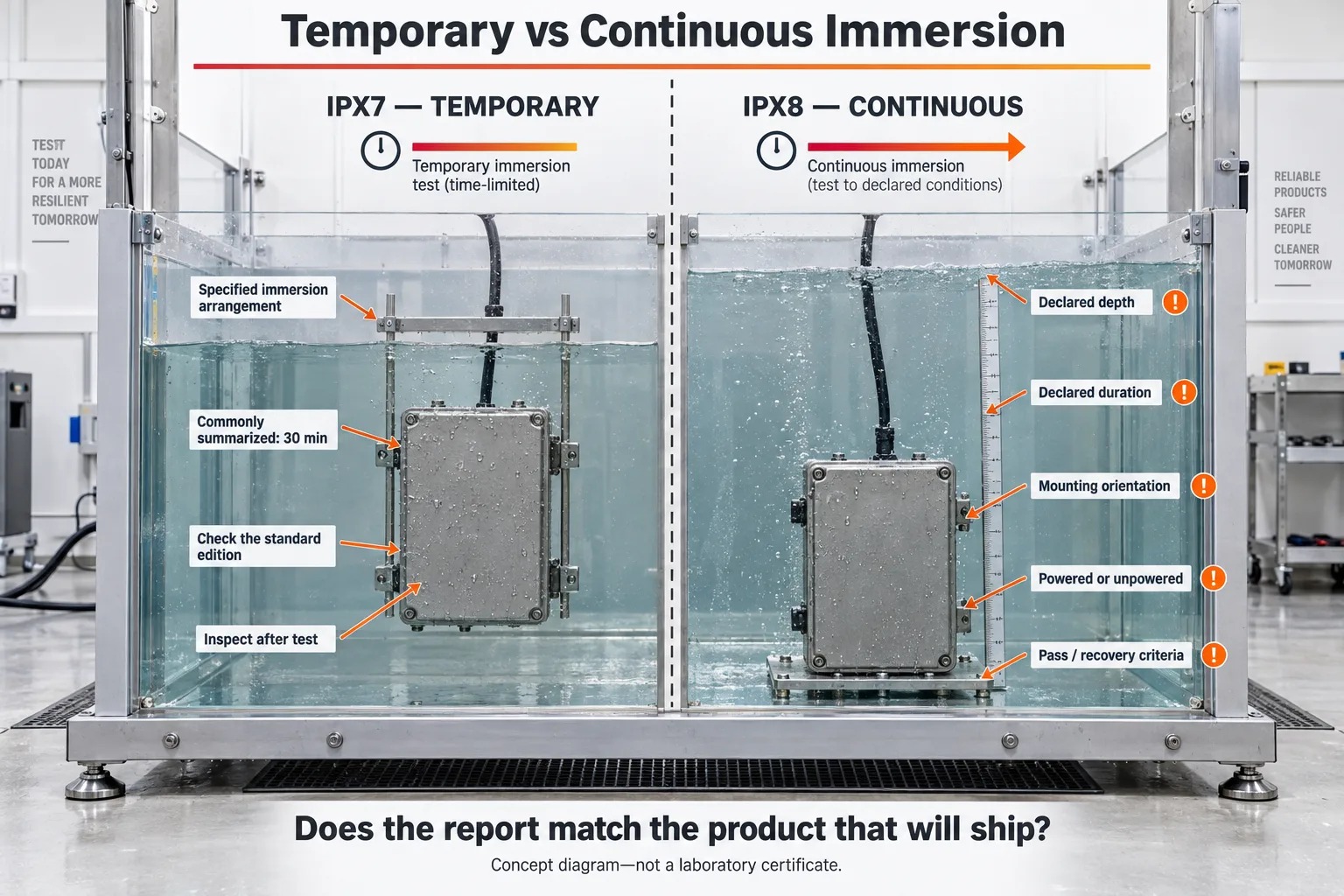
IPX7 is commonly summarized as immersion in water for 30 minutes at a test depth associated with one metre. The precise test setup depends on enclosure dimensions and the applicable edition or adoption of the standard, so a tender should cite the required standard and request the report instead of copying a shorthand sentence from a product listing. Intertek’s current IEC 60529 IP testing guide lists IP6X as dust-tight and IPX7 as temporary immersion.
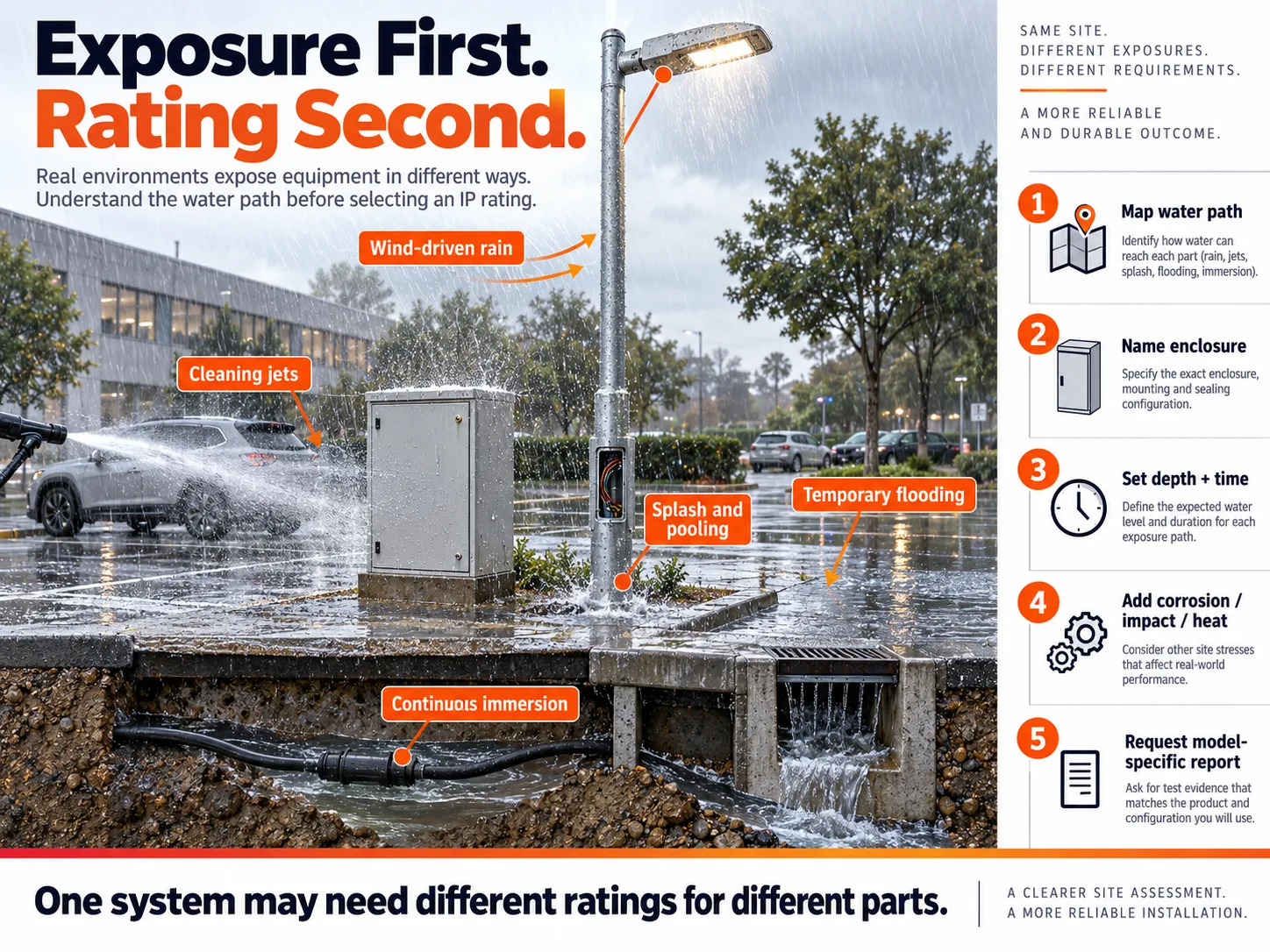
For lighting, IP67 can make sense for a low-mounted enclosure, connector, or control box that could be briefly covered by standing water. It does not automatically make sense for every pole-mounted luminaire. A light head exposed mainly to rain and cleaning jets has a different water path from a controller box in a flood-prone base.
What does IP68 mean?
In an IP67 vs IP68 specification, IP68 also starts with dust-tight protection, but its second numeral covers continuous immersion. The important detail is that IPX8 conditions are product-specific. The manufacturer must state the relevant depth and other test conditions. “IP68 waterproof” without those conditions is incomplete information for a buyer.
This is why two IP68 products are not automatically equivalent. One may be tested for a defined shallow depth and another for a deeper or longer condition. The enclosure may be unpowered during the test, powered during the test, or assessed according to a product-specific program. The evidence package should resolve those details.
The same label also says nothing by itself about:
- salt spray or coastal corrosion;
- UV aging of plastics and gaskets;
- pressure washing or high-temperature jets;
- impact resistance and vandalism;
- thermal performance inside a sealed enclosure;
- condensation caused by temperature cycling;
- cable glands added after the laboratory test;
- damage after the enclosure has been opened for service.
UL Solutions’ lighting reference likewise separates dust and water ingress categories, describing IPX7 as temporary immersion and IPX8 as continuous immersion. It is a useful reminder that the rating belongs to a test category, not to the marketing word “waterproof.”
Is IP68 always better than IP67?
In practical IP67 vs IP68 selection, IP68 represents a different and generally more demanding immersion condition, but “better” is only meaningful when immersion is the real hazard. A higher numeral can still be the wrong specification if the project actually needs resistance to powerful water jets, hot high-pressure cleaning, corrosion, mechanical impact, or repeated thermal cycling.
Do not assume an IP68 label answers every lower-numbered water exposure. Procurement documents should name each required condition. If a site uses hose-down cleaning, ask for jet-test evidence. If equipment may be submerged, define the water depth, expected duration, operating state, and recovery requirement. If both conditions exist, request evidence for both rather than relying on one badge.
This distinction matters because field failure rarely respects the one number printed in a catalogue. Water may enter through a cable gland, a connector that was not fully seated, a service cover with a twisted gasket, a drilled hole, or a conduit that carries condensation into an otherwise sound enclosure.
How to choose IP67 vs IP68 for outdoor lighting
Start with the site, not the product label. The following sequence keeps the decision tied to a real failure path.
1. Map where water can actually reach the system
Separate wind-driven rain, splashing, cleaning jets, temporary pooling, floodwater, and continuous immersion. Record the highest credible water level and whether the enclosure sits above or below it. A road luminaire mounted several metres above grade and a controller box near a drain should not share one unexamined requirement.
2. Name the exact enclosure
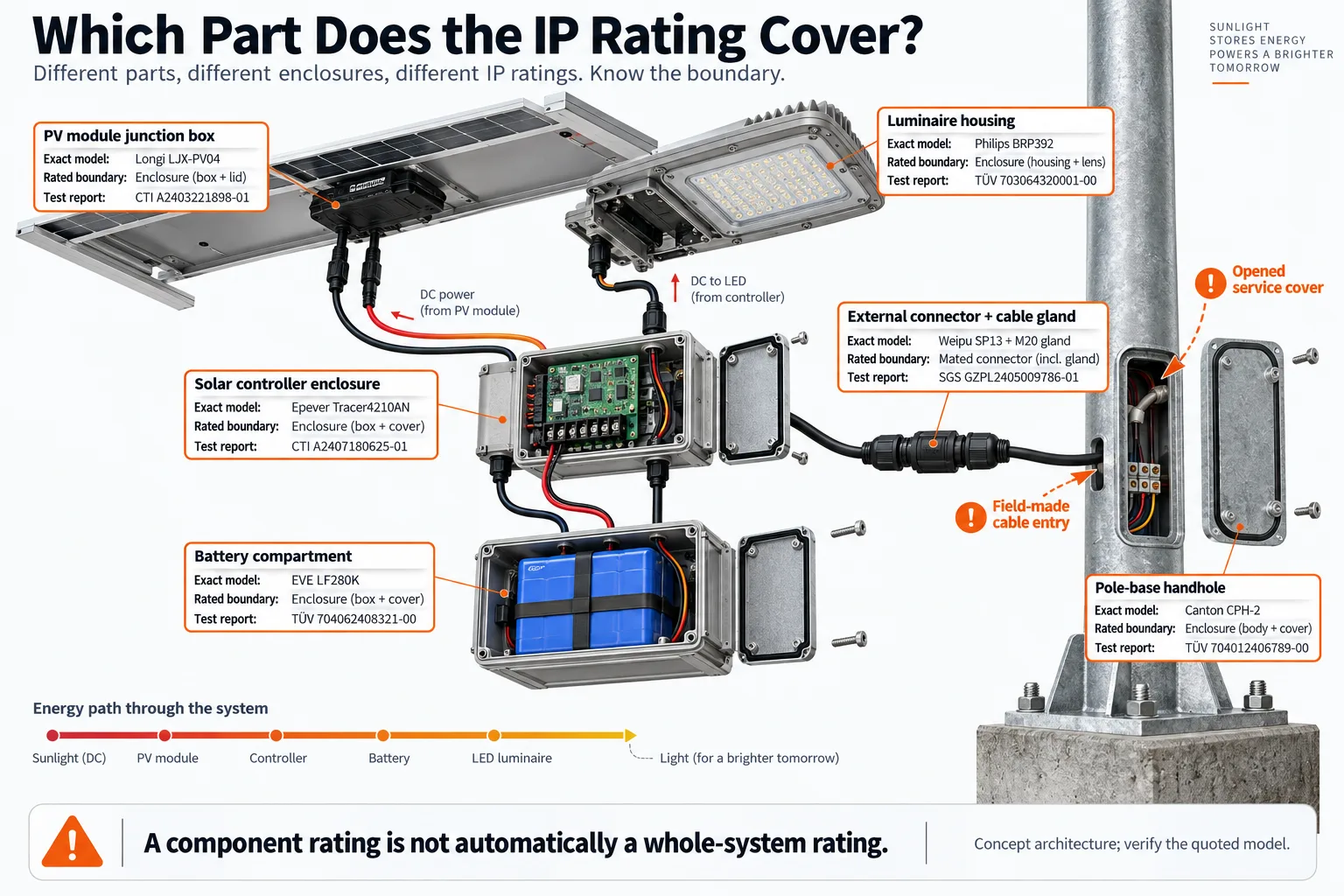
A solar lighting system can include the luminaire, battery compartment, controller, PV junction box, connectors, cable glands, pole handhole, and remote cabinet. Write the requirement against each component. “System shall be IP68” is ambiguous unless the contract defines the tested boundary.
3. Define time, depth, orientation, and operating state
For any immersion requirement, state how deep, how long, in which orientation, and whether the equipment must operate during exposure or only recover afterward. These are especially important for IP68 because the declared test conditions are part of the meaning.
4. Add the environmental checks that IP cannot replace
For coastal, desert, industrial, or flood-prone sites, add separate requirements for corrosion, UV exposure, temperature range, impact, sealing after maintenance, and drainage. The existing Inlux guide to IP65 vs IP67 for solar street lights covers the separate choice between water-jet and temporary-immersion exposure. Keep that decision distinct from IP67 vs IP68.
5. Ask for model-specific evidence
Request a test report or certificate that identifies the exact model, enclosure, configuration, standard edition, test condition, and result. Check that the quoted product and the tested sample match. A family brochure, supplier declaration, or test for a different enclosure is not the same evidence.
One lighting system can legitimately contain different IP ratings
Component-level ratings are normal. They become a problem only when a supplier turns one component’s rating into a claim for the whole installation.
The current Inlux DRAGON All-in-Two solar street light page is a useful example. Its system specification lists IP66 / IK09 for the luminaire protection level, while the interior-structure section lists an IP68 smart solar controller. Those statements refer to different parts. They should not be collapsed into “the whole street light is IP68.” For a tender, the buyer should still request model-specific evidence and confirm the quoted configuration.
| System part | Likely exposure question | Useful evidence |
|---|---|---|
| Pole-mounted luminaire | Rain, dust, wind-driven water, cleaning, gasket aging | Complete-luminaire IP report, assembly drawing, sealing and maintenance instructions |
| Integrated controller | Sealed electronics, temperature cycling, condensation, service access | Controller enclosure rating, operating limits, installation orientation, connector details |
| Battery compartment | Water path, venting, drainage, heat, field opening | Enclosure test, battery safety documentation, vent/drain design, maintenance procedure |
| External connector or cable gland | Mating quality, cable diameter, installation torque, field damage | Exact connector/gland rating, assembly instructions, inspection checklist |
| Pole base or cabinet | Splashing, pooling, flooding, soil moisture, corrosion | Site flood level, enclosure rating, corrosion strategy, drainage and elevation detail |
This component map is more useful than purchasing “the highest IP.” It also creates a clearer warranty conversation because the failed boundary can be identified.
A worked specification example
Imagine a 120-pole road project with four separately exposed parts: 120 luminaires at 8 m mounting height, 120 pole-base handholes 300 mm above grade, 120 controller enclosures inside the luminaires, and 240 external cable connectors. A flood study predicts temporary standing water of 450 mm for up to 6 hours near 18 poles.
One blanket “IP68 required” line cannot describe that project. The clarification should identify the 18 flood-zone poles, set a component-specific immersion condition for anything below the 450 mm level, and keep the elevated luminaires tied to their actual dust, rain, jet, impact, thermal, and corrosion exposures. The bidder should return four evidence rows—not one—and flag any connector or handhole that falls below the requirement.
This approach also improves inspection. The commissioning team can sample the exact 18 locations, photograph gland assembly, record cover and gasket condition, verify drainage and elevation, and link each serial number to its report. Six months later, a maintenance technician can distinguish installation damage from an unsupported product claim.
IP ratings do not predict the service life of an outdoor light
An ingress test is evidence about enclosure protection under a defined test. It is not a lifetime test. Outdoor lighting reliability still depends on materials, joints, thermal design, surge protection, installation, and maintenance.
Consider four common examples:
- A sealed enclosure can trap heat. Higher sealing does not remove the need for thermal design around the driver, battery, or LED module.
- A good housing can be defeated by a poor entry point. A field-installed gland with the wrong cable diameter can become the weakest part of the system.
- Water resistance is not corrosion resistance. Salt, chemicals, dissimilar metals, coating damage, and fastener choice require separate evidence.
- A tested seal can be disturbed during service. Gasket condition, screw sequence, torque, cleanliness, and replacement rules affect the restored enclosure.
For failure investigation, use a system path rather than assuming every wet enclosure needs a higher rating. The solar street-light failure-mode guide helps separate power, battery, controller, driver, connector, and installation issues. Where lightning or switching surges are involved, use the separate surge-protection guide; IP67 and IP68 do not describe electrical surge immunity.
How to audit an IP test report in two minutes
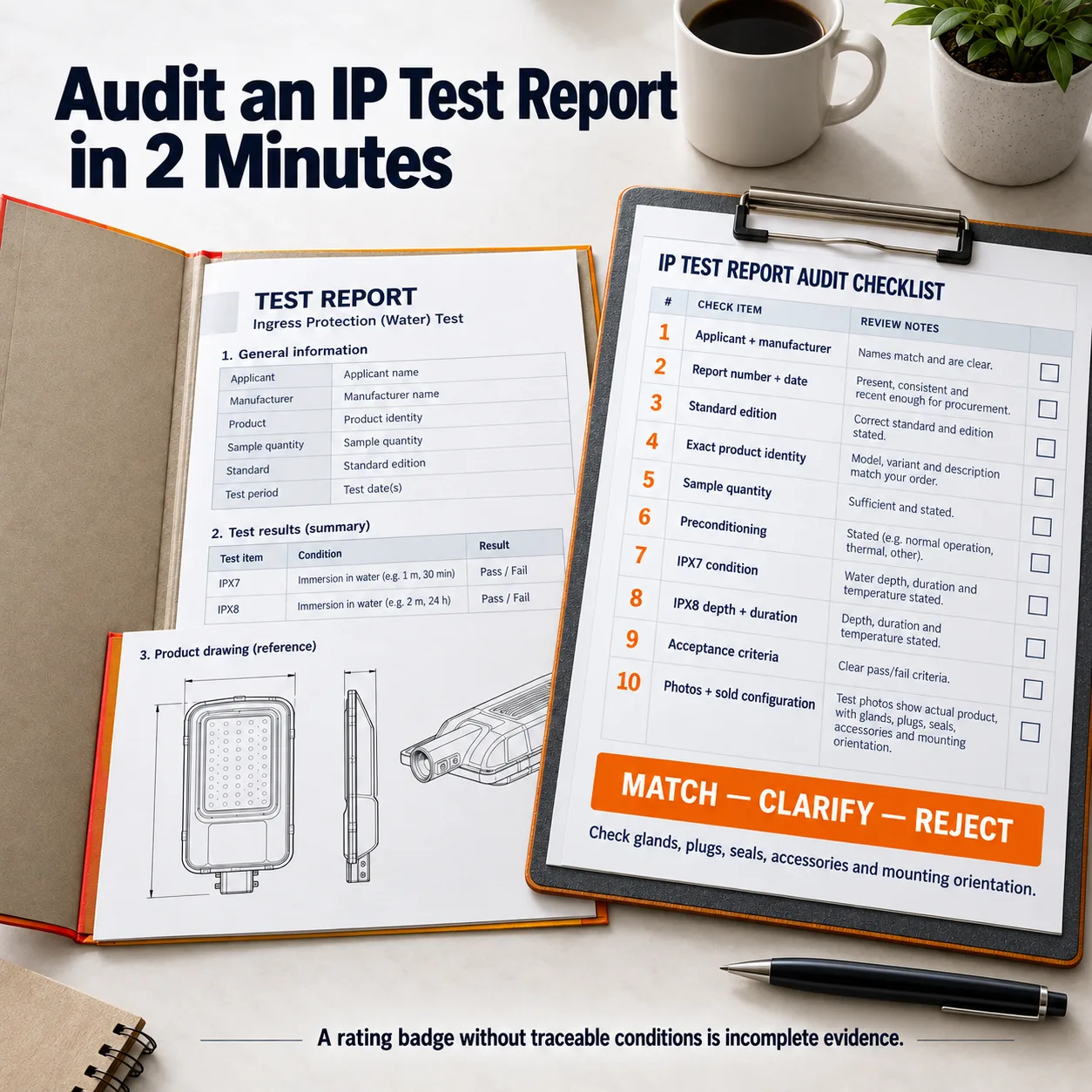
Sebuah IP67 vs IP68 certificate image with a large rating is not enough. Open the underlying report and compare these ten fields with the quotation:
- Applicant and manufacturer: confirm who submitted the sample and who made it.
- Report number and issue date: record both so a later revision cannot be substituted silently.
- Standard edition: look for IEC 60529 and the edition or national adoption used by the laboratory.
- Product identity: match the model, housing size, material, cover, gasket, fasteners, and accessories to the bill of materials.
- Sample quantity: note whether one sample or several were tested and whether they represent every quoted size.
- Preconditioning: check whether aging, thermal cycling, operation, or mechanical preparation occurred before ingress testing.
- IPX7 condition: where applicable, confirm the immersion arrangement and the stated 30-minute test period rather than relying on a retailer’s “1 m waterproof” summary.
- IPX8 condition: confirm the declared depth, duration, water temperature, mounting orientation, and powered or unpowered state.
- Acceptance criterion: identify what counted as harmful ingress and which electrical or functional checks followed the water exposure.
- Photos and configuration: compare cable glands, blanking plugs, connectors, cover screws, seals, and installation position with the product that will ship.
Then inspect the exclusions. A report may cover the enclosure with factory plugs installed but not a site-added sensor lead. It may cover one housing size but not a longer model. It may require a specified cable diameter or tightening torque. These details are not paperwork trivia; they define the tested boundary.
For large tenders, make the evidence traceable in the bid comparison: supplier, model, enclosure, rating, IEC edition, laboratory, report number, report date, test condition, discrepancy, and clarification status. A one-row register makes unsupported claims visible before purchase orders are issued.
A copy-paste RFQ checklist for IP67 vs IP68
For a procurement-ready IP67 vs IP68 decision, use this block in a lighting enquiry or tender clarification:
Identify every enclosure included in the quoted lighting system and state its IP rating separately. For each IP67 or IP68 claim, provide the exact model number, tested enclosure boundary, applicable IEC 60529 edition or national adoption, test laboratory, report or certificate reference, mounting orientation, and pass criteria. For IP68, state the immersion depth, duration, water condition, equipment operating state, and post-test functional requirement. Also state the ratings and installation requirements for connectors, cable glands, junction boxes, battery or controller compartments, and field-made entries. Provide separate evidence for corrosion, impact, UV, temperature, surge, and any required water-jet or pressure-cleaning exposure.
Before sending an RFQ, add the site information that allows a supplier to answer it:
- project location and climate;
- coastal, industrial, flood, dust, or washdown exposure;
- mounting height and enclosure elevation above grade;
- expected water depth and duration, if immersion is credible;
- cleaning method;
- luminaire, controller, battery, and connector arrangement;
- maintenance access and opening frequency;
- required service life and inspection interval;
- applicable tender, electrical, and lighting standards.
For product-family selection, compare the commercial solar street-light range, grid-powered LED street lights, commercial LED flood lights, dan solar flood-light solutions by the actual site task. The IP requirement should follow the selected architecture and exposure, not replace them.
Pertanyaan yang Sering Diajukan
Is IP68 completely waterproof?
No. IP68 means the tested enclosure met continuous-immersion conditions defined for that product. It does not mean unlimited depth or time, and it does not automatically cover salt water, pressure washing, corrosion, impact, damaged seals, or field-added cable entries. Ask for the declared test conditions and the exact enclosure covered.
Is IP68 better than IP67?
IP68 addresses continuous immersion, while IP67 addresses temporary immersion. IP68 may be the more suitable rating when continuous immersion is a credible design condition. It is not automatically the better outdoor-lighting specification when the real hazards are rain, jets, heat, corrosion, impact, or installation damage.
Can IP67 equipment be left underwater?
IP67 is a temporary-immersion classification, not a continuous-submersion promise. Do not leave an IP67 product underwater unless its manufacturer separately states that use and provides the relevant conditions and evidence.
Does an IP68 rating include salt-water protection?
No. IEC IP water tests do not by themselves establish resistance to salt-water corrosion. A coastal project should request separate material, coating, fastener, salt-spray or corrosion evidence appropriate to the site.
Does a street light need IP68?
Not necessarily. A pole-mounted luminaire may need strong protection against dust, rain, and water jets without facing continuous immersion. A low controller box, connector, or battery enclosure may face pooling or flooding. Specify each component against its actual exposure instead of assigning one rating to the whole street light.
What should an IP68 test report state?
It should identify the exact product or enclosure, standard and edition, test laboratory, mounting and sample configuration, immersion depth, duration, operating state, acceptance criteria, and result. Check whether connectors, glands, covers, and accessories in the sold configuration were part of the tested boundary.
The practical conclusion
The useful answer to IP67 vs IP68 is not simply “68 is higher.” Both are dust-tight classifications; the difference is temporary versus continuous immersion. The right choice depends on the exact enclosure, water path, depth, duration, installation, and evidence.
If you are specifying a road, parking, industrial, flood-prone, or solar lighting system, send the component list, site exposure, mounting arrangement, control and battery architecture, and required test evidence. Ask Inlux Solar for a component-level lighting proposal so the IP requirement is assigned to the right part instead of becoming a one-line catalogue claim.
Sources
- International Electrotechnical Commission, IEC 60529: Degrees of protection provided by enclosures (IP Code), accessed September 6, 2026.
- Intertek, IP Testing: Ingress Protection per IEC 60529, accessed September 6, 2026.
- UL Solutions, Horticultural Lighting Safety & Performance Criteria, accessed September 6, 2026.