An LED driver regulates the electrical supply delivered to an LED assembly. Choosing one means matching the supply type, the LED’s current and voltage requirements, the control method and the installed environment—not just finding the same wattage. A grid-powered road luminaire and a battery-powered solar street light may require different driver arrangements even when their light output looks similar.
For a new project, ask the luminaire supplier to identify the driver and LED-module combination on the quotation. For a replacement, start with the original part reference and complete equipment configuration. This guide helps buyers screen the documentation; it is not a live-testing or wiring procedure. Electrical work belongs to qualified personnel following the manufacturer’s instructions and the site’s isolation rules.
Constant-current or constant-voltage LED driver?
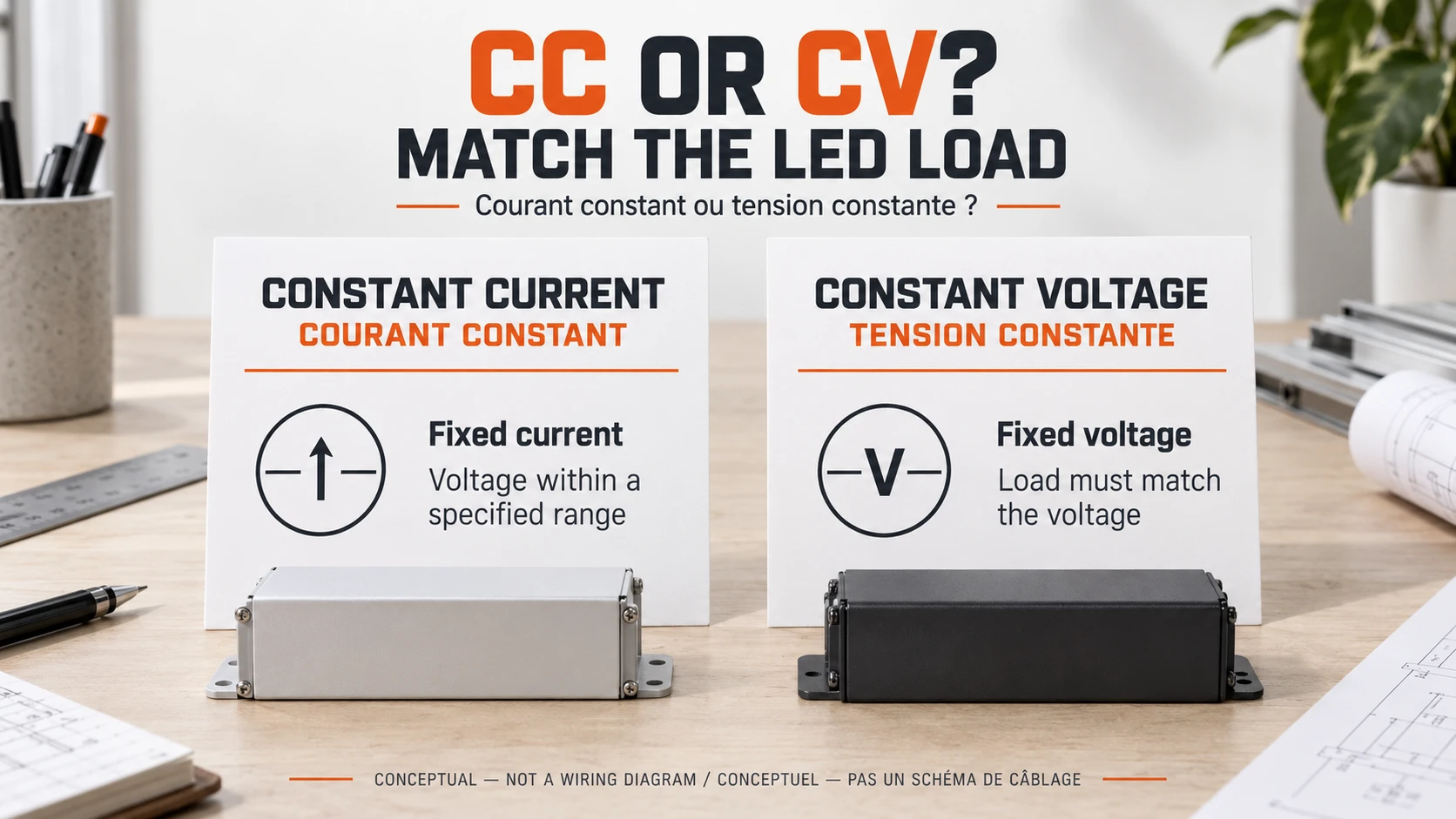
The first decision is the regulation mode required by the load. A constant-current driver regulates current over a specified output-voltage range. A constant-voltage supply holds a stated voltage for a compatible load. Neither description establishes compatibility on its own: the module’s permitted input and the driver’s complete operating envelope must agree.
| Driver mode | Main value to match | Other essential check |
|---|---|---|
| Constant current (CC) | Required output current in mA or A | The LED voltage stays inside the supported operating range |
| Constant voltage (CV) | Required output voltage in V | Load current, regulation arrangement and power limits are compatible |
The Eaton LED driver guide distinguishes these two regulation modes and highlights output-current, voltage and dimming requirements. Avoid turning a broad type label into a buying shortcut. A fixed-voltage strip-light supply is not automatically a replacement for a road luminaire’s constant-current driver.
Read the output window before the wattage
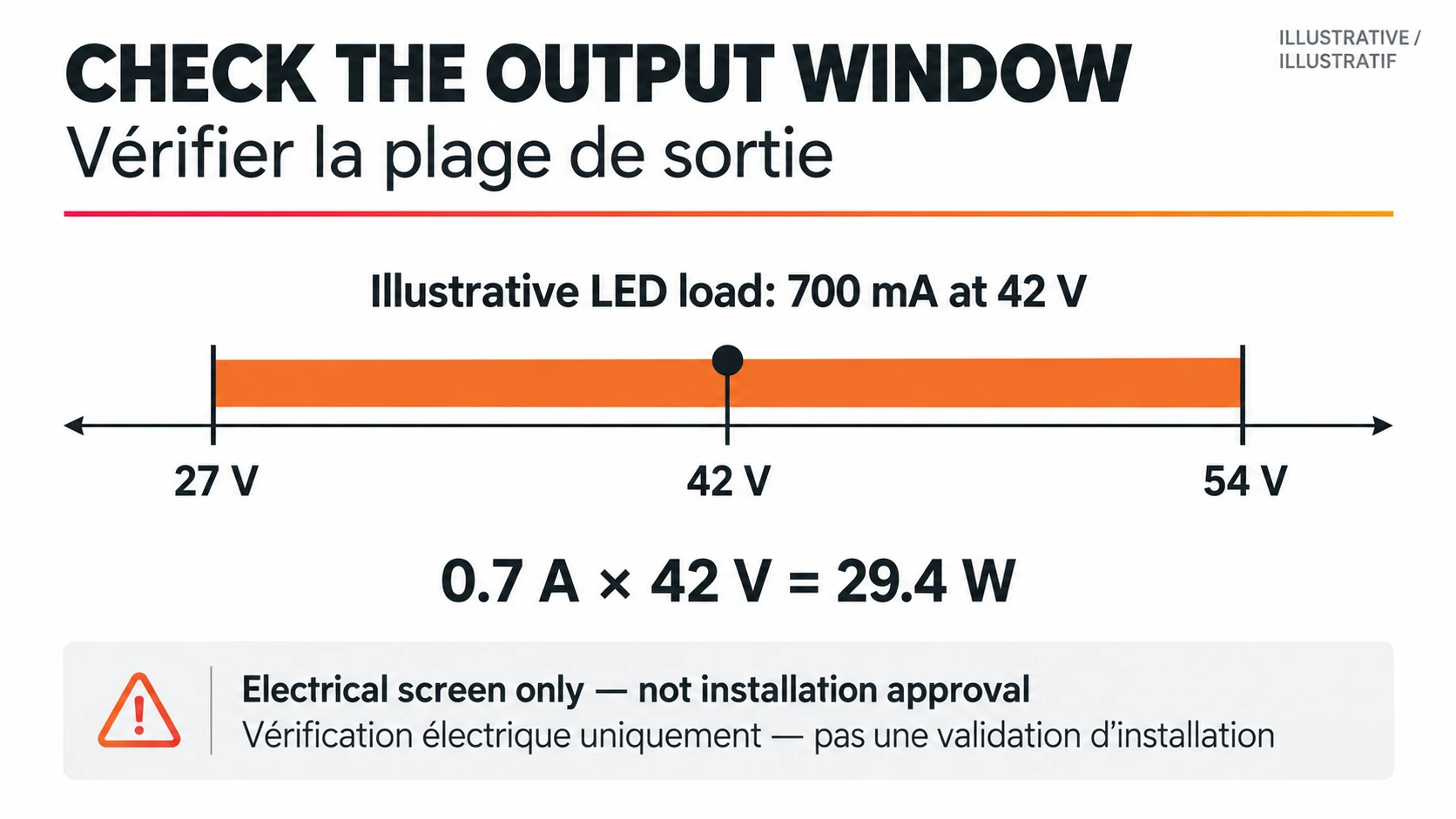
Consider a fictional LED assembly approved to operate at 700 mA and approximately 42 V at one stated operating condition. Its electrical load at that point is 0.7 A × 42 V = 29.4 W. This is a calculation example, not an Inlux model specification, and it is not the luminaire’s measured mains input power.
| Illustrative candidate | Declared output | First screening result |
|---|---|---|
| Driver A | 700 mA, 27–54 V | 42 V is inside the range; continue the full review |
| Driver B | 700 mA, 54–86 V | 42 V is outside the stated operating range |
| Driver C | 1050 mA, 27–54 V | Current does not match the approved 700 mA setting |
Driver A has only passed an initial electrical screen. The supplier still needs to check the LED voltage across the specified operating conditions, power limits, tolerances, thermal behavior and start-up conditions. A single 42 V value cannot prove that the entire LED operating range fits the driver. For a programmable model, the approved programmed current matters as much as the available adjustment range.
A larger wattage number does not repair a current mismatch or an unsuitable voltage window. Nor should “extra headroom” become an arbitrary percentage copied into every tender. Request the manufacturer’s permitted loading and derating basis for the exact driver and installation. Keep the approved setting in the delivery record so a later spare does not silently change the luminaire output.
Keep driver output power separate from luminaire input power. The illustrative 29.4 W LED load does not include conversion losses or every auxiliary load. For solar equipment, ask which power value is used in the nightly energy budget and whether controls are counted. A successful output-current match is not evidence that the battery and PV system can support the selected lighting schedule.
Grid input and solar battery input are different questions
A grid luminaire normally receives its specified AC supply through an appropriate driver arrangement. A solar street light has a PV, controller and battery energy chain, and its LED driving function may be integrated or separate. Do not assume that every solar light needs an additional external AC LED driver, or that the solar charge controller and LED driver are interchangeable devices.
For battery-fed equipment, verify the specified DC input range, not only a nominal battery voltage. For mains-fed equipment, verify the AC input rating and the project’s supply conditions. A mains-input rating such as 100–240 V AC does not establish suitability for direct operation from a 12.8 V battery. Ask for a system-level compatibility statement rather than improvising a conversion or bypass.
The separate Inlux solar charge-controller guide covers the PV and battery-control role. For a complete grid-connected luminaire, use the Inlux LED street-light range. Confirm the actual driver arrangement in the selected configuration; this article does not assign one driver type to every Inlux model.
Seven checks for an outdoor LED driver quotation
| Procurement check | Information the supplier should identify | What a headline cannot prove |
|---|---|---|
| 1. Input | AC/DC type and permitted supply range | Matching watts do not establish input compatibility |
| 2. LED output | CC/CV mode, current setting and voltage envelope | A maximum-power label is not a complete load match |
| 3. Controls | Exact control interface and approved operating behavior | “Dimmable” does not identify the control system |
| 4. Thermal installation | Mounting, ventilation and applicable derating conditions | An ambient headline is not an installed thermal assessment |
| 5. Outdoor assembly | Enclosure, connectors and complete luminaire arrangement | A driver IP label does not certify the whole installed system |
| 6. Protection and project compliance | Applicable requirements and evidence for the quoted configuration | A component logo is not whole-system approval |
| 7. Service and spares | Part reference, settings, replacement approval and warranty scope | A physically fitting spare may change performance |
A useful thermal review concerns the installed unit, not a driver photographed on an open bench. The MEAN WELL LED power-supply installation manual warns that mounting orientation and high ambient temperature can require output derating, and that sealed connector joints need attention. Apply the instructions for the actual product; do not transplant a clearance, temperature or dimming method from an unrelated model.
Inlux Solar’s standard warranty is five years. The quotation should still identify the covered driver arrangement, service route and approved replacement conditions; a component maker’s headline warranty and a complete lighting-system warranty are not automatically the same agreement. In a project comparison, keep warranty scope beside the named configuration rather than comparing a number of years alone.
Replacement: record the problem before ordering a spare
Flickering, reduced output or a dark luminaire does not identify the failed component by itself. Supply interruptions, a control command, damaged LED modules, connectors or thermal protection can produce similar symptoms. Record when the symptom occurs, how many luminaires are affected, the control state and the original equipment references. Photographs of accessible labels are useful when obtained safely under the site procedure.
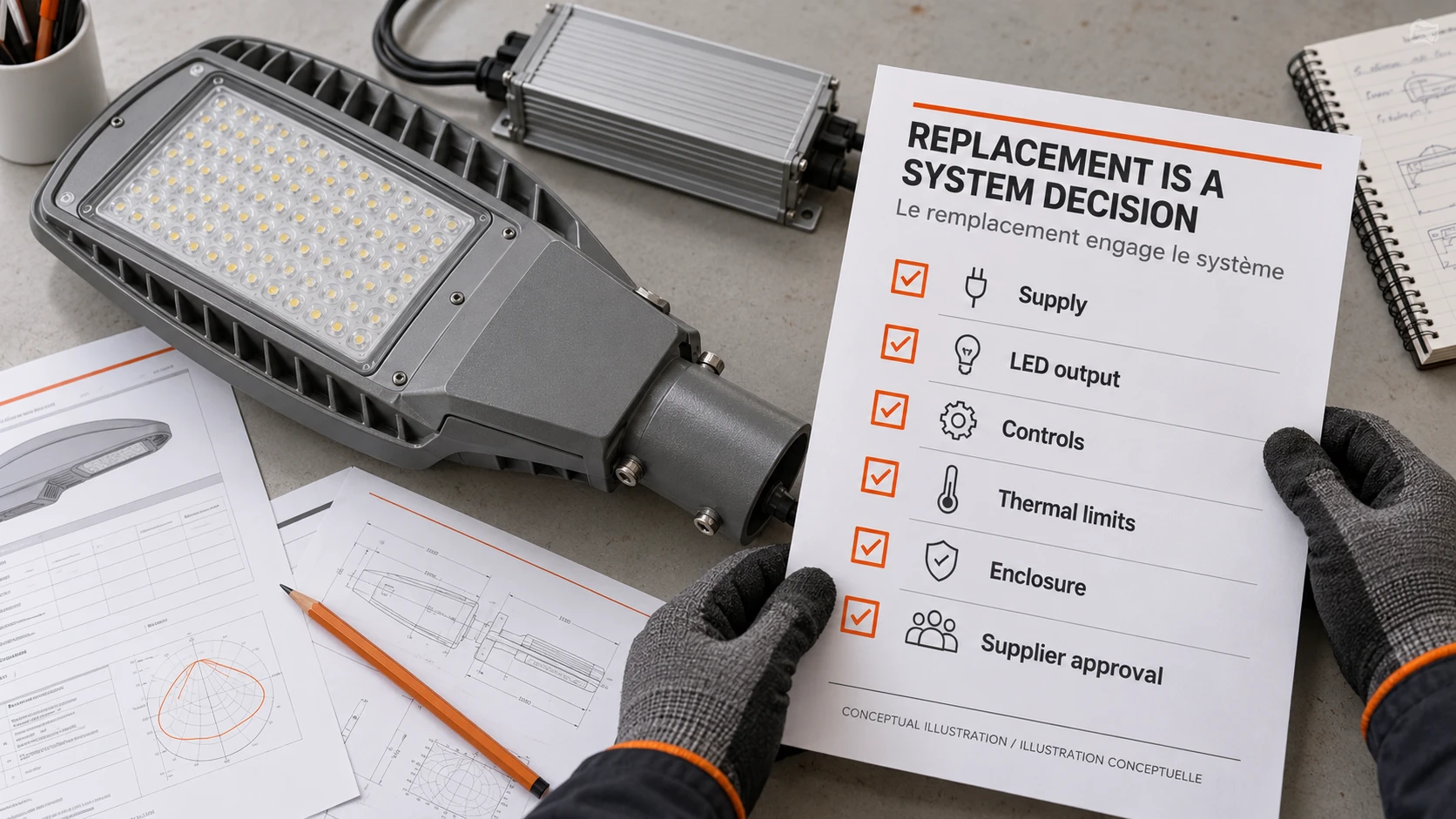
Have qualified personnel follow the manufacturer’s diagnostic process. Do not short terminals, bypass the driver, open sealed equipment without authorization or try an unknown spare to see whether it lights. Before approving a substitute, have the supplier confirm electrical compatibility, programmed settings, controls, fit, sealing and the effect on the original luminaire’s approvals and warranty. A return to light is not the whole acceptance test.
Pertanyaan yang sering diajukan
What does an LED driver do?
It conditions and regulates power for a compatible LED assembly. Depending on the design, it may also support dimming or protection functions. Its input rating, regulation mode and output limits must match the complete equipment; the word “driver” alone does not define those capabilities.
Can an LED work without a separate driver?
Some complete lamps or modules already include the required regulation, so no additional external driver is specified. That is different from powering an unregulated LED assembly directly. Follow the luminaire’s design and approved supply requirements; do not remove or bypass a required driving function.
How can I tell whether the LED driver is faulty?
Symptoms are clues, not proof. Record the fault pattern and equipment references, then have qualified personnel distinguish the supply, controls, driver and LED load using the manufacturer’s procedure. Do not diagnose a driver from flicker alone or use an unapproved live test.
Can I replace an LED driver with a higher-wattage model?
Not on wattage alone. The input, current setting, output-voltage range, controls, thermal limits and approved assembly must all be checked. A higher available power does not make an incorrect current or voltage suitable. Obtain approval for the exact replacement and its settings.
Is an LED driver the same as a solar charge controller?
No. A solar charge controller manages the PV-to-battery charging role and may include load or lighting functions. LED driving regulates the LED load. Those functions can share one assembly or use separate components; confirm the actual architecture before selecting parts.
Does an IP-rated driver make the complete street light waterproof?
No. The installed luminaire includes housings, seals, connectors and cable entries. Review the rating and installation conditions for the complete quoted assembly. A protected component does not automatically establish the protection of every joint or the whole lighting system.
Bring the driver question back to the lighting task
For a solar project, compare the actual system arrangement in the Inlux All-in-One range with the configuration offered in the Inlux All-in-Two range. For commercial solar parking-area lighting, include the operating schedule and required lighting result, not only a driver wattage.
Send the luminaire reference, supply details, LED load or original driver label, control requirements, site conditions and quantity with a driver-and-luminaire project enquiry to Inlux Solar. For a failed installation, add the observed symptoms and maintenance history. That makes the next discussion about a traceable configuration rather than a generic replacement part.