







LiFePO4 Battery Lifespan: How Long Solar Street Lights Last
Executive Summary for Project Engineers: While LiFePO4 (LFP) chemistry is inherently stable, achieving a 10-year field life in solar street lighting requires more than “Grade A” cells. Lifespan is a function of electro-mechanical variables: Mechanical Compression, Boundary Voltage Management, dan Thermal-induced Calendar Aging. This guide provides an auditable engineering framework to move beyond marketing cycle-counts and ensure long-term ROI in extreme environments.
Di Mana Panduan Ini Cocok
- Mulai dari sini: Pusat Panduan Pembeli
- Halaman sistem terkait: Lampu Jalan Tenaga Surya Tipe Split, Lampu Jalan Tenaga Surya All-In-One
- Pusat bukti: Definisi Spesifikasi · IES/DIALux · Bukti Kualitas
TL; DR (Aturan keputusan)
- Cycle life is not a single number. It depends on depth of discharge (DoD), temperature, charge/discharge rates, and BMS protections.
- Usable energy matters. Compare quotes using usable Wh assumptions, not “Ah” marketing.
- Heat and rainy-season deficits kill batteries. Chronic low SOC or deep cycling accelerates aging.
- Aturan pengadaan: require cell identification, pack build disclosure, BMS protection list, and warranty evidence workflow.
Referensi internal utama:
- Autonomy Days Calculation (usable Wh)
- Rainy Season Sizing (SOC walk-down risk)
- Failure Modes (battery-driven patterns)
- Warranty Terms (evidence chain)
What determines LiFePO4 Battery Lifespan (in real projects)
1) Depth of Discharge (DoD) and usable energy policy
Battery lifespan depends heavily on how deeply you cycle it. If a system regularly drains to very low SOC(State of Charge), aging accelerates. This is why “usable Wh” must be declared and consistent across bids.
Use the usable-energy math here:
2) Temperature exposure (heat is the silent killer)
Higher temperatures generally accelerate battery aging. Hot climates and sealed housings that trap heat increase risk. Battery thermal environment is a system-level design issue.
Related thermal context:
3) Charge/discharge rates and daily energy deficit patterns
In rainy seasons, systems can enter “SOC walk-down” where daily charging cannot fully recover. That forces deeper cycling and increases stress. This is a sizing and controller issue, not only a battery issue.
4) Cell quality and pack build (more important than brand slogans)
- Cell consistency (matching) affects pack stability.
- Pack build quality (welding, busbars, insulation, compression) affects reliability.
- Quality control records and traceability determine whether you can enforce warranty.
5) BMS protections and firmware behavior
A good LiFePO4 pack must have BMS protections (over-charge/over-discharge/over-temp/balancing). In the field, BMS behavior determines whether the system fails safely or fails silently.
In-Depth Technical Analysis of LiFePO4 Battery Lifespan
1. Mechanical Integrity: The Role of Cell Compression
The Engineering Reality: LFP cells physically expand and contract during lithiation (charge) and de-lithiation (discharge). Why it matters: Without an internal bracing system providing 2 to 10 psi of constant pressure, the active material can delaminate from the current collector, leading to a 30-40% faster rise in internal resistance. Procurement Rule: Inquire if the battery pack utilizes rigid end-plates or spring-loaded compression to maintain stack pressure.

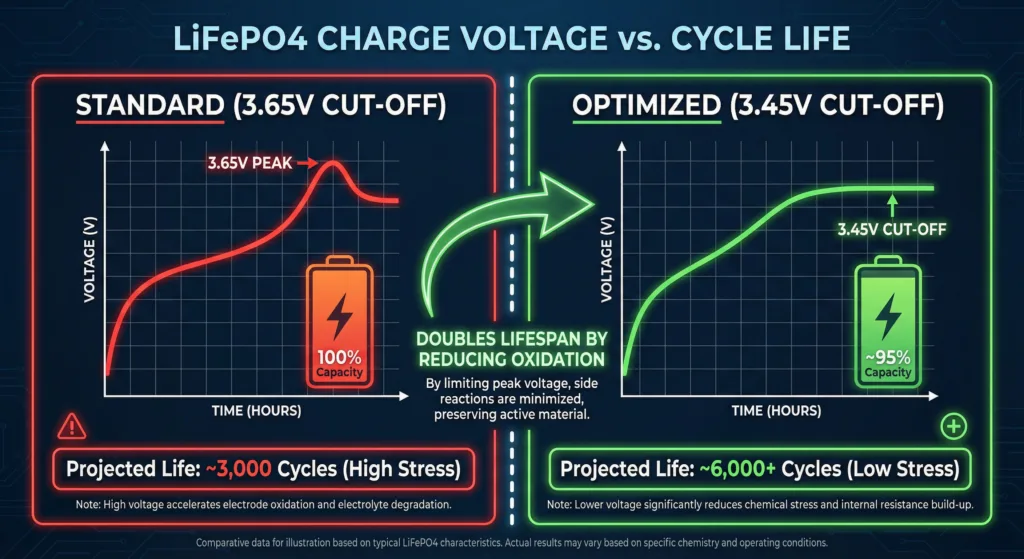
2. The 3.45V “Sweet Spot” Strategy
The Engineering Reality: Although the standard charge cut-off for LFP is 3.65V, the final 5% of charge causes the highest chemical stress. Why it matters: Capping the charge at 3.45V per cell significantly slows down electrolyte oxidation while still capturing ~95% of usable energy. This simple firmware adjustment can potentially double the cycle life in high-frequency solar applications.
(Source: Zheng et al., Electrochimica Acta, 2012).
3. Calendar Aging vs. Cycle Life in Solar
The Engineering Reality: In many solar projects, batteries die not from “cycling,” but from Calendar Aging. Why it matters: High State of Charge (SOC) combined with high ambient temperature accelerates the growth of the Solid Electrolyte Interphase (SEI) layer. Solusi: For hot climates, system sizing should aim to keep the average SOC between 40% and 70% during peak heat hours.

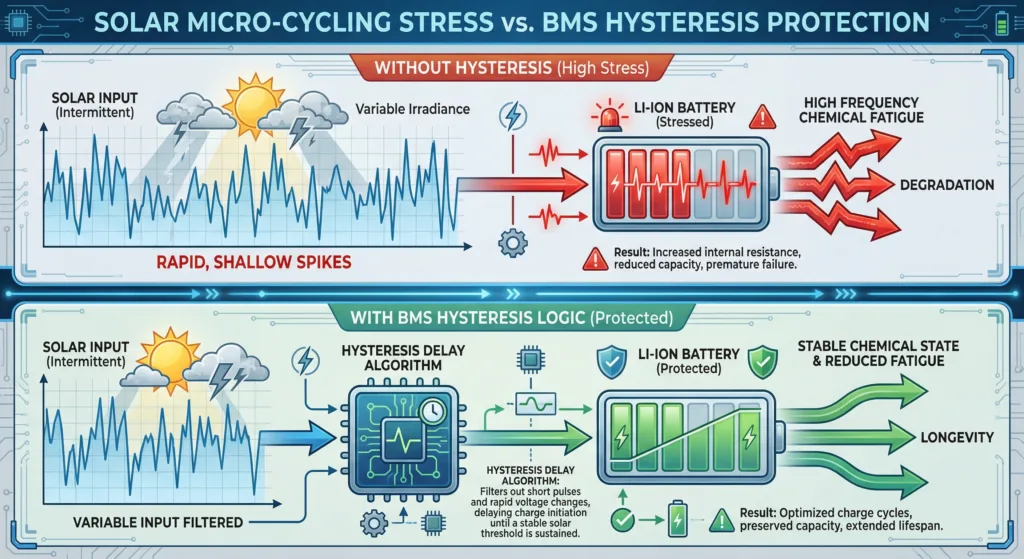
4. Micro-Cycling & Hysteresis Fatigue
The Engineering Reality: Intermittent cloud cover causes “Micro-cycling”—thousands of shallow, high-frequency charge/discharge pulses. Why it matters: These pulses cause lattice fatigue in the cathode. Solusi: Use a BMS with Hysteresis Control that delays the start of charging until a significant SOC drop is detected, preventing chemical “flutter.”
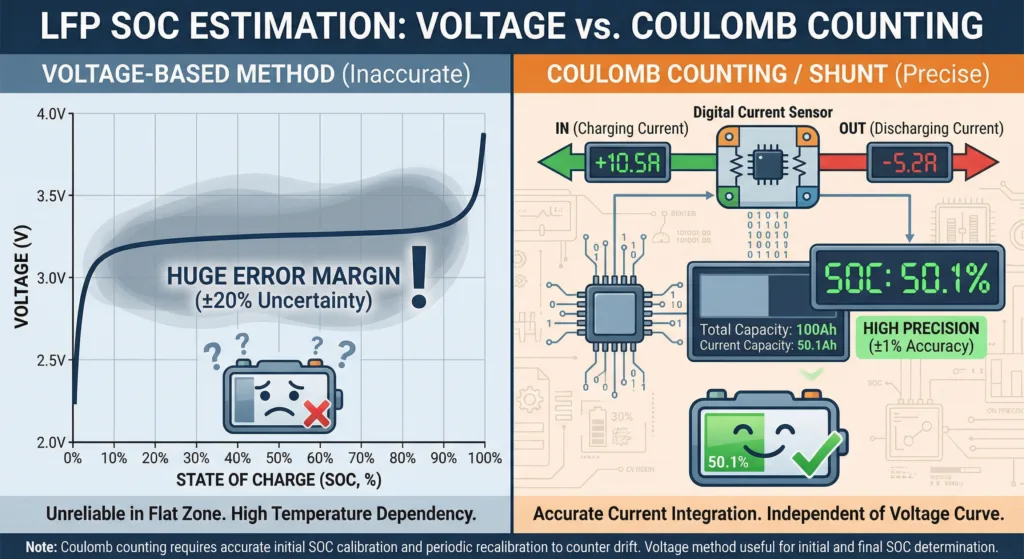
5. SOC Drift: Voltage vs. Coulomb Counting
The Engineering Reality: LFP has an extremely flat discharge curve. Relying on voltage to estimate SOC is fundamentally flawed (errors can exceed 20%). Why it matters: SOC drift leads to accidental deep discharges or overcharging. Requirement: Demand a BMS with integrated Coulomb Counting (Shunt-based) to ensure accurate energy management.
6. DCIR vs. ACIR Aging Metrics
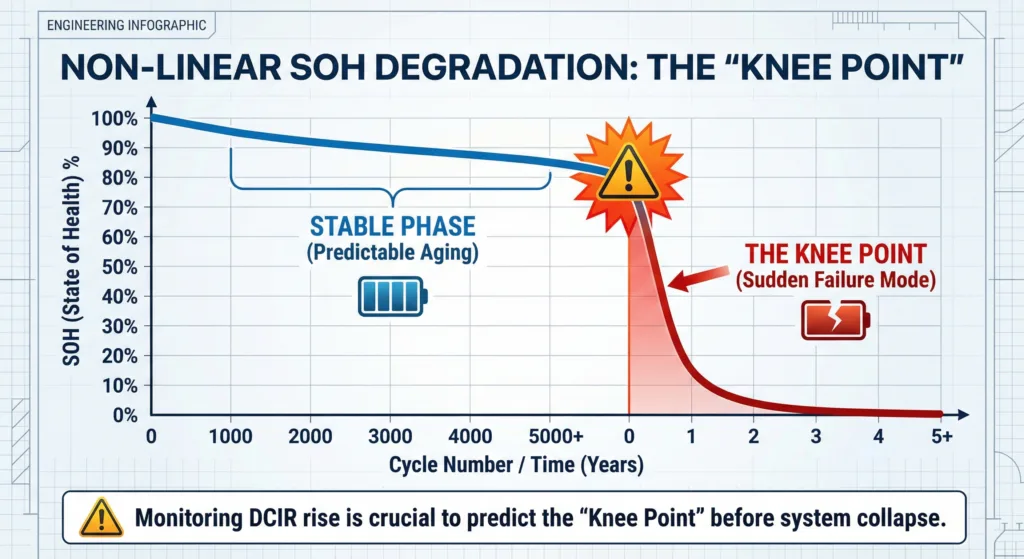
The Engineering Reality: Standard data sheets often list AC Internal Resistance (ACIR), which is a lab metric. Why it matters: Direct Current Internal Resistance (DCIR) is what affects heat generation and power delivery in the field. As a battery ages, DCIR rises much faster than ACIR. Audit Tip: Monitor DCIR during routine maintenance to predict the “Knee Point” (the point of rapid failure).
7. Electrolytic Decomposition at High Voltage
The Engineering Reality: Holding a battery at a “Float Charge” (continuous high voltage) is the most damaging state for LFP. Why it matters: It promotes continuous electrolytic breakdown. Solusi: Solar controllers should utilize a “Bulk-Absorb-Rest” cycle rather than a continuous “Float” stage common in Lead-Acid systems.
8. Interconnect Electro-galvanic Corrosion
The Engineering Reality: In humid or saline environments, the junction between the cell terminal and the busbar is a failure point. Why it matters: Micro-corrosion increases resistance, causing localized heating (hot spots) that accelerates the aging of the nearest cells. Audit Tip: Ensure all interconnects are nickel-plated copper with anti-corrosion grease.
9. SOH (State of Health) Non-linearity
The Engineering Reality: Battery degradation is not linear. It follows a “Knee” curve. Why it matters: Capacity might drop 10% in the first 2 years and stay stable for 5 years, then drop 30% in 6 months. Solusi: Use predictive analytics to detect the shift in the DCIR curve before total failure occurs.
10. Thermal Stratification in Battery Enclosures
The Engineering Reality: Heat is not uniform. The top cells in a pole-mounted box can be 10°C hotter than the bottom cells. Why it matters: Temperature variance causes cell imbalance, which the BMS cannot always correct. Solusi: Use aluminum-cased cells and thermally conductive padding to equalize temperature across the entire pack.
Engineering Comparison: Marketing Specs vs. Real-World Lifespan
| Parameter | Marketing Promise (Standard) | Engineering Excellence (Reliable) |
|---|---|---|
| Charge Cut-off | 3.65V (Maximum stress) |
3.45V – 3.50V (Extended life) |
| SOC Calculation | Voltage-based (High error) |
Coulomb Counting / Shunt (High precision) |
| Balancing Logic | Passive Balancing (Slow/Heat) |
Active Balancing (Fast/Efficient for 100Ah+) |
| Cell Housing | Plastic / PVC Wrap (Poor heat sink) |
Aluminum Hard-case (Optimal heat dissipation) |
| Mechanical Build | Loose Stack | Compressed Stack ($2\text{-}10\text{ psi}$) |
How to compare battery specs fairly (avoid Ah traps)
Rule 1: compare by Wh, not Ah
Ah without voltage is not a full energy specification. Require nominal battery voltage and calculate nominal Wh, then apply a declared usable factor.
Rule 2: require a declared usable energy policy
- Nominal baterai Wh
- Declared usable factor (project policy)
- Low-voltage cutoffs and how they protect the pack
Use this page as the standard method:
Evidence to request (LiFePO4 battery lifespan becomes auditable)
A) Cell identification (minimum)
- Cell chemistry: LiFePO4 (confirm)
- Cell format and model identification (ask for cell-level identification, not “Grade A” only)
- Cell sourcing statement (who supplies the cells)
B) Pack build disclosure (minimum)
- Pack configuration (series/parallel count)
- Connection method (welding/busbar design) and insulation approach
- Pack protection method (mechanical protection, enclosure, strain relief)
C) BMS protections list (mandatory)
- Over-charge protection
- Over-discharge protection (low-voltage cutoffs)
- Perlindungan arus berlebih/korsleting
- Over-temperature protection
- Cell balancing method and policy
D) Traceability and QC records (mandatory for serious projects)
- Serial number system linking unit → battery pack → QC records
- Incoming inspection records for battery-related materials
- Final QC test record template
Referensi verifikasi pabrik:
Warranty and service: define battery terms explicitly
Battery warranties become disputes when scope is unclear. Require component-level warranty terms and an evidence workflow.
Minimum battery warranty definition
- Battery/BMS scope (what is covered)
- Exclusions (improper installation, vandal, unauthorized modification)
- Claim evidence list (serial mapping, commissioning record, logs)
- SLA (response/diagnosis/dispatch time)
Referensi:
Field symptoms that point to battery aging or misuse
- Early shutoff becomes more frequent over months (capacity fade or chronic deficit).
- Works in summer, fails in rainy season (undersizing + SOC walk-down).
- Random resets or unstable behavior (BMS cutoffs or controller behavior).
Use failure diagnosis here:
Aturan pengadaan LULUS/GAGAL
Tandai tawaran GAGAL (Tidak Sebanding) jika kurang:
- Battery specification in Wh (voltage + Ah or direct Wh)
- Declared usable energy policy (usable factor + cutoffs)
- Daftar perlindungan produk PASI
- Warranty terms that include claim evidence workflow
Copy/Paste RFQ Clauses (LiFePO4 Battery Lifespan)
Clause 1 :Battery energy disclosure (mandatory)
Supplier shall specify battery capacity in Wh (nominal voltage and Ah or direct Wh) and disclose the declared usable energy policy (usable factor and low-voltage cutoffs). Ah-only claims are not acceptable for bid comparison.
Clause 2 :BMS protections (mandatory)
Supplier shall disclose BMS protections including over-charge, over-discharge, over-current/short, over-temperature, and cell balancing policy.
Clause 3:Rainy-season recovery alignment
Supplier shall ensure battery sizing and controller strategy supports worst-month/rainy-season recovery assumptions and provide a sanity check consistent with the energy budget sheet.
Clause 4:Traceability & warranty evidence
Supplier shall provide traceability via serial numbers linking luminaire to battery pack and QC records. Warranty claims require serial-to-location mapping, commissioning record, and maintenance log evidence.
Request Toolkit: Battery Specification & Warranty Evidence Toolkit
Get the editable toolkit to prevent battery marketing traps and standardize warranty evidence:
- Battery spec sheet template (Wh, usable factor, cutoffs)
- BMS protections disclosure checklist
- Traceability and QC records request list
- Battery warranty clause templates (scope + SLA + evidence)
Ingin pemeriksaan kewarasan teknik yang cepat?
Bagikan kelas jalan, tinggi tiang, target lux/keseragaman, dan asumsi PSH bulan terburuk.
Langkah Selanjutnya (Jaga agar Proyek Anda Tetap Siap untuk Tender)
Pastikan proyek lampu jalan tenaga surya Anda memenuhi semua standar pengadaan dan teknik.
Templat & Bukti
- 📑 Pusat Panduan Pembeli - Pilih skenario & ikuti jalur yang mengutamakan bukti.
- 📊 Perpustakaan Sumber Daya - Spesifikasi, bukti QC, & alur kerja IES.
- 🔍 Pusat Definisi Spesifikasi - Menormalkan bukti Wavg, Wh, & IP/IK.
- 💡 Pusat IES & DIALux - Validasi jarak & keseragaman.
- 🛡️ Pengujian Kualitas - Bukti terverifikasi vs klaim pemasaran.
- 📋 Kit RFQ & BOQ - Templat, klausa & rubrik penilaian.
Pilih Jenis Sistem
- 🚀 Lampu Jalan Tenaga Surya All-in-One
- 🌓 Lampu Jalan Tenaga Surya All-in-Two
- 🛠️ Lampu Jalan Tenaga Surya Tipe Split
- 📏 Lampu Tiang Surya
- ✨ Lampu Jalan Tenaga Surya Hias
- ⚠️ Solusi Khusus (Tahan ledakan/Hibrida)