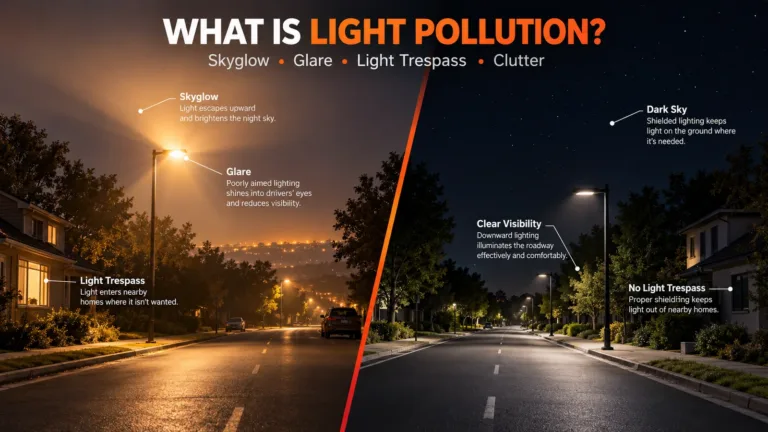
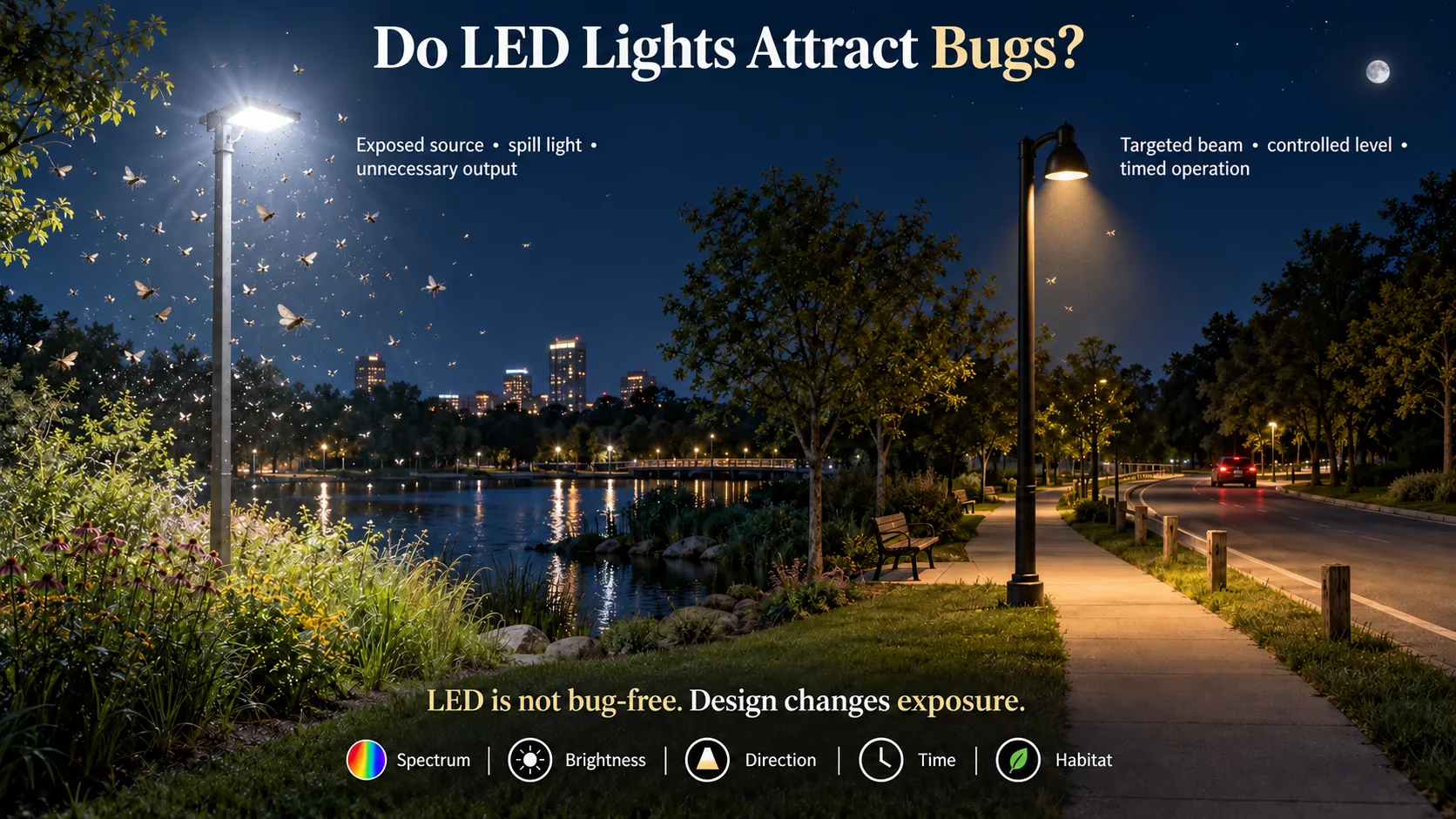
Do LED lights attract bugs? Yes, some LEDs attract and disrupt flying insects at night—but “LED” alone does not predict how strong the effect will be. Spectrum, brightness, exposure of the light source, beam direction, operating time, location and insect species all matter. A well-aimed, controlled outdoor LED system can reduce unnecessary attraction compared with a bright, exposed light that spills into nearby habitat.
That distinction matters for roads, parks, campuses, resorts, parking areas and perimeter projects. Changing the fixture label or choosing a warmer-looking lamp is not a complete strategy. The useful question is: how can the project deliver the required visibility while putting less light into places and times where it serves no purpose?
In this guide
- Quick Answer
- Why Bugs Gather Around Lights
- Do LED Lights Attract Bugs Less Than Other Lamps?
- What Color LED Lights Attract the Fewest Bugs?
- Do Solar Lights Attract Bugs?
- Five Design Moves That Matter More Than a “Bug Light” Label
- A Practical Outdoor-Site Review
- How This Connects to an Actual Inlux Configuration
- What to Include in the RFQ
- Common Myths About LEDs and Bugs
- Soalan Lazim
- The Short Answer
Quick Answer
- Can LEDs attract bugs? Yes. No outdoor white LED should be treated as insect-free.
- Does LED always attract more insects than older lamps? No. Some tested LEDs attracted fewer insects than tungsten and compact fluorescent lamps, but results depend on the source and setting.
- Is warm white automatically safe for insects? No. Lower-blue light can be one useful choice, but CCT alone does not describe the whole spectrum or control exposure.
- What can a project team control? Use only necessary light, aim it at the task, limit brightness, reduce direct source visibility, control operating time and keep spill away from sensitive habitat.
Why Bugs Gather Around Lights
The familiar phrase “like a moth to a flame” makes the behavior sound simple. Recent flight-tracking research tells a more interesting story.
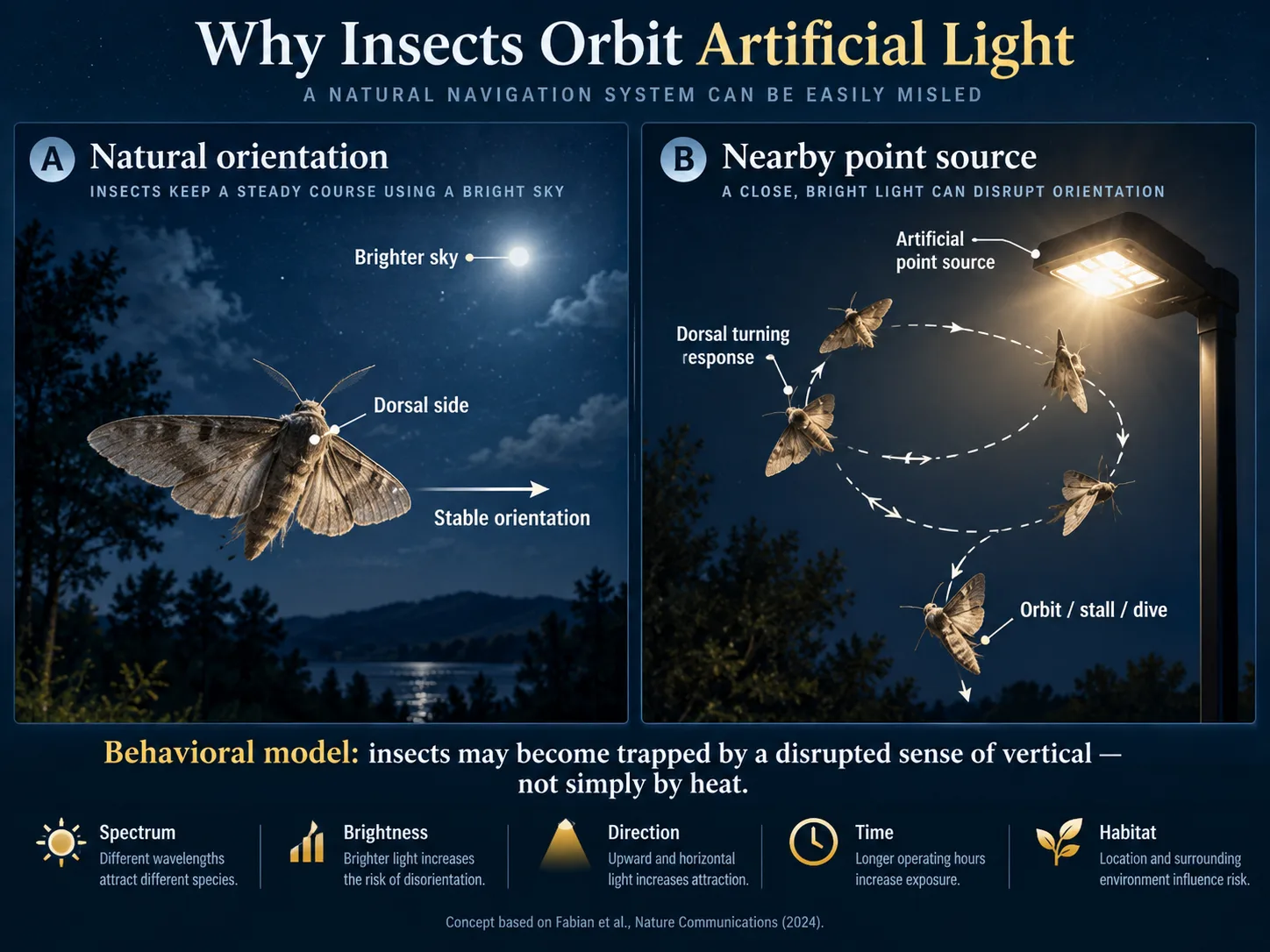
In a 2024 Nature Communications study, researchers recorded three-dimensional insect flight around artificial lights. At close range, many insects did not fly straight toward the source. They tilted their backs toward it, a response that normally helps them orient to the brighter sky. A nearby artificial source can corrupt that cue, leading to orbiting, stalls, dives and entrapment around the light. The response varied among species, so it is not a universal on-off mechanism.
This helps explain why an LED can affect insects even though it produces far less radiant heat than a flame. The visual signal—not simply heat—is important.
Do LED Lights Attract Bugs Less Than Other Lamps?
Sometimes, but the result depends on what is being compared.
A 2016 field experiment compared tungsten filament, compact fluorescent, cool-white LED and warm-white LED lamps. The LED lamps caught significantly fewer insects than the traditional alternatives in that experiment. However, the researchers did not find a significant difference between their warm-white and cool-white LEDs.
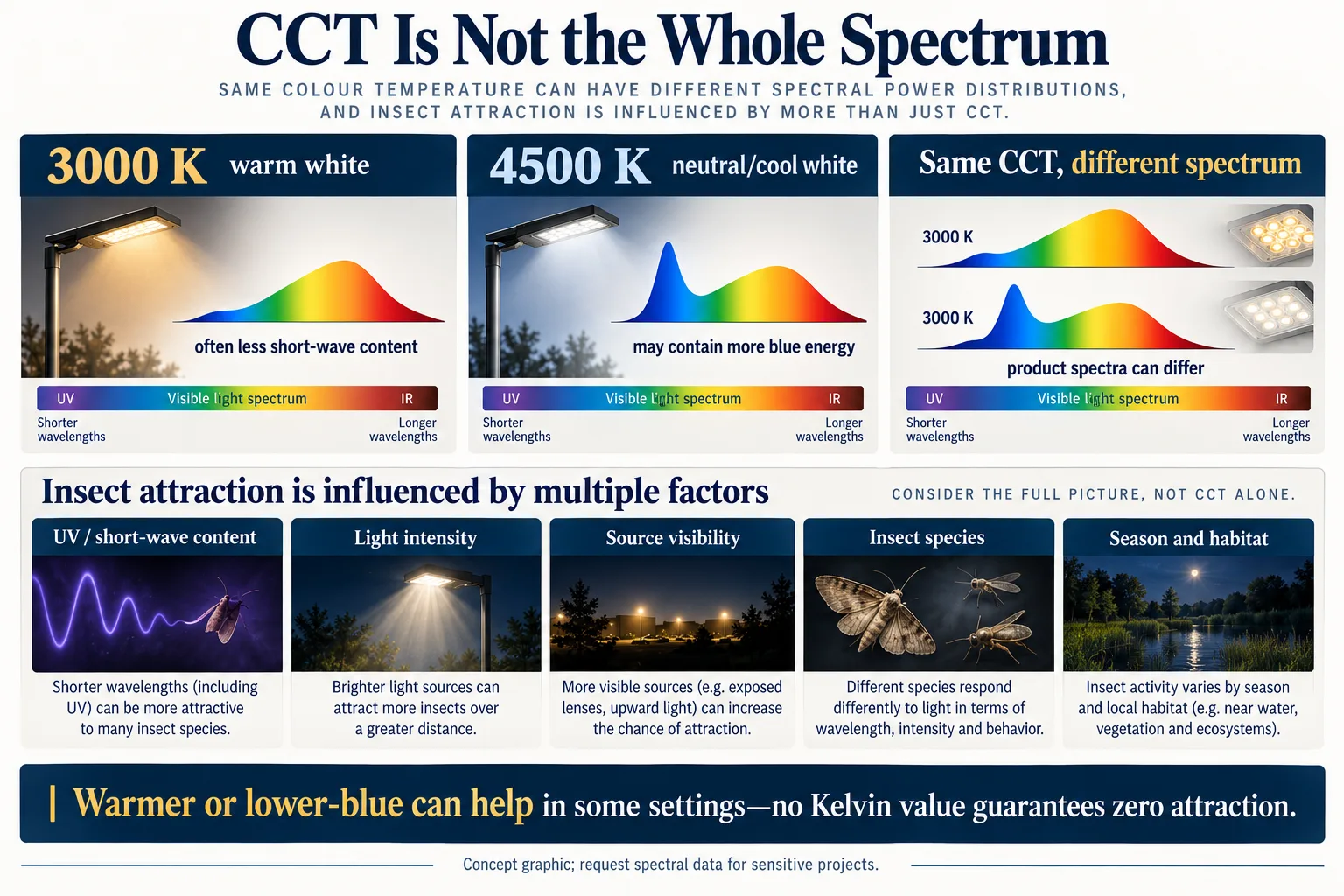
A separate 2023 outdoor experiment compared narrow wavelengths and broad-spectrum white LEDs. Shorter-wave blue treatments were generally more attractive than longer-wave treatments. The 4,500 K treatment caught 1.43 times as many insects as the 3,000 K treatment across the four dominant orders, yet the authors also reported that the broad white-LED difference was not statistically significant. Responses differed by insect order.
Those findings are not contradictory once the limits are clear. So, do LED lights attract bugs less than older lamps? Some tested LEDs did, but the product spectrum and field setting decide whether that comparison applies. “Warm” and “cool” are broad appearance categories. Two products with the same correlated color temperature can have different spectral power distributions, and insect communities differ by place and season.
| What the evidence supports | What it does not support |
|---|---|
| Some LED spectra can attract fewer insects than some older lamp types. | Every LED attracts fewer insects than every non-LED source. |
| Short-wave and ultraviolet content can be important for many insects. | One color works for every insect species and habitat. |
| Warm/low-blue options are reasonable to evaluate where the project allows them. | A Kelvin number by itself guarantees “bug-free” lighting. |
| Direction, shielding, intensity and operating time can be designed. | Changing color temperature compensates for excessive or badly aimed light. |
What Color LED Lights Attract the Fewest Bugs?
There is no universal “no-bug” color. This is why the answer to “do LED lights attract bugs?” cannot be reduced to one Kelvin number. In many studies, shorter wavelengths—especially ultraviolet and blue-rich light—produce stronger responses for many nocturnal insects, while longer-wavelength or lower-blue options can reduce attraction. But different species see and respond to spectra differently.
For a real project, treat color temperature as a useful screening variable, not a biological guarantee:
- Review the actual spectral data when ecological sensitivity is important. CCT alone compresses a complex spectrum into one appearance value.
- Consider a warmer or lower-blue source where visual tasks, color recognition, standards and local requirements still can be met.
- Do not compensate for a warmer source by installing more light than the task needs. Intensity and exposure remain important.
- Verify the result at the site. Nearby water, vegetation, seasonal insect activity and surrounding lights can change what happens.
Our guide to soft white versus daylight LED lighting explains the visual side of Kelvin selection. For insect-sensitive sites, that human-vision decision should be reviewed alongside spectrum, habitat and operating time.
Do Solar Lights Attract Bugs?
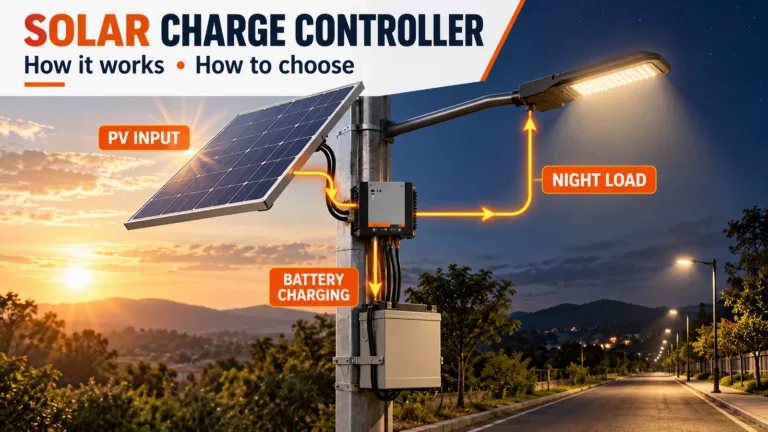
Solar power does not make emitted light invisible to insects. For a solar project, “do LED lights attract bugs?” is still a question about the emitted light and its operation. A solar light and a grid-powered light can use similar LEDs and optics. If their spectrum, intensity, distribution and schedule are similar, their power source is not the main attraction variable.
Solar systems do offer one useful design advantage: their energy budget already encourages deliberate operating profiles. A project can use scheduled dimming or motion response to reduce output when traffic is low, provided the transition still meets safety and operational requirements. The controller must be configured as part of the lighting and battery design; a sensor does not create extra stored energy.
For the day-to-night control sequence, see how solar lights work and our dusk-to-dawn outdoor lighting guide.
Five Design Moves That Matter More Than a “Bug Light” Label
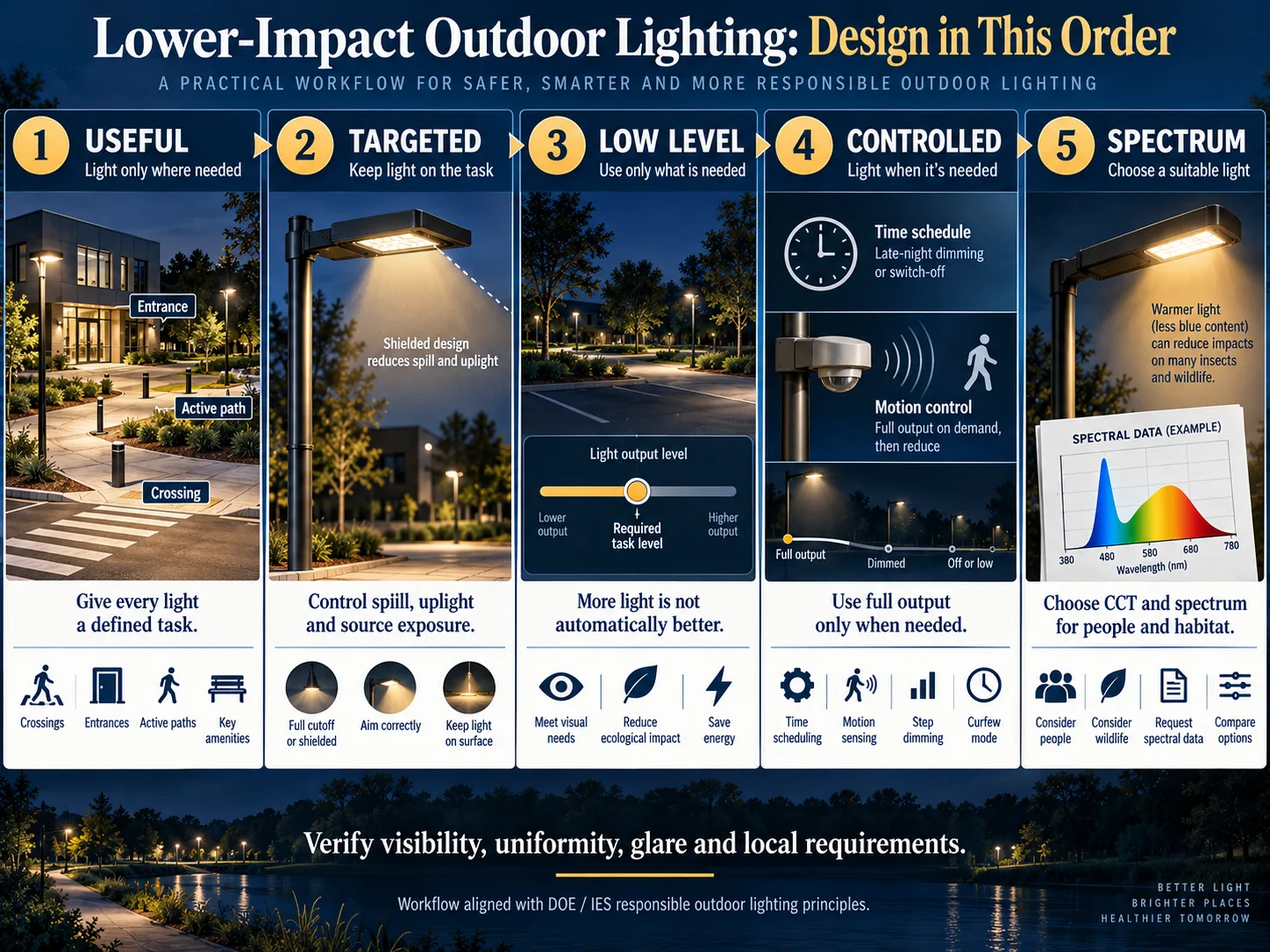
When clients ask, “Do LED lights attract bugs?”, it is tempting to solve the issue with a product label. For commercial outdoor lighting, the more reliable approach is a sequence of design decisions.
1. Confirm that every light has a job
Define the visual task before selecting output: a road conflict point, a pedestrian route, an entrance, a loading area or a security boundary. Decorative spill into trees or water should not be treated as free light.
2. Put the beam on the task
Shielding and controlled optics reduce exposure of the bright source and keep light out of adjacent habitat. A 2024 road-lighting field study compared tailored, shielded luminaires with conventional luminaires at nearly identical road illuminance. The spatially optimized designs significantly reduced flying-insect attraction. That is particularly useful evidence because the improvement was not achieved by simply making the road dark.
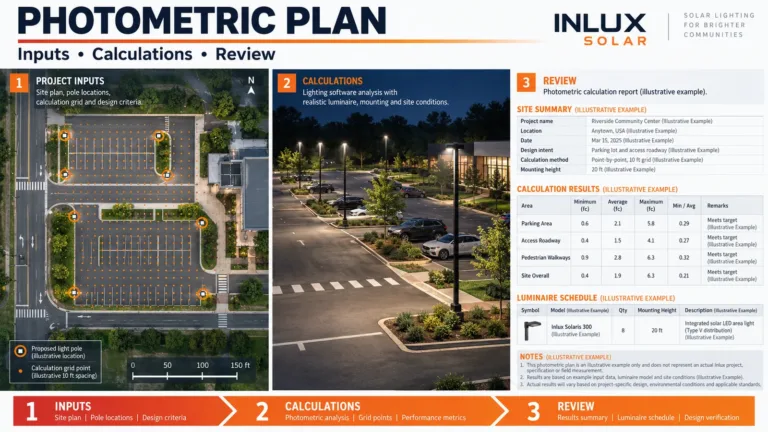
Use photometric files to test pole position, mounting height, tilt and distribution. For sensitive edges, inspect backlight and uplight—not only the average lux on the road.
3. Use the lowest level that performs the task
More light is not automatically safer or more comfortable. Excess output can increase glare, spill and ecological exposure while wasting stored energy in a solar system. Check average, minimum, uniformity and vertical visibility together instead of selecting by watts alone.
4. Control when full output is available
Timers, photocells, astronomical schedules, occupancy sensing and remote controls solve different problems. Use dimming or switch-off periods only where the operating risk allows them. Near a late-night crossing or active security gate, the safe schedule may be different from a closed park path.
5. Then refine spectrum and CCT
After quantity, distribution and schedule are under control, select the spectrum that balances visibility, color recognition, environmental sensitivity and local requirements. The U.S. Department of Energy’s responsible-outdoor-lighting summary uses the same order of thinking: useful, targeted, low level, controlled and warmer-colored where possible.
A Practical Outdoor-Site Review
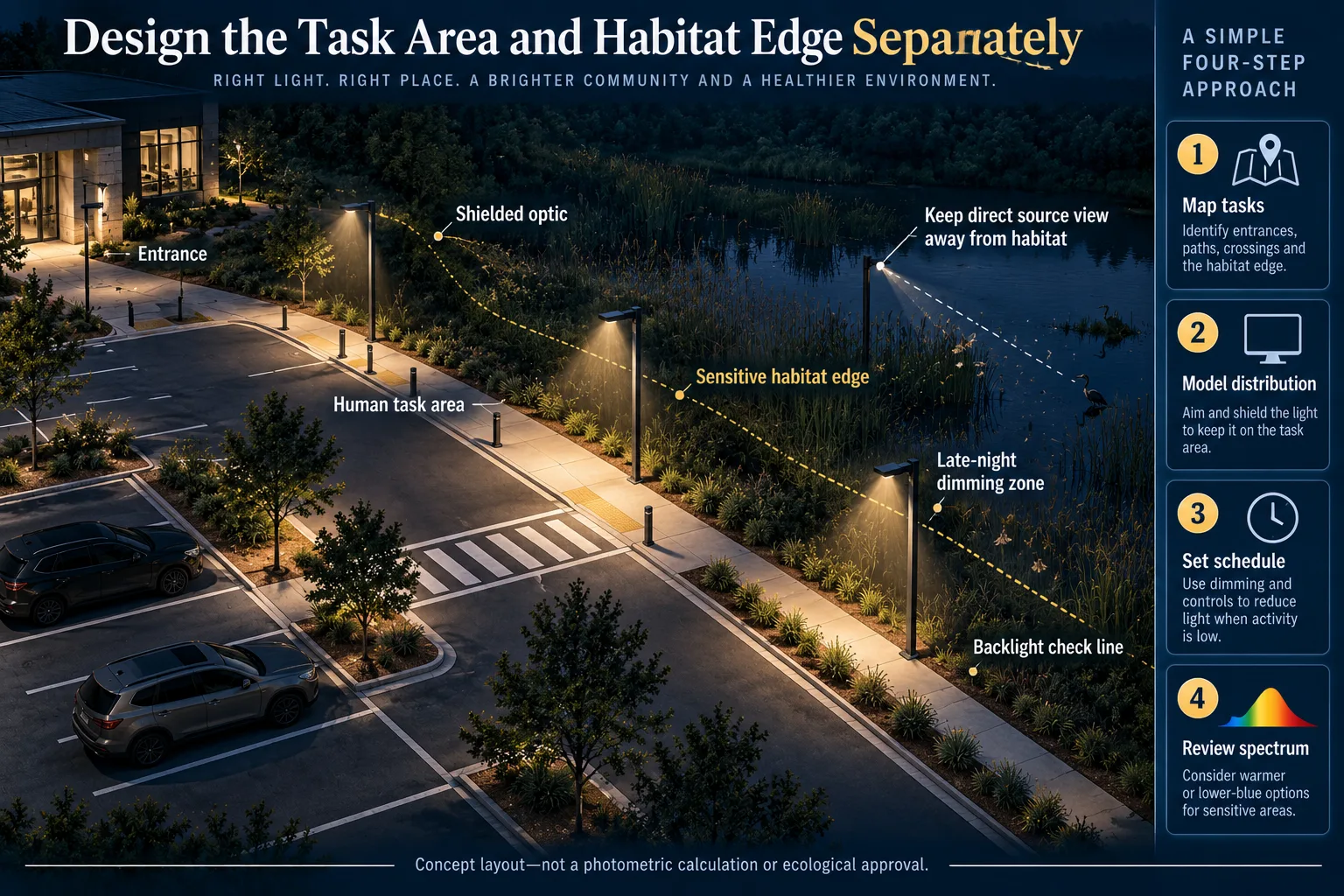
Imagine a path running between a parking area and a wetland edge. The wrong starting point is “use 3,000 K and the bug problem is solved.” A better review separates the human task from the habitat boundary.
First, mark the path, crossings and entrances that need visibility. Then model a distribution that keeps useful light on those surfaces and limits backlight toward the wetland. Check whether late-night use justifies full output all night. Only after those decisions should the team compare lower-blue spectral options that still provide the needed visibility and color recognition.
The result might use the same nominal CCT as another project but a different optic, output and schedule. That is why copying a fixture schedule from a parking lot to a waterfront path is risky.
For parks and recreation areas, start with the site functions described on our park and recreation lighting page. Perimeters with cameras or access control need a separate review of vertical visibility and contrast; see perimeter security lighting.
How This Connects to an Actual Inlux Configuration
The current INL-LED22 LED street light page lists a 3,000–6,500 K CCT range, three beam-angle options—60×120°, 70×140° and 80×150°—and an optional photocell. These are configuration choices, not proof that one setting is insect-safe.
For an insect-sensitive project, the useful next step is to identify which CCT and optic are available for the proposed wattage, request the photometric file, define the control schedule and map the sensitive boundary. If ecological performance is a contractual requirement, agree on a measurement or monitoring method with the project ecologist and lighting designer. Do not substitute a catalogue Kelvin value for that work.
What to Include in the RFQ
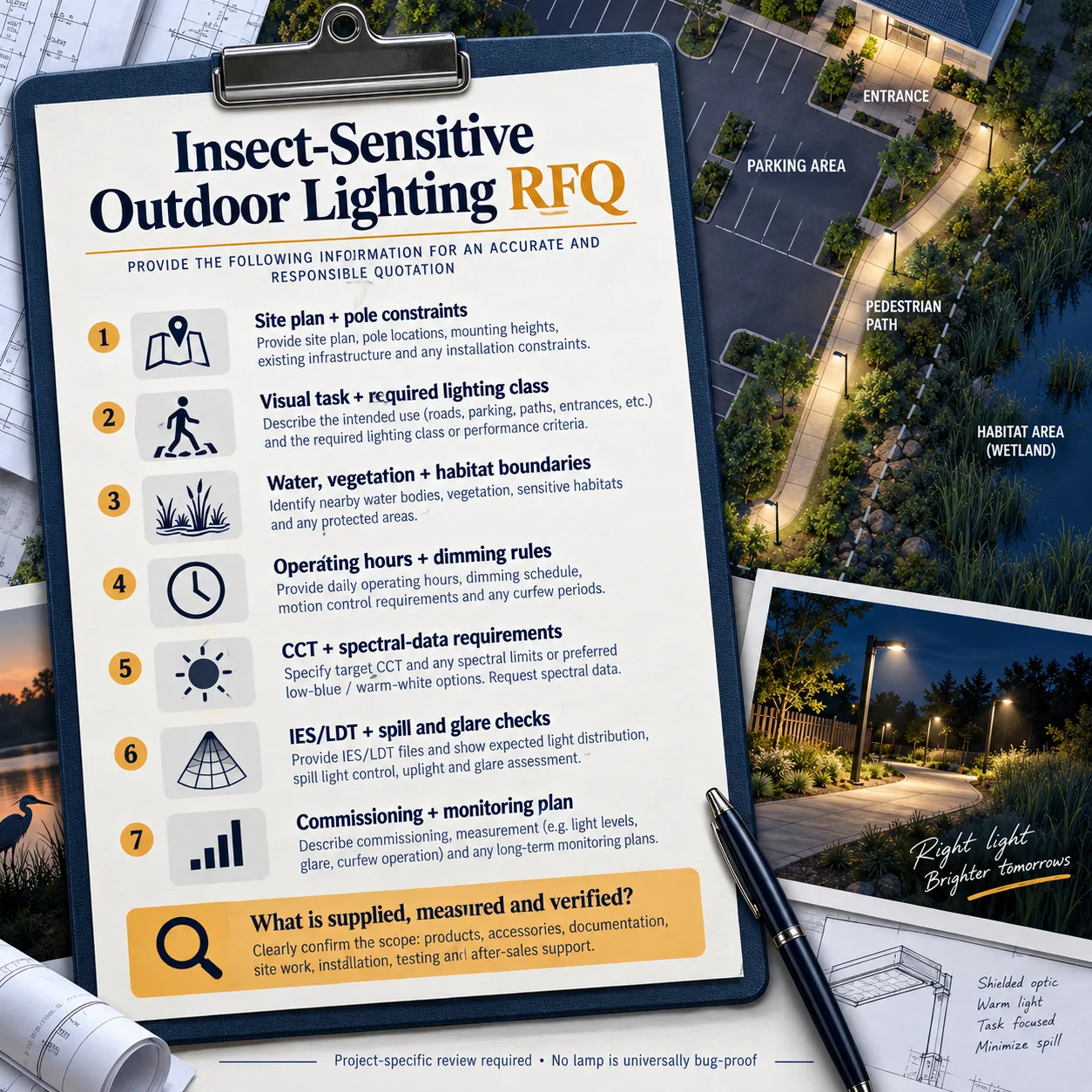
A client may begin with “do LED lights attract bugs?”, but an actionable RFQ needs enough information for the supplier and designer to discuss the same problem:
- Site plan, road or path width, pole locations and mounting-height constraints.
- Required lighting class or project-specific visual tasks.
- Nearby water, vegetation, protected habitat, residences and property boundaries.
- Hours of activity, curfew, dimming windows and motion-response rules.
- Preferred CCT plus any requirement for spectral data or blue-light limits.
- Required IES/LDT files, glare or spill criteria and calculation points at sensitive edges.
- Local electrical, planning, environmental and road-authority requirements.
- A commissioning plan that checks aiming, controls and the actual boundary condition after installation.
If you are planning a solar road or area-lighting system, review the solar street light range and send the site information through contact us. Ask for a project-specific configuration rather than a claim that any lamp is “bug-proof.”
Common Myths About LEDs and Bugs
“LEDs do not attract insects.” They can. The strength and type of response depend on the source and setting.
“Warm white never attracts bugs.” Warm or lower-blue light can be a useful mitigation choice, but no white-light CCT eliminates attraction across all species.
“Solar lights attract more bugs.” Solar is the power system. The nighttime light spectrum, distribution, level and schedule are the relevant variables.
“A brighter site is always safer.” Poorly controlled brightness can create glare and sharp contrast. Design to the task and verify the layout.
“Color is the only ecological variable.” The amount of light, its direction, source visibility, operating time and proximity to habitat can be just as important.
Soalan Lazim
Do LED lights attract bugs at night?
Yes. Many flying insects can gather or become trapped around LED light at night. The response is not identical for every LED or insect species.
Are bugs more attracted to blue or warm light?
Many studies find stronger responses to shorter blue or ultraviolet wavelengths. Warmer or lower-blue sources are often worth evaluating, but product spectrum, brightness and species still matter.
Do LED lights attract fewer bugs than incandescent lights?
One field experiment found the tested warm- and cool-white LEDs attracted significantly fewer insects than tungsten and compact fluorescent alternatives. That result should not be generalized to every product and habitat.
Can a 3,000 K light stop insects gathering around a fixture?
No guarantee. A 3,000 K source can still attract insects. Shielding, output, optical control, operating time and site placement must be addressed too.
Should insect-sensitive roads be left unlit?
Not automatically. The visual task and safety obligation come first. Research on tailored and shielded road luminaires shows that spatial control can reduce attraction while maintaining similar illuminance on the road.
What is the first specification to change?
Start by removing unnecessary light and controlling where and when the remaining light operates. Then evaluate spectrum and CCT within the project’s visibility and compliance requirements.
The Short Answer
Do LED lights attract bugs? Yes, but the fixture technology is only the beginning of the answer. A lower-impact outdoor design combines useful light levels, controlled distribution, limited source exposure, an appropriate schedule and a carefully selected spectrum. For sensitive sites, verify the result with project-specific photometry and ecological input rather than relying on a “bug light” label.
Sources
- Fabian et al., Why flying insects gather at artificial light, Nature Communications (2024).
- Wakefield et al., Experimentally comparing the attractiveness of domestic lights to insects, Ecology and Evolution (2016).
- Hao et al., Assessing the attraction of narrow-spectrum and broad-spectrum artificial light to nocturnal insects, Frontiers in Ecology and Evolution (2023).
- Dietenberger et al., Reducing the fatal attraction of nocturnal insects using tailored and shielded road lights, Communications Biology (2024).
- U.S. Department of Energy, Five Principles for Responsible Outdoor Lighting.