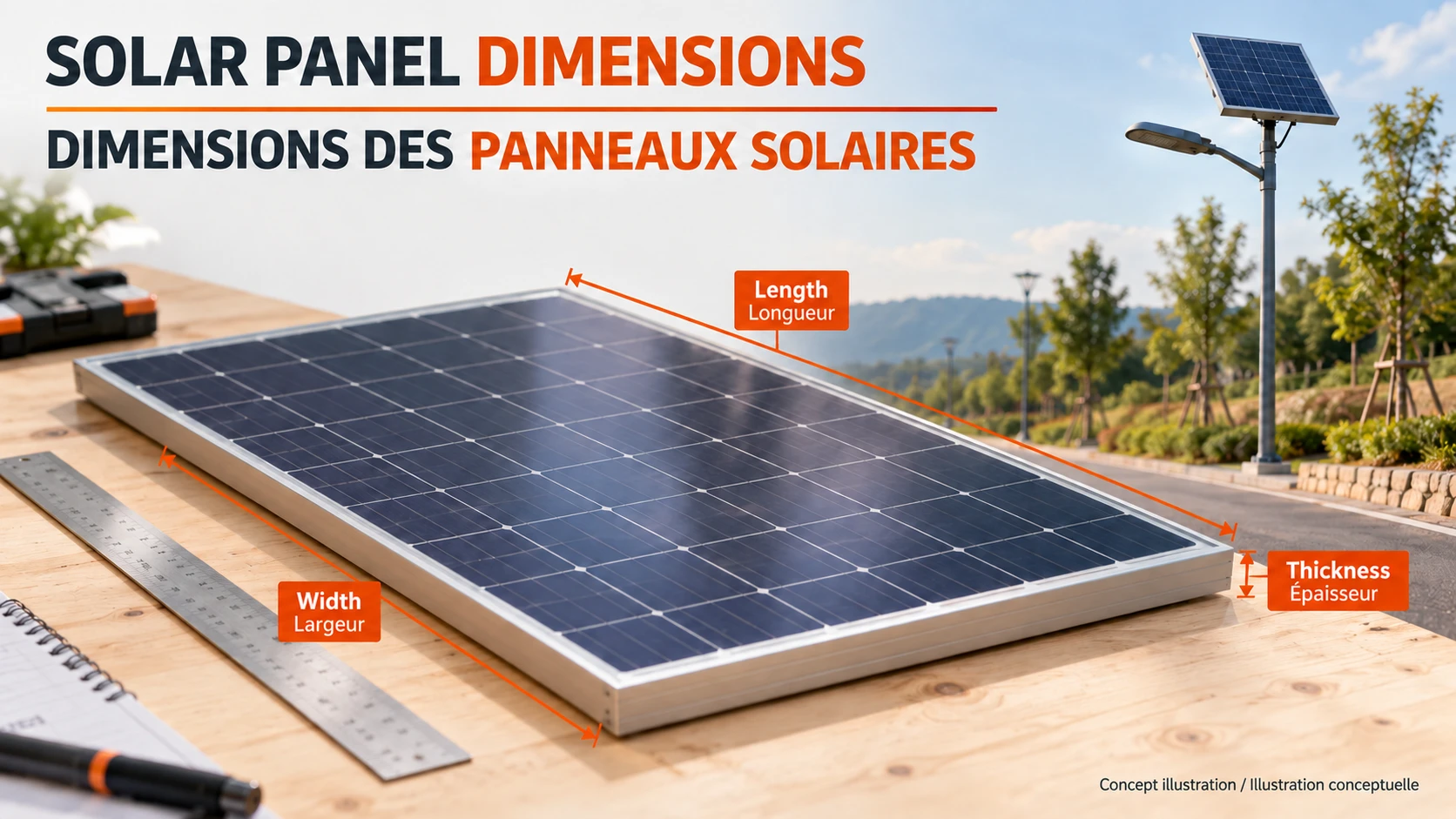
Solar panel dimensions are the physical length, width and thickness of a module, usually measured across the outside of its frame. There is no single standard size for a given wattage. For example, the specific 200 W and 400 W modules below measure 1262 × 764 × 30 mm and 1722 × 1134 × 30 mm respectively. These are named examples—not dimensions you can apply to every panel with the same power rating.
A panel can fit inside a rectangle on a drawing and still be unsuitable for a street-light installation. Its mounting interfaces may not match the bracket; its rear junction box may foul a support; or the larger assembly may need a fresh structural assessment. Start with the dimensioned module drawing, then check the installed assembly. Do not order a replacement from the wattage alone.
Solar panel dimensions chart: two documented examples
The table uses dimensions and mass from the manufacturers’ own documents. The Renogy example is RSP200DC-ASR-G1; the Canadian Solar example is the CS6R-400MS in the HiKu6 All-Black data sheet, version V2.31C25_EN, dated March 2024. Verify the revision supplied with an actual quotation. Neither example is a declaration of the panel fitted to an Inlux street light or a recommendation to mount that module on a pole.
| Documented module | Rated PV power | Outer dimensions, mm | Dimensions, inches | Module mass |
|---|---|---|---|---|
| Renogy ShadowFlux RSP200DC-ASR-G1 | 200 W | 1262 × 764 × 30 | 49.69 × 30.08 × 1.18 | 10.81 kg |
| Canadian Solar HiKu6 All-Black CS6R-400MS; V2.31C25_EN | 400 W | 1722 × 1134 × 30 | 67.8 × 44.6 × 1.18 | 21.3 kg |
Manufacturer documents for this chart: Renogy RSP200DC-ASR-G1 mechanical data dan Canadian Solar HiKu6 All-Black V2.31C25_EN. Inch values above are the manufacturers’ published rounded equivalents. Module mass does not include a street-light pole, bracket, fasteners or foundation. To convert an unrounded drawing value, inches = millimetres ÷ 25.4; retain the original mm drawing for fit approval rather than reverse-calculating from a rounded inch figure.
Notice that the Canadian Solar document covers 380–405 W variants within the same listed frame dimensions. That is a useful warning against treating watts as a ruler. For power selection rather than physical fit, use our solar panel wattage guide. A wattage requirement and a dimensional limit belong on separate lines in an RFQ.
Read the whole drawing, not just length × width
Check whether the drawing is a front view, rear view or frame cross-section. Hole centres shown on the rear view are not the outside dimensions. A frame-height dimension does not tell you the clearance needed below a junction box or cable. The important measurements are different because they answer different questions.
| Drawing or document item | Question it answers | Do not assume |
|---|---|---|
| Outside length, width and frame thickness | Will the module fit within the available outer envelope? | That it will attach to the existing bracket |
| Mounting-hole pattern or permitted clamp arrangement | How may this exact module be supported? | That every hole is a mounting hole or any frame edge may be clamped |
| Rear junction box and cable position | Will the underside and cable route remain clear? | That frame thickness is the total required rear space |
| Module mass plus support details | What complete assembly needs checking? | That module mass alone establishes pole or foundation adequacy |
| Packaging dimensions | Will the shipment fit the transport and handling plan? | That carton size is the module size |
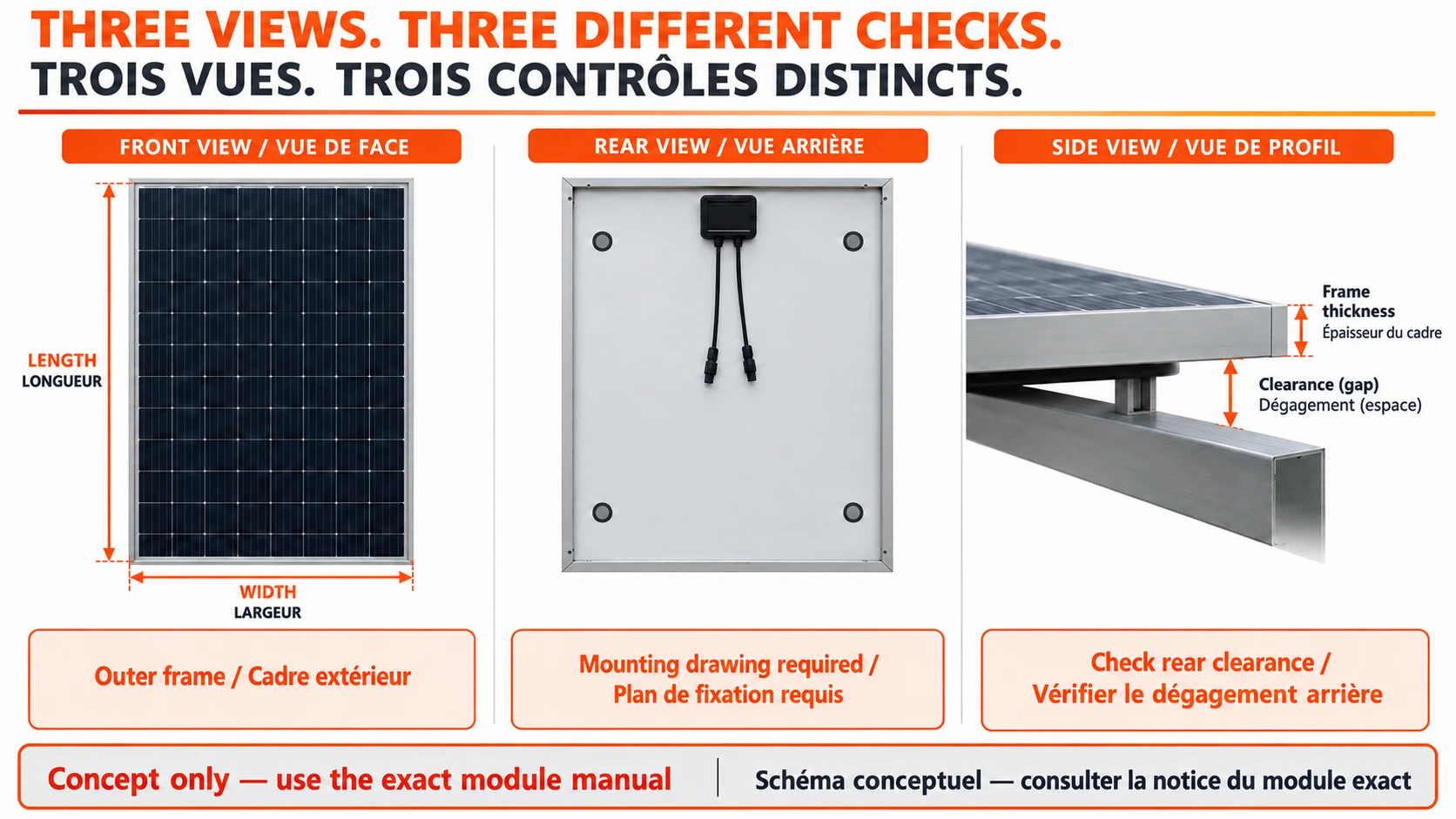
For an existing installation, record the old module reference and the support arrangement before selecting a substitute. If the information is missing, arrange a qualified assessment rather than improvising new holes, clamps or cable routes. Dimensions can identify an obvious mismatch; matching dimensions do not establish electrical or structural compatibility.
Flat panel area is not the installed envelope
For a rectangular module, face area in square metres is length in metres multiplied by width in metres. The 1262 × 764 mm example has a face area of about 0.964 m². That number describes the module’s flat outline. It is not an approved roof allocation, a pole wind-load value or the space needed around the finished assembly.
A simple side-view example shows the difference. Suppose a panel edge is 2.0 m long and rises at 30° above horizontal, measured from one lower hinge. Its horizontal reach is 2.0 × cos(30°), about 1.732 m. Its rise above that hinge is 2.0 × sin(30°), or 1.0 m. The calculation excludes bracket offsets, frame thickness, cables, movement and maintenance clearance.
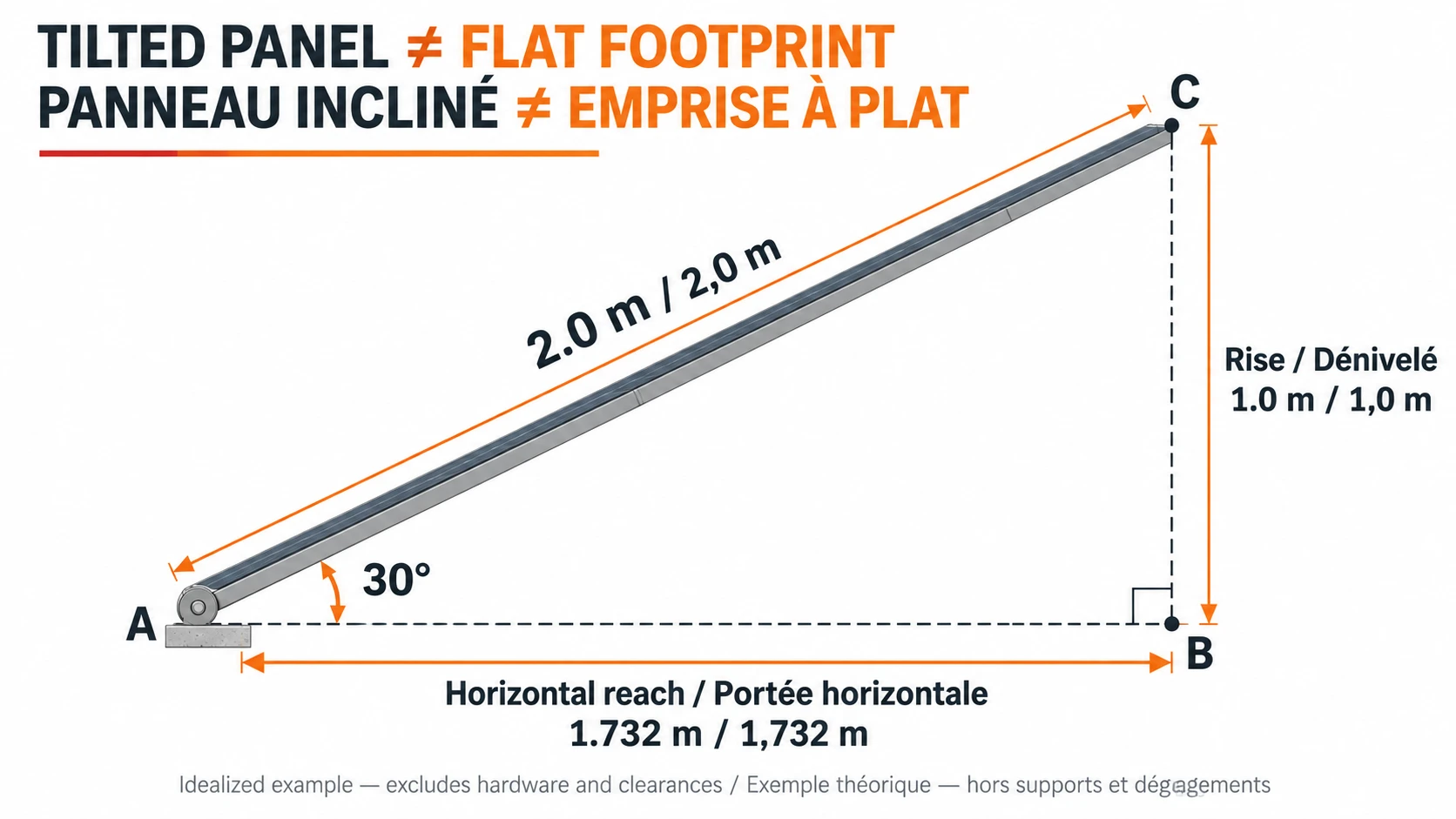
This is geometry, not a tilt recommendation or a wind calculation. The real support position and required clearances come from the approved assembly. Use the solar panel angle guide for orientation and seasonal-energy questions. A smaller horizontal projection does not, by itself, prove a lower wind demand or adequate space for a technician.
Five fit checks for a solar street-light project
1. Separate the panel envelope from the lighting head
On an integrated product, the panel and lighting body share an assembly; a standalone roof-panel dimension is not a replacement specification. Review the complete dimensions and mounting interface of the Inlux All-in-One range. A panel with more area may change the body or support requirements instead of simply increasing a component inside the existing outline.
2. Match a separate panel to its actual support
For the Inlux All-in-Two range, check the separate panel and bracket as a matched arrangement. Confirm the module reference, outer size, attachment method and allowable orientation with the quoted configuration. Do not assume that a bracket accepting one panel width accepts every module of that width, particularly when frame profiles or attachment locations differ.
3. Review the complete pole assembly
A larger panel changes the geometry of the supported assembly. Ask the responsible engineer to assess the panel, bracket, luminaire, pole and foundation together for the site conditions. A panel’s own mechanical-load statement is not approval of that complete assembly. Our solar street light pole page is the product route for a matched pole enquiry, not a substitute for site-specific approval.
4. Leave room for service and handling
Check access to the junction box, connectors and fasteners in the installed position. Confirm the lifting and handling plan for the complete assembly, not just the module’s catalogue weight. Shipment packaging is another separate envelope. For a remote project, discovering an incompatible bracket or inaccessible connection after delivery is a much harder problem than resolving the drawing before ordering.
5. Keep the mechanical and electrical approvals together
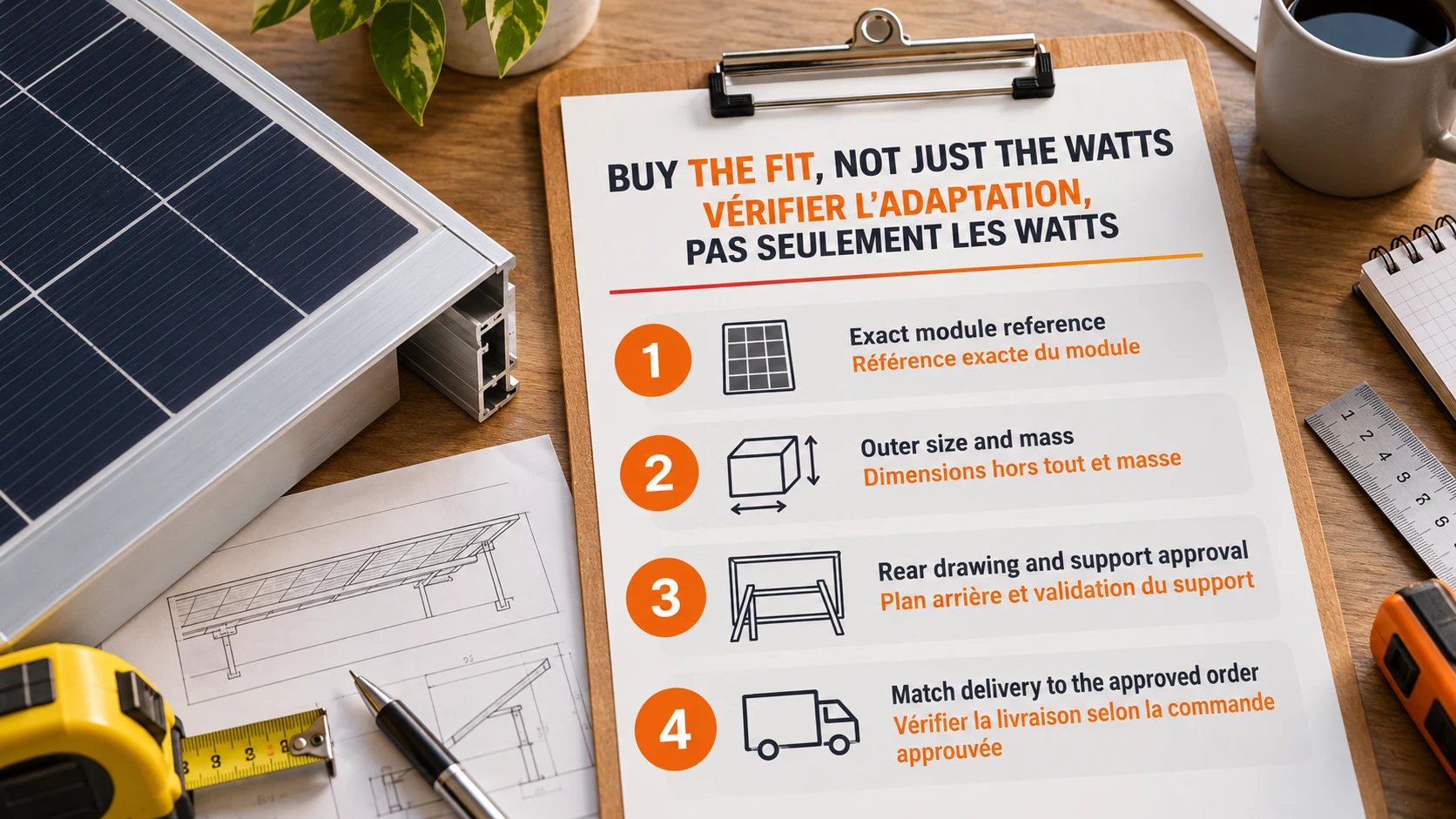
Even a mechanically compatible replacement must meet the system’s electrical requirements. Keep the exact module, controller and approved configuration together in the order record. If a supplier proposes a different panel, review the change before acceptance. The dimensions chart helps with screening; it cannot authorize a substitution on its own.
What to send with a dimensional-fit enquiry
Send the project location, intended lighting arrangement, available space, proposed pole height and any existing panel or bracket reference. Include the dimensioned drawing you already have, rather than estimating dimensions from a product photograph. If a drawing is not yet available, mark the interface as unconfirmed; do not fill the blank with a “standard” hole spacing found online.
Inlux Solar serves projects in 60+ countries, where site and installation requirements differ. For commercial solar parking lot lighting, also identify vehicle circulation, pedestrian areas and maintenance access. Use those constraints to compare complete configurations. Requested component drawings and engineering information remain subject to configuration confirmation and availability; this article is not a ready-to-install design package.
Soalan lazim
What are standard solar panel dimensions in inches?
There is no single standard dimension covering all modules. The named examples here are 49.69 × 30.08 × 1.18 inches and 67.8 × 44.6 × 1.18 inches. Use the exact model’s published drawing, not a typical residential-size estimate, to order a panel or approve a support.
How large is a 400 W solar panel?
The CS6R-400MS example in the cited March 2024 Canadian Solar document is 1722 × 1134 × 30 mm and 21.3 kg. That is one documented 400 W module, not a universal 400 W size. A different series, frame or revision needs its own dimensional and mounting check.
Can I work out panel dimensions from watts?
No—not accurately enough for procurement. The rated watts describe electrical power under specified conditions. Cell technology, layout and frame design affect physical dimensions. Obtain both the power specification and the mechanical drawing for the proposed part.
Does a panel’s area equal the space needed for installation?
No. Length multiplied by width gives the flat face area. The installed envelope also depends on tilt, support offsets, rear components, cable routes and the required access. Roof layouts have additional project and local requirements; do not transfer a general roof-spacing rule to a pole installation.
Can a bigger panel be fitted to an existing solar street light?
Only after checking the approved system and assembly. More area may affect bracket compatibility, clearances and structural demand, while different electrical characteristics may affect the controller. Size or wattage alone cannot establish that the change is suitable. Use the model-specific review and qualified installation process.
Which dimensions matter when checking delivery?
Match the delivered model and revision to the approved order, then compare the outer dimensions, frame profile, attachment features, rear layout and stated mass with that model’s documents. Keep packaging measurements separate. Do not approve an unlisted substitute simply because its carton or frame looks similar.
Turn a size limit into a matched lighting quotation
Shortlist a system using the solar street light product range, then send an Inlux project RFQ with the physical limits and available drawings. State what is fixed, what is negotiable and what still needs confirmation. That gives the supplier something more useful to work with than “a panel that fits.”