A solar street-light battery is not chosen by Ah alone. The number must match the real night-time load, the operating profile, the required reserve for low-sun periods, the system voltage, the permitted usable capacity and the temperature at the site.
That sounds obvious, but it is where many proposals become hard to compare. One quote may list a large Ah number without stating voltage. Another may use a strong battery but leave the lighting profile undefined. A third may show a battery data sheet without showing whether it can carry the road or area lighting task through the required operating period.
This guide is for project teams that need a reviewable battery basis before they compare solar street-light quotations. It does not prescribe one universal battery size or promise a fixed number of nights. The correct result depends on the actual site and design brief.
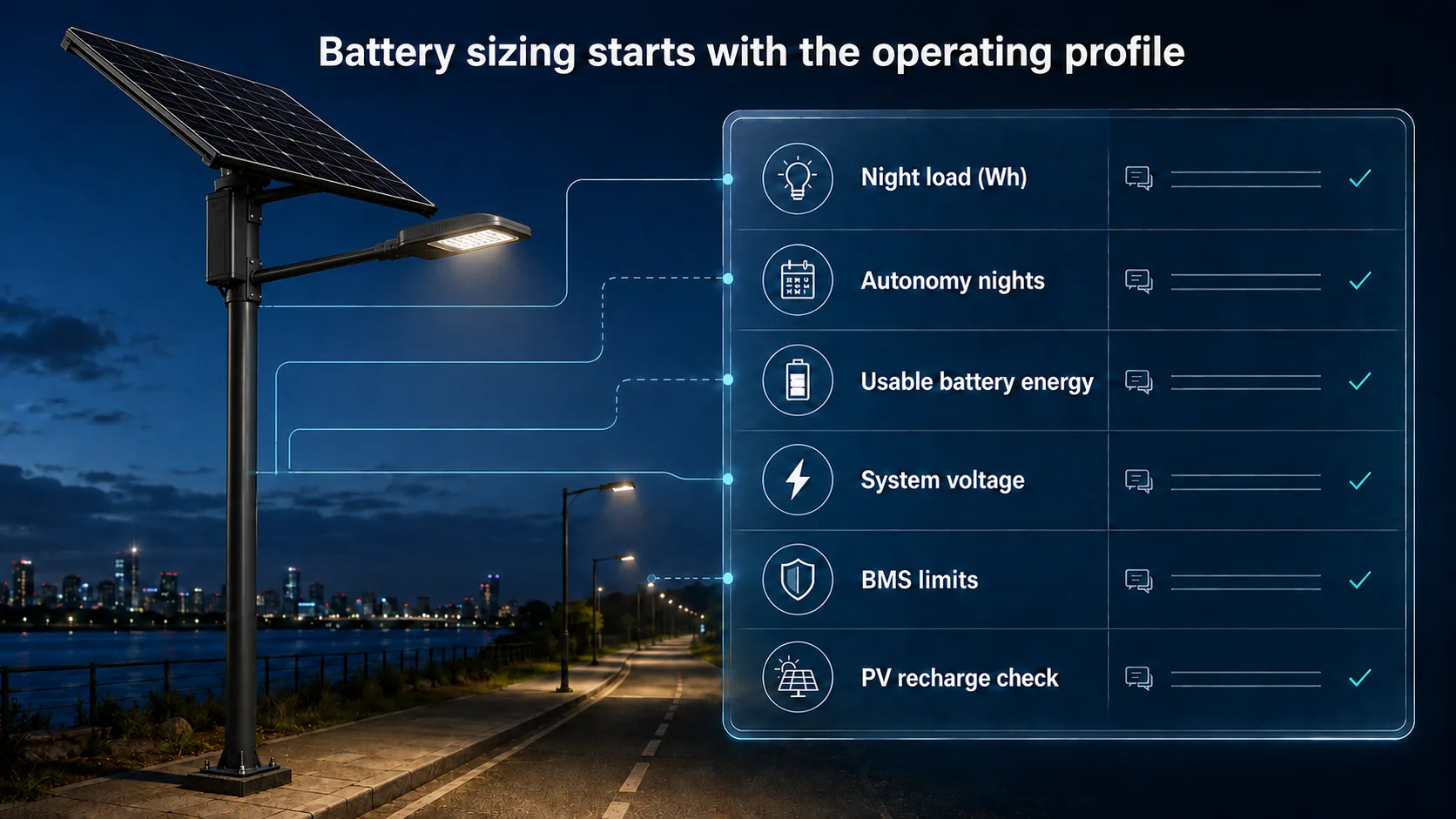
Scope: This page owns battery capacity and sizing logic. For chemistry selection, use LiFePO4 vs Lead-Acid/AGM for Solar Street Lights. For battery service-life evidence, use Tempoh hayat bateri LiFePO4. For the complete lighting-system brief, start at Commercial Solar Street Lights.
Start with the night-time energy profile
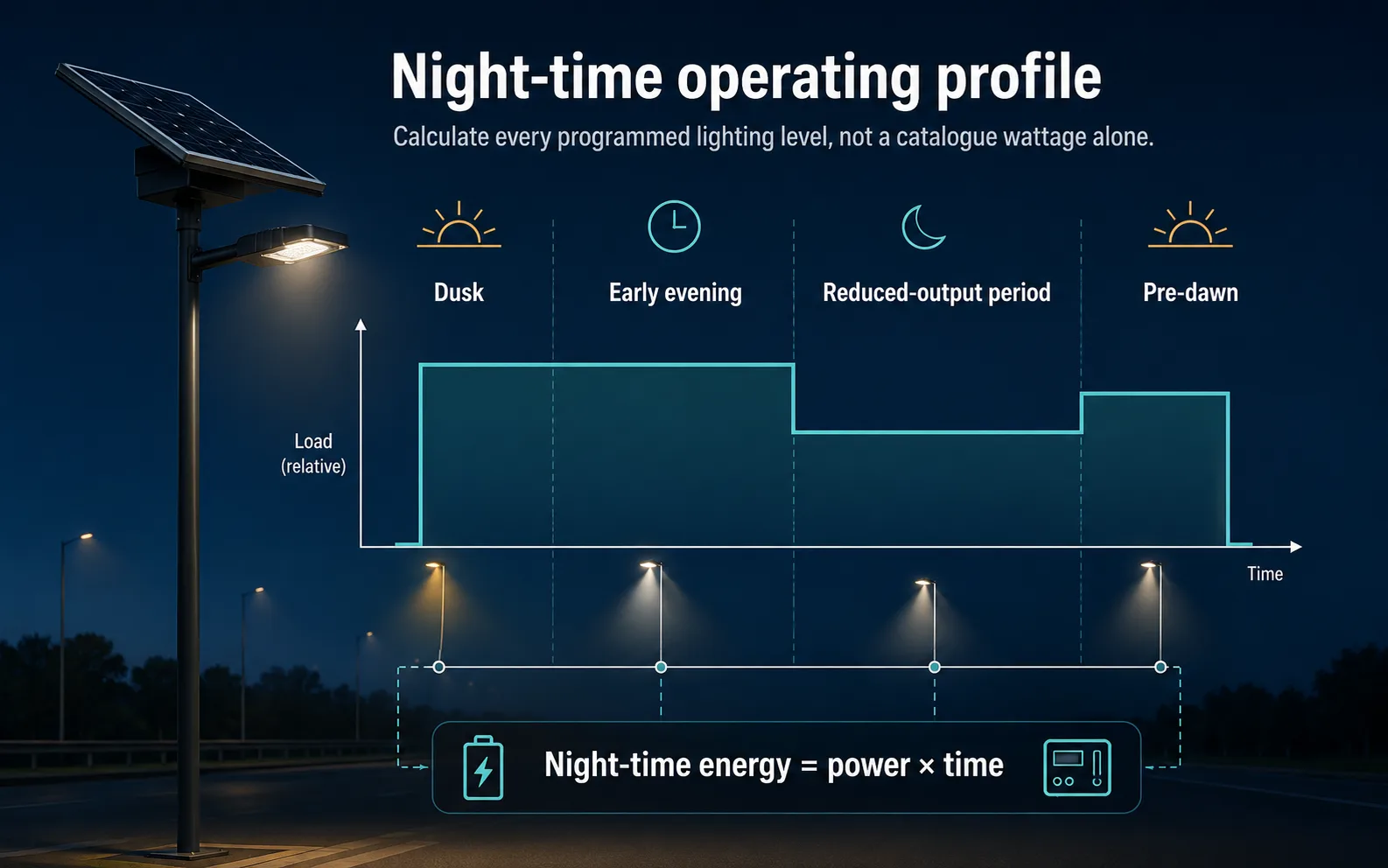
The battery must supply the energy the luminaire actually uses after sunset. That means the calculation starts with the programmed load profile, not with a catalogue wattage printed on the front of a fixture.
For each part of the night, record the input power and the scheduled duration:
Night-time energy (Wh) = Σ [input power at each operating level (W) × hours at that level (h)]
For example, a system may operate at one output level during early evening, dim after traffic falls, then return to a different level before dawn. The calculation must use each programmed segment. A single “watts × 12 hours” shortcut is only valid when the actual profile is full output for all 12 hours.
Ask the supplier to identify whether the quoted power is LED source power, luminaire input power, or a marketing-equivalent rating. Battery sizing should use the input power of the proposed operating configuration.
Convert the project brief into a storage requirement
Once the nightly energy is clear, the project team can set the reserve it actually needs. The battery design must account for more than one normal night.
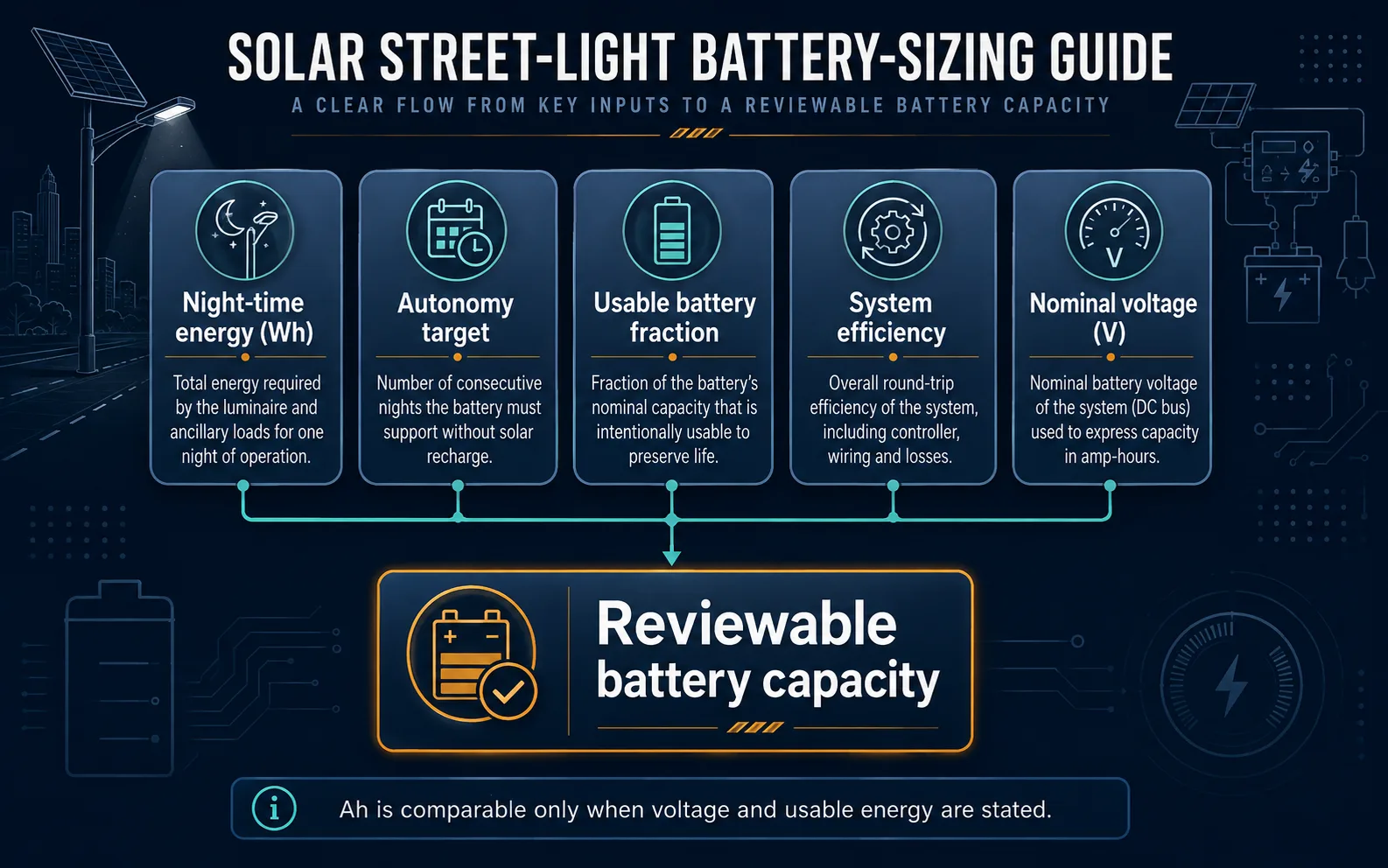
Required stored energy =
night-time energy × required autonomy nights
÷ permitted usable battery fraction
÷ applicable system-efficiency factor
The permitted usable battery fraction is not a number to guess. It should come from the proposed battery chemistry, BMS settings and warranty/service conditions. Likewise, the system-efficiency factor should state what it covers: controller behavior, cable losses, conversion losses, temperature effects or other design allowances.
This is why two batteries with the same Ah label may not provide the same usable project reserve. Capacity only becomes comparable when voltage and allowed discharge range are visible.
Convert Wh to Ah only after voltage is stated
Watt-hours describe stored energy. Amp-hours describe charge at a stated voltage. Neither number is complete on its own.
Nominal battery capacity (Ah) = required stored energy (Wh) ÷ nominal system voltage (V)
The calculation is intentionally simple, but the specification around it is not. Record the nominal voltage, the permitted voltage range, the battery configuration and the BMS cut-off settings. If a proposal only states Ah, request the voltage and usable energy in Wh before comparing it with another offer.
A practical quotation comparison table
| Item to request | Mengapa ia penting | Do not accept as a substitute |
|---|---|---|
| Night-time load profile | Defines the energy required each night | A single headline wattage |
| Nominal voltage and energy in Wh | Lets you compare storage on the same basis | Ah without voltage |
| Required autonomy definition | Shows what “backup” means for this project | A generic “rainy-day” claim |
| Permitted discharge/BMS limits | Defines usable rather than nameplate capacity | A chemistry label alone |
| Temperature range and derating basis | Tests whether the storage model fits the installation climate | Indoor cell data only |
| Charge controller settings | Shows how PV, battery and dimming logic work together | A panel-watt figure without control logic |
| Warranty scope | Clarifies what is covered and what evidence is required | A broad system-warranty headline |
Autonomy is a project decision, not a marketing badge
Autonomy is the number of operating nights the system is expected to support when charging conditions are below the design assumption. The project should define it before a supplier optimizes the battery around it.
The correct target depends on local solar conditions, seasonal weather, acceptable dimming behavior, road or site criticality, maintenance response time and whether there is any grid fallback. A pedestrian path, remote access road and active industrial yard can legitimately require different answers.
Write the answer in the RFQ as an operating rule, not as a vague request for “long backup.” For example: state the approved lighting profile, the autonomy target, the acceptable low-battery behavior and the site data used for solar-resource assessment. That gives both parties something testable.
Temperature, mounting and service access change the battery answer
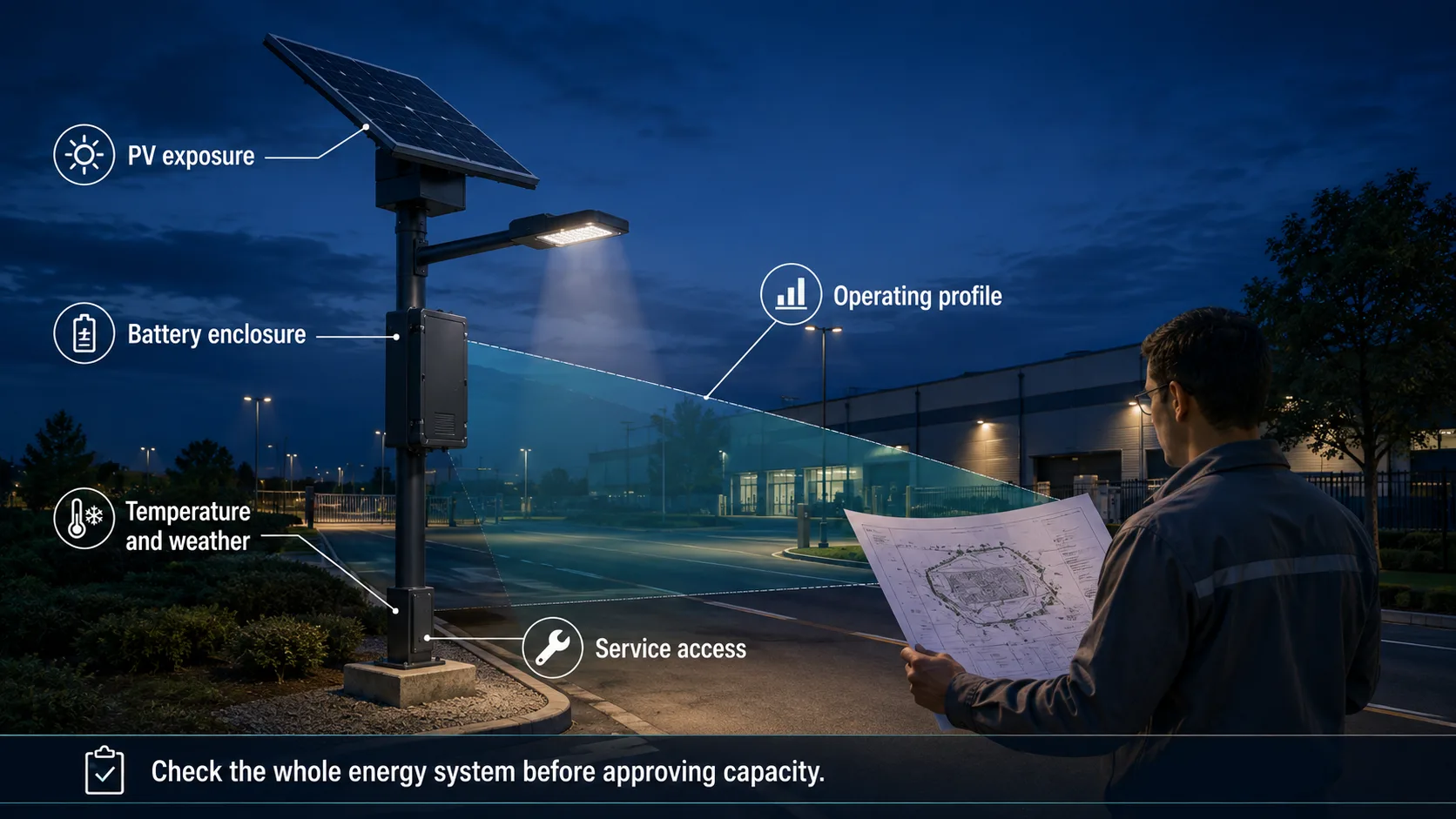
A battery model that looks adequate in a clean data table can perform differently once it is installed in a hot pole enclosure, cold outdoor cabinet or service-restricted site. The design review needs to address the complete arrangement:
- Where the battery sits: integrated luminaire, pole enclosure, underground box or separate cabinet.
- How it is protected from water ingress, heat accumulation, corrosion and tampering.
- Whether the cable, connector and enclosure arrangement matches the stated IP/installation configuration.
- How the team will inspect, diagnose and replace a battery safely when a fault occurs.
- Whether the controller and BMS allow the specified lighting profile without an undocumented deep-discharge condition.
Yang solar light parts guide explains the wider component chain. This page keeps the question narrower: can the proposed battery and control setup support the required lighting profile at this site?
Do not select capacity before the PV side is checked
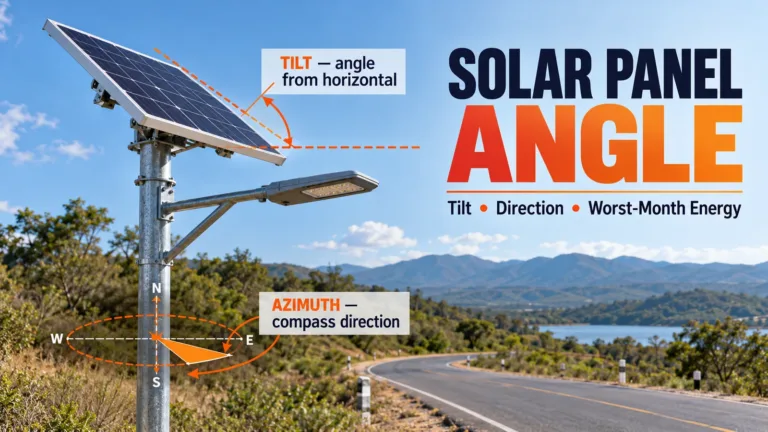
A larger battery cannot correct a PV module that cannot replenish the energy used over the operating period. Battery and panel must be reviewed together with the local solar resource, shading, orientation, controller behavior and seasonal profile.
For a project review, request a short energy-balance sheet showing:
- daily energy demand from the proposed lighting profile;
- expected energy harvest under the stated design conditions;
- battery usable-energy assumption;
- autonomy target and low-battery control rule; and
- the assumptions that would require the design to be revised.
This is more useful than a claim that a panel or battery is “oversized.” It allows the engineer, buyer and site operator to see the same system boundary.
The RFQ inputs that make battery sizing reviewable
Send these items before asking a supplier to recommend a solar street-light battery:
- installation city or coordinates, including seasonal weather concerns;
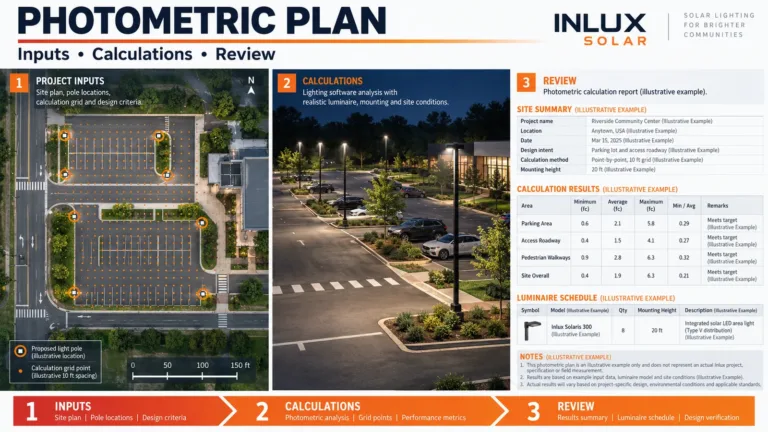
- road, path, yard or parking-area geometry and required lighting result;
- pole height, mounting arrangement and quantity;
- intended nightly profile, including dimming or motion-control logic;
- required autonomy and acceptable low-battery behavior;
- shading, mounting orientation and grid-fallback information where relevant;
- ambient-temperature, wind, dust, salt or flood-exposure conditions;
- service access, maintenance responsibility and any tender/approval requirements.
Inlux Solar’s standard warranty is five years. For a live project, the quotation should still state exactly how the battery, controller, capacity retention, exclusions and service route are covered; a broad warranty phrase does not replace the project battery specification.
Where this guide fits in the buying process
Use this page after the site task and before the final comparison of quotations. It should help a project team challenge an unclear energy claim without turning every procurement review into a battery-chemistry debate.
- Need to decide between battery types? Read LiFePO4 vs Lead-Acid/AGM.
- Need to review expected service life and evidence? Read Tempoh hayat bateri LiFePO4.
- Need a complete solar street-light system route? Visit Commercial Solar Street Lights.
If you are preparing a project RFQ, send the site plan, lighting task, operating profile, autonomy target and environmental conditions through Hubungi Inlux Solar. The engineering review can then compare the energy-system assumptions against the proposed layout rather than selecting a battery from an Ah number alone.
Questions project teams ask
How do I choose a solar street light battery size?
Start with the actual night-time energy profile in Wh, then set the required autonomy, usable capacity limit, applicable efficiency assumptions and nominal voltage. The final capacity must also fit the PV harvest, temperature and controller/BMS limits for the installation site.
Is a higher Ah battery always better for a solar street light?
No. Ah has meaning only with voltage and usable discharge limits. An unnecessarily large battery can also be poorly matched to the available PV harvest, operating profile, enclosure space or project cost. Compare usable energy and the full system design.
How many nights of autonomy should a solar street light have?
There is no universal answer. Set the target from local solar conditions, site criticality, operating profile, acceptable dimming behavior, maintenance response time and any tender requirement. Record the definition in the RFQ.
Can a battery be sized without the solar panel details?
Not reliably. The battery stores energy, but the PV module and controller must be able to replenish it under the stated design conditions. Request an energy-balance review of the whole system.
Does a five-year system warranty define the battery capacity?
No. A warranty and a capacity calculation answer different questions. Ask the supplier to define the battery configuration, usable-energy basis, BMS limits, operating profile and warranty scope in the project quotation.