A COB LED is a chip-on-board light source: several LED dies share a substrate and, in a typical white-light device, a common phosphor-covered emitting region. It is not a different alternative to LED technology; it is one way to build an LED source. For an outdoor-lighting buyer, the important question is not whether COB looks smoother or uses fewer visible packages. It is whether the exact source, driver, optic and housing work together to deliver the required light on the road or parking area.
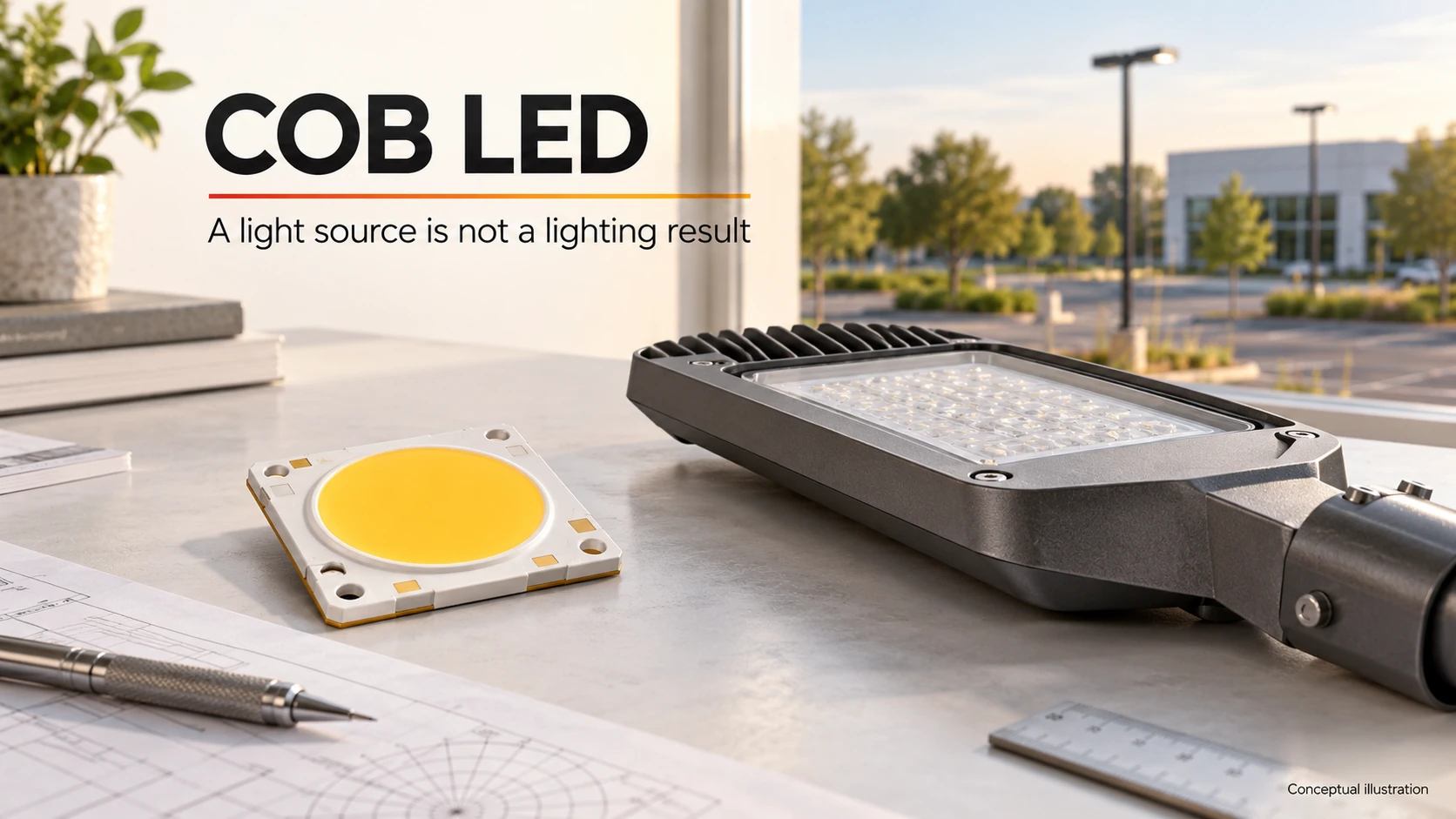
COB LED meaning: one source, several dies
Lumileds’ explanation of CoB construction describes closely arranged bare dies beneath a shared phosphor layer. This creates a compact emitting region rather than a board of individually packaged emitters. The construction can be useful when an optical design needs a concentrated source. That advantage is about how the source can be used; it does not establish the efficiency, glare or lifetime of every finished product carrying the COB label.
The term also appears on flexible LED strips, work lights, spotlights and display products. Those are not interchangeable buying categories. A cuttable strip is not a street-light engine, and a powerful photography light is not evidence of road-lighting suitability. Establish whether a quotation describes a bare emitter, an assembled light engine or the complete luminaire before comparing prices.
COB versus SMD: compare the architecture, not a winner label
| Question | COB source | Array of packaged SMD LEDs |
|---|---|---|
| How are the emitters presented? | Multiple dies in a shared source assembly | Individually packaged LEDs mounted on a board |
| What must the optical design accommodate? | The specific emitting region and its position | The package arrangement and its position relative to the optics |
| Does the name establish road coverage? | No; the finished optical system matters | No; the finished optical system matters |
| Can procurement approve it from wattage alone? | No | No |
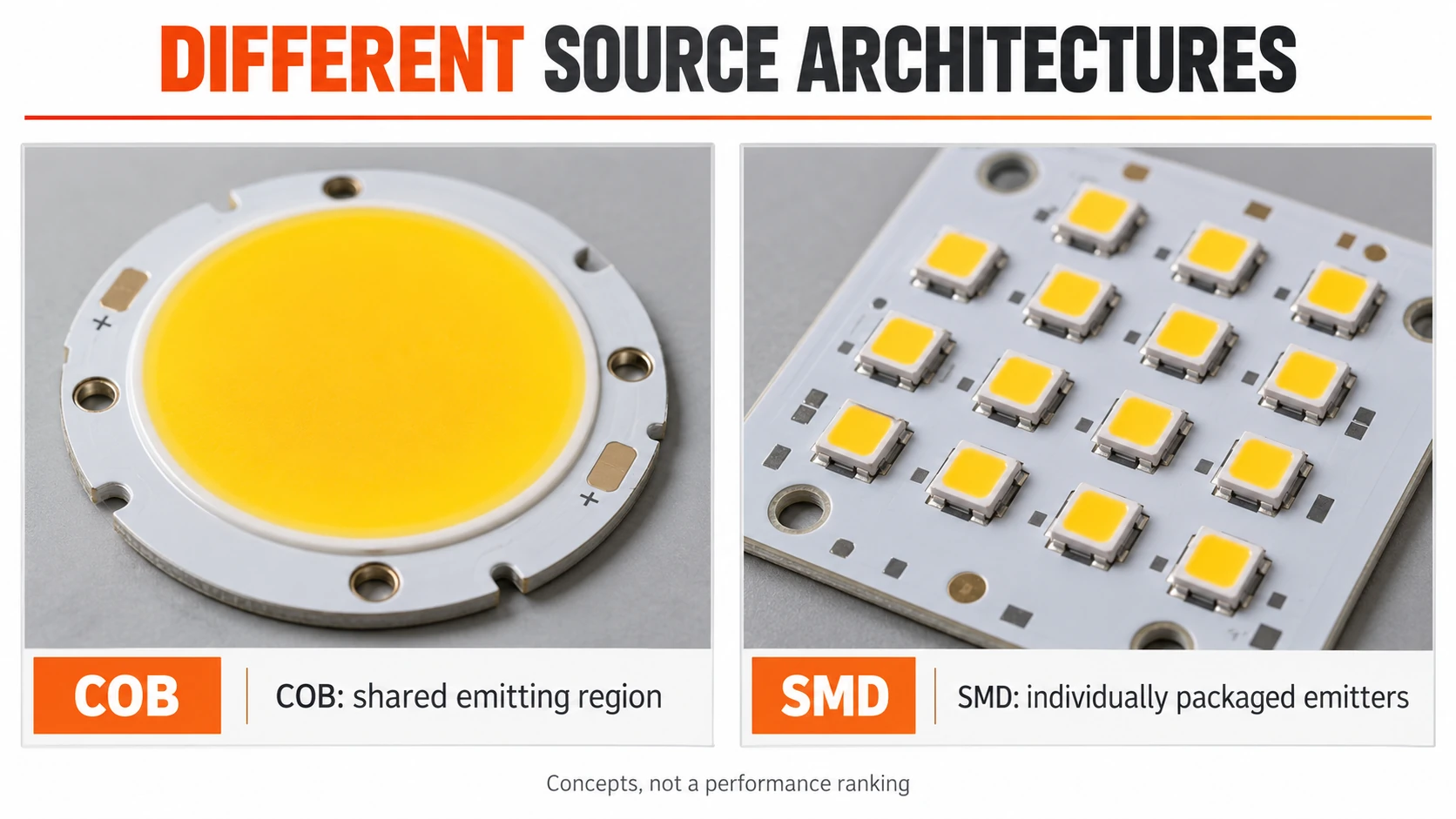
Neither column is an automatic quality grade. A source can be excellent for a spotlight yet unsuitable for an unchanged road-light optic. Another design may use many packaged emitters to distribute light through multiple lenses. Compare the actual luminaire, not a claim that fewer visible dots must mean better lighting. The separate SMD LED package-selection guide covers 3030 and 5050 identities; those package labels do not replace a COB comparison.
The purchase-critical dimension is the emitting region
Two COB boards may fit the same mounting space yet present different light-emitting surfaces, often abbreviated LES. Do not confuse board diameter with emitting-area diameter. A reflector surrounds and redirects the light from a particular source geometry; a mounting hole pattern only establishes part of the mechanical interface. An apparently tidy replacement can therefore fit physically without retaining the original distribution.
The LEDiL optics selector separates COB LES size, LED manufacturer/model and application. It also directs users to optical results for each LED rather than treating a typical illustration as the measurement. For a bid, identify the emitter and optic together. Keep the source position, holder and relevant mechanical arrangement with that identity. Do not approve a larger or smaller emitting region solely because the supplier calls it an equivalent wattage.
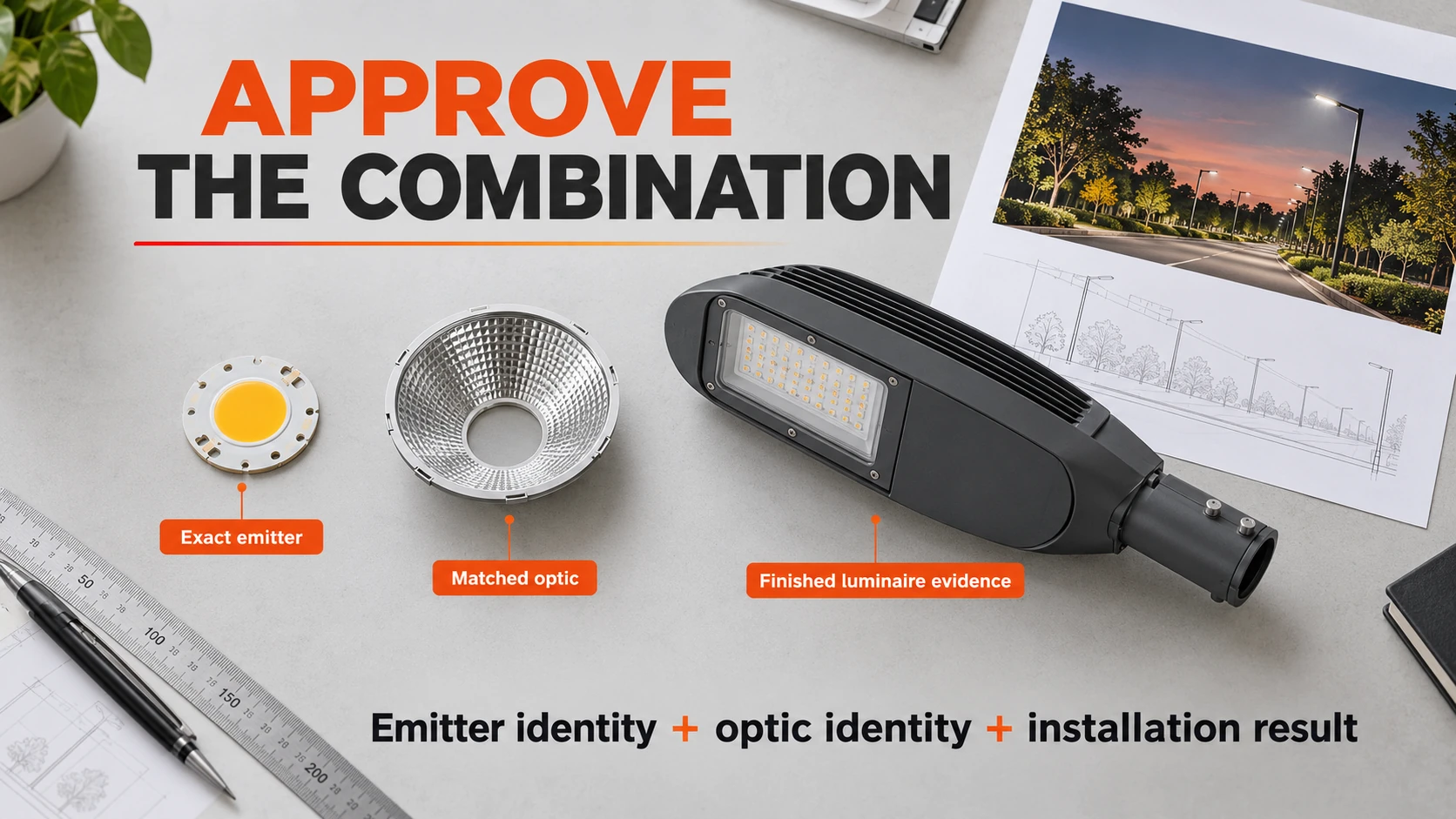
For street and parking projects, ask what happens between the poles and at the site boundary, not only directly beneath the lamp. A bright centre can coexist with weak coverage elsewhere. Total lumens cannot answer every directional question; the candela-versus-lumens guide explains that distinction. Review the proposed installation through a project photometric plan, with the actual geometry and agreed criteria. No simulated result or measurement for a particular Inlux COB assembly is implied here.
A 54 W source and a 60 W input can describe one example
Consider an assumed steady operating point of 36 V across a COB source at 1.5 A. Source electrical power is 36 V × 1.5 A = 54 W. If the driver is assumed to be 90% efficient at that point, its input is 54 W ÷ 0.90 = 60 W. The two figures are not contradictory: they sit on different sides of the driver. All values are illustrative, not specifications or test results for an Inlux model.
| Assumed quantity | Value | Limits of this assumed quantity |
|---|---|---|
| COB operating point | 36 V at 1.5 A | A universal supply voltage for COB LEDs |
| Electrical power at source | 54 W | Light output, road illuminance or heat alone |
| Driver input at assumed 90% efficiency | 60 W | Battery-side demand of every solar system |
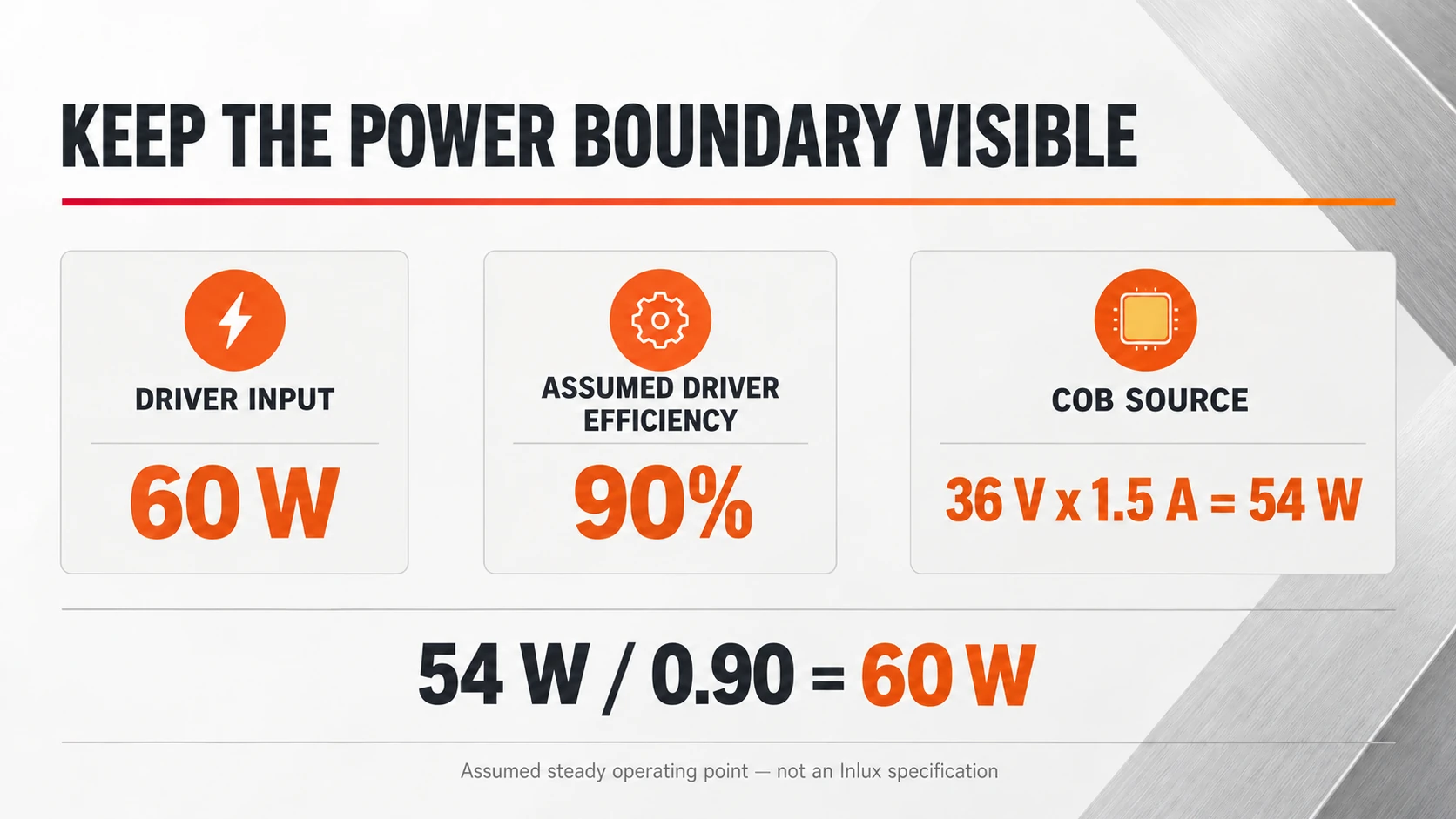
Ask where a quoted wattage is measured and what is included. A COB LED is not automatically a 12 V or 24 V constant-voltage load, and two visible terminals are not permission to connect it directly to a battery. Its specified current and voltage range must match an approved driver. The outdoor LED-driver guide explains that interface. Changes in current or temperature can change the operating point, so a single label is not the whole compatibility check.
Treat a COB replacement as a lighting-system change
A replacement review has three separate outcomes: electrical operation, safe thermal operation and an acceptable lighting result. Passing one does not prove the others. A source that turns on may still place the driver outside its approved range, run too hot in the closed housing or change glare and coverage. Compare the declared thermal interface and temperature conditions for the assembled design, not just the size of a metal plate or a photograph of cooling fins.
Replacing a light engine may also disturb seals, holders, insulation and service access. Keep the work with qualified personnel and the manufacturer’s approved process. Do not stare into an operating emitter or use direct battery connection as a trial. For an existing asset, record the installed source and driver identities, optic and symptoms before asking for a substitute. A supplier’s proposed equivalent should be identified in the quotation, not left as a verbal promise.
What a comparable outdoor-lighting offer should identify
| Offer detail | Useful procurement question |
|---|---|
| Source and assembly identity | Which exact emitter and assembled light engine are offered? |
| Optic pairing | Which optic and source geometry does the lighting result represent? |
| Electrical boundary | Is the quoted power at the emitter, driver input or complete system? |
| Installation result | Does the proposed arrangement meet this road or parking layout? |
| Change and service scope | Which substitutions need approval, and which replacement arrangement is supported? |
For a grid-fed road project, start with the LED street-light collection and the intended site conditions. For off-grid work, start with the solar street-light system range. These are complete-system decisions. Neither the COB label nor a claim of high chip efficacy specifies battery capacity, solar recovery or the night-time operating schedule.
For complete-system procurement, compare Inlux All-in-One systems dan Inlux All-in-Two systems as system arrangements, not as an automatic promise of COB construction. Confirm the light-engine specification in the particular offer. Inlux Solar’s standard warranty is five years; confirm the offered component and service scope rather than reading that company term as a universal COB lifetime.
FAQs about COB LEDs
What does COB LED stand for?
COB means chip-on-board. In the white-light construction discussed here, several bare LED dies share a substrate and phosphor-covered emitting region. The term describes the source architecture, not a complete lamp, a fixed wattage or a lifetime guarantee.
Which is better, COB or SMD LED?
There is no universal winner. Compare exact sources within their finished optical, thermal and electrical designs. For outdoor procurement, an acceptable installed lighting result and a supportable configuration matter more than whether the source has one common emitting region or many visible packages.
Can a COB LED be used outdoors?
It can be part of an outdoor luminaire when the complete design is suitable for the environment and lighting task. A bare emitter is not a weatherproof street light. Confirm the finished enclosure, electrical protection, thermal design and optical arrangement; a COB label alone approves none of them.
What are the disadvantages of COB LEDs?
The constraints to assess include concentrated heat removal, matching the source geometry to the optic, driver compatibility and the approved replacement route. These are design considerations, not proof that every COB product runs hotter or performs worse than SMD. Evaluate the actual assembly and operating conditions.
Can I connect a COB LED directly to 12 V?
Do not infer that from the name. Use the exact device or assembled module’s supply requirements and approved driver. Bare COB devices and constant-voltage strip products are different categories. A battery or adapter voltage that looks plausible is not a safe compatibility test.
Can COB LED strips be cut anywhere?
No. For a strip designed to be cut, follow only its manufacturer’s marked cutting positions and instructions, with power isolated. That does not apply to a rigid COB light engine or justify modifying a sealed outdoor luminaire. Cutting rules for decorative strips do not establish street-light service procedures.
Bring the lighting task into the quotation
When planning a commercial solar parking-lighting project, send the site layout, mounting restrictions, required operating hours and lighting objectives. For an existing road, include the installed arrangement and the problem to solve. Request a project-based lighting quotation so the offered light engine and complete system can be reviewed together, rather than buying a COB label in isolation.