An SMD LED is a light-emitting diode packaged for surface mounting on a circuit board. SMD describes how the component is packaged and mounted; it is not a separate alternative to LED. For a street light, a label such as “3030” or “5050” is only the beginning of a specification—not a guarantee of watts, brightness, lifetime or interchangeability.
If you are comparing outdoor-lighting quotations, start with the exact manufacturer part number and finish with evidence for the complete luminaire. Two offers can use the same package family yet deliver different road lighting. This guide explains what the package name tells you, what it leaves unanswered, and the five checks worth making before accepting an LED selection or substitution.
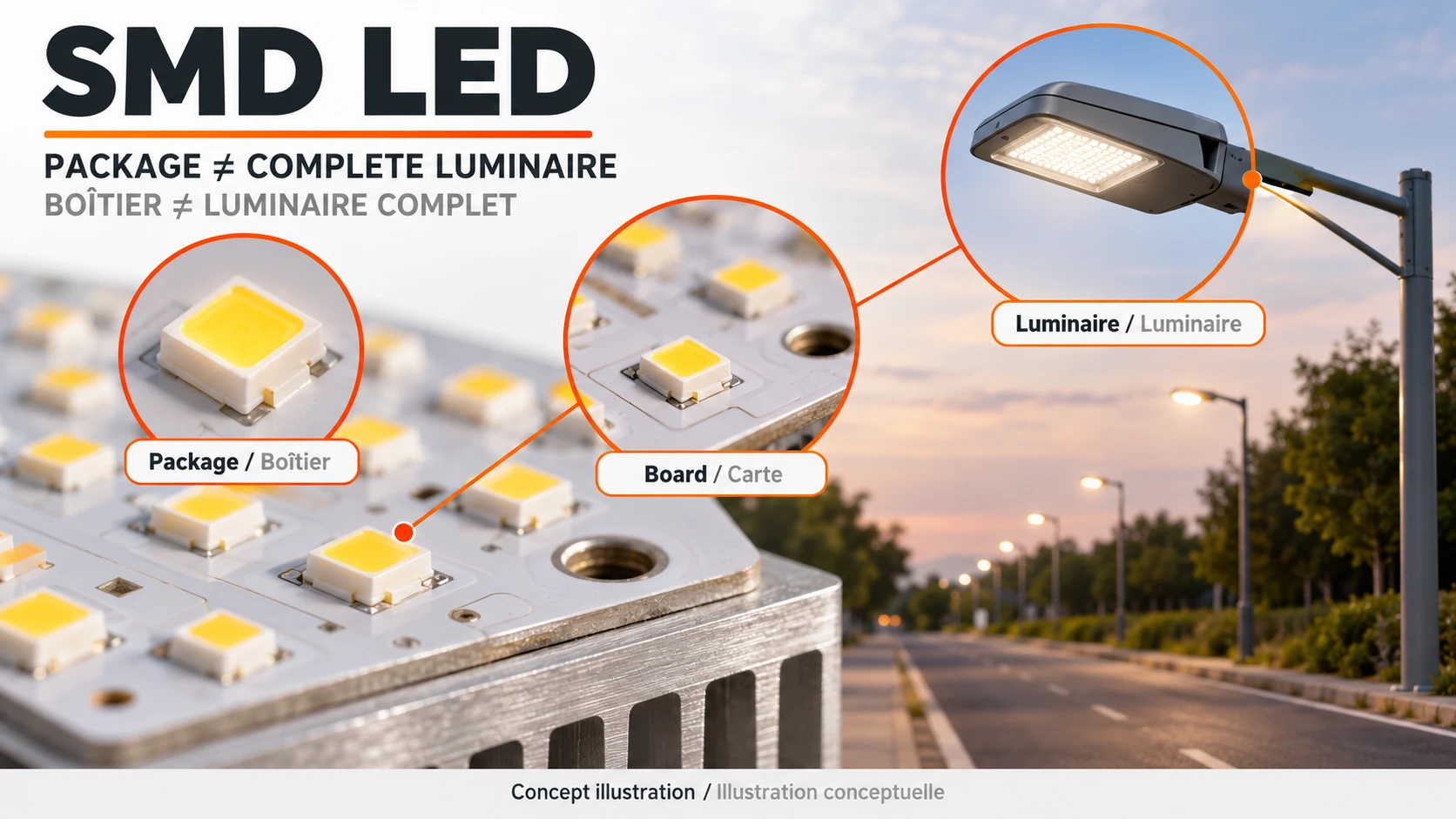
SMD LED meaning: component, board and luminaire
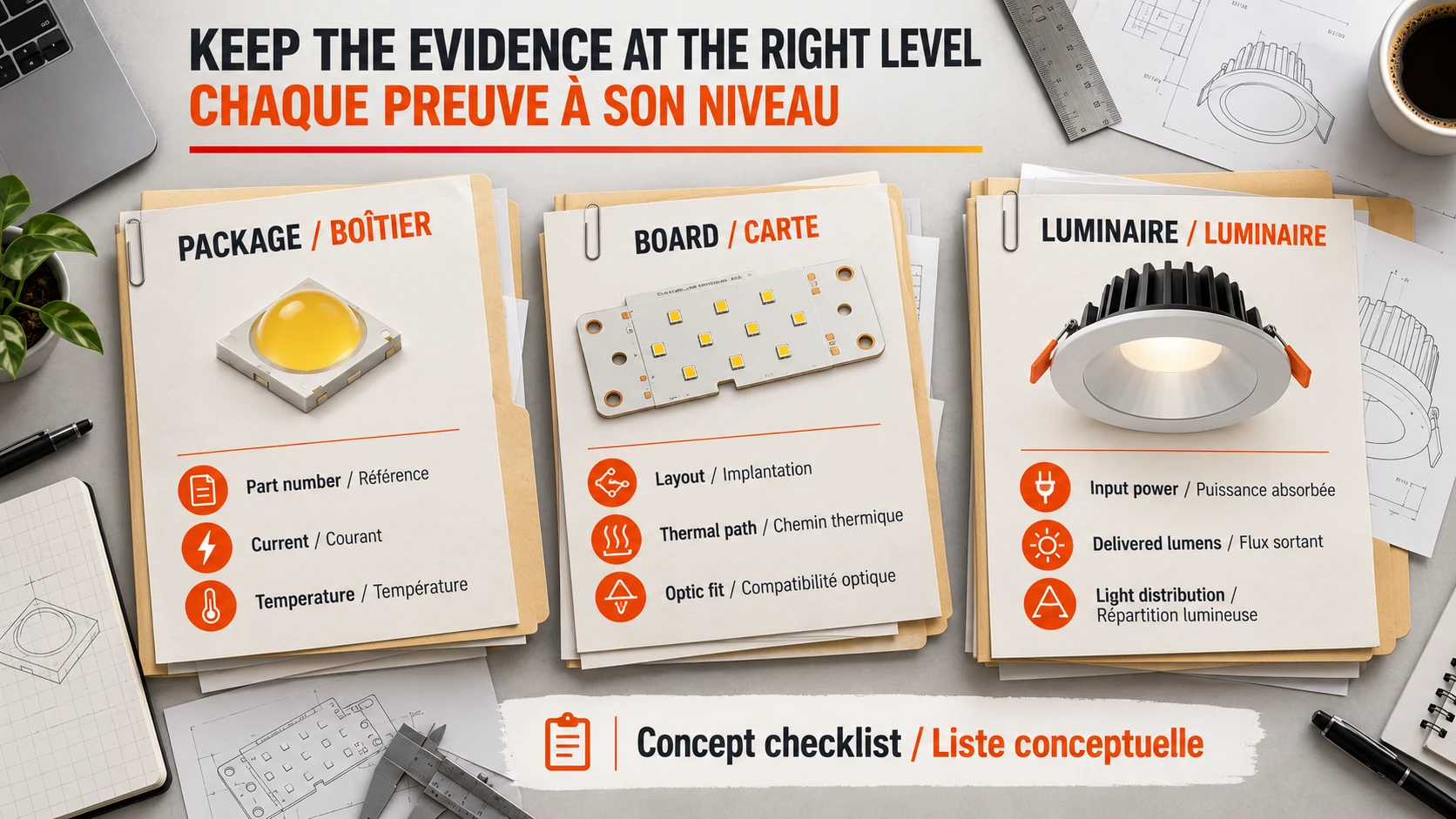
The useful distinction is between three levels. The LED package contains the light-emitting semiconductor and its package connections. An assembled board combines packages with a circuit layout and a thermal path. The complete luminaire adds the optical system, housing and power-control arrangement. A package data sheet describes the first level, not all three.
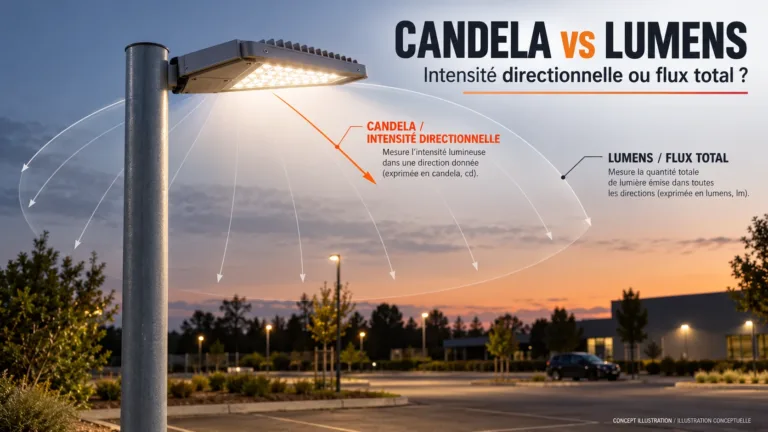
That matters when a quotation says only “high-efficiency SMD chips.” Ask which quantity the supplier is quoting: package flux at a stated current and temperature, board output, or lumens leaving the finished fixture. Do not put those figures in the same comparison column. For the wider relationship between input power and light output, use our wattage and lumens guide.
3030 and 5050: useful clues, not complete specifications
Common lighting-package names often refer to nominal dimensions. However, always read the dimensional drawing for the exact part. Do not assume that every numbering system uses the same units or that the visible outer size defines the solder-pad pattern, thermal pad or electrical connection. A purchasing description should identify the actual series and ordering code, not just four digits.
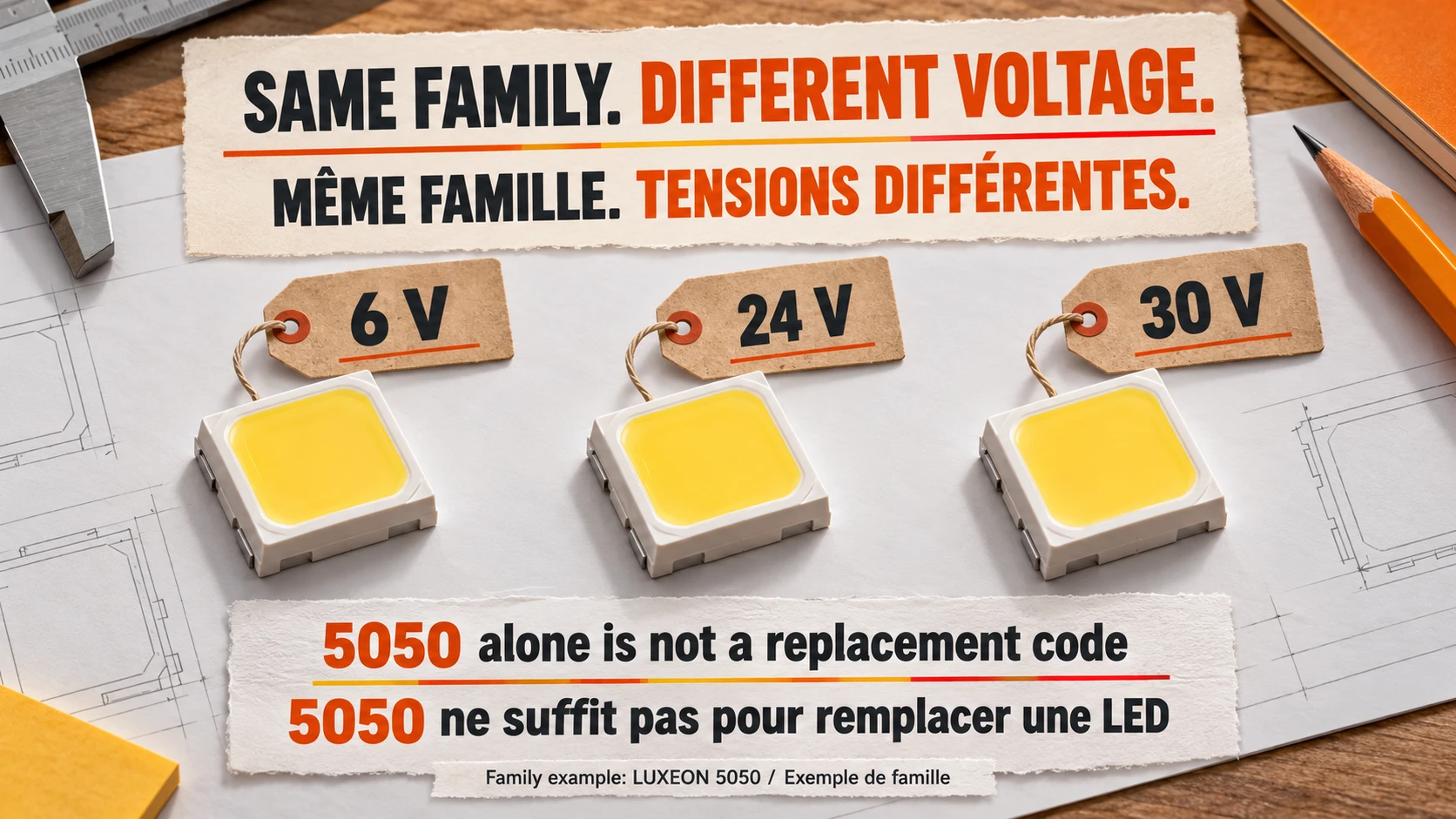
A concrete example is Lumileds LUXEON 3030 2D: the manufacturer identifies a 3.0 mm × 3.0 mm package and a 6 V emitter. That statement applies to the named product family. It does not make every 3030 LED a 6 V device, or establish the voltage of a board made from multiple devices.
Another useful example is the LUXEON 5050 range. Lumileds lists 6 V and 24 V Round versions, 6 V and 30 V Square versions, and further HE variants. A shared 5050 family name therefore does not establish electrical equivalence. These are manufacturer examples, not a declaration of the components fitted to any particular Inlux model.
| Label on the offer | What it can identify | What still needs confirmation |
|---|---|---|
| SMD LED | Surface-mount component format | Exact manufacturer, series and ordering code |
| 3030 or 5050 | A package-family clue | Drawing, pad arrangement, voltage and current conditions |
| LED brand name | Named component manufacturer | Specific part, bin and approved supply traceability |
| Package lm/W | Component efficacy under stated conditions | Complete-luminaire output and input-power basis |
5 checks before approving an SMD LED selection
1. Lock the part identity, not just the brand
Record the manufacturer, full part number, package series and relevant bin specification in the approved configuration. White LEDs also need the agreed CCT and CRI requirements. A photograph of a yellow square cannot establish those details. If alternatives are allowed, identify them explicitly and state which approval process applies before production; “equivalent brand” is too vague to settle a later dispute.
2. Match the electrical and physical interfaces
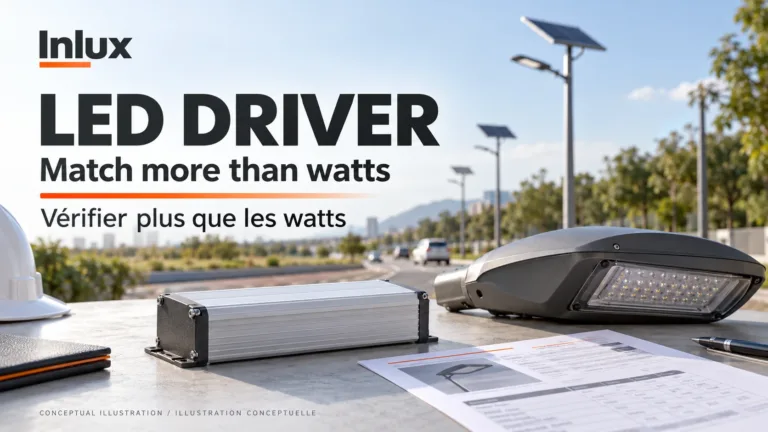
A replacement has to suit the board circuit, drive current, voltage range, footprint and thermal-pad arrangement. Similar dimensions are not enough. The driver and LED board must also remain compatible as an assembly. Our LED driver guide covers the separate driver-selection task; a package name alone cannot answer it. This is a design-review requirement, not an instruction to open or probe an energized light.
3. Compare performance at the same operating conditions
For any package lumen or efficacy claim, keep the stated drive current, temperature, CCT and CRI alongside the number. A maximum rating is not a recommended operating point, and a typical value is not automatically a guaranteed minimum. A comparison assembled from the best number in each unrelated data-sheet column is not an approved design. Ask the supplier to show the conditions applying to the proposed configuration.
4. Keep thermal and optical evidence with the assembly
The board, its thermal interface and the housing determine how heat leaves the LED assembly. The lens arrangement determines where the light goes. Changing package geometry or the emitting surface can require an optical review even if the new part fits the board. For a hot outdoor site, ask for the specified ambient conditions and the basis of the supplier’s thermal assessment—not an unexplained lifetime number attached to the word SMD.
5. Approve the finished lighting result
The buying decision is about the road or parking area, not the number of yellow squares on a board. Require the complete-luminaire output, input-power definition and distribution for the quoted configuration. Match the proposed layout to pole height, spacing, road or bay geometry and the required lighting criteria. The LED street light range is the product-level starting point; the component data sheet is supporting evidence.
Why package efficacy is not luminaire efficacy
Consider a deliberately simplified example, not an Inlux rating. Suppose LED packages consume 100 W in total and produce 20,000 lm at that operating point. Their efficacy is 200 lm/W. If the optical system transmits 90% of that flux, 18,000 lm leave the luminaire. If the driver is 90% efficient, input power is about 111.1 W. Complete-luminaire efficacy is then about 162 lm/W, not 200 lm/W.
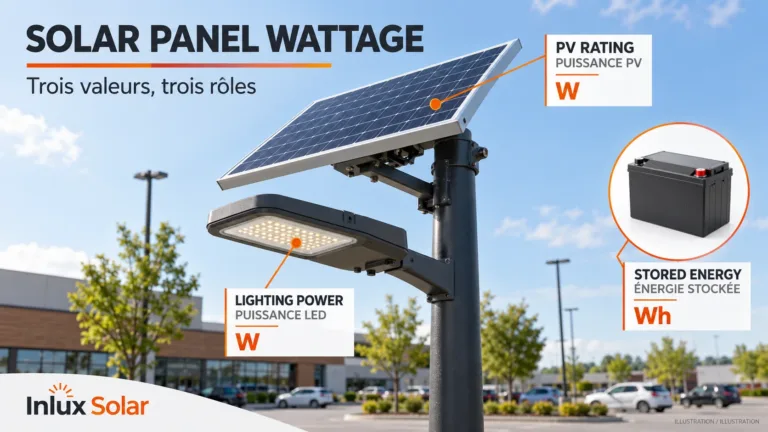
The calculation only illustrates the boundary between component and system. Real results also depend on operating temperature, component selection, control settings and other losses; the assumed percentages are not universal. In a solar system, keep the LED lighting load separate from PV-panel power and battery energy. Do not use an impressive package figure as a substitute for the specified nighttime operating profile.
SMD LED substitution: accept, review or hold?
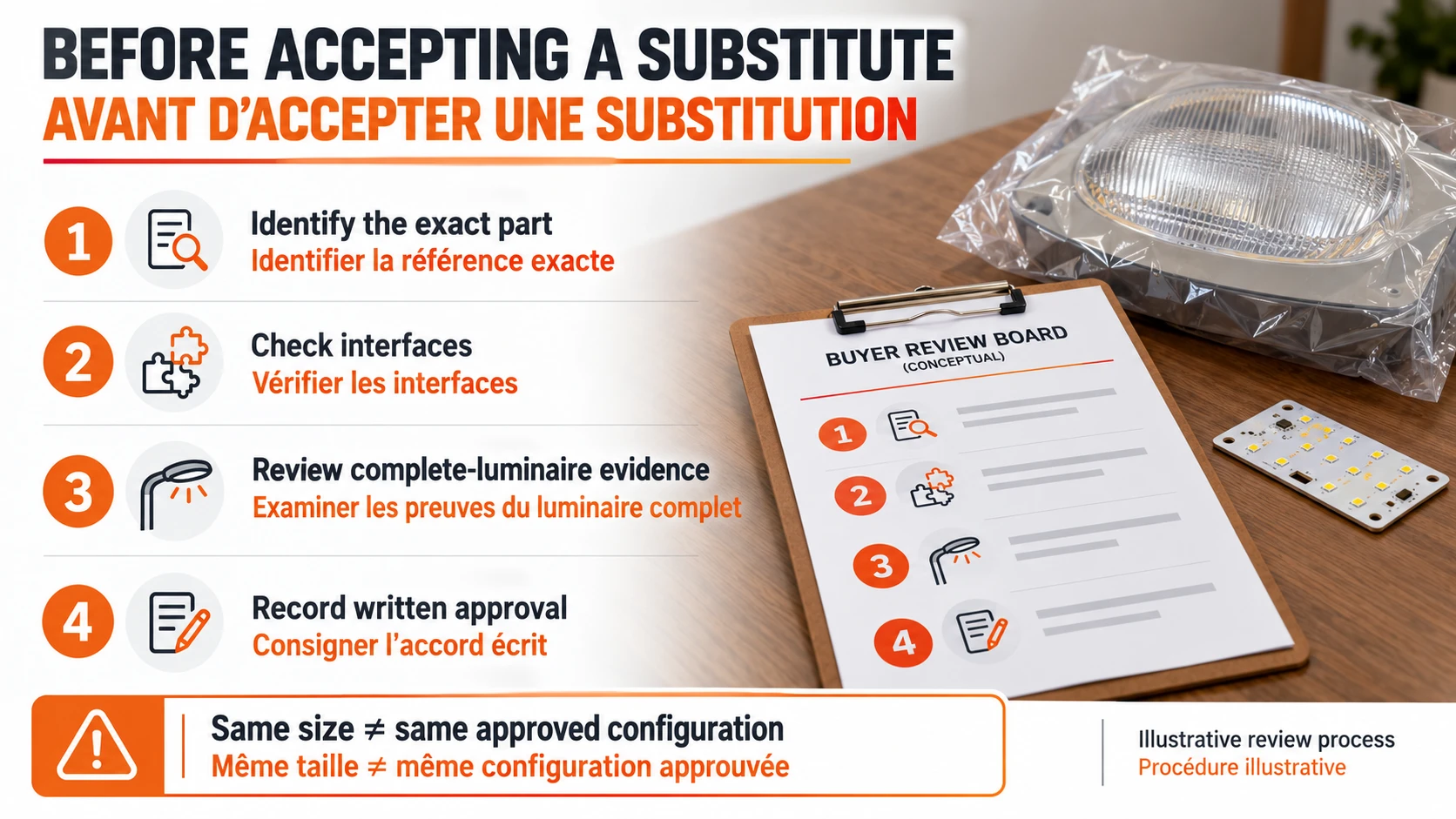
Treat a proposed substitution as a configuration change. The right question is not “does the new LED look the same?” It is “which approved requirements remain demonstrated, and which evidence must be updated?” This keeps procurement, engineering and after-sales teams working from the same record. It also prevents an innocent-looking component change from quietly altering the basis of a quotation.
| Substitution situation | Purchasing decision | Evidence to retain |
|---|---|---|
| Same approved part and configuration | Check traceability against the approved order | Part reference, agreed bin and lot/supply record |
| Different part, claimed equivalent | Engineering review before acceptance | Electrical, thermal and optical compatibility; updated configuration evidence |
| Only matching size or a brand claim | Hold approval pending identification | Exact part number and a reasoned comparison |
| Complete board/module replacement | Follow the model-specific service process | Approved assembly reference, compatibility and qualified installation requirements |
What to put in a street-light RFQ
For the Inlux All-in-One range dan the Inlux All-in-Two range, send the project location, layout, mounting height, required operating schedule and any specified LED-component restrictions. Ask the quotation to identify the configuration being offered, its complete-light performance basis and the process for approving alternatives. A preferred package should be a documented requirement, not a proxy for the whole lighting design.
Inlux Solar has delivered 300,000+ units cumulatively across its business. That company-level fact is not proof that every unit uses one package or that every configuration has the same output. For commercial solar parking lot lighting, include the parking layout and pedestrian areas so that the proposed distribution can be assessed against the actual site. Component and engineering documents remain subject to configuration confirmation and availability; this guide is not a promise of an immediately downloadable report.
Pertanyaan yang sering diajukan
Which is better: LED or SMD?
They are not competing categories. LED means light-emitting diode; SMD identifies a surface-mount package format. An SMD LED is an LED. Compare the specified devices or complete luminaires at matched conditions rather than assuming that one of these words describes a brighter or more reliable technology.
Are SMD LED lights good for outdoor street lighting?
They can be, when the selected component and complete luminaire are designed for the application. The package name alone does not establish weather protection, thermal performance or road coverage. Review the approved fixture configuration, enclosure requirements and lighting result; do not approve an outdoor luminaire from an LED-chip description alone.
How long do SMD LEDs last?
There is no single lifetime for all SMD LEDs. Ask what the stated life describes, under which current and temperature, and whether it refers to lumen maintenance or complete-luminaire service. A component projection does not automatically cover the driver, seals, connections or other parts. Use evidence for the exact configuration, not an unqualified hours claim.
How can I identify SMD LED positive and negative?
Use the exact manufacturer’s package drawing and pin-assignment information. Do not treat a corner notch, dot or printed board symbol as a universal rule across all parts. For a complete street light, identification or repair belongs with qualified personnel following the model-specific service procedure, with the equipment safely isolated. This guide is not a live-testing or rework instruction.
Is a 5050 LED always better than a 3030 LED?
No. Package family or size does not rank every LED’s efficacy, reliability or suitability. Compare the exact part, operating point, board and optic design, then the complete-light result. A larger package is not a universal promise of more road illumination per watt, and a higher package lumen figure is not a substitute for a comparable luminaire specification.
Can a failed SMD LED be replaced with one of the same size?
Not on size alone. The part must match the electrical, physical, thermal and optical requirements of the approved assembly. A model-specific board or module replacement may be the appropriate service route, but that depends on the manufacturer’s instructions. Do not authorize a substitute only because it fits or lights up during an informal check.
Compare a complete lighting configuration, not a chip label
Begin with the solar street light product range to shortlist the system type, then send an Inlux project RFQ with your site layout, operating schedule and any approved LED-part requirements. Ask for the quoted configuration and the evidence available for it. That is a much stronger basis for procurement than simply requesting “the brightest SMD chip.”