Dusk to dawn outdoor lighting describes a lighting objective: the right areas should be illuminated after daylight falls and should stop operating when they are no longer needed. It is not one switch setting that fits every product or project. The control method, site conditions and energy source determine whether that objective is reliable in practice.
For commercial roads, campuses, yards, parking areas and perimeters, start by choosing the control logic. A photocell responds to ambient light. A timer follows a schedule. An astronomical clock follows calculated sunrise and sunset times. A solar lighting system adds another constraint: the night-time schedule must be supported by the energy collected and stored during the day.
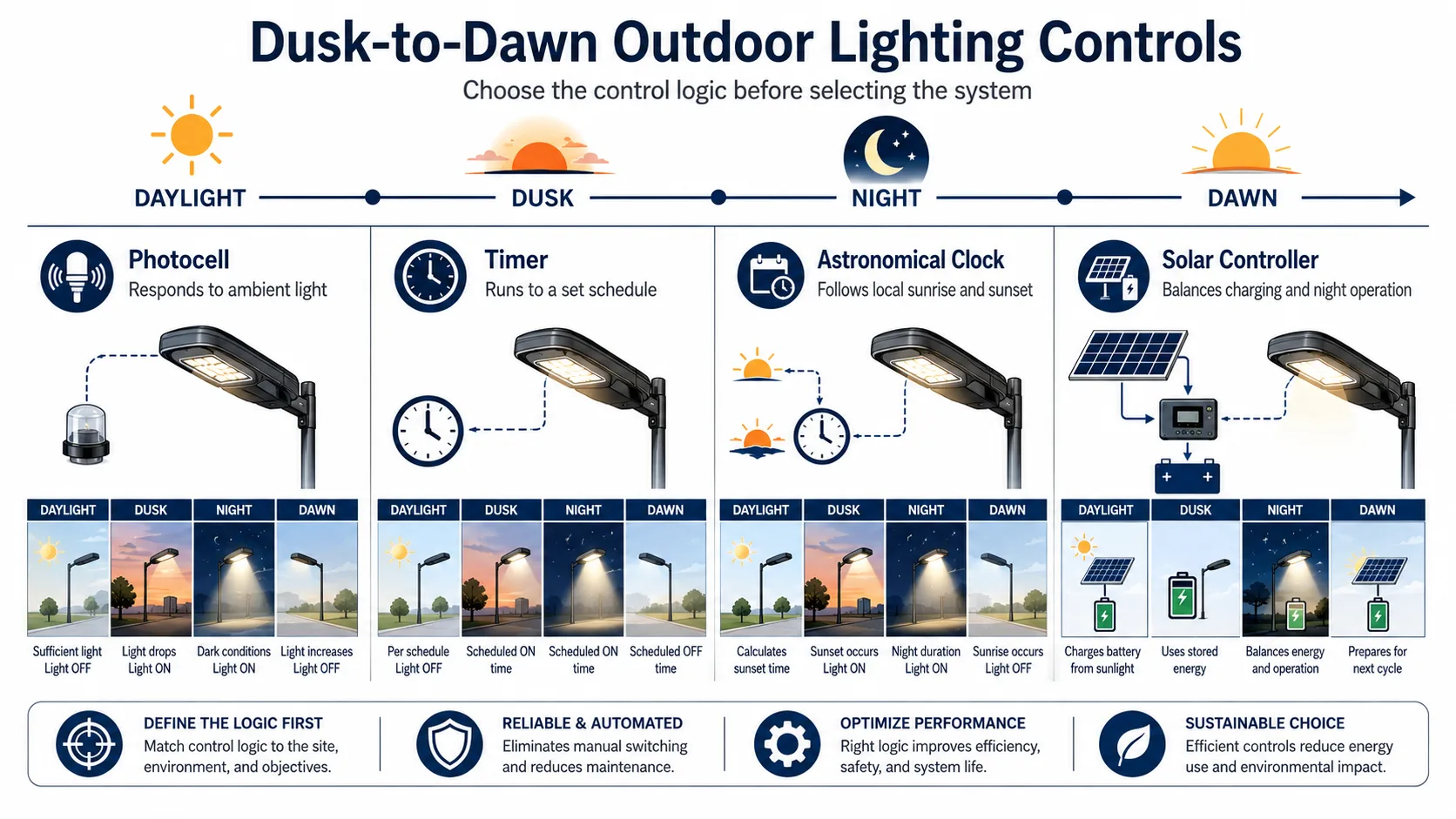
The Difference Between Photocell, Timer and Astronomical Controls
| Control method | What triggers it | Useful for | What the project team must check |
|---|---|---|---|
| Photocell | Ambient light level | Sites where actual daylight conditions should drive switching | Sensor placement, shade, temporary light sources and commissioning |
| Timer | A set local schedule | Predictable operating windows such as a shift, gate or curfew | Seasonal daylight changes, clock settings and operational exceptions |
| Astronomical clock | Calculated sunrise and sunset for the location | Programmed outdoor-lighting schedules across seasons | Correct location, time zone, seasonal overrides and site operating rules |
| Solar controller | A programmed lighting profile supported by stored energy | Solar systems designed around local charging and night-time demand | Panel exposure, storage design, dimming plan and reduced-sun periods |
A photocell can be appropriate when the lighting need follows real ambient conditions. It can also be affected by its surroundings. A sensor aimed at a lighted wall, hidden under an overhang or shaded by new vegetation may make the system behave differently from the design intent. The control position should be reviewed as part of installation, not left as an afterthought.
Timers are useful when a site has a defined operating pattern. For example, a loading zone may need full light until the end of a shift but not throughout the quietest part of the night. A timer does not respond to cloud cover or a darker-than-normal afternoon, so it should be chosen for a schedule—not because it is assumed to be a universal dusk sensor.
What Changes When the Light Is Solar-Powered?
Grid-powered and solar outdoor lights can both use photocells, timers or programmed dimming. The difference is that a solar system must balance its night-time load against solar collection and stored energy. The panel location, shading, local climate, operating profile and battery/storage design all matter.
This is why “dusk to dawn” should be written as a project requirement to be assessed, rather than used as an unconditional product promise. A system may be designed to operate through a planned night-time profile, but the appropriate profile depends on the location and intended task. For the component relationship, see Inlux Solar’s solar power system overview dan commercial solar street-light solutions.
Where the project requires the same output for long or variable hours and has reliable electrical supply, a grid-connected LED outdoor-lighting solution may be the more suitable option. A solar selection and an AC selection should be compared against the same lighting task, mounting conditions and control requirement.
Choose the Control Strategy by Site Task
Roads, paths and public circulation areas
The project brief should define the periods when people or vehicles need light, the level of continuity expected and any restrictions on glare or light spill. A photocell or astronomical schedule may be considered, while the luminaire layout, pole spacing and maintenance route remain separate design decisions.
Parking and access areas
Parking and access areas often have a predictable peak window followed by lower activity. A project may use a planned operating profile rather than treating all hours identically. Link the control choice to the site’s access plan, security requirements and any camera coverage. For a dedicated product/solution path, see lampu tempat parkir tenaga surya.
Perimeters, gates and yards
Security lighting should be based on the required observation and access task, not on a product label alone. Clarify whether the objective is wayfinding, deterrence, gate operation, camera support or a combination. The answer affects where light is aimed, when it operates and whether dimming is appropriate.
Commissioning Checks Before Handover
Before a dusk to dawn system is handed over, record how it is expected to behave and test that behaviour safely. A concise commissioning checklist should include:
- Confirm the intended control method and its programmed schedule, if applicable.
- Check that the sensor or controller is not blocked by a canopy, sign, foliage or temporary equipment.
- Confirm the panel location has the intended solar exposure for solar installations.
- Observe a complete switching cycle where practical, and log unexpected early switch-on, delayed switch-off or repeated cycling.
- Record the equipment location, control settings, responsible maintenance contact and any seasonal adjustment procedure.
Do not diagnose a persistent electrical, structural or storage fault by repeatedly changing control settings. Escalate damaged wiring, water ingress, loose mounting, overheating or repeated abnormal operation to a qualified service process.
A Project Brief That Gets a Useful Answer
When requesting a dusk to dawn outdoor-lighting recommendation, provide the site location, target areas, mounting information, intended operating hours, preferred control method, solar exposure notes and any security or camera constraints. This lets the engineering team distinguish an ordinary schedule setting from a site-wide lighting and energy requirement.
Inlux Solar reports more than 300,000 total units delivered in 60+ countries. This is a company-wide delivery figure, not evidence that one dusk-to-dawn setting is suitable for every climate or project. For a specific installation, request the relevant product data, control options and layout inputs.
Pertanyaan yang Sering Diajukan
Does dusk-to-dawn mean a light stays at full brightness all night?
Not necessarily. Dusk-to-dawn describes the operating period. A project can require a continuous full-output profile, a timed reduction, or another approved control strategy. The choice should match the lighting task and energy design.
Is a photocell better than a timer?
They solve different problems. A photocell responds to ambient light, while a timer follows a schedule. The better choice depends on site conditions, operating rules and the required response to seasonal daylight changes.
Can solar lights run from dusk to dawn in winter?
That depends on the available solar resource, shading, system design and night-time operating profile at the project location. It should be assessed as part of the system design rather than assumed from a generic product claim.
Why does an outdoor light turn on too early or stay on too long?
Possible causes include the sensor’s view, nearby reflected light, shade, a programmed schedule or a system fault. First record the condition and control setting; do not perform live electrical work unless qualified to do so.
What information should be included in an RFQ?
Include location, site plan, mounting height, target areas, operating hours, desired control logic, solar exposure notes, quantity and delivery requirements. These inputs support a more useful product and layout review.
Plan a Dusk-to-Dawn Lighting Strategy
For a project-level review, send the site plan, operating requirement and control preference to the Inlux Solar engineering team. The team can identify the inputs needed for product selection, control strategy, lighting layout and delivery documentation.