Most purple street lights were not designed to be purple. In documented utility cases, a layer that helps a blue or violet LED package produce white light separated or degraded. More of the underlying short-wavelength light then became visible, so the roadway luminaire appeared blue-purple instead of white.
That is the short answer, but color alone does not prove that every purple fixture has the same defect. A responsible assessment still needs the fixture model, installation date, affected batch, approved color specification, warranty terms, and a check of the actual road-lighting performance.
Jawaban cepat: Purple LED street lights commonly indicate a color-maintenance failure in the LED package or optical system. Utilities have specifically documented phosphor-coating delamination, but other material changes can also shift LED color. The fixture may still emit light, yet still fail the approved color or project specification.
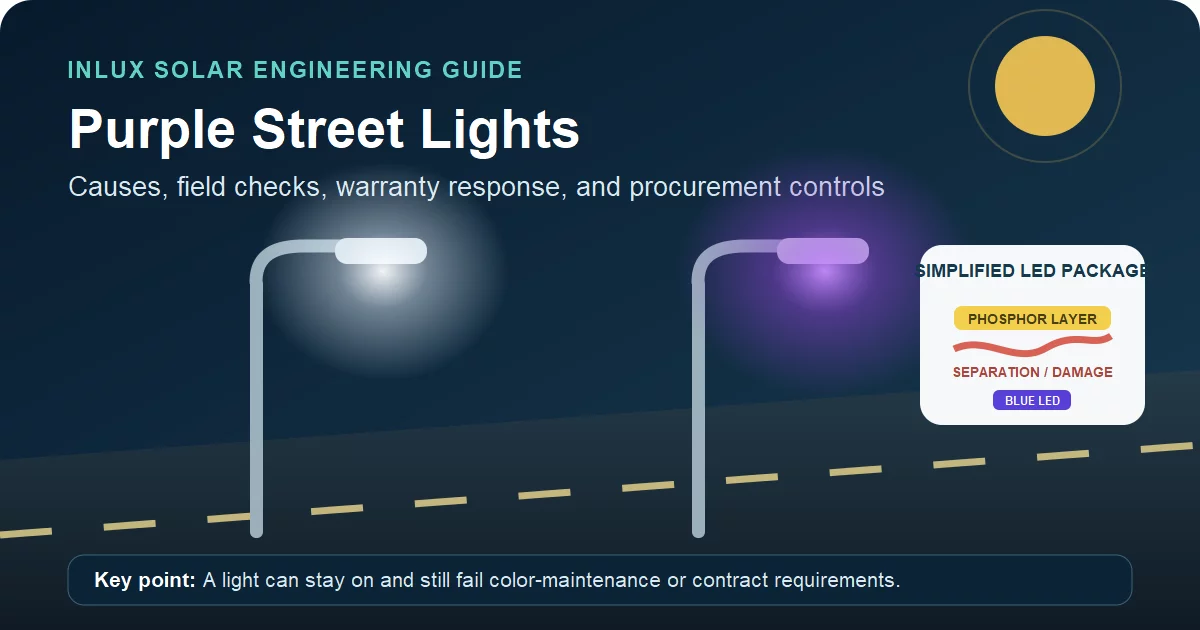
Purple Street Lights at a Glance
| Question | Practical answer |
|---|---|
| Are purple street lights intentional? | Usually not when isolated white roadway luminaires change color after installation. Confirm the original lighting design before deciding. |
| What is the best-documented cause? | Utilities have documented phosphor-coating delamination that exposes more of the blue or violet LED output. |
| Does purple mean the lamp has gone out? | No. A fixture can continue emitting light while its chromaticity no longer matches the approved white-light condition. |
| Is every purple light dangerous? | No universal conclusion is valid. Check road performance, visibility complaints, electrical condition, and the local authority’s requirements. |
| Can a driver reset fix it? | Not when the color change comes from package-level phosphor or optical-material failure. |
| What should an owner record? | Location, photos, fixture model, batch or serial number, installation date, quantity, color measurements, photometric checks, and warranty status. |
How a White LED Street Light Produces White Light
Many white roadway LEDs start with a blue or violet semiconductor light source. A phosphor material absorbs part of that short-wavelength output and re-emits light at longer wavelengths. The combination is perceived as white.
The final color is not controlled by the LED chip alone. It depends on the complete optical path:
- LED die or package
- Phosphor material and its distribution
- Encapsulant and package interfaces
- Lens, reflector, diffuser, or protective glass
- Junction temperature and operating conditions
The U.S. Department of Energy describes color shift, or chromaticity shift, as a reliability issue that can result from changes in LED packages, phosphors, encapsulants, resins, and optical components. A luminaire can therefore keep producing light while its color appearance moves outside the condition accepted by the buyer.
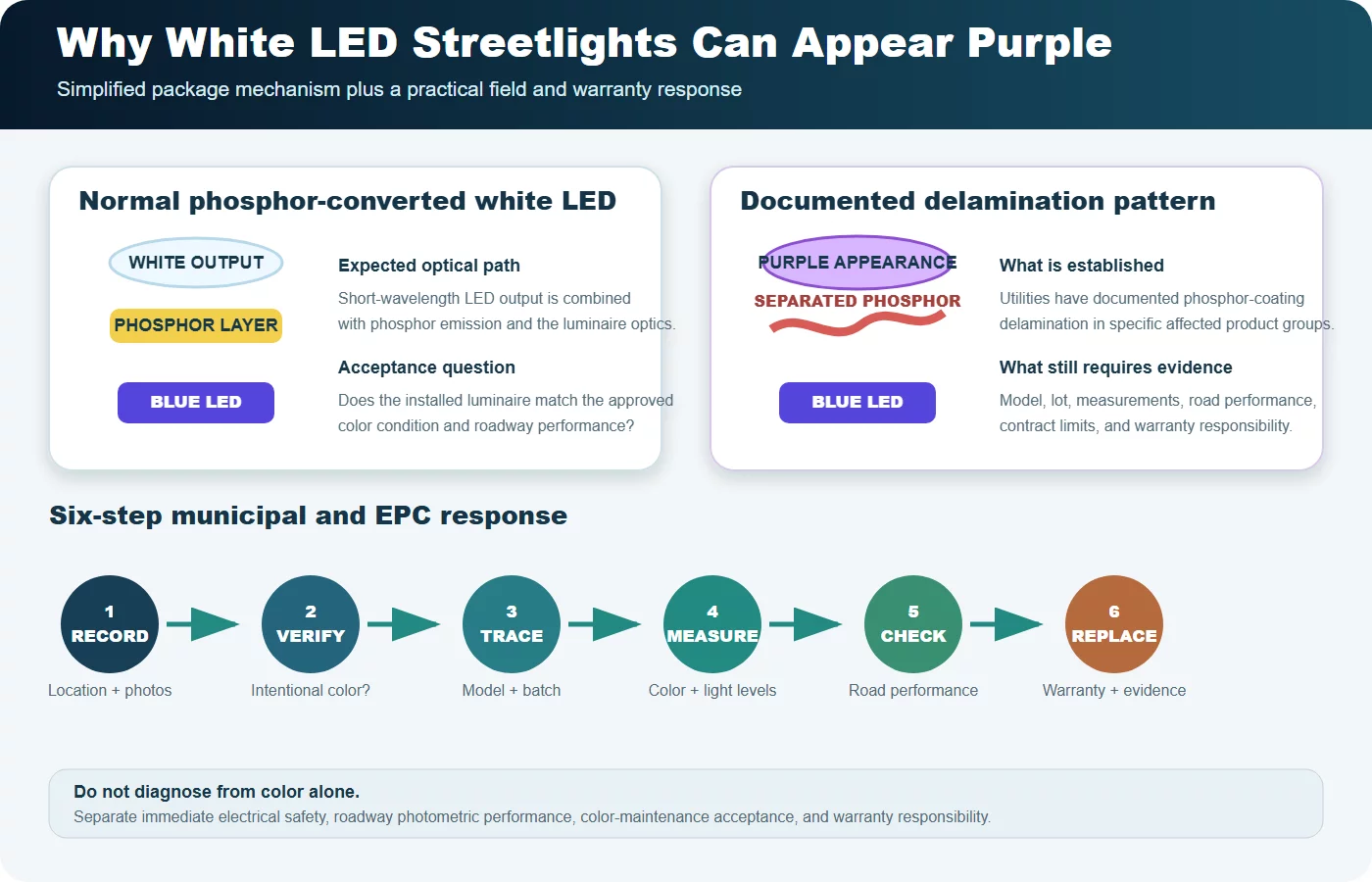
Purple Defect or Intentional Colored Lighting?
Not every purple light is defective. Architectural lighting, event lighting, under-bridge lighting, plant-growth lighting, and some safety or identity programs may intentionally use colored LEDs.
Use the installation pattern before drawing a conclusion:
| Observation | More consistent with intentional color | More consistent with an unintended color shift |
|---|---|---|
| Distribution | A complete zone or coordinated design | Scattered fixtures among otherwise white lights |
| Timing | Purple from commissioning day | White at first, purple after months or years |
| Control behavior | Changes by schedule or scene | Remains purple whenever energized |
| Documentation | Listed in drawings, controls, or owner instructions | No colored-light requirement in the design |
| Fixture population | Multiple models behave as planned | One model, lot, or installation period clusters |
| Owner response | No defect ticket | Warranty or maintenance investigation opened |
Camera white balance can also exaggerate blue or purple tones. Compare the fixture with adjacent lights in person and, when the decision matters, use a suitable color-measurement instrument instead of a phone image alone.
What Can Cause LED Street Lights to Turn Purple?
Documented phosphor-coating delamination
Manitoba Hydro describes a manufacturer defect called delamination. Its explanation states that the phosphor coating used to convert blue or purple LED-package output to white can separate, allowing more of the underlying color to show.
An official LG&E and KU Energy document filed with the Kentucky Public Service Commission gives the same field mechanism: some LEDs appeared purple instead of white because the phosphor coating delaminated. The document instructed crews to retain the failed lights and notify the Standards group for warranty replacement.
These sources establish a real failure mode. They do not prove that every purple luminaire, in every country and product family, has identical construction or the same root cause.
Other color-shift mechanisms
The Department of Energy’s broader LED reliability work identifies several mechanisms that can change chromaticity:
- phosphor degradation associated with heat or oxidation
- encapsulant cracking, discoloration, or other material changes
- resin changes that alter light transmission
- lens or diffuser degradation
- temperature-dependent changes in LED emission
- humidity, chemical exposure, and thermal cycling
Some mechanisms can move color in a different direction than purple. A field team should therefore treat “phosphor delamination” as a strong hypothesis for the classic purple-streetlight pattern, not as a substitute for batch records, inspection, or laboratory analysis.
Problems that may look similar
Several issues are often confused with LED color shift:
- A failing driver more often causes flicker, cycling, dimming, or outage.
- Dirt or a colored film on the external lens may change appearance without an internal package failure.
- A mixed retrofit may place two approved CCTs next to each other.
- A camera may render normal cool-white light as blue-purple.
- Decorative color scenes may be operating exactly as specified.
Diagnosis should start with what changed, when it changed, and whether the affected fixtures share a model or production lot.
Are Purple Street Lights Dangerous?
There is no defensible one-word answer for every installation.
Manitoba Hydro stated that, for its affected lights, there were no safety concerns with the spectrum and the fixtures emitted the same amount of light in a different color. That is useful first-party evidence about that utility’s installed population. It is not proof that every purple fixture elsewhere has unchanged illuminance, uniformity, glare, electrical condition, or visual performance.
Three questions should be separated:
1. Is there an immediate electrical hazard?
Color shift alone does not prove exposed wiring, shock risk, or structural danger. Public observers should still report the fixture from the ground and should never climb the pole or open an energized luminaire. Qualified crews must handle electrical and structural inspection.
2. Does the road still meet its lighting requirement?
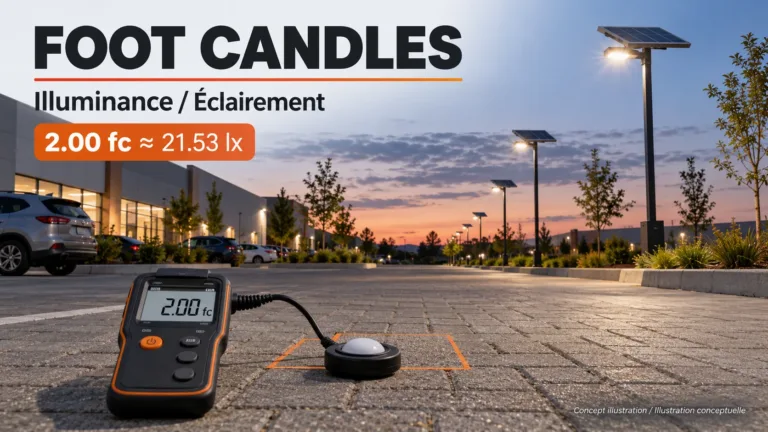
A lux meter can help check illuminance, but it does not fully characterize spectral or chromaticity change. For a roadway decision, compare the current installation with the approved requirements for:
- luminance or illuminance
- overall and longitudinal uniformity
- glare limits
- conflict-area and pedestrian requirements
- color or chromaticity acceptance
- complaints about visibility or object recognition
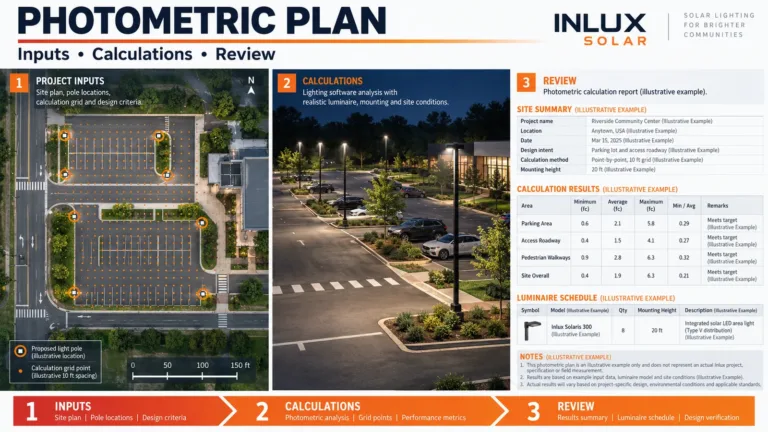
The appropriate criteria depend on the road class and the local authority. Inlux’s IES and DIALux road-lighting checklist explains the geometry, optic, spacing, and acceptance inputs needed for a project-level review.
3. Has the product failed commercially or contractually?
The Department of Energy notes that chromaticity shift can constitute product failure even when light is still emitted. If the luminaire no longer matches the approved sample, color coordinates, warranty promise, or visual consistency requirement, replacement may be justified before a complete outage occurs.
Six-Step Field Check for Municipalities and EPCs
Step 1: Record the location without touching the fixture
Capture the pole number, road name, GPS position, direction of travel, date, time, and ground-level photos. Photograph an adjacent normal fixture in the same exposure if possible.
For public reporting, use the utility or municipality’s official repair channel. Duke Energy’s repair workflow, for example, asks the reporter to locate the light on a map, select the best observation, and add details. Procedures vary by owner.
Step 2: Confirm whether purple was intended
Check the lighting schedule, control scenes, landscape plan, commissioning report, and approved material submittal. A planned colored zone should appear in the design documentation. An isolated purple fixture among white street lights is a different pattern.
Step 3: Identify the affected population
Record:
- manufacturer and luminaire model
- wattage, CCT, optic, and driver
- serial number or production lot
- installation and commissioning date
- pole or feeder group
- number installed and number affected
- maintenance or surge history
Map the results. A tight model-and-date cluster is more actionable than a list of unrelated complaints.
Step 4: Measure color and light output
Use calibrated equipment appropriate to the decision. A color meter or spectrometer can document chromaticity coordinates, CCT, and spectral changes. A photometer or lux meter can document light levels, but a lux reading alone cannot explain why the light appears purple.
Compare affected and unaffected fixtures under similar conditions. Preserve the raw readings and instrument information.
Step 5: Recheck roadway performance
If the installation serves a public road, compare field measurements and the approved photometric design. When optics or complete luminaires are replaced, confirm that the selected replacement still matches the intended distribution and mounting arrangement.
The Inlux road and street lighting solution covers standards-led layouts, optics, pole arrangements, IES files, and acceptance deliverables.
Step 6: Open the warranty and retain evidence
Notify the supplier with the model, lot, quantities, photographs, measurements, and contract documents. Retain at least one removed fixture or module when the owner, supplier, or laboratory may need failure analysis.
Do not discard every failed unit before the root-cause and warranty process is documented. The LG&E and KU instruction to retain failed lights before warranty replacement is a practical precedent for evidence control.
Repair the LED Module or Replace the Luminaire?
The correct action depends on the failure layer.
| Finding | Likely action |
|---|---|
| External dirt, film, or residue | Clean using the manufacturer’s approved method, then remeasure |
| Driver flicker or cycling with normal color | Diagnose driver, controls, surge protection, wiring, and supply |
| Replaceable LED module with confirmed package color failure | Replace the approved module and verify thermal interface, optics, and output |
| Sealed or non-serviceable luminaire with confirmed color failure | Replace the luminaire under the applicable warranty or maintenance plan |
| Multiple fixtures from one lot affected | Escalate to batch investigation, retained-sample analysis, and coordinated replacement |
| Unknown cause or mixed symptoms | Isolate the evidence and obtain qualified electrical and photometric review |
Cleaning or resetting a driver will not reverse phosphor delamination inside an LED package. Manitoba Hydro reported replacing its affected fixtures free of charge under warranty. A different owner may have different product construction, contract terms, labor responsibility, and replacement process.
Procurement Checklist to Reduce Repeat Failures
Purple street lights are partly a maintenance issue, but they are also a procurement-document issue. A buyer needs more than an initial CCT value on a datasheet.
1. Lock an approved color reference
Record the approved CCT, chromaticity tolerance or bin, and visual sample. State whether the acceptance test applies to the LED package, module, or complete luminaire.
2. Request the correct maintenance evidence
Different standards answer different questions:
| Document | What it helps evaluate | What it does not prove alone |
|---|---|---|
| ANSI/IES LM-80 | Maintenance of light-output characteristics for solid-state light sources | Complete installed-luminaire behavior |
| ANSI/IES TM-21 | Long-term flux projection from applicable LED-source data | Color stability of every luminaire material |
| ANSI/IES LM-84 | Optical-radiation maintenance of LED lamps, engines, and luminaires | Compliance with a buyer’s unstated color limit |
| ANSI/IES TM-35 | Projected chromaticity-coordinate shift for LED packages, arrays, and modules | Complete roadway performance after replacement |
| ANSI/IES RP-8 | Roadway and parking-facility lighting practice | Product warranty or batch traceability |
The buyer must still write an acceptance criterion. A report number without a contractual threshold does not define when replacement is required.
3. Require lot and serial traceability
The submittal should connect each delivered luminaire to:
- model and revision
- LED package and bin
- production date and lot
- driver and optic
- inspection record
- destination or pole schedule
Traceability allows a municipality to distinguish a batch event from random maintenance.
4. Define color-shift warranty coverage
The contract should state:
- what measured or visible color change triggers investigation
- the measurement method and comparison condition
- whether module, luminaire, freight, labor, traffic control, and disposal are covered
- the supplier’s response and replacement timeline
- evidence the owner must retain
- how replacement optics and CCT will be matched
Inlux Solar’s standard warranty is five years. For any road-lighting project, the quotation and contract should still state whether chromaticity shift is covered and which replacement costs are included. A general warranty period is not a complete color-maintenance clause.
5. Keep project photometrics connected to the product revision
Store the approved IES file, optic code, luminaire revision, pole schedule, and calculation report together. If the replacement product or optic changes, review the layout instead of assuming identical road performance.
Review the Inlux CCT, CRI, and beam-angle procurement guide and the range of project-grade LED street lights when preparing a comparable specification.
Sample RFQ Clause
The supplier shall identify the LED package, CCT/chromaticity bin, luminaire
revision, production lot, driver, and optic for each delivered batch. The
submittal shall include applicable LED-source and complete-luminaire maintenance
evidence, the method used to evaluate chromaticity change, and the warranty
remedy if installed luminaires no longer meet the project-approved color
condition. Replacement responsibilities shall state whether modules, luminaires,
freight, labor, traffic control, and post-replacement photometric verification
are included.
The project authority should add its own measurable tolerance, test duration, ambient conditions, and acceptance method. There is no responsible universal number for every road class, product architecture, and jurisdiction.
Pertanyaan yang Sering Diajukan
Why are some street lights purple?
In documented utility cases, a phosphor coating used to convert blue or violet LED output to white delaminated, allowing more of the underlying color to appear. Other package or optical-material changes can also shift color, so the exact cause should be confirmed for the affected model and lot.
Are purple street lights installed on purpose?
Some decorative or controlled lighting is intentionally purple. Random purple fixtures among otherwise white roadway lights, especially after a period of normal operation, are more consistent with an unintended color shift. Check the approved design and control schedule.
Are purple LED street lights harmful?
Color alone does not prove an immediate hazard. Manitoba Hydro reported no safety concerns and unchanged light quantity for its affected population. Other installations still require local checks of electrical condition, roadway performance, visibility complaints, and contract requirements.
Can a purple street light still be bright?
Yes. A fixture can continue producing substantial light while its chromaticity has shifted. Brightness or a lux reading alone does not establish acceptable color maintenance or complete roadway performance.
Can a bad LED driver make a street light purple?
A driver problem more commonly causes flicker, cycling, dimming, or outage. A stable purple appearance is more consistent with an LED-package or optical color-shift issue, but the driver and controls should still be checked during a qualified inspection.
Can purple street lights be repaired?
External contamination may be cleanable, and some luminaires allow an LED module to be replaced. Package-level phosphor delamination is not normally reversed by cleaning or resetting the driver. Many owners replace the module or complete luminaire under warranty.
Why do only some lights in the same street turn purple?
Affected fixtures may share a production lot, LED package, material batch, installation date, thermal condition, or exposure history. Lot and serial tracking are needed before attributing the pattern to one cause.
How should I report a purple street light?
Use the utility or municipality’s official repair channel. Provide the location, pole number if visible, ground-level photos, time observed, and a note that the light appears purple while adjacent fixtures appear white. Do not climb the pole or open the fixture.
How can a buyer reduce the risk of repeat color-shift failures?
Require an approved color reference, batch traceability, applicable maintenance-test evidence, a measurable chromaticity acceptance method, retained samples, and explicit warranty replacement responsibilities. Keep the approved IES file and product revision with the project record.
Get an Engineering Review
If you are replacing affected luminaires or writing a new roadway specification, send the road geometry, pole schedule, fixture model, optic, approved IES file, photographs, installation date, affected quantity, batch information, and warranty documents.
Technical References
- Manitoba Hydro: What’s up with purple street lights?
- Kentucky Public Service Commission filing: LG&E and KU LED standards attachment
- U.S. Department of Energy: LED Luminaire Reliability – Impact of Color Shift
- U.S. Department of Energy GATEWAY: Color Maintenance of LEDs in Laboratory and Field Applications
- Illuminating Engineering Society Lighting Library
- Duke Energy: Street and Area Light Repair Map FAQs