Sebuah MPPT solar inverter is a solar inverter whose DC input uses Maximum Power Point Tracking to keep a photovoltaic array operating near the voltage and current that produce the most available power. In a grid-tied unit, the inverter then converts that DC power to AC. In many hybrid or off-grid units, the same enclosure may also contain a battery charger and an MPPT charge controller.
That definition sounds simple, but it hides an important distinction:
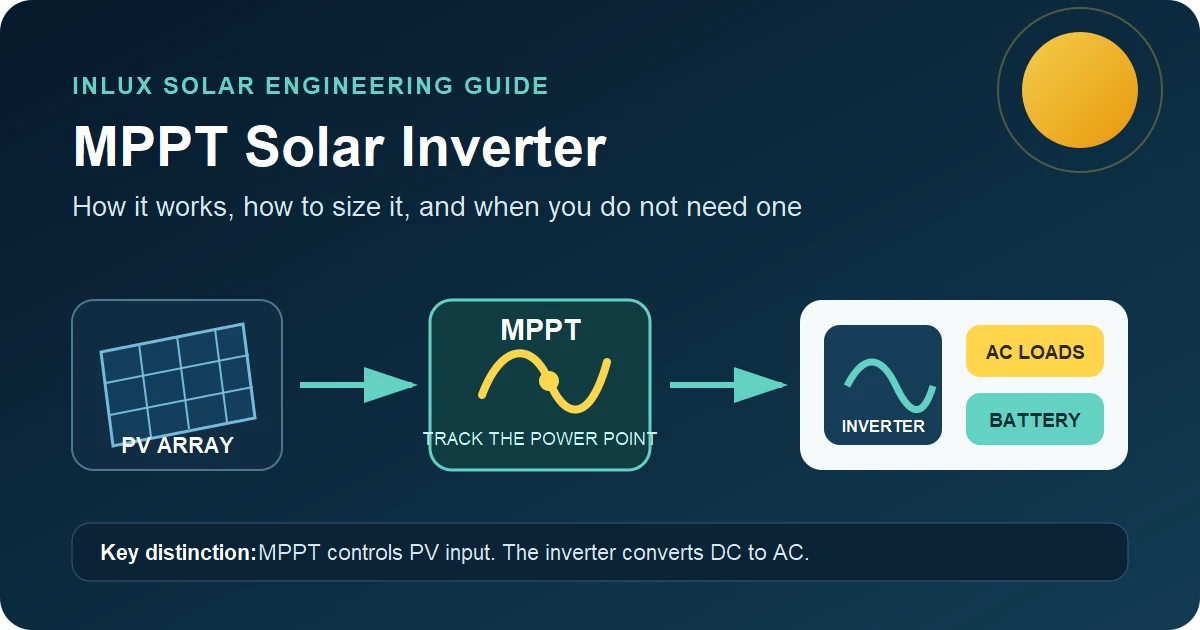
MPPT is a control function. An inverter is a power-conversion device. An MPPT charge controller and an MPPT-equipped inverter may use similar tracking logic, but they are not automatically the same product.
This guide explains the difference, shows how MPPT works, provides a practical inverter sizing process, and identifies a common design mistake: adding an AC inverter to a stand-alone DC solar lighting system that does not need one.
Quick Answers
| Question | Short answer |
|---|---|
| What does MPPT mean? | Maximum Power Point Tracking. |
| What does MPPT do in an inverter? | It adjusts the PV array’s electrical operating point to extract the highest available DC power under current conditions. |
| Is MPPT the same as an inverter? | No. MPPT controls the PV input; the inverter converts DC electricity to AC electricity. |
| Is an MPPT inverter the same as an MPPT charge controller? | Not always. Some hybrid products integrate both functions, while stand-alone charge controllers do not produce AC output. |
| Is dual MPPT always better? | It is useful when arrays have different orientations, shading patterns, or electrical characteristics. It adds little value when both inputs see identical conditions. |
| Does a solar street light need an inverter? | A stand-alone DC solar street light usually does not. It normally uses a solar charge controller, battery, and DC LED driver. |
What Is MPPT?
Solar modules do not produce one fixed voltage and current. Their output changes with irradiance, cell temperature, shading, angle of incidence, and the electrical load connected to them.
At any moment, the module has an operating point on its current-voltage curve. Power is:
Power (W) = Voltage (V) x Current (A)
The maximum power point is the voltage-current combination where that product is highest. Module datasheets usually identify it with:
Vmp: voltage at maximum powerImp: current at maximum powerPmp: maximum power, approximatelyVmp x ImpVoc: open-circuit voltageIsc: short-circuit current
Texas Instruments describes MPPT as the process used to obtain the maximum available power from a PV system as irradiance, temperature, and load conditions change. Common tracking methods include Perturb and Observe and Incremental Conductance.
An MPPT controller repeatedly measures PV voltage and current, estimates power, and changes the converter’s operating point. If the new operating point produces more power, it continues in that direction. If power falls, the controller changes direction or recalculates.
This is a control loop, not a source of extra energy. MPPT cannot create power that the array is not producing. Its job is to avoid leaving available PV power unused because the electrical operating point is poorly matched.
What Is an MPPT Solar Inverter?
The phrase is used for several different architectures. Before comparing products, identify which one a supplier means.
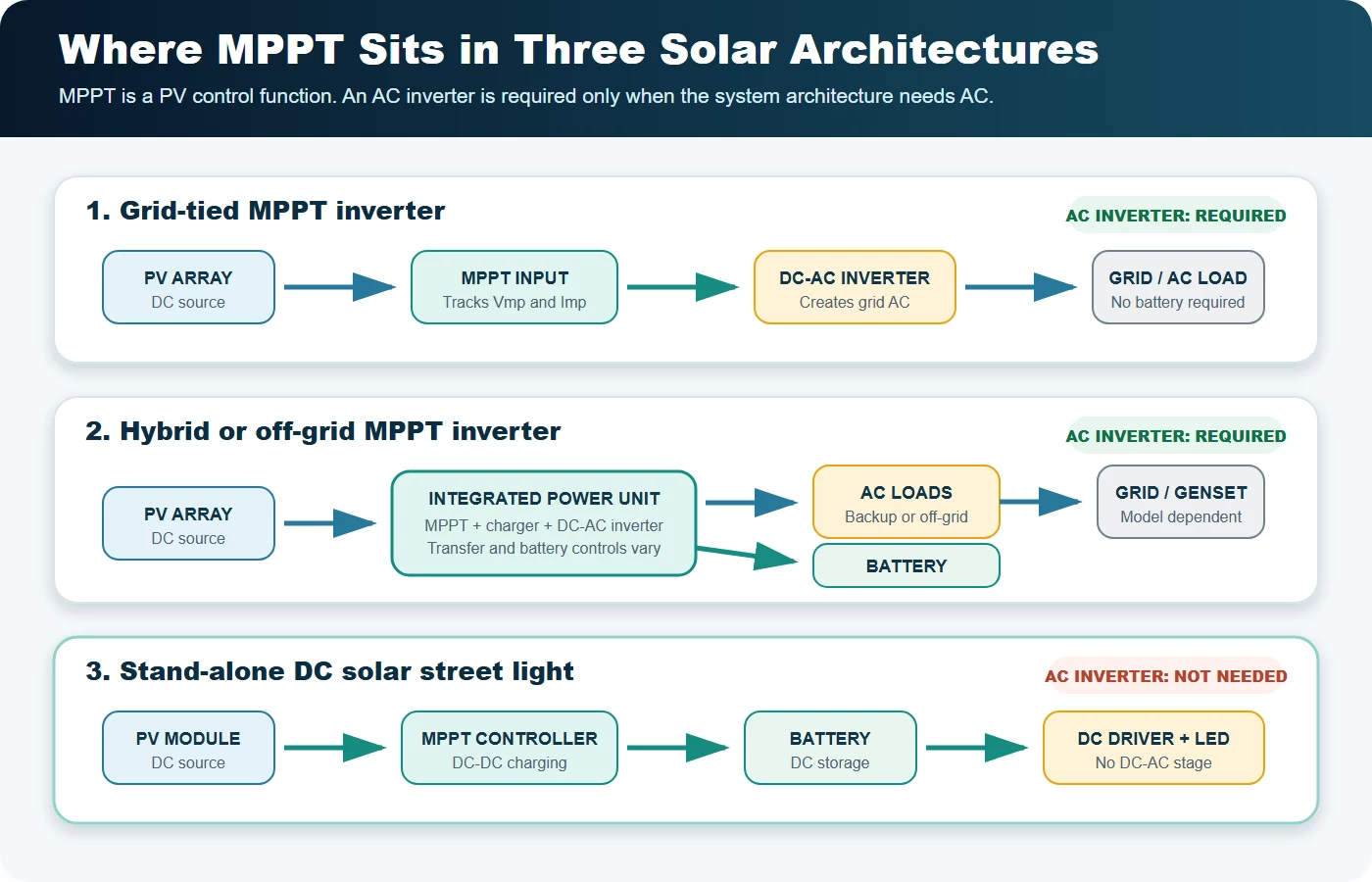
1. Grid-tied solar inverter with MPPT
The PV array connects to one or more MPPT inputs. The inverter tracks the array and converts DC power to grid-compatible AC. A battery is not required in a conventional grid-tied architecture.
2. Hybrid solar inverter with an integrated MPPT charger
This unit coordinates PV, battery, AC loads, and often the utility grid or a generator. It may contain:
- PV-side MPPT conversion
- Battery charging and discharging control
- DC-to-AC inversion
- AC-to-DC charging
- Transfer or backup functions
- Battery management system communication
The term “all-in-one solar inverter” often refers to this architecture, but functions vary by model.
3. Off-grid inverter/charger/MPPT
This combines an MPPT solar charger with a battery inverter and often an AC charger. The battery establishes the DC bus and supplies loads when PV power is unavailable.
These three products may all be called MPPT solar inverters, even though their system behavior is different. Always compare a block diagram and datasheet, not the marketing name alone.
How Does MPPT Work in a Solar Inverter?
The process has four basic stages.
Step 1: Measure the PV input
The inverter samples PV voltage and current. It calculates input power from their product.
Step 2: Search for a better operating point
The MPPT algorithm changes the electrical load seen by the PV array. This moves the array to a different point on its current-voltage curve.
Step 3: Track environmental changes
Cloud movement, module temperature, shading, and sun angle change the maximum power point. The controller continues adjusting instead of using one fixed voltage.
Step 4: Convert and route the power
What happens next depends on the architecture:
- A grid-tied inverter converts DC to AC for the building or grid.
- A hybrid inverter may send power to loads, charge a battery, or export to the grid.
- A stand-alone MPPT charge controller converts PV power to a controlled battery-charging output without creating AC.
Illustrative power example
Assume a PV input is operating at:
Vmp = 31.5 V
Imp = 12.7 A
Pmp = 31.5 x 12.7 = 400.05 W
An MPPT DC-DC stage can convert that higher-voltage, lower-current input into a lower-voltage, higher-current output suitable for a battery bus, subject to conversion losses and current limits.
For example, delivering 380 W to a 25 V battery-charging bus would require approximately:
Output current = 380 W / 25 V = 15.2 A
This example demonstrates the voltage-current trade. It is not a universal efficiency or energy-gain claim. Actual performance depends on the equipment, wiring, temperature, battery acceptance, and operating conditions.
MPPT Inverter vs MPPT Charge Controller vs PWM
These terms are frequently mixed together.
| Device or function | Main job | Typical input | Typical output | Produces AC? |
|---|---|---|---|---|
| MPPT function | Find and track the PV maximum power point | PV voltage and current measurements | Control command to a converter | No |
| MPPT charge controller | Optimize PV input and regulate battery charging | PV array | Controlled DC battery output | No |
| PWM charge controller | Regulate battery charging with a simpler switching method | PV array | Controlled DC battery output | No |
| Solar inverter | Convert DC to AC | PV or battery DC bus | AC electricity | Ya. |
| Hybrid MPPT inverter | Track PV, manage battery, and convert DC/AC | PV, battery, and sometimes grid/generator | AC loads, battery charging, export | Ya. |
The practical consequence is important. If a system’s load is already DC, an inverter may add cost, standby consumption, heat, and another failure point without providing a useful function.
For a deeper procurement comparison focused on lighting systems, see the Inlux guide to MPPT vs PWM controllers for solar street lights.
Do MPPT Inverters Always Produce More Energy?
There is no defensible universal percentage.
The result depends on what is being compared:
- MPPT versus direct battery connection
- MPPT versus a PWM controller
- One MPPT algorithm versus another
- A correctly sized array versus an electrically mismatched array
- Uniform sun versus fast-changing shade
- Cold modules versus hot modules
MPPT has more opportunity to recover otherwise unused power when the PV operating voltage differs substantially from the battery or DC bus voltage, or when conditions move the maximum power point throughout the day.
However, the total system gain is not the same as MPPT tracking efficiency or inverter conversion efficiency. These are separate measurements:
- MPPT tracking efficiency: how closely the controller follows the available maximum power point.
- Conversion efficiency: how much input power remains after electronic conversion losses.
- Energy yield: the energy delivered over time after weather, clipping, wiring, temperature, downtime, battery limits, and other losses.
Treat any fixed “up to 30%” statement as incomplete unless the supplier defines the baseline system and test conditions.
Single MPPT vs Dual MPPT
A dual MPPT solar inverter has two independent trackers. Each tracker can operate its connected array at a different voltage-current point.
Dual MPPT is useful when:
- One array faces east and another faces west.
- Roof sections have different tilt angles.
- One string experiences regular shading.
- Arrays use different module counts that the inverter explicitly supports.
- Separate subarrays need independent monitoring or design flexibility.
Dual MPPT is not automatically useful when:
- Both arrays have the same orientation, tilt, module type, and irradiance.
- The two inputs are not electrically independent.
- The installer exceeds current or voltage limits while assuming an extra tracker removes those constraints.
Commercial inverters may have more than two trackers. For example, SMA’s Sunny Tripower X 13-US datasheet specifies three MPP trackers and separately lists the MPPT operating voltage range, start voltage, and maximum current per tracker. This illustrates why tracker count must be read together with electrical limits.
How to Size an MPPT Solar Inverter
Do not size the inverter from panel wattage alone. Use this sequence.
1. Define the AC load and operating mode
Record:
- Continuous AC load
- Starting or surge load
- Single-phase or three-phase requirement
- Required AC voltage and frequency
- Grid-tied, backup, or fully off-grid operation
- Critical-load transfer requirements
The inverter’s rated power, apparent power, overload behavior, and transfer function must match the real load.
2. Check maximum PV open-circuit voltage
For modules in series:
String Voc = module Voc x modules in series
Voc rises as module temperature falls. The cold-condition string Voc must remain below the inverter’s maximum DC input voltage, including the manufacturer’s required design margin.
Checking only the STC Voc printed on a module label is not enough for a cold climate.
3. Keep operating voltage inside the MPPT range
For modules in series:
String Vmp = module Vmp x modules in series
Vmp normally falls as cells become hotter. Verify that the hot-condition operating voltage remains inside the inverter’s MPPT range. Also verify the minimum DC or startup voltage.
A string can be below the maximum voltage limit and still perform poorly if its operating voltage falls outside the tracking range.
4. Check current for every tracker
For parallel strings:
Array operating current = module Imp x parallel strings
Array short-circuit current = module Isc x parallel strings
Compare both values with the inverter’s permitted operating and short-circuit current for each MPPT input. Do not assume unused wattage capacity permits excess current.
5. Assign strings to independent trackers
Keep materially different orientations or shading conditions on separate MPPTs when possible. Follow the inverter manufacturer’s rules for:
- Minimum strings per tracker
- Unequal string lengths
- Parallel input connectors
- Permitted module-current ratios
- Shared versus independent inputs
6. Match the battery side for hybrid or off-grid systems
Confirm:
- Nominal battery voltage
- Permitted battery-voltage range
- Kimia baterai
- Maximum charge and discharge current
- BMS communication protocol
- Low-temperature charging restrictions
- Backup depth of discharge
- Generator or grid charging limits
The labels 12 V, 24 V, atau 48 V often describe the battery bus. They do not automatically describe the PV MPPT input range.
7. Check the installation environment
Review:
- Ambient temperature and thermal derating
- Indoor or outdoor enclosure rating
- Humidity, dust, salt, and corrosion exposure
- Altitude derating
- DC and AC protection requirements
- Isolation, grounding, and rapid-shutdown requirements where applicable
- Warranty terms and local service capability
The best MPPT algorithm cannot compensate for an inverter installed outside its thermal or environmental limits.
MPPT Solar Inverter Specification Checklist
Use this table when comparing quotations.
| Spesifikasi | Mengapa ini penting |
|---|---|
| Rated AC power and VA | Confirms continuous load capability |
| Surge or overload rating and duration | Checks motor, pump, and compressor starting |
| Maximum PV open-circuit voltage | Sets the cold-condition string limit |
| MPPT operating voltage range | Sets the usable PV tracking window |
| Minimum DC and startup voltage | Determines when conversion can begin |
| Maximum input current per MPPT | Limits parallel strings and high-current modules |
| Maximum short-circuit current per MPPT | Protection and array compatibility |
| Number of independent MPPTs | Determines whether unlike subarrays can be tracked separately |
| Maximum charge current | Critical for battery charging time and cable/protection sizing |
| Supported battery voltage and chemistry | Prevents battery and charger mismatch |
| BMS communication | Affects lithium battery control and fault handling |
| AC output voltage, phase, and frequency | Must match the loads and local electrical system |
| Conversion and standby data | Affects delivered energy and off-grid runtime |
| Thermal derating curve | Shows output capability in hot conditions |
| Enclosure and corrosion rating | Determines environmental suitability |
| Protection functions | Covers overvoltage, overcurrent, reverse polarity, ground fault, and temperature |
| Monitoring and data export | Supports commissioning and fault diagnosis |
Common MPPT Inverter Sizing Mistakes
Confusing battery voltage with PV input voltage
A 48 V inverter may use a 48 V battery while accepting a much higher PV string voltage. Read both sides of the datasheet.
Checking only maximum PV wattage
An array can be within the advertised wattage limit but exceed maximum voltage or input current.
Using STC voltage without temperature correction
Cold weather raises Voc. Hot cells reduce Vmp. Both ends matter.
Mixing unlike arrays on one tracker
Different orientations or shading patterns can force one tracker to choose a compromise operating point.
Assuming more MPPTs always means more yield
Tracker count improves design flexibility only when the connected subarrays actually need independent control.
Treating MPPT as battery protection
MPPT optimizes PV operation. Battery charging still requires correct voltage limits, current limits, temperature rules, and BMS behavior.
Adding an inverter to a DC-only system
If the load is DC and the battery/controller can supply it correctly, converting DC to AC and back to DC is usually unnecessary.
When a Solar Street Light Does Not Need an Inverter
Most stand-alone solar street lights use this architecture:
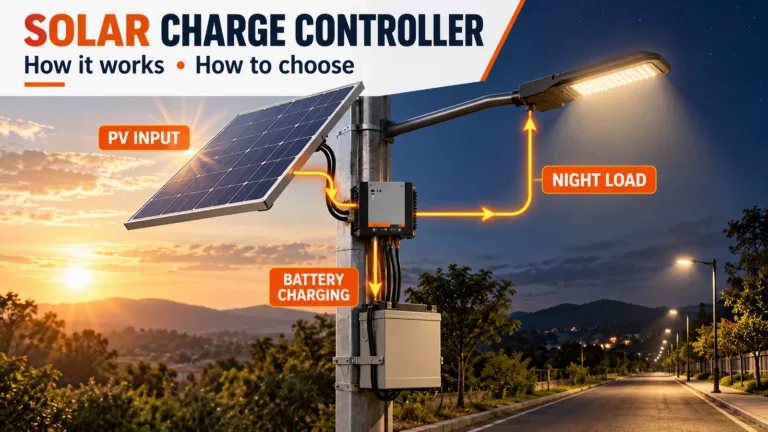
PV module -> MPPT or PWM charge controller -> battery -> DC LED driver -> LED luminaire
There is no AC load in that chain, so there is no fundamental need for a DC-to-AC inverter.
This matters because the phrase “solar inverter” is sometimes used loosely in lighting quotations. Procurement teams should ask the supplier to identify each component and its function:
- Is the device an MPPT solar charge controller?
- Is there an actual AC output?
- What load requires AC?
- Is the LED driver supplied from the DC battery bus?
- What are the controller’s charge, discharge, dimming, and low-voltage settings?
An inverter may be justified in a solar lighting project when the system must also power:
- AC cameras or communication equipment
- AC tools or auxiliary loads
- Grid-interactive lighting circuits
- A hybrid AC/DC site system
But it should be added because the load architecture requires it, not because “MPPT inverter” sounds more advanced.
Inlux Solar specializes in commercial solar street lighting rather than residential or energy-storage inverter catalogs. For lighting projects, our engineering focus is the complete energy balance: PV input, controller behavior, battery storage, dimming profile, LED load, autonomy, and worst-month recovery.
Explore commercial solar street light system types or use the autonomy-days calculation guide to connect controller choice with the actual nightly energy budget.
What Determines MPPT Solar Inverter Price?
There is no useful global price for “an MPPT inverter” without a specification. Price changes with:
- Grid-tied, hybrid, or off-grid architecture
- Rated kW and surge requirement
- Battery charger and transfer-switch functions
- Number of independent MPPTs
- Maximum PV voltage and current
- Single-phase, split-phase, or three-phase output
- Outdoor enclosure and thermal design
- Monitoring, communication, and grid-code functions
- Certification and warranty coverage
- Local distribution, service, and installation
Compare total system scope, not only the inverter unit price. A cheaper model that forces shorter strings, adds external chargers, cannot communicate with the battery, or derates heavily in heat may increase the installed cost.
For a solar street light project, first determine whether an inverter is required at all. Removing an unnecessary conversion stage can be more valuable than negotiating a lower inverter price.
A Better Procurement Rule
Before approving an MPPT solar inverter, require the supplier to submit:
- A system block diagram.
- PV string calculations for cold Voc and hot Vmp.
- Current calculations for each MPPT.
- Load and surge calculations.
- Battery voltage, chemistry, current, and BMS compatibility.
- Thermal derating and enclosure data.
- Protection and commissioning settings.
- A clear statement of which loads are AC and which are DC.
For solar street lighting tenders, the Inlux RFQ and BOQ kit helps buyers request comparable energy, controller, battery, lighting, and project inputs instead of relying on product labels.
Pertanyaan yang Sering Diajukan
What does MPPT mean in a solar inverter?
MPPT means Maximum Power Point Tracking. It is the control process that adjusts the PV array’s electrical operating point so the inverter can capture the highest available power under current irradiance and temperature conditions.
Are MPPT and inverter the same?
No. MPPT manages the PV input operating point. An inverter converts DC electricity to AC electricity. A hybrid product may integrate both functions in one enclosure.
What is the difference between an MPPT inverter and an MPPT charge controller?
An MPPT charge controller converts and regulates PV power for battery charging but does not normally provide AC output. An MPPT inverter includes DC-to-AC conversion. Hybrid inverter/chargers may integrate both.
Is dual MPPT better than single MPPT?
Dual MPPT is better when two PV subarrays have different orientations, shading, tilt, or supported electrical configurations. If both arrays operate under identical conditions, a second tracker may not produce a meaningful benefit.
Can an MPPT solar inverter work without a battery?
A conventional grid-tied MPPT inverter works without a battery. Hybrid and off-grid behavior is model-specific. Some hybrid units can operate in limited modes without a battery, while many off-grid systems require a battery to establish and stabilize the DC bus.
Is MPPT better than PWM?
MPPT provides more flexible PV voltage conversion and can capture more available PV power when array voltage and battery voltage differ or conditions change. The actual energy difference depends on system design and operating conditions, so a fixed percentage should not be assumed.
What is a 12 V, 24 V, or 48 V MPPT inverter?
Those labels often refer to the nominal battery voltage of a hybrid or off-grid inverter. The permitted PV input voltage is a separate specification and may be much higher.
How many solar panels can I connect to an MPPT inverter?
The answer depends on maximum PV voltage, MPPT operating range, maximum input current, short-circuit current, tracker configuration, temperature-adjusted module values, and the inverter manufacturer’s string rules. Panel wattage alone is not enough.
Does a solar street light need an MPPT inverter?
Usually not. A stand-alone DC solar street light normally uses an MPPT or PWM charge controller, battery, DC LED driver, and LED luminaire. An inverter is needed only if the project includes an AC load or grid-interactive architecture.
Plan a Solar Street Lighting System Without Unnecessary Conversion Stages
If your project is for municipal roads, industrial areas, parking sites, public spaces, or remote infrastructure, send Inlux Solar:
- Project city and country
- Road width or site dimensions
- Pole height and target spacing
- Required lighting level or road class
- Operating and dimming schedule
- Required backup nights
- Any AC auxiliary loads
Our engineering team can help define the system architecture, controller type, battery and PV energy budget, lighting layout inputs, and tender-ready documentation.
Technical References
- Texas Instruments, Introduction to Photovoltaic Systems Maximum Power Point Tracking.
- SMA, Sunny Tripower X 13-US datasheet.
- Victron Energy, MPPT solar charger manual.