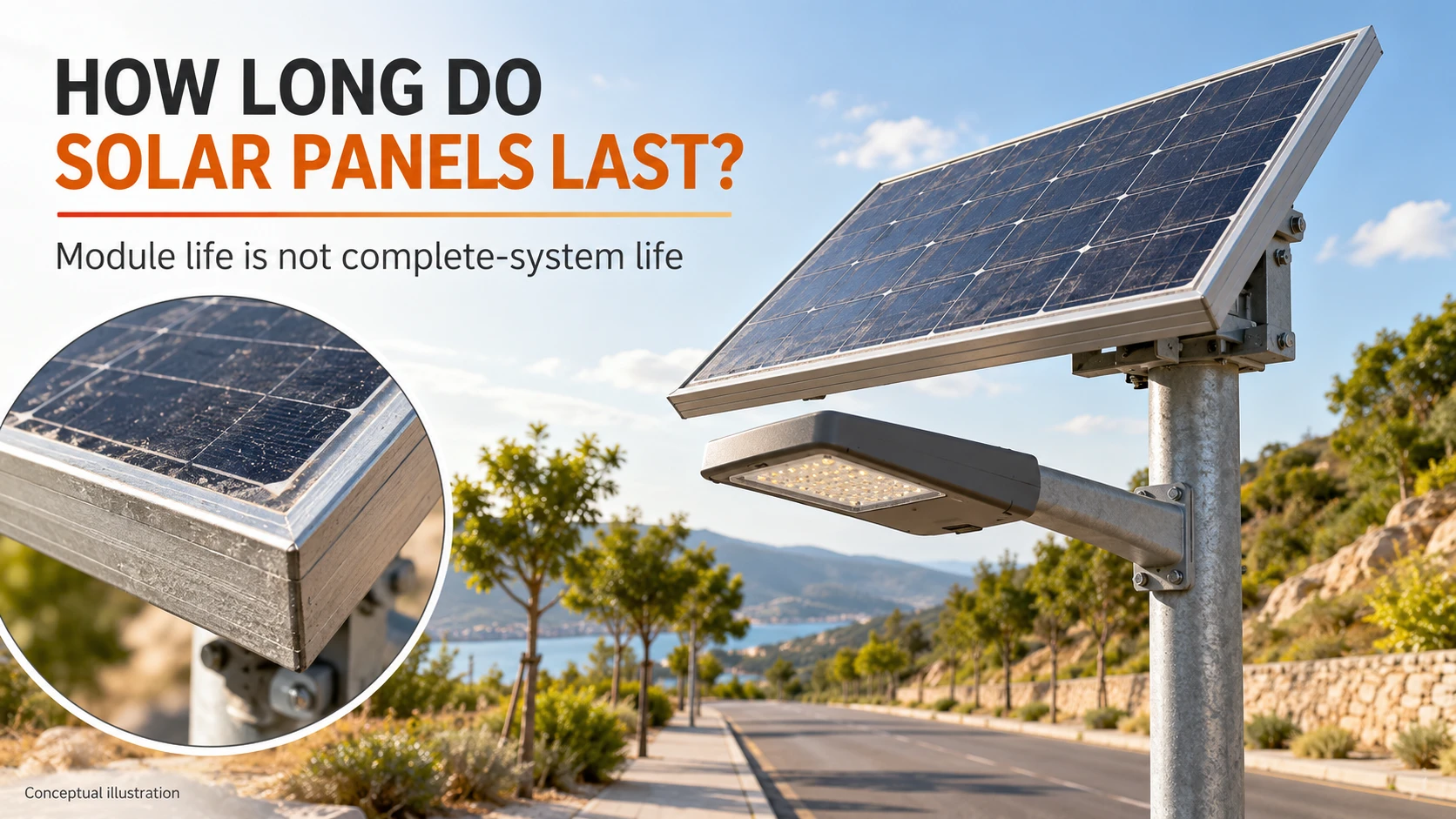
How long do solar panels last? The U.S. Department of Energy cites an average operational lifespan of 25–35 years in 2025, based on a survey of U.S. solar-industry professionals. That is a useful planning reference, not an expiry date or a guarantee for every module. Panels normally lose output gradually; damage can end service earlier. For a solar street light, the practical question is more demanding: will the ageing panel still supply enough energy for the required night, and can it be replaced without retiring the rest of the light?
A panel does not stop working on its warranty anniversary
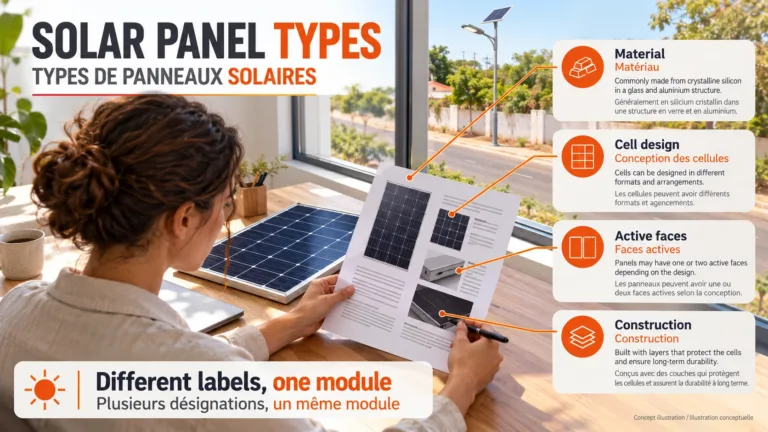
On module retirement, the DOE end-of-life overview describes retirement as a lifecycle decision. A working module may stay in service beyond its warranty, while an owner may replace another earlier to recover output or upgrade the installation. Its 25–35-year reference concerns PV panels, not a promise that a battery, controller, LED module and seals will survive equally long without attention.
Separate four things when reading a quotation. Product warranty covers specified defects under stated terms. Performance warranty sets a contractual power-retention floor and a measurement method. Service life is the period the module remains safe and useful. Lighting-system life also depends on energy storage, controls, light output and serviceability. None of these is a substitute for the others. A long performance warranty is especially easy to misunderstand: retaining a percentage of rated power is not the same as delivering a fixed number of watt-hours every day.
How long do solar panels last as output declines?
Degradation means a lasting reduction in output under comparable conditions. In their 2013 review of photovoltaic degradation rates, Jordan and Kurtz assembled nearly 2,000 historical measurements and reported a median of 0.5% per year. That research is a reference across studied modules and systems, not a prediction for a current Inlux configuration. Technology, manufacturing, climate and measurement quality matter; a single average cannot approve an individual purchase.
For a transparent example, assume a constant 0.5% annual loss, compounded on the previous year’s remaining output, with no separate first-year loss. The retained-power factor after n years is (1 − 0.005)^n. Multiplying this factor by 100 gives the percentages below. A warranty may instead specify an initial step followed by a linear annual allowance, so use its actual wording rather than substituting this formula.
| Elapsed time in this example | Calculated retained power |
|---|---|
| Start | 100.0% of initial power |
| 10 years | 95.1% of initial power |
| 20 years | 90.5% of initial power |
| 25 years | 88.2% of initial power |
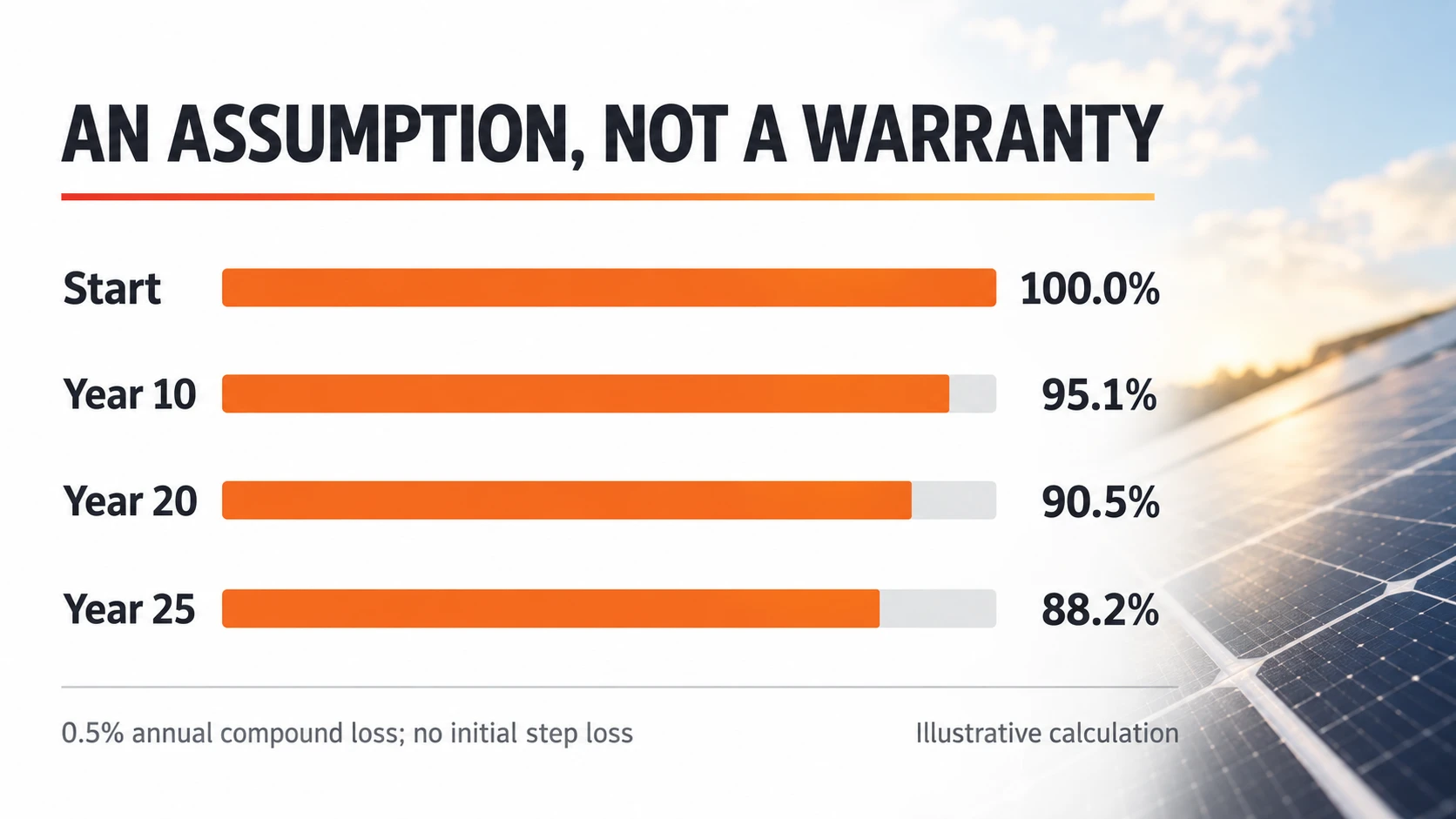
These figures are not annual energy yields, failure probabilities or a claim about Inlux modules. They hold other conditions constant and ignore sudden faults. A panel delivering 88.2% of its original comparable-condition output may still be useful. Whether it is useful on a particular pole depends on the energy margin the complete lighting configuration had in the first place.
The overlooked question: enough energy for the night?
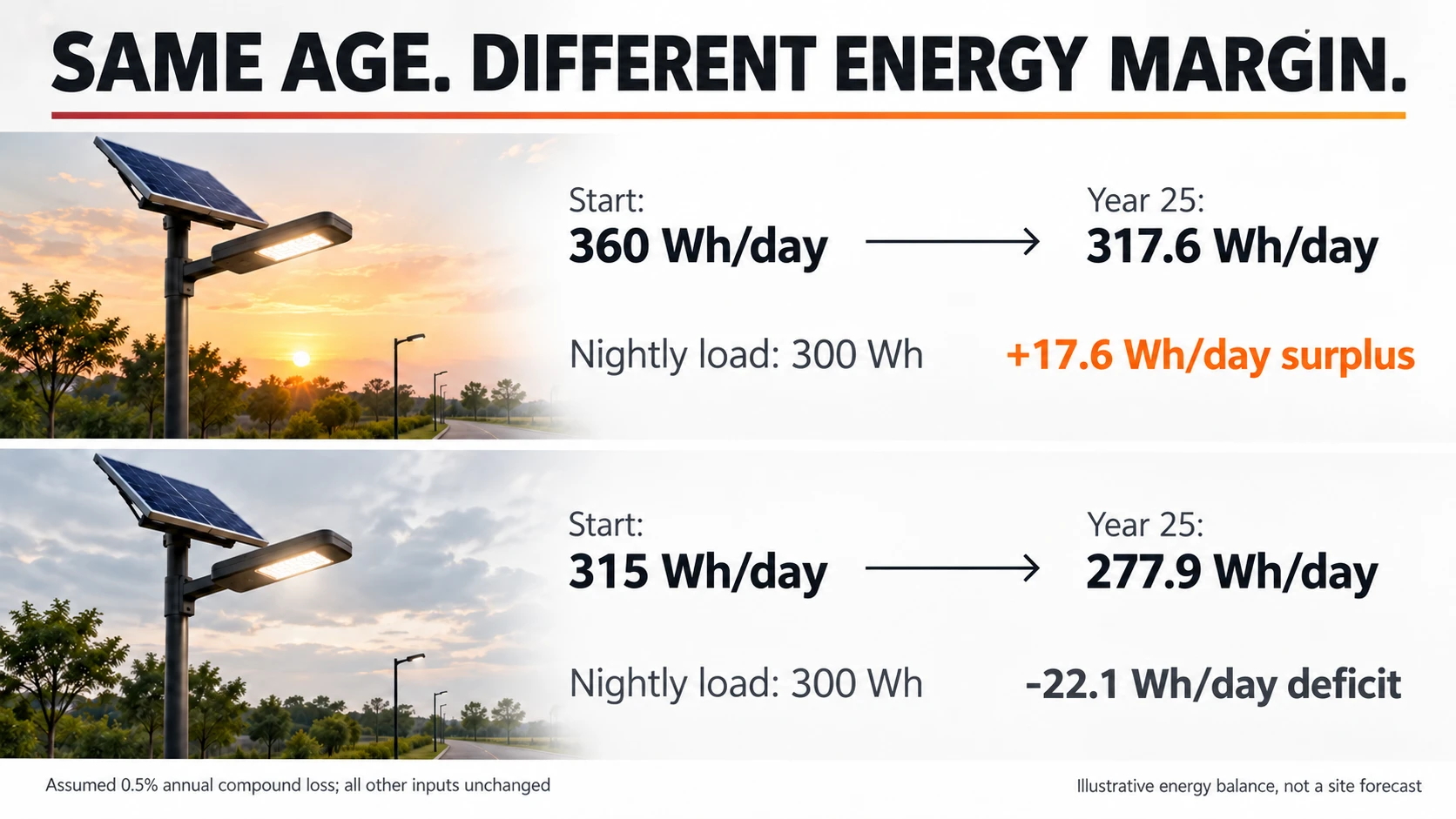
Consider two hypothetical solar-lighting configurations. Each draws 300 Wh per night at the battery boundary. In the same reference day, one initially supplies 360 Wh to that boundary and the other 315 Wh, with relevant charging-path losses already included. Apply the illustrative 25-year factor of 0.8822 to their daily charging energy, leaving weather, temperature, shading, losses and nightly demand unchanged. This is a sensitivity calculation, not a site forecast or a complete autonomy design.
| Illustrative configuration | Initial charging energy | Charging energy at year 25 | Daily balance against 300 Wh |
|---|---|---|---|
| Larger initial margin | 360 Wh/day | 317.6 Wh/day | +17.6 Wh/day |
| Smaller initial margin | 315 Wh/day | 277.9 Wh/day | −22.1 Wh/day |
The second configuration has an energy deficit even though its panel retains the same 88.2% as the first. The first still has a positive daily balance, but that alone does not prove adequate cloudy-day reserve or recovery after a low-sun sequence. Do not round a small surplus into a claim of all-night reliability. The decision needs the actual operating schedule, worst-month input and recovery requirement. Increasing battery capacity alone does not replenish energy that the PV system cannot harvest.
For a road, village or commercial car park, ask for this ageing sensitivity alongside the normal design check. Keep the panel’s remaining-power assumption distinct from battery usable capacity and lighting depreciation. The solar street light battery-sizing guide addresses storage and nightly demand; this page addresses the PV module’s continuing contribution.
A low-output day does not measure solar panel lifespan
A dusty panel, a new tree shadow and an ageing module can all reduce charging, but they call for different actions. Soiling and movable obstructions may be reversible. Heat and changing irradiance affect a reading taken that day. Damaged cells, interconnections, encapsulation or insulation may require specialist diagnosis or replacement. A controller limit, a full battery or a connection fault can also make recorded charging look low without proving a panel defect.
Compare like with like: module identity, orientation, irradiance, temperature, cleanliness and measurement boundary. Keep the commissioning record and later observations together. Open-circuit voltage alone does not establish available power or remaining life. Electrical checks and work at height belong to qualified personnel following the product manual and site safety procedures. The safe solar-panel testing guide explains those boundaries; do not short a module or bypass protection to investigate a lifespan claim.
When to retain, investigate or replace a panel
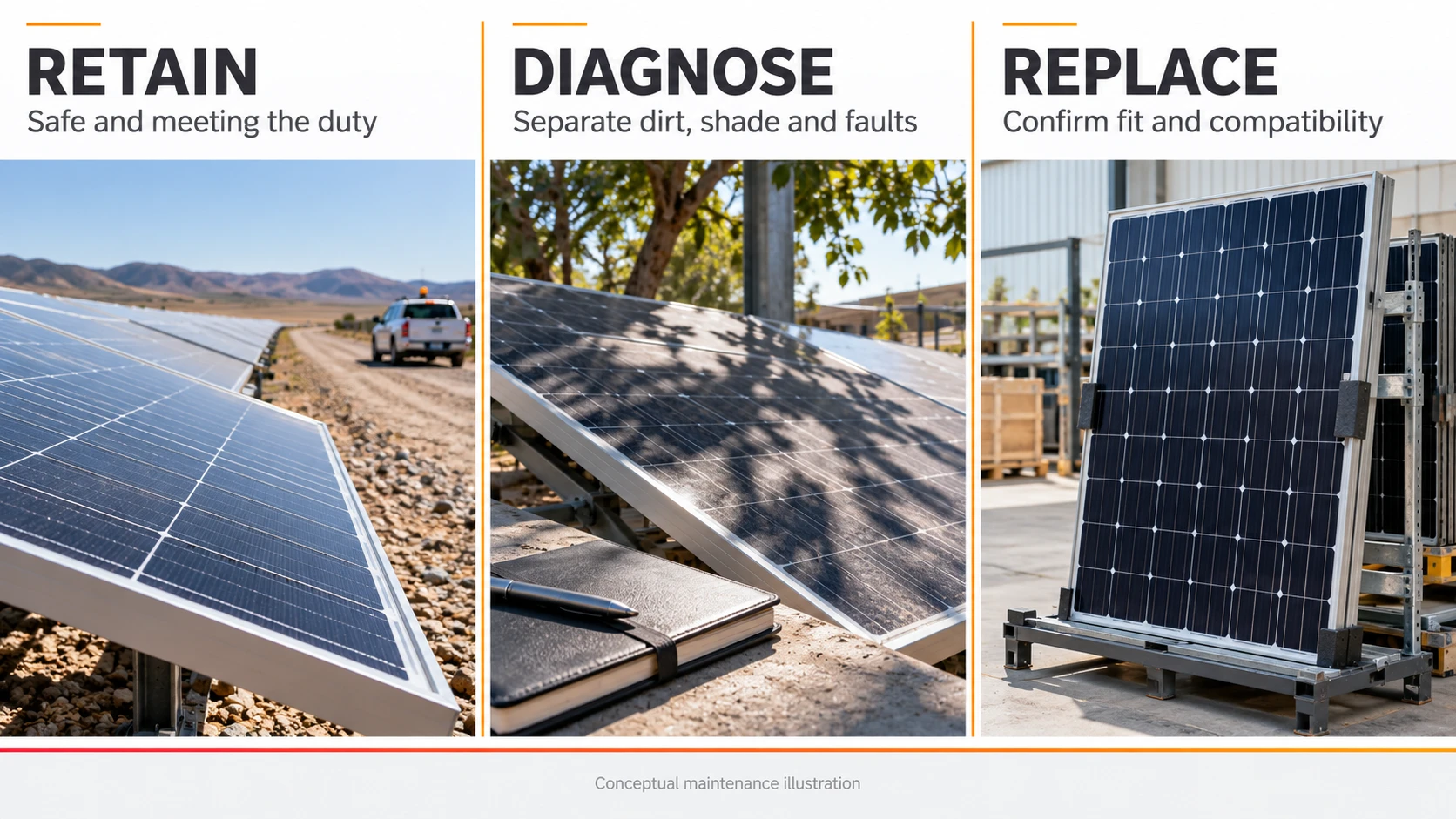
Age is a reason to review condition, not an automatic replacement instruction. For a fleet, separate a repeatable system-wide trend from a few damaged locations. Changing every module because some lights switch off early can leave the original charging, storage or control fault unresolved. Start with the failed function and the evidence, then choose the smallest safe intervention.
| Observed condition at review | Decision to assess | Before authorising service |
|---|---|---|
| Safe module, required energy duty still met | Retain and monitor | Record the baseline and next review trigger |
| Output low; dirt, shade or system limit not excluded | Diagnose before buying a panel | Separate module loss from site and controller effects |
| Cracked glass, damaged insulation or other safety concern | Restrict access and obtain qualified assessment | Follow site isolation and replacement procedures |
| Confirmed inadequate PV contribution or uneconomic repair | Assess compatible replacement or redesign | Recheck electrical limits, mounting, load and recovery |
A longer-lived replacement still has to fit the system
Replacement access differs by construction. In an Inlux All-in-One configuration, the panel forms part of an integrated lighting assembly. An Inlux All-in-Two configuration uses a separate PV module. Neither arrangement guarantees a particular replacement time or allows an arbitrary higher-wattage panel. Confirm the offered variant’s service procedure, spare-part identification and mounting arrangement before awarding a long-term maintenance contract.
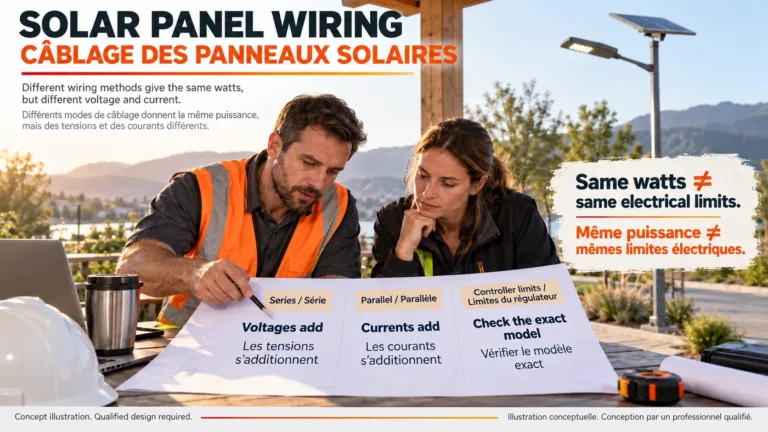
Match more than the wattage label. Verify module dimensions, mounting points, weight and wind-loading implications; voltage and current limits across relevant temperatures; connector compatibility; and the controller’s accepted PV operating range. Consult the PV module dimensions guide. A further reference is series and parallel PV input comparison for PV input compatibility. A replacement that physically fits can still be electrically unsuitable.
Keep three items attached to the purchase record: the identified module and its performance-warranty wording; the lighting configuration and assumptions used to assess ageing; and responsibility for diagnosis, access equipment, labour, transport and disposal. When comparing lifetime cost, include those service costs rather than treating a free replacement module as a cost-free intervention. Retired modules should go through the appropriate local collection and treatment route, not be placed back in service merely because they still produce voltage.
Questions buyers ask about solar panel lifespan
Do solar panels stop working after 25 years?
No. Twenty-five years is not an electrical cut-off. Some panels remain useful longer; others are retired earlier because of damage, inadequate output or an upgrade decision. Judge safety and useful performance separately from the warranty anniversary.
Can solar panels last 40 years?
A module surviving that long does not establish a 40-year life for a new installation. Continued use requires acceptable condition, safe operation and enough output for the intended duty. Do not extend a bid’s design life from an exceptional old-module example.
Does cleaning reverse solar panel degradation?
Cleaning may recover output lost to removable dirt. It does not reverse permanent cell or material degradation. Compare performance under comparable conditions after safe cleaning and shade checks before assigning the remaining loss to age.
Does a panel performance warranty guarantee all-night lighting?
No. It concerns stated module performance under its contractual conditions. Nightly lighting also needs adequate solar input, compatible charging, usable battery energy and the correct operating schedule. A panel can meet its warranted power floor while an undersized system misses its nightly duty.
Should panels be replaced whenever the battery is replaced?
Not automatically. Inspect and assess both components against their own requirements. A sound panel may remain suitable after a battery change. For the complete asset, the component-by-component solar-light service-life guide covers the separate replacement decisions.
Will a higher-wattage replacement extend useful service?
Only if it is compatible and addresses the actual constraint. Extra rated watts do not fix shade, a controller fault or a damaged battery. Check electrical limits, mounting, temperature behaviour and the revised energy balance before approving a change.
Bring the module and the lighting duty into the same enquiry
Inlux Solar’s standard warranty is five years. That company-level term is not a 25-year panel-performance promise, and the precise offered scope must remain in the quotation. Review the solar street light product range. Commercial sites can also examine the commercial solar parking-lot lighting options. Compare the actual service duty rather than the largest lifespan number.
For a new project or replacement review, send the location, night-time operating schedule, known shading, existing module and controller identification, observed problem and quantity. State whether the aim is restoring service, increasing reserve or standardising spares. Request a configuration and lifecycle review so the module choice, energy margin and maintenance route can be assessed together.