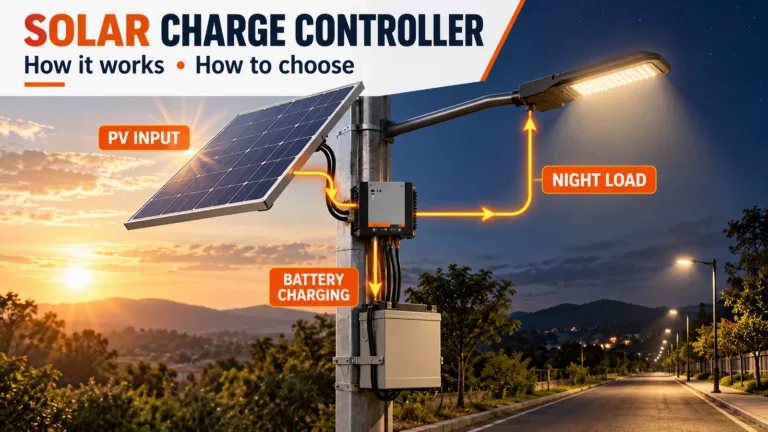
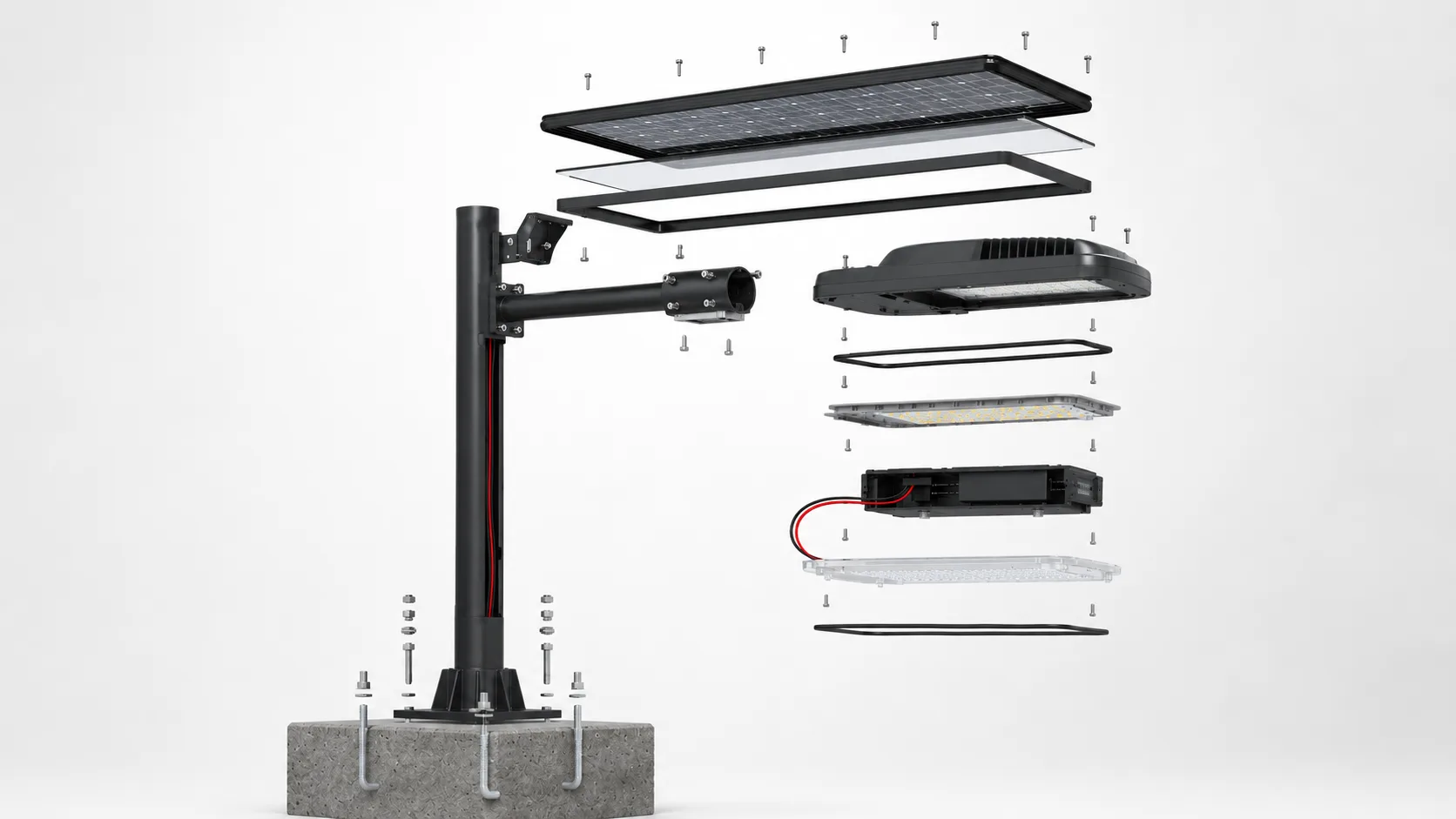
Street lights are made of more than a pole and a bulb. A complete street light normally includes a pole, luminaire housing, LED light engine, optical lens, wiring, grounding, controls, foundation, fasteners and protective finishes. A solar street light adds a photovoltaic panel, rechargeable battery, charge controller, brackets and often a battery box or integrated electronics compartment.
That material stack matters because each part fails in a different way. A pole is judged by strength, corrosion resistance and wind loading. A luminaire is judged by heat dissipation, sealing and optical control. A solar unit is judged by panel exposure, battery life, controller protection and whether service teams can reach the parts without replacing the whole light.
The Short Answer
Most modern street lights are built from these material groups:
| Bagian | Common materials | Why it is used |
|---|---|---|
| Pole | Galvanized steel, painted steel, aluminum, concrete or composite | Structural support, wind resistance and corrosion control |
| Luminaire housing | Cast or die-cast aluminum | Heat dissipation, low weight and corrosion resistance |
| Lens or cover | Tempered glass, polycarbonate or acrylic | Optical control, impact protection and weather sealing |
| LED light engine | LED chips, metal-core PCB, driver and heat sink | Efficient light output and thermal control |
| Wiring and grounding | Copper or aluminum conductors, grounding hardware | Power delivery and electrical safety |
| Foundation and anchors | Reinforced concrete, anchor bolts, nuts and washers | Stability and load transfer into the ground |
| Finish and sealing | Hot-dip galvanizing, powder coating, gaskets and stainless hardware | Protection from rain, salt, dust and vibration |
| Solar parts | PV module, battery, controller, brackets and battery enclosure | Off-grid energy generation, storage and lighting control |
The City of Los Angeles describes a streetlight as infrastructure, not just a visible fixture: a pole and light source connected to a wider underground conduit and copper-wire network. See the LA Bureau of Street Lighting FAQ: what is a streetlight. That is the right way to think about materials: visible parts plus the electrical and structural system behind them.
Main Street Light Components
A street light can look simple from the road, but the bill of materials is usually split into structural, optical, electrical and control parts.
Pole
The pole carries the luminaire, arm, wiring, grounding point and sometimes extra attachments. For roadway lighting, steel and aluminum are the most common choices. NYC’s official Street Design Manual lists steel Octagonal and Davit poles as current standard street light poles for city streets, with LED luminaires as indicated: NYC Street Design Manual – Lighting.
Steel is used when strength, stiffness and predictable fabrication matter. It is often galvanized or painted to slow corrosion. Aluminum is lighter and naturally corrosion resistant, which can help in decorative, coastal or lower-load applications. Concrete and composite poles also exist, but buyers should check local standards, wind zone, maintenance method and replacement availability before specifying them.
Arm, bracket and mounting hardware
The arm or bracket sets the luminaire position over the road. It must resist vibration and wind while keeping the fixture level. Hardware is a small cost item that can become a failure point if it corrodes, loosens or uses mismatched metals. For public projects, ask whether bolts, washers, screws and exposed fittings are corrosion resistant and whether the handhole cover can be serviced without damaging the finish.
Luminaire housing
The luminaire housing is the metal body that holds the LED engine, driver, optics and seals. Aluminum is common because it is light, corrosion resistant and conducts heat away from LED boards. Boise’s LED street lighting specification states that roadway LED luminaire housing and heat sink should be constructed out of aluminum and that hardware should be corrosion resistant: City of Boise LED street lighting specification.
Good housing design does two things at once: it protects the electronics from water and dust, and it moves heat out of the LED module. If the housing traps heat, lumen output and driver life suffer even when the LED chip itself is high quality.
LED light engine and driver
Modern street lights usually use LEDs instead of HPS, mercury vapor, metal halide or incandescent lamps. The LED light engine includes LED chips or modules, a PCB, thermal path, driver, surge protection and wiring connections.
The driver converts input power into the right current for the LEDs. It is often the part that determines how well the fixture handles voltage fluctuation, heat and surge events. For procurement, the driver should be treated as a system component, not an anonymous accessory hidden inside the housing.
Lens, optic and cover
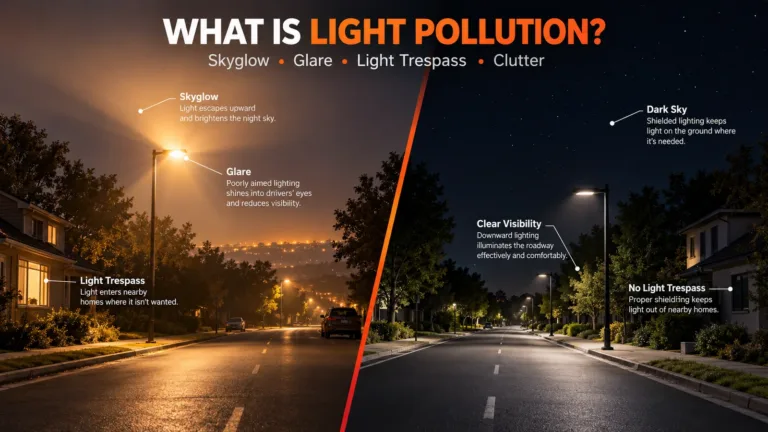
The lens controls where the light goes. Street lighting optics may be molded lenses, refractors or glass covers depending on the fixture. Polycarbonate is impact resistant and light. Tempered glass can resist scratching and heat better in some applications. Acrylic appears in some decorative or lower-impact designs.
The important buyer question is not only “what is the lens made of?” It is whether the optical material gives the required distribution, stays clear in the local climate, resists UV exposure and seals properly against dust and water.
Wiring, grounding and conduit
Grid-connected street lights need conductors, grounding and often underground conduit. LA reports that its streetlighting system is connected by thousands of miles of conduit and copper wire; the exact network is city-specific, but the principle is universal: the visible pole depends on a hidden electrical system.
Solar street lights reduce or remove trenching for grid power, but they still need internal wiring between panel, controller, battery and LED load. Cable gauge, connector sealing, strain relief and battery-box routing become material decisions because they affect water ingress, voltage drop and serviceability.
Foundation, anchor bolts and base cover
The foundation holds the pole upright and transfers wind and weight into the ground. Common materials include reinforced concrete, steel anchor bolts, nuts, washers and sometimes a decorative or protective base cover. A beautiful pole with weak anchoring is not a good street light.
For RFQs, the foundation should not be copied from a picture. It should follow local soil, pole height, wind speed, fixture load and installation method. If you are comparing bids, ask each supplier whether foundation drawings and anchor-bolt patterns are included.
What Are Solar Street Lights Made Of?
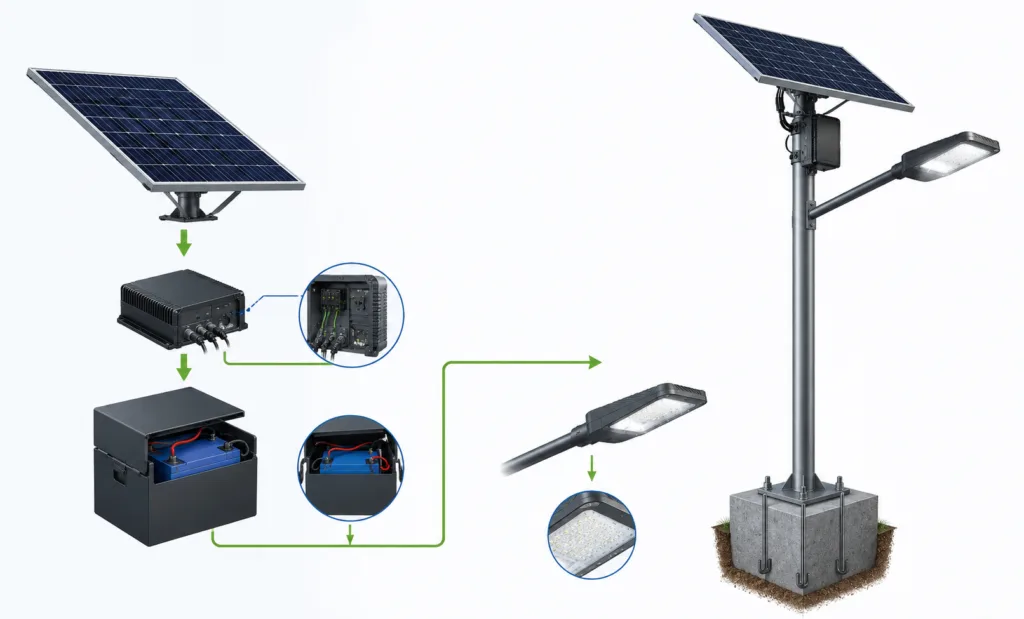
A solar street light includes the same lighting and structural parts, then adds its own power system.
This section is a materials overview. If you need a part-by-part sourcing or replacement list for panels, batteries, controllers, sensors, poles and accessories, use Inlux’s dedicated solar light parts guide. Keeping the materials overview separate from the parts guide helps buyers compare both the physical material stack and the serviceable component list.
Solar panel
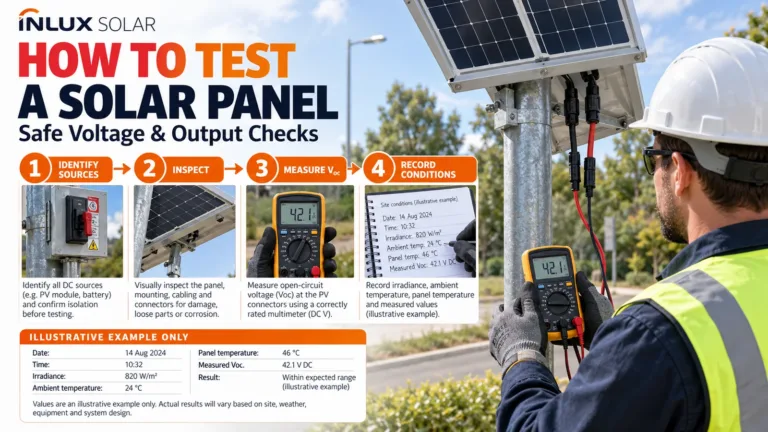
The solar panel is usually a glass-front PV module with silicon cells, aluminum frame, encapsulant, backsheet and junction box. In a split system, the panel is mounted separately from the luminaire. In an all-in-one or all-in-two system, the panel may be integrated into the fixture body or mounted close to it.
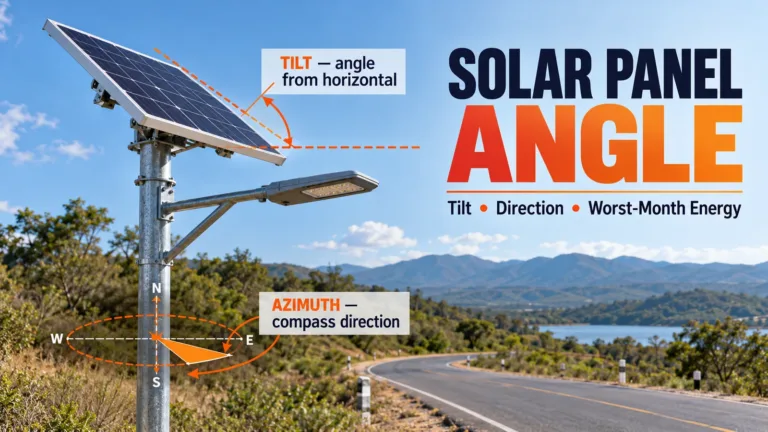
For project design, panel material is only one part of the question. Buyers should also check panel wattage, tilt, shading, soiling, wind load and whether the mounting frame can be adjusted for the site.
Baterai
Solar lights store daytime energy in a rechargeable battery. Modern project-grade systems commonly use lithium batteries, especially LiFePO4, while older or lower-cost systems may use lead-acid or gel batteries. The battery chemistry affects weight, cycle life, usable capacity, temperature behavior and replacement cost.
For deeper procurement detail, use Inlux’s guide to LiFePO4 battery lifespan in solar street lights. This article only covers what the system is made of.
Charge controller
The controller manages charging, discharging, dimming and protection. It may be a simple PWM controller or a higher-efficiency MPPT controller depending on system size and cost target. In solar street lighting, the controller is the decision center between panel, battery and LED load.
If a supplier gives a panel and battery size without controller details, the material list is incomplete. Compare controller type, protection logic and dimming schedule before comparing price. See MPPT vs PWM controller for the controller-specific decision.
Battery box and electronics compartment
The battery may sit in the pole, in a ground box, in a luminaire compartment, in an external box or inside an integrated all-in-one body. Material choices here affect theft resistance, water ingress, heat, ease of replacement and maintenance time.
For public roads and municipal projects, do not judge the box only by how clean it looks in a render. Ask where water goes, how cables enter, whether the gasket is replaceable, how the technician opens it and whether the battery can be replaced without removing the whole light.
Steel vs Aluminum Poles
Both steel and aluminum can be correct. The better choice depends on load, corrosion environment, design style, cost and maintenance expectations.
| Bahan | Strengths | Watch-outs |
|---|---|---|
| Galvanized steel | Strong, widely available, familiar to municipal installers | Needs coating protection and proper corrosion detailing |
| Painted or powder-coated steel | Good structural option with color control | Finish damage can expose steel if not maintained |
| Aluminum | Lighter, corrosion resistant, good for decorative or coastal contexts | Lower stiffness than steel in some designs; cost and wall thickness matter |
| Concrete | Durable, heavy and familiar in some regions | Transport, impact repair and appearance can be limiting |
| Composite or fiberglass | Corrosion resistant and lightweight in some applications | Local approval, UV behavior and long-term familiarity vary by market |
Seattle City Light’s ornamental streetlight standard is a useful example of why “steel pole” is not a vague phrase. The standard specifies Chief Seattle ornamental steel streetlight poles, industry standards, galvanized steel construction and shaft attributes: Seattle City Light steel streetlight pole standard.
For a buyer, the lesson is simple: ask for the pole material, finish, wall thickness or equivalent structural basis, handhole design, anchor detail and applicable standard. A quote that says “strong pole” is not enough for a roadway project.
Materials That Affect Maintenance Most
The parts most likely to affect maintenance are not always the most visible.
Heat path
LED output and driver life depend on heat control. Aluminum housings and heat sinks are used because they move heat away from the LED board. If the fixture is sealed well but sheds heat poorly, it can still fail early.
Seals and gaskets
Gaskets protect against water, dust and insects. They also age under UV, heat and repeated service. A fixture that requires gasket damage during maintenance is a long-term maintenance problem.
Fasteners
Cheap screws can corrode, strip or seize. Stainless or corrosion-resistant hardware is especially important for coastal sites, humid climates and solar products where batteries or controllers may need periodic access.
Connectors
Solar street lights rely on connectors between the PV module, controller, battery and LED load. Waterproof connectors, strain relief and clear polarity reduce installation errors and service calls.
Finish
Hot-dip galvanizing, powder coating, paint systems and surface preparation protect metal parts. The finish should match the exposure: inland city street, coastal road, desert dust, rainy tropical site or industrial zone.
How to Read a Street Light Materials List
If you are comparing suppliers, ask for a materials list in this order:
- Pole material, height, arm, finish and anchor-bolt pattern.
- Luminaire housing material, heat-sink design, sealing and optical distribution.
- LED module, driver, surge protection and dimming control.
- Lens or cover material and impact/weather rating.
- Wiring, connectors, grounding method and access points.
- Foundation drawing or foundation assumptions.
- For solar: panel, battery chemistry, controller type, autonomy design and battery-box material.
- Warranty scope: what is covered, what is excluded and which parts are replaceable.
This is where a traffic article becomes a procurement article. A page can answer “what are street lights made of” in one paragraph, but an EPC buyer needs to know which materials create risk after installation.
For solar projects, the material list should connect to energy sizing. A good bill of materials still fails if the panel and battery are undersized for the site. Use Inlux’s autonomy days calculation guide when you need to move from “what parts are included” to “will this system stay on through bad weather?”
Specification Fields Worth Requesting
A material list becomes useful when it can be checked against a drawing, test report or installation method. For a street lighting RFQ, request these fields before comparing unit price:
| Field | Mengapa ini penting |
|---|---|
| Pole standard or load basis | Confirms the pole is designed for the required height, arm, fixture and wind exposure |
| Galvanizing or coating standard | Shows how steel parts are protected before powder coating or paint |
| Housing and heat-sink material | Connects LED temperature control to the metal body, not only to LED chip brand |
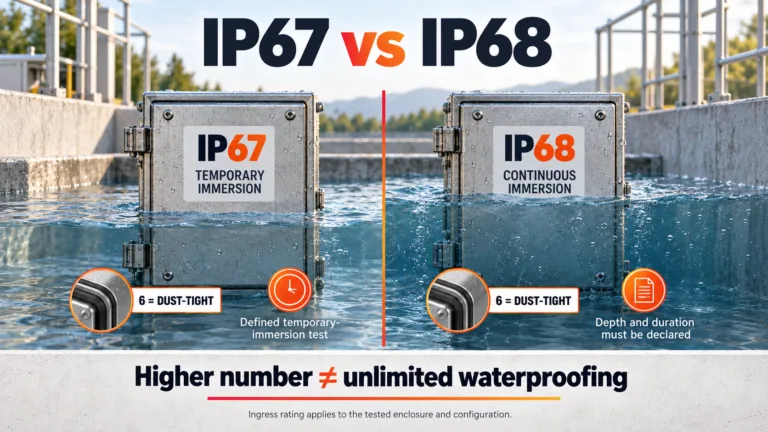
| IP and IK ratings | Checks dust, water and impact protection; use Inlux’s IP/IK rating selection guide when the site has rain, dust or vandalism risk |
| LM-80, TM-21 or photometric basis | Separates LED package data from complete fixture performance; see thermal management and lumen depreciation |
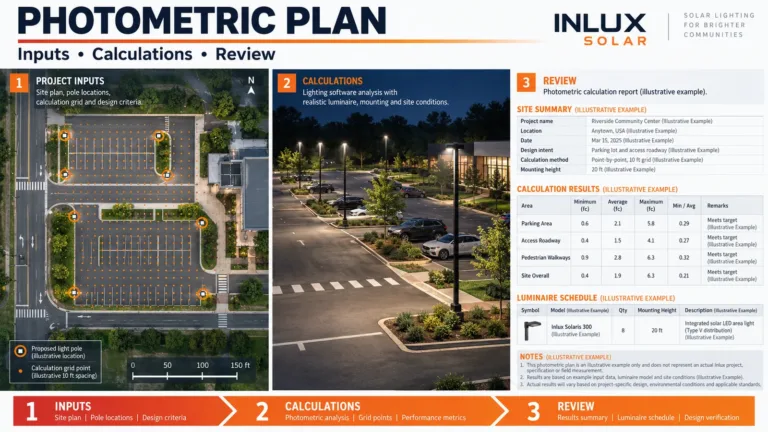
| IES or LDT file | Lets designers verify distribution in DIALux or equivalent software; see IES and DIALux resources |
| Controller and dimming schedule | Determines how the system protects the battery and manages nightly output |
| Replaceable parts list | Shows whether future maintenance replaces a driver, battery or controller instead of the whole fixture |
Inlux Perspective: Material Choices Should Match the Project
Inlux Solar supplies solar street lighting systems for municipal, EPC, government and humanitarian projects. The locked project baseline is 300,000+ total units delivered across 60+ countries and 1,000+ projects; see the Inlux project portfolio dan produsen lampu jalan surya page for product and procurement context.
From an engineering perspective, the best material choice is rarely the most expensive part on a spreadsheet. It is the combination that fits the site:
- coastal road: corrosion-resistant finish, sealed housing, serviceable hardware
- windy open highway: pole strength, panel wind load and anchor design
- hot climate: thermal path, battery placement and electronics derating
- theft-prone area: battery-box location, fastener access and cable routing
- municipal retrofit: bracket compatibility, foundation reuse and maintenance method
- rural solar project: panel exposure, autonomy, controller protection and local service tools
If a supplier’s quote does not explain these tradeoffs, the material choice is not yet ready for tender comparison.
Procurement Checklist
Use this checklist before approving a street light or solar street light material proposal:
- Does the quote name the pole material and finish, or only say “metal pole”?
- Does the luminaire housing describe aluminum body, heat sink and sealing?
- Are driver, surge protection and controller details listed separately?
- Is the lens or optic material named?
- Are anchor bolts, foundation assumptions and wind load considered?
- For solar, are PV module, battery chemistry, controller type and autonomy days specified?
- Can the battery, driver and controller be serviced without replacing the complete unit?
- Are coating, gasket and fastener materials suitable for the local climate?
- Does the supplier provide IES files, DIALux support or photometric data when required?
- Is the warranty tied to replaceable components, not only the complete fixture?
For a structured RFQ, use Inlux’s RFQ and BOQ requirements guide or the RFQ/BOQ kit.
Pertanyaan yang Sering Diajukan
Are street light poles steel or aluminum?
Both are common. Many city roadway standards use steel poles, while aluminum appears in decorative, coastal and lower-weight applications. The right choice depends on height, wind load, corrosion exposure, budget and local approval.
What is the light fixture body made of?
Modern LED street light housings are often aluminum because aluminum helps dissipate heat and resists corrosion. The housing may also include gaskets, stainless or corrosion-resistant hardware, a driver compartment and an optical lens.
What are solar street lights made of?
A solar street light includes a pole, LED luminaire, PV module, rechargeable battery, charge controller, wiring, brackets and an enclosure for the battery or electronics. The exact layout depends on whether the product is all-in-one, all-in-two or split type.
Is the lens glass or plastic?
It can be either. Tempered glass, polycarbonate and acrylic are all used in different fixtures. The choice should match impact risk, UV exposure, optical distribution, heat and maintenance requirements.
Why do materials matter for street light lifespan?
Materials control corrosion, heat, sealing, vibration resistance and serviceability. A good LED chip cannot save a poor housing, weak gasket, undersized pole or badly protected driver.
Technical Sources
- LA Bureau of Street Lighting: General Streetlighting FAQ
- NYC Street Design Manual: Lighting
- Seattle City Light: Steel Streetlight Poles, Ornamental, Chief Seattle
- City of Boise: Specifications for LED Street Lighting
Need a Street Light Materials Review?
If you are comparing solar street light quotations, send Inlux Solar your pole height, road width, target lighting level, site location, autonomy requirement and preferred product format. The Inlux engineering team can review the material stack, battery/controller choice, panel sizing and photometric requirements before you lock the BOQ.
Mulailah dengan solar street light product hub or send the project details through Hubungi Kami.