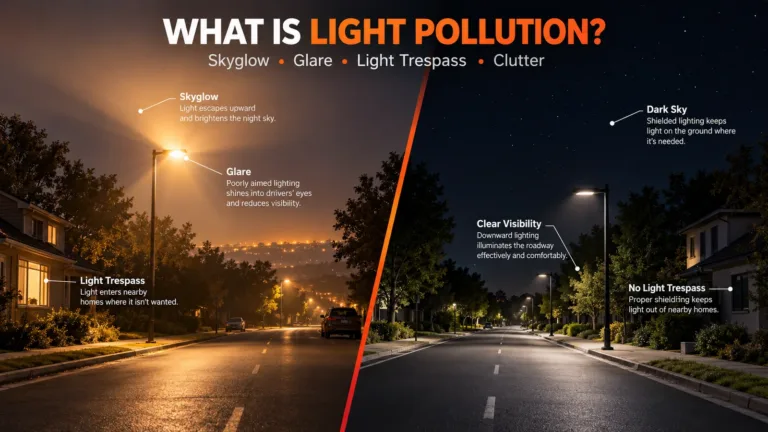
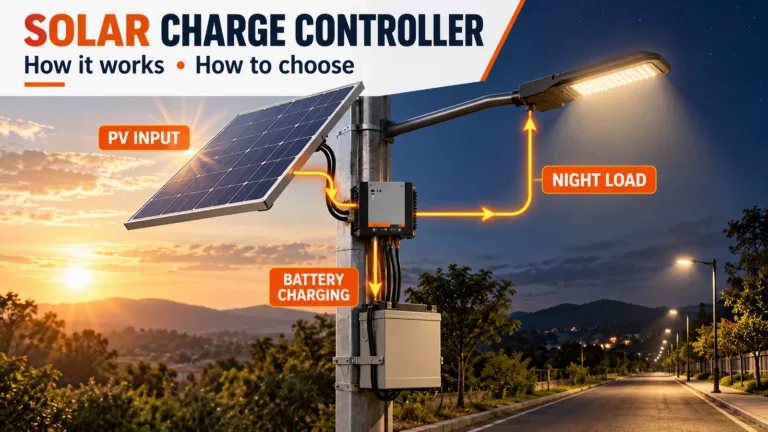
A solar street light is an off-grid outdoor lighting system that uses a photovoltaic (PV) panel to charge a battery during the day and power an LED luminaire after dark. A project-grade system also includes a charge controller, optics, mounting structure and a programmed lighting profile.
For roads, parking areas and public spaces, the right solar street light is selected by more than wattage. Road width, pole height, target light level, operating hours, local solar conditions, low-sun autonomy, wind exposure and maintenance access must all be checked before a model is specified.
Quick project check: prepare the installation city, road width, pole height, pole spacing, operating schedule, autonomy target and quantity before asking for a recommendation.
Komponen utama
- Modul PV (panel mono/setengah sel),
- Pengontrol muatan MPPT/PWM,
- Baterai (LiFePO₄ atau lithium-ion mainstream untuk masa pakai siklus tinggi),
- Luminer & optik LED efisiensi tinggi,
- Tiang/braket & kabel, sensor opsional/pemantauan jarak jauh.
Cara kerjanya (siklus siang/malam)
- Hari: PV mengubah sinar matahari menjadi DC → pengontrol mengisi daya baterai dengan mengikuti algoritma yang dioptimalkan (MPPT meningkatkan hasil panen).
- Malam: Pengontrol menyalakan LED per profil peredupan (misalnya, 100% pada saat puncak hunian; 30-50% pada malam hari) untuk menyeimbangkan tingkat cahaya dan otonomi energi. (Praktik umum dalam desain pencahayaan di luar jaringan).

For a component-by-component explanation of charging, storage and control, read how solar lights work from sunlight to light at night.
Jenis & kapan menggunakannya
| System type | Best fit | Choose it when | Use caution when | Project inputs to confirm |
|---|---|---|---|---|
| Lampu Jalan Tenaga Surya All-in-One | Community roads, pathways, parks, parking areas and fast-deployment projects | You want compact equipment, minimal cabling and straightforward installation. | The site needs very large battery capacity, flexible panel orientation or extended low-sun autonomy. | Road width, pole height, mounting space, dimming profile and autonomy target. |
| All-in-Two Solar Street Light | Municipal roads, main corridors and sites where panel orientation needs more flexibility | You need a separate PV panel position while keeping the battery and luminaire in a compact assembly. | The buyer requires the smallest possible fixture or has very limited pole space. | PV orientation, pole-arm design, wind load, battery capacity and lighting layout. |
| Lampu Jalan Tenaga Surya Tipe Split | Wide roads, higher-output public lighting, rainy-season projects and remote infrastructure | You need more flexibility to size and locate the PV panel, battery and luminaire separately. | The project cannot support more detailed installation, cabling and maintenance planning. | Solar resource, low-sun days, battery service access, cable route, theft risk and civil-work scope. |
Need a deeper comparison? Read our All-in-One vs All-in-Two vs Split Solar Street Lights guide before choosing a system architecture.
Model Lampu Jalan Tenaga Surya All-In-Two
Kami All-In-Two Solar Street Light is available in the JAGUAR, Falcon, and Bison series. Utilizing the latest semi-integrated design, the lithium battery and solar controller are housed within the light casing, while the solar panel is mounted externally. A separate design of the solar panel ensures a large solar panel capacity to achieve big LED output and the semi-integrated design simplifies installation while significantly enhancing anti-theft security.

JAGUAR (INL-AIT5)
All-in-two output tinggi dengan 5050 LED, LiFePO4 besar, optik canggih yang dibuat untuk jalan raya dan jalan utama.

ELANG (INL-AIT6)
Output menengah, optik serbaguna, pemasangan cepat-ideal untuk jalan, jalan setapak, dan lahan.

BISON (INL-AIT7)
Ringkas, efisien, >180 lm/W kelas komunitas dan halaman industri siap pakai.
Model Lampu Jalan Tenaga Surya All-In-One
Kami Lampu Jalan Tenaga Surya All-In-Onet tersedia dalam seri SIRIUS (INL-AIO9), GALAXY (INL-AIO6), ALIEN (INL-AIO5), dan POLARIS (INL-AIO2). Memanfaatkan desain terintegrasi terbaru, baterai lithium, pengontrol tenaga surya, dan panel surya, semuanya ditempatkan di dalam casing lampu. Desain ini menyederhanakan pemasangan sekaligus meningkatkan keamanan anti-pencurian secara signifikan.

SIRIUS (INL-AIO9)
AIO output tinggi dengan head yang dapat disesuaikan, optik Tipe II/III, 5050 LED, dan LiFePO4-dibangun untuk jalan raya dan jalan raya dua arah.

GALAKSI (INL-AIO6)
AIO modular untuk output kecil hingga sedang; 5050 LED, LiFePO4, dan gerakan opsional/IoT-perawatan yang mudah untuk jalan, jalan setapak, parkir.

ALIEN (INL-AIO5)
AIO lengan ganda dengan penyesuaian vertikal/horizontal dan optik presisi-ideal untuk jalan yang kompleks, kampus, dan kawasan industri.

POLARIS (INL-AIO2)
AIO yang ringkas dan hemat biaya menggunakan panel efisiensi tinggi, 5050 LED dan LiFePO4 yang dapat diandalkan untuk jalan perumahan, taman, dan trotoar.
For commercial, municipal and public-infrastructure applications, explore commercial solar street light systems and compare the project inputs for each type.
How to Select a Solar Street Light for a Road Project
Start with the road or site, not a nominal wattage. The lighting layout should define the required pole height, spacing, optical distribution, illuminance or luminance target, and uniformity. The solar system is then sized around the LED load, dimming schedule, local solar resource, system losses and required low-sun autonomy.
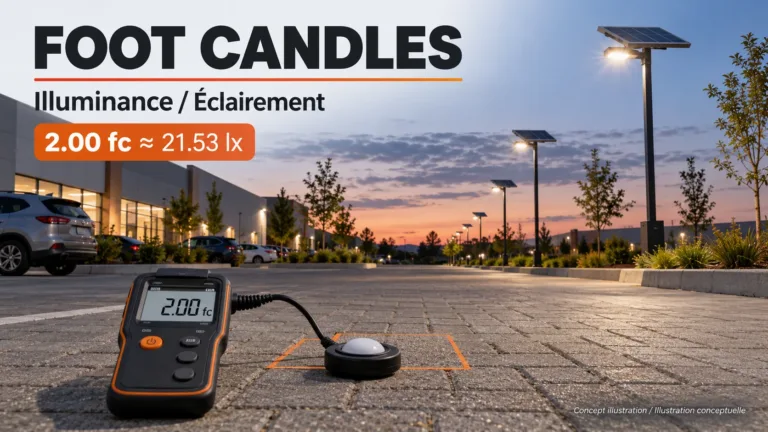
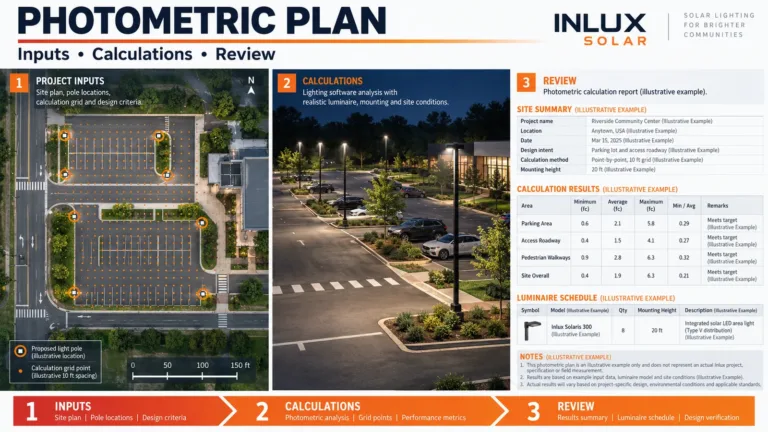
Use EN 13201 or IES road-lighting criteria where applicable, then verify the proposed layout with the relevant photometric files. A higher-wattage fixture is not automatically the better choice if its optics, pole layout or solar-energy budget do not fit the site.
Before requesting a quotation, confirm:
- Road width, traffic pattern and the area to be lit
- Pole height, arm length and planned pole spacing
- Required operating hours and dimming profile
- Installation city, shading, dusty season and expected low-sun period
- Wind, corrosion and foundation requirements
- Maintenance access, monitoring needs and project quantity
Sizing Checks Before You Request a Quote
The example below explains the calculation logic only. Final PV and battery sizing must be based on the actual installation location, solar resource, temperature range, required lighting profile, component specifications and approved engineering assumptions.
Masukan (contoh)
- Daya LED: 40 W
- Profil peredupan: 6 jam @ 100% + 6 jam @ 30%
- Efisiensi sistem (pengontrol/kabel): 85%
- Baterai: Lithium, desain DOD = 80%
- Tegangan sistem: 24 V
- Hari-hari otonomi: 2
- Jam Puncak Matahari Bulan Terburuk (PSH): 4,0 jam/hari
- Penurunan daya PV (suhu/kotoran/penuaan): 0.75
1) Energi LED harian (Wh):
- 40 W × 6 jam = 240 Wh
- 0,3 × 40 W × 6 jam = 72 Wh
- Total = 312 Wh/hari
2) Termasuk kerugian sistem:
- Energi harian yang disesuaikan = 312 ÷ 0,85 = 367,06 Wh/hari
3) Kapasitas baterai (Ah):
Formula: Ah = (Wh Harian × Otonomi) ÷ (Sistem V × DOD)
- (367.06 × 2) ÷ (24 × 0.8) = 38,24 Ah
- Rekomendasi: pilih ≥ 40 Ah @ 24 V (≈ 960 Wh dapat digunakan) untuk margin.
4) Ukuran array PV (Wp):
Formula: Wp = Wh harian ÷ (PSH × PV derate)
- 367.06 ÷ (4.0 × 0.75) = 122,35 Wp
- Tambahkan ≥ margin desain 20% → 150-180 Wp direkomendasikan.
Aturan praktis:
- Otonomi yang umum adalah 2-3 malam; di musim dingin yang keras/daerah hujan, pertimbangkan 5-7 malam.
- LiFePO₄ mendukung DOD yang lebih tinggi, membantu mengurangi volume dan massa sambil mempertahankan masa pakai.
For a project-specific calculation, send the site location, operating schedule, target autonomy, road geometry and lighting target. Inlux Solar can match the system configuration to the project inputs and provide the relevant technical documentation.
What Makes a Solar Street Light Reliable in Real Conditions?
Solar street light reliability is decided by the complete system, not by the lamp head alone. A suitable design considers the local solar resource, battery temperature, panel soiling, corrosion exposure, wind loading, optical performance and the practical ability to maintain the installation.
For hot, dusty, coastal or long-rainy-season locations, ask how the proposed PV panel, battery, controller, housing, pole and mounting system are configured for those conditions. The quotation should also state the operating profile and the assumptions used to calculate low-sun autonomy.
- Solar resource and seasonal shading
- Battery temperature and usable capacity
- Panel cleaning access and dust accumulation
- IP/IK requirements and corrosion exposure
- Pole, bracket, foundation and wind-load design
- LED optics, dimming profile and maintenance access
Need a Solar Street Light Design for Your Project?
Send your project location, road width, pole height, pole spacing, target lighting level, operating schedule, autonomy target and quantity. Our engineering team can recommend a suitable system type and provide product documentation, photometric files and layout support where available.
See solar street light project examples for applications across roads, communities and public infrastructure.
Daftar periksa pemasangan dan pemeliharaan
For the on-site process, use our solar street light installation guide covering site survey, foundation, pole erection and commissioning.
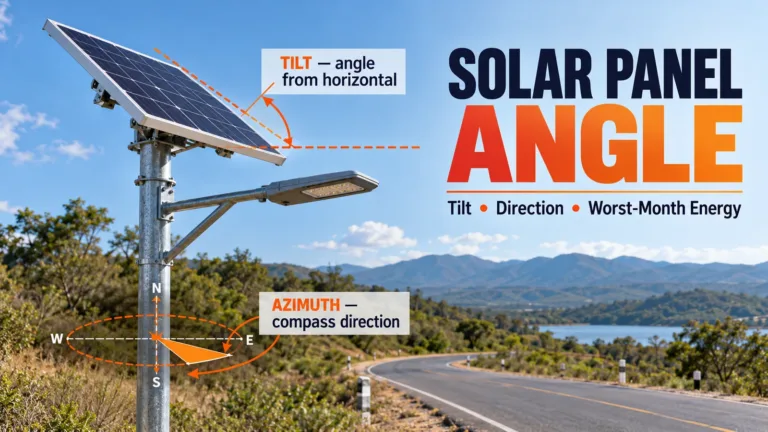
- Lokasi & bayangan: pastikan PSH pada bulan terburuk dan hindari naungan pohon/bangunan.
- Tiang & beban angin: periksa area layar yang efektif (terutama untuk all-in-one head) dan gunakan flens dan sangkar jangkar yang memadai.
- Optik & pembidikan: mencocokkan lebar jalan dan kemundurannya; memverifikasi pencahayaan/keseragaman di lokasi.
- Firmware: profil peredupan berbasis waktu program atau berbasis sensor; tren tegangan/arus log.
- Perawatan rutin: bersihkan panel setiap tiga bulan hingga setengah tahun sekali (lebih sering di daerah berdebu/pesisir); lakukan pengencangan ulang pada pengencang; tinjau kesehatan baterai setiap tahun.
Sertifikasi dan peringkat
- Peringkat IP (IEC 60529): untuk jalan raya dan lingkungan pesisir, IP66 umumnya ditentukan.
- Peringkat IK (EN/IEC 62262): IK08-IK10 untuk ketahanan terhadap benturan/perusakan.
- UN38.3: uji transportasi wajib untuk baterai litium (udara/laut/darat).
- Gunakan IES RP-8 atau EN 13201 sebagai dasar penerimaan Anda untuk proyek jalan raya dan parkir.