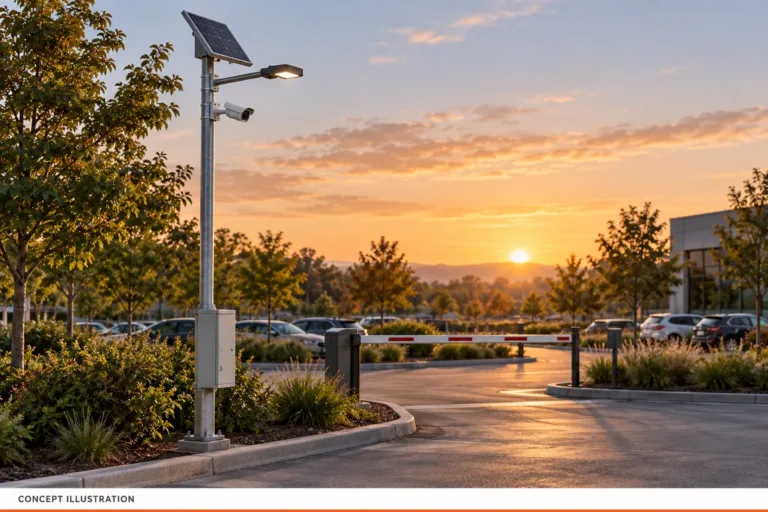
A solar street light is an off-grid outdoor lighting system that uses a photovoltaic (PV) panel to charge a battery during the day and power an LED luminaire after dark. A project-grade system also includes a charge controller, optics, mounting structure and a programmed lighting profile.
For roads, parking areas and public spaces, the right solar street light is selected by more than wattage. Road width, pole height, target light level, operating hours, local solar conditions, low-sun autonomy, wind exposure and maintenance access must all be checked before a model is specified.
Quick project check: prepare the installation city, road width, pole height, pole spacing, operating schedule, autonomy target and quantity before asking for a recommendation.
Key components
- PV module (mono/half-cell panels),
- MPPT/PWM charge controller,
- Battery (LiFePO₄ or lithium-ion mainstream for high cycle life),
- High-efficiency LED luminaire & optics,
- Pole/brackets & wiring, optional sensors/remote monitoring.
How it works (day/night cycle)
- Day: PV converts sunlight to DC → controller charges the battery following an optimized algorithm (MPPT improves harvest).
- Night: Controller powers the LED per a dimming profile (e.g., 100% at peak occupancy; 30–50% late night) to balance light levels and energy autonomy. (General practice in off-grid lighting design.)

For a component-by-component explanation of charging, storage and control, read how solar lights work from sunlight to light at night.
Types & when to use them
| System type | Best fit | Choose it when | Use caution when | Project inputs to confirm |
|---|---|---|---|---|
| All-in-One Solar Street Light | Community roads, pathways, parks, parking areas and fast-deployment projects | You want compact equipment, minimal cabling and straightforward installation. | The site needs very large battery capacity, flexible panel orientation or extended low-sun autonomy. | Road width, pole height, mounting space, dimming profile and autonomy target. |
| All-in-Two Solar Street Light | Municipal roads, main corridors and sites where panel orientation needs more flexibility | You need a separate PV panel position while keeping the battery and luminaire in a compact assembly. | The buyer requires the smallest possible fixture or has very limited pole space. | PV orientation, pole-arm design, wind load, battery capacity and lighting layout. |
| Split Type Solar Street Light | Wide roads, higher-output public lighting, rainy-season projects and remote infrastructure | You need more flexibility to size and locate the PV panel, battery and luminaire separately. | The project cannot support more detailed installation, cabling and maintenance planning. | Solar resource, low-sun days, battery service access, cable route, theft risk and civil-work scope. |
Need a deeper comparison? Read our All-in-One vs All-in-Two vs Split Solar Street Lights guide before choosing a system architecture.
All-In-Two Solar Street Light Models
Our All-In-Two Solar Street Light is available in the JAGUAR, Falcon, and Bison series. Utilizing the latest semi-integrated design, the lithium battery and solar controller are housed within the light casing, while the solar panel is mounted externally. A separate design of the solar panel ensures a large solar panel capacity to achieve big LED output and the semi-integrated design simplifies installation while significantly enhancing anti-theft security.

JAGUAR (INL-AIT5)
High-output all-in-two with 5050 LEDs, large LiFePO4, advanced optics—built for highways and major roads.

FALCON (INL-AIT6)
Mid-output, versatile optics, fast installation—ideal for streets, pathways, and lots.

BISON (INL-AIT7)
Compact, efficient, >180 lm/W class—community and industrial yards ready.
All-In-One Solar Street Light Models
Our All-In-One Solar Street Light is available in the SIRIUS (INL-AIO9), GALAXY (INL-AIO6), ALIEN (INL-AIO5), and POLARIS (INL-AIO2) series. Utilizing the latest integrated design, the lithium battery, solar controller, and solar panel are all housed within the light casing. This design simplifies installation while significantly enhancing anti-theft security.

SIRIUS (INL-AIO9)
High-output AIO with adjustable head, Type II/III optics, 5050 LEDs and LiFePO4—built for two-way roads and highways.

GALAXY (INL-AIO6)
Modular AIO for small-to-medium outputs; 5050 LEDs, LiFePO4 and optional motion/IoT—easy maintenance for streets, pathways, parking.

ALIEN (INL-AIO5)
Double-arm AIO with vertical/horizontal adjustment and precision optics—ideal for complex roads, campuses, and industrial zones.

POLARIS (INL-AIO2)
Compact, cost-effective AIO using high-efficiency panel, 5050 LEDs and LiFePO4—reliable for residential streets, parks and walkways.
For commercial, municipal and public-infrastructure applications, explore commercial solar street light systems and compare the project inputs for each type.
How to Select a Solar Street Light for a Road Project
Start with the road or site, not a nominal wattage. The lighting layout should define the required pole height, spacing, optical distribution, illuminance or luminance target, and uniformity. The solar system is then sized around the LED load, dimming schedule, local solar resource, system losses and required low-sun autonomy.
Use EN 13201 or IES road-lighting criteria where applicable, then verify the proposed layout with the relevant photometric files. A higher-wattage fixture is not automatically the better choice if its optics, pole layout or solar-energy budget do not fit the site.
Before requesting a quotation, confirm:
- Road width, traffic pattern and the area to be lit
- Pole height, arm length and planned pole spacing
- Required operating hours and dimming profile
- Installation city, shading, dusty season and expected low-sun period
- Wind, corrosion and foundation requirements
- Maintenance access, monitoring needs and project quantity
Sizing Checks Before You Request a Quote
The example below explains the calculation logic only. Final PV and battery sizing must be based on the actual installation location, solar resource, temperature range, required lighting profile, component specifications and approved engineering assumptions.
Inputs (example)
- LED power: 40 W
- Dimming profile: 6 h @ 100% + 6 h @ 30%
- System efficiency (controller/wiring): 85%
- Battery: Lithium, design DOD = 80%
- System voltage: 24 V
- Days of autonomy: 2
- Worst-month Peak Sun Hours (PSH): 4.0 h/day
- PV derate (temperature/soiling/aging): 0.75
1) Daily LED energy (Wh):
- 40 W × 6 h = 240 Wh
- 0.3 × 40 W × 6 h = 72 Wh
- Total = 312 Wh/day
2) Include system losses:
- Adjusted daily energy = 312 ÷ 0.85 = 367.06 Wh/day
3) Battery capacity (Ah):
Formula: Ah = (Daily Wh × Autonomy) ÷ (System V × DOD)
- (367.06 × 2) ÷ (24 × 0.8) = 38.24 Ah
- In this example: 40 Ah @ 24 V gives 960 Wh nominal energy. At the assumed 80% DOD, 768 Wh is available before additional losses or reserve allowances; this is calculation arithmetic, not an Inlux model rating.
4) PV array size (Wp):
Formula: Wp = Daily Wh ÷ (PSH × PV derate)
- 367.06 ÷ (4.0 × 0.75) = 122.35 Wp
- Add ≥ 20% design margin → 150–180 Wp recommended.
Rules of thumb:
- Typical autonomy is 2–3 nights; in harsh winter/rainy regions consider 5–7 nights.
- LiFePO₄ supports higher DOD, helping reduce volume and mass while maintaining cycle life.
For a project-specific calculation, send the site location, operating schedule, target autonomy, road geometry and lighting target. Inlux Solar can match the system configuration to the project inputs and provide the relevant technical documentation.
What Makes a Solar Street Light Reliable in Real Conditions?
Solar street light reliability is decided by the complete system, not by the lamp head alone. A suitable design considers the local solar resource, battery temperature, panel soiling, corrosion exposure, wind loading, optical performance and the practical ability to maintain the installation.
For hot, dusty, coastal or long-rainy-season locations, ask how the proposed PV panel, battery, controller, housing, pole and mounting system are configured for those conditions. The quotation should also state the operating profile and the assumptions used to calculate low-sun autonomy.
- Solar resource and seasonal shading
- Battery temperature and usable capacity
- Panel cleaning access and dust accumulation
- IP/IK requirements and corrosion exposure
- Pole, bracket, foundation and wind-load design
- LED optics, dimming profile and maintenance access
Need a Solar Street Light Design for Your Project?
Send your project location, road width, pole height, pole spacing, target lighting level, operating schedule, autonomy target and quantity. Our engineering team can recommend a suitable system type and provide product documentation, photometric files and layout support where available.
See solar street light project examples for applications across roads, communities and public infrastructure.
Installation and maintenance checklist
For the on-site process, use our solar street light installation guide covering site survey, foundation, pole erection and commissioning.
- Site & shading: confirm PSH in the worst month and avoid tree/building shade.
- Pole & wind load: check effective sail area (especially for all-in-one heads) and use adequate flange and anchor cage.
- Optics & aiming: match road width and setback; verify illuminance/uniformity on site.
- Firmware: program time-based or sensor-based dimming profiles; log voltage/current trends.
- Routine care: clean panels quarterly to semi-annually (more often in dusty/coastal areas); re-torque fasteners; review battery health annually.
Certifications and ratings
- IP rating (IEC 60529): for roads and coastal environments, IP66 is commonly specified.
- IK rating (EN/IEC 62262): IK08–IK10 for impact/vandal resistance.
- UN38.3: mandatory transport tests for lithium batteries (air/sea/road).
- Use IES RP-8 or EN 13201 as your acceptance basis for roadway and parking projects.