







إضاءة مواقف السيارات
Parking lot lighting is the coordinated design of fixtures, poles, optics, spacing, controls and power for vehicles and pedestrians moving through a parking area after dark. The right system is not chosen by wattage alone. It must provide the required average light level, minimum light level, uniformity, glare control and maintainability for the actual lot.
The main choices are LED grid lighting, standalone solar parking lot lights, hybrid systems and high-mast lighting for very large open areas. Start with the lot geometry, traffic pattern and lighting target, then verify the layout with photometric calculations before procurement.
Design Principles for Parking Lot Lighting

الفصول الدراسية التي تقودها المعايير
Horizontal illuminance and uniformity for parking areas; add عمودي/سيميل أسطواني metrics on pedestrian routes and entrances.

البصريات والتركيب
Type III/IV/V distributions, 8–12 m poles for lots; high-mast reserved for very large facilities.

Security & visibility
Better color rendering and vertical light near cameras, entries and EMV/payment points.

الطاقة والضوابط
Scheduling, occupancy sensing and adaptive dimming; for solar, autonomy sizing for worst-case nights.

Glare & spill control
Limit disability glare; manage باغ ratings and backlight along perimeters.
Understanding Average, Minimum, and Uniformity in Parking Lot Lighting
Effective parking lot lighting is not defined by a single brightness number. A layout should be evaluated using average illuminance, minimum illuminance, and uniformity together. A design that looks bright in one zone but leaves dark transitions elsewhere can still perform poorly in real use.
Average illuminance indicates the overall light level across the site, while minimum illuminance helps reveal weak points such as perimeter corners, circulation edges, and transitions between parking bays and pedestrian routes. Uniformity shows how evenly light is distributed, which is critical for visual comfort, security perception, and safer movement through the site.
In practice, a good design balances these metrics rather than chasing one number at the expense of everything else. Excessively high peak brightness can increase glare and reduce comfort, while weak minimum values can create dark pockets that undermine safety and wayfinding.
This is why parking lot lighting design should always consider layout geometry, optic selection, pole height, and mounting position together instead of only comparing fixture wattage.
Common Types of Parking Lot Lighting Systems
Parking lot lighting systems can be configured in different ways depending on site size, available power, operating profile, and maintenance strategy. The most suitable system is usually determined by the application rather than by fixture type alone.
- Pole-mounted LED area lights: The most common solution for general parking areas, drive aisles, and mixed-use commercial lots.
- Solar parking lot lights: Best suited for sites where trenching is difficult, grid extension is expensive, or rapid deployment is important.
- High-mast lighting: Useful for very large open parking areas, logistics yards, ports, or transport hubs that need broad-area coverage from fewer poles.
- Wall-mounted and perimeter lighting: Often used to support building edges, access routes, service lanes, and transition zones.
- Smart-controlled systems: Systems with dimming schedules, motion response, or remote monitoring can improve energy performance and operating flexibility.
- Commercial solar pole lights: Vertical-PV poles for roads, aisles, and perimeters where clean streetscape and wind performance matter — see the commercial solar pole lights guide.
The right choice depends on area classification, required light level, pole locations, available power, and the need to control glare and light spill at the property boundary.
| System type | Best fit | Main design question |
|---|---|---|
| LED grid-connected lighting | Lots with reliable power and existing conduits | Can the layout meet uniformity and glare requirements at the lowest lifecycle cost? |
| Standalone solar parking lot lights | Remote lots, new sites or projects where trenching is expensive | Can PV, battery autonomy and the night profile cover the worst operating period? |
| Hybrid solar/grid lighting | Sites needing solar savings with a grid backup | Which loads, seasons and outage conditions should the backup cover? |
| High-mast lighting | Very large lots, yards, interchanges or open industrial areas | Can fewer tall poles cover the area without creating maintenance or glare problems? |
| Pedestrian-scale lighting | Walkways, entrances and crossings inside a lot | Are faces, vertical surfaces and conflict areas visible without excessive glare? |
These categories describe the system and application, not a fixed product list. The same luminaire can perform differently when pole height, optics, tilt, pavement and spacing change.
When buyers search for “parking lot lights,” they may mean the fixture, the pole, or the complete lighting system. A useful quotation should identify all three. Ask for the fixture’s delivered lumens and photometric file, but also request the pole height, arm, spacing, layout, lighting target, uniformity, glare assumptions, controls, foundation and power configuration.
Optics, Pole Height, and Spacing
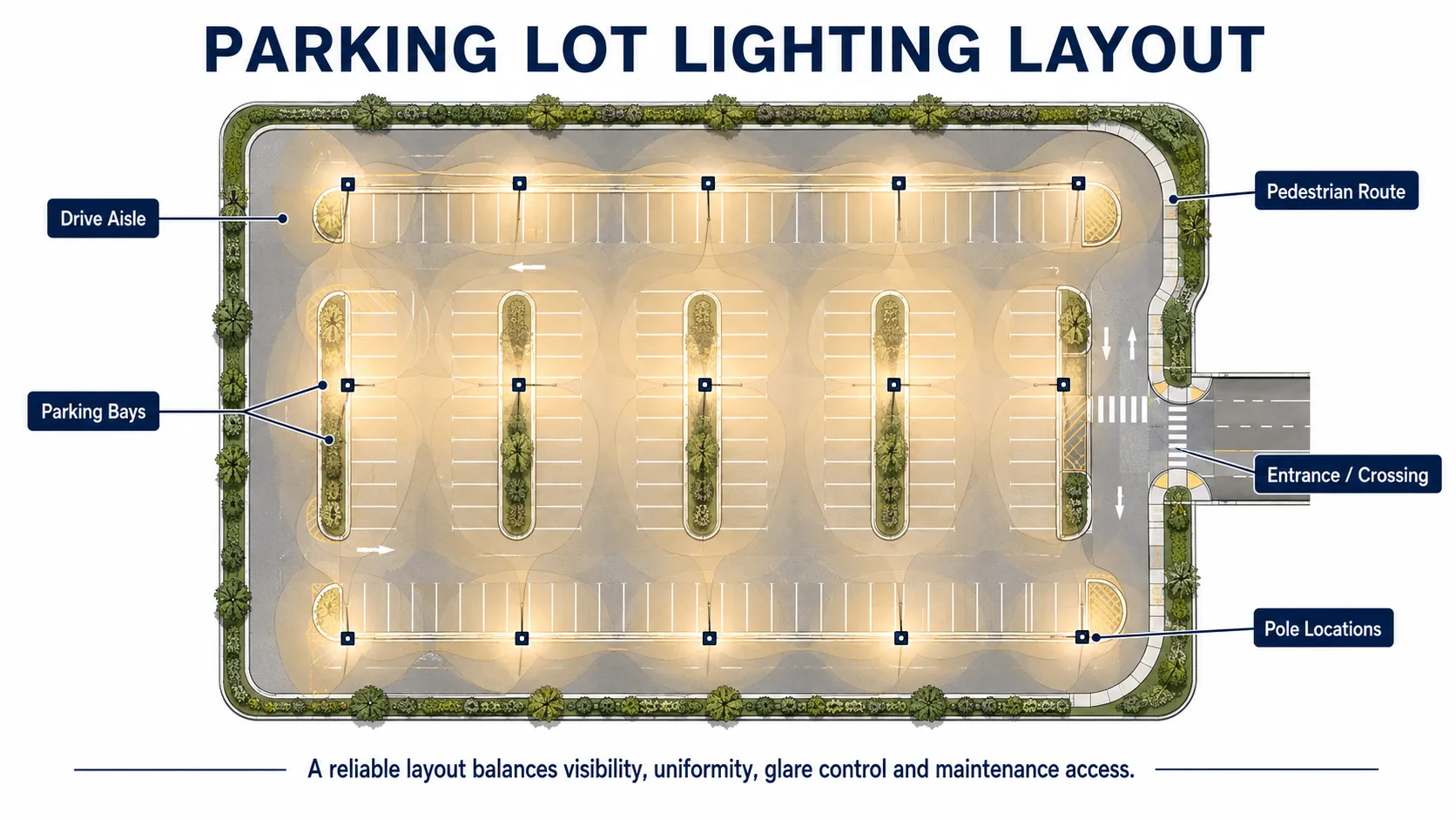
Optic distribution, mounting height, and pole spacing work together to determine whether a parking lot lighting layout will deliver consistent coverage or produce bright spots and dark gaps. These decisions should be based on site geometry and usage patterns, not copied from another project without adjustment.
Higher mounting heights can improve coverage and reduce the number of poles in some layouts, but they may also change intensity distribution and visual comfort if the optics are not matched correctly. Lower mounting heights may help with localized control, but they can require tighter spacing to maintain uniformity.
Type III, Type IV, and Type V distributions are commonly used depending on whether the lighting needs to serve aisles, perimeter zones, open parking fields, or mixed circulation areas. The design objective is not simply to spread light farther, but to place useful light where it is needed while avoiding waste outside the target zone.
A proper layout review should check pole height, spacing, setback, mounting orientation, and beam distribution together before the design is finalized.
Glare, Spill Light, and Boundary Control
Good parking lot lighting should improve visibility without creating excessive glare or unwanted spill beyond the site boundary. This is especially important for projects near roads, residential edges, pedestrian approaches, and neighboring properties.
Glare can reduce visual comfort and make it harder for drivers and pedestrians to adapt to contrast changes across the site. Spill light can create complaints, reduce environmental quality, and complicate project approval in sensitive locations. Both issues are affected by optic choice, mounting height, aiming, pole placement, and the relationship between bright zones and darker surroundings.
A strong lighting design controls light distribution at the source rather than trying to correct poor placement after installation. Boundary conditions should be reviewed early, especially where the parking lot is close to property lines, building entrances, or public streets.
الحلول حسب السيناريو
General Parking Bays
Uniform horizontal illuminance with Type III/IV/V optics and low glare.
Pedestrian Routes & Crossings — Added vertical/semicylindrical components for face recognition and safety.
Entrances, Facades & Payment Booths
Targeted vertical illuminance and veiling control for CCTV clarity.
Pedestrian Routes & Crossings
Added vertical/semicylindrical components for face recognition and safety.
Mid-Block Crossings
Target ≈ 20 lx vertical @1.5 m across the full width of the crossing to reveal pedestrians earlier to drivers.
Large Lots (High-Mast Option)
Wide-area coverage using high-mast where few poles are preferred.
ما تحصل عليه
- IES RP-8 / EN 12464-2 compliant layout (with vertical metrics where applicable)
- ملفات القياس الضوئي (IES/LDT) + تقارير الحسابات
- رسومات الأعمدة/الأساسات + الأسلاك خط واحد
- قائمة المواد مع الخيارات (الصمام الثنائي الباعث للضوء (ليد) مقابل الطاقة الشمسية، وارتفاعات الأعمدة، والبصريات)
- قائمة مراجعة التشغيل والصيانة والضمان والقبول
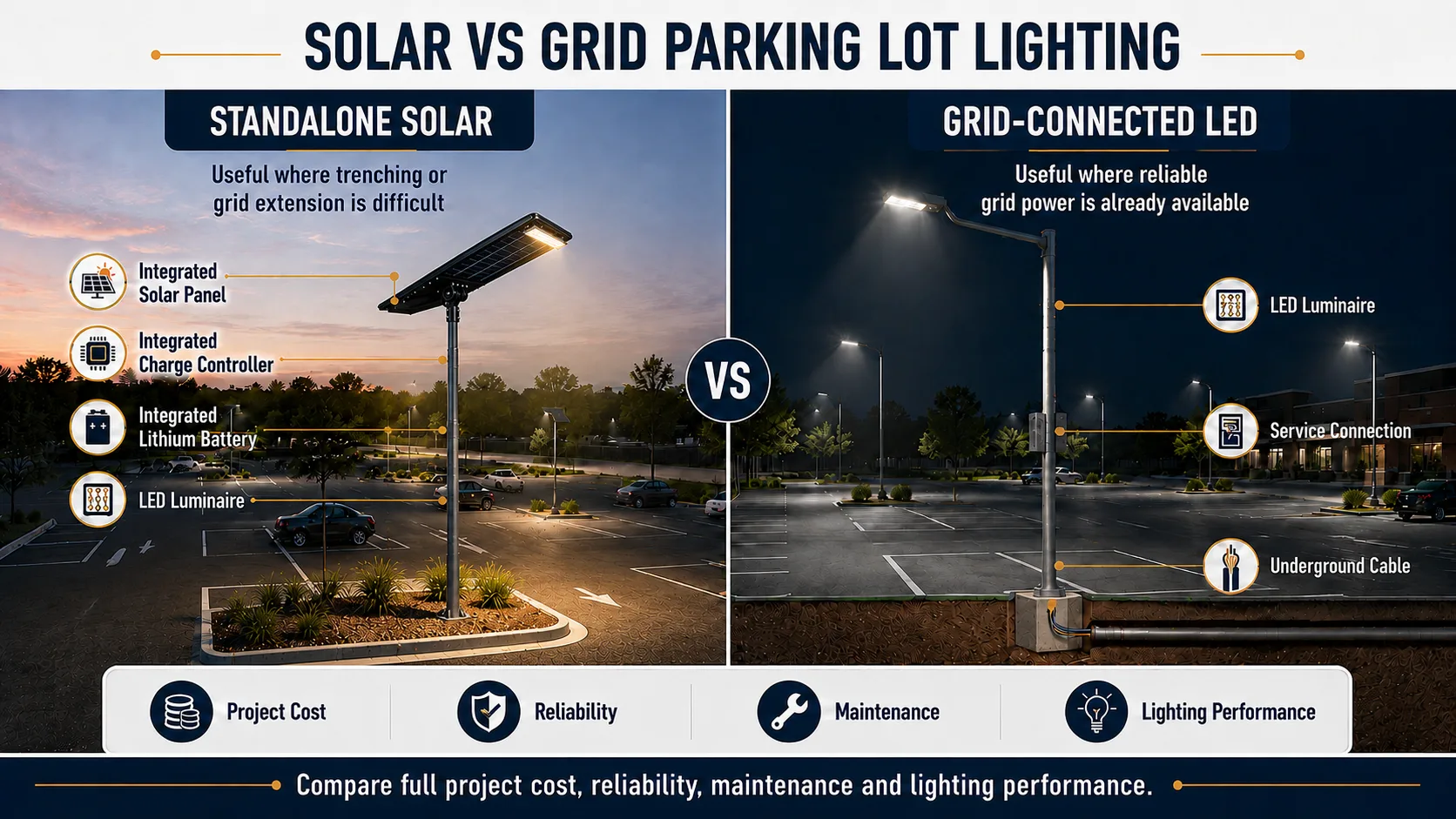
When to Use Solar vs Grid-Powered LED
Solar parking lot lights are most useful when the site has an expensive grid extension, unreliable utility power, dispersed parking bays or a finished surface where trenching would be disruptive. Grid-connected LED may still be the better choice when reliable power is already available or when the site has a high, continuous lighting load. Compare the complete project—poles, foundations, cable, trenching, utility connection, battery replacement, maintenance and outage risk—not only the fixture price.
Solar parking lot lighting is often a strong option when trenching is difficult, utility access is limited, temporary or phased deployment is required, or the project needs faster installation with reduced civil work. It can also work well for remote sites, overflow lots, perimeter extensions, and projects where energy independence is a priority.
Grid-powered LED lighting may remain the better fit where utility infrastructure is already available, lighting operation is extremely intensive, or local standards and site conditions strongly favor a conventional electrical approach.
For projects considering an off-grid or hybrid solution, review our أضواء مواقف السيارات بالطاقة الشمسية page for system planning, product selection, and quotation support.
Parking Lot Lights With Poles: Compare the Same Scope
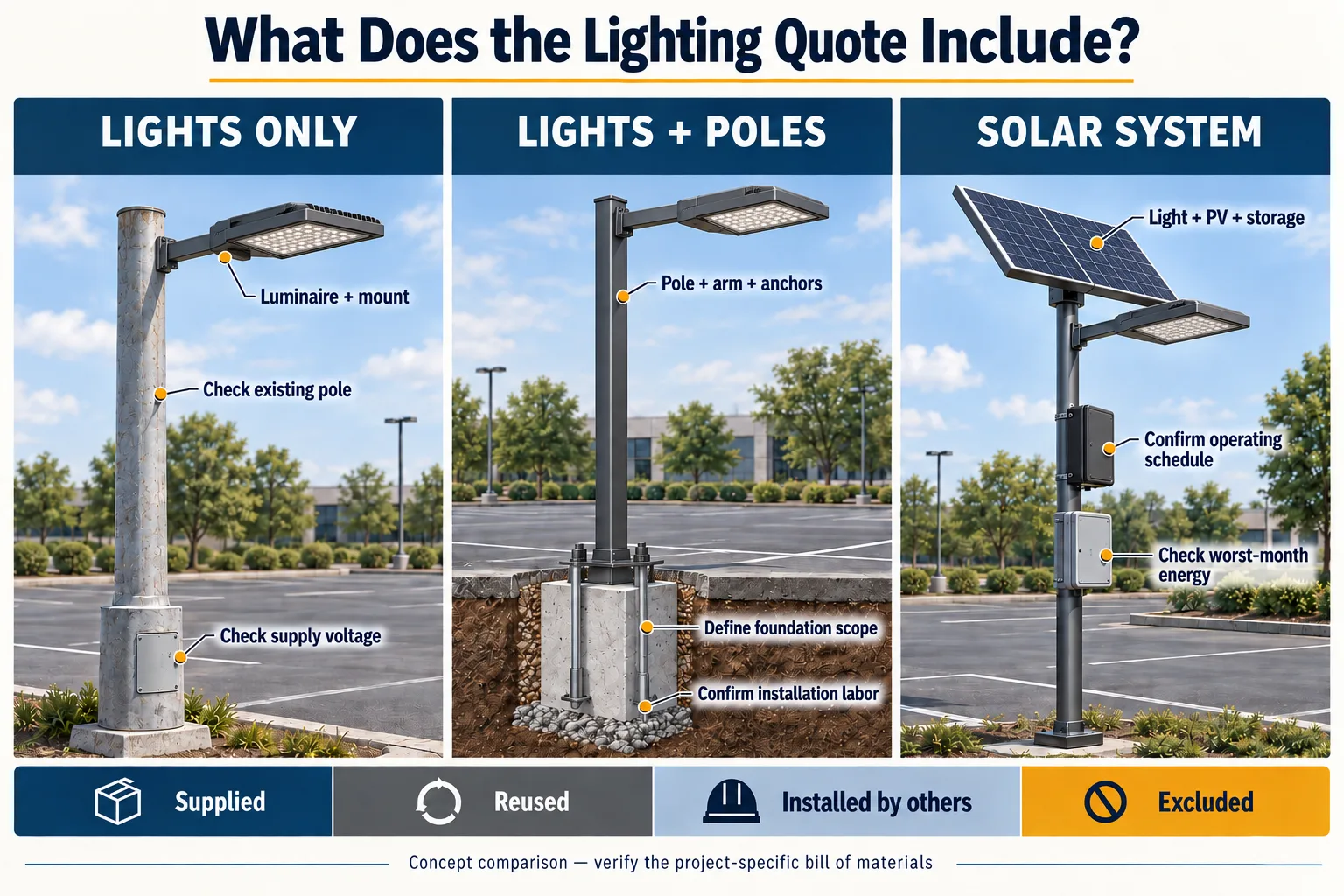
A quote for parking lot lights with poles can look cheaper simply because it leaves out work another supplier has included. Before comparing totals, mark each item as supplied, reused, installed by others, or excluded.
| Purchase scope | What to put on the same quotation sheet | What still needs checking |
|---|---|---|
| New lights on existing poles | Luminaire, mounting adapter, controls and electrical connection work | Pole and foundation condition, mounting compatibility, supply voltage and the revised light distribution |
| New lights and poles | The above, plus pole, arm, anchor assembly and foundation scope | Who designs and builds the foundations, and who supplies lifting equipment and installation labor |
| Standalone solar system | Luminaire, pole, PV panel, battery, controller, mounts and operating schedule | Worst-month energy balance, battery access, autonomy assumptions and whether civil works are included |
An existing pole is not automatically suitable for a new luminaire—or for the extra wind area of a solar panel. Have the proposed loading and condition assessed before agreeing to reuse it. The DOE parking lot lighting guide discusses retaining suitable poles and locations, while warning that a one-for-one lighting replacement may not meet the new layout requirements. It is a design reference, not a current local approval.
For an Inlux parking lot lighting request, attach the marked scope sheet to your site plan. Use the light pole options to discuss structures and the أضواء مواقف السيارات بالطاقة الشمسية page for the off-grid route. Ask for exclusions to be written into the proposal; a fixture price alone is not an installed-system price.
What to Send for a Preliminary Parking Lot Lighting Layout
A preliminary layout is more useful when the design team understands the site early. Even a simple marked plan can help define fixture arrangement, pole count, and design priorities before detailed revisions begin.
- Site drawing or marked map showing the parking area and main circulation routes
- Approximate dimensions of the lot, aisles, entrances, and pedestrian zones
- Preferred pole heights or any existing pole standards already in use
- Lighting target in lux or foot-candles if required by the project
- Project location and environment including wind, coastal exposure, or severe weather concerns
- Power condition indicating grid-powered, solar, or hybrid preference
With this information, the design team can prepare a more realistic preliminary recommendation and identify the most suitable parking lot lighting approach for the site. For a project review, send the site plan and marked supply-scope sheet.
For a solar option, also send the project location, worst-month solar resource assumption, required operating hours, autonomy expectation, battery environment, dust/heat/coastal exposure and maintenance plan. For a full tender-ready input list, see the Solar Street Light Buyer’s Guide. You can also compare the broader solar street light solution, light pole options و high-mast lighting systems before requesting a layout.
Parking Lot Lighting FAQs
Which standards do you follow for parking lot lighting?
IES RP-8 and EN 12464-2 principles, with horizontal illuminance and uniformity plus vertical components where required.
How do you control glare and light spill?
By selecting BUG-compliant optics and managing backlight near the site perimeter.
When should vertical or semicylindrical illuminance be added?
On pedestrian routes, entrances, payment booths and EV islands for recognition and security.
Do you provide high-mast solutions for large lots?
Yes, with wide-area coverage and reduced pole counts.
Can I request both LED and solar proposals?
Yes, two BOMs for comparison.
What documents will I receive?
IES/LDT photometry, calculation reports, CAD drawings, BOM, O&M and warranty.
Do you size solar autonomy for worst-case nights?
Yes, battery/array sizing with adaptive dimming.
How is pole spacing determined?
It’s a calculation outcome based on targets, optics, mounting height and site geometry—not a fixed number.