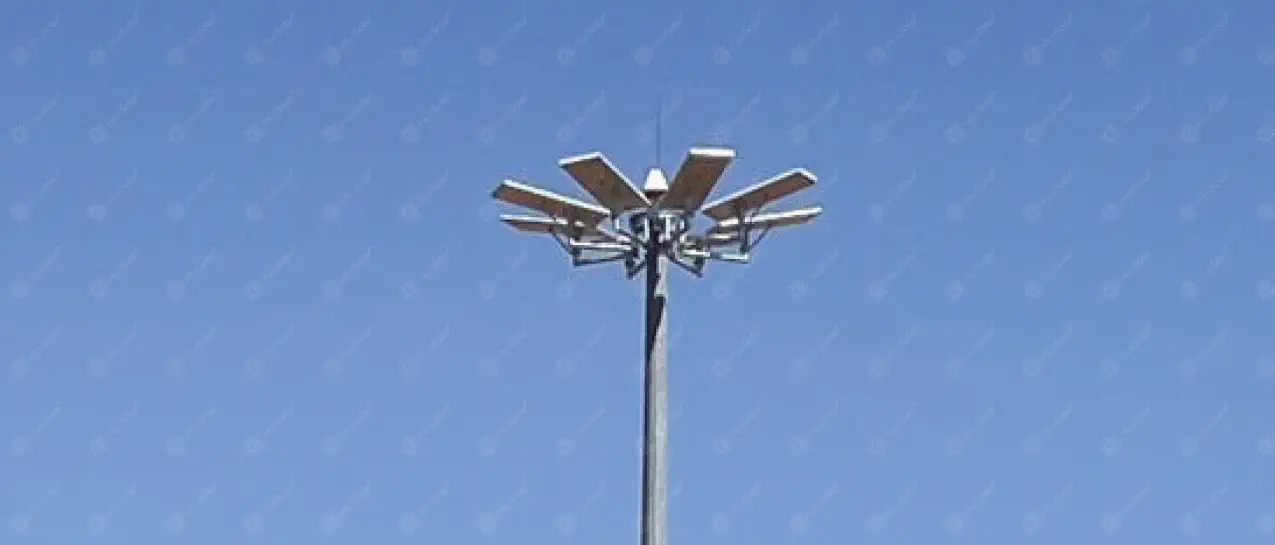
This Johannesburg project in South Africa applies an Integrated Solar Mast Light configuration to public-area high mast lighting. The project covers 64 sets and was completed in April 2025. For similar buyers, the main decision is how the mast structure, multi-head LED layout, battery chemistry and site-specific lighting design work together before the RFQ is finalized.
Lighting Context for the Johannesburg Site
Public-area high mast lighting requires a clear view of the mounting height, the number and arrangement of LED heads, the intended lighting area and the responsibilities for installation and commissioning. In this case, the project uses 20 m poles and an 8 × 150W LED configuration. The project details identify Johannesburg as the site and the application as public-area high mast lighting, giving similar EPC, private-development and municipal buyers a practical reference point for an initial scope discussion.
Configuration Logic for a 20-Metre High Mast
The listed configuration combines a 20 m Q235 pole with LiFePO₄ battery chemistry, 6000K color temperature and a stated 3,500-cycle battery life. The project information also lists a 120 km/h wind-resistance specification and IP66/IK09. These values should be checked against the structural calculation, foundation design, final bill of materials and the applicable component datasheets; a luminaire IP/IK rating should not be treated as a rating for the complete installed system.
The configuration was selected around a tall-mast public-lighting application rather than a low mounting-height street-light layout. Buyers comparing حلول إضاءة الصاري الشمسي العالي should therefore confirm the required lighting distribution, LED aiming, solar energy sizing, battery autonomy and access plan before approving the final design.
Procurement Checks for Similar Public-Lighting Projects
- Request an IES/DIALux design or equivalent photometric package for the actual site geometry, lighting class and target mounting arrangement.
- Confirm the solar panel, battery capacity, autonomy calculation and operating profile; these project details do not provide panel size, battery capacity or dimming settings.
- Review the pole material, foundation interface, structural calculation and wind-load basis together. The project specification lists Q235 and 120 km/h, but the final design still needs site-specific engineering review.
- Clarify whether IP66/IK09 applies to the luminaire or another component, and request the relevant datasheet and test documentation.
- Define the handover boundary: supply, delivery, owner-side installation, commissioning, documentation and after-sales responsibilities should be separated in the RFQ.
How Inlux Solar Can Support the Next RFQ
For a comparable tender or private-development project, Inlux Solar can support the technical package with product datasheets, IES/DIALux files, drawings, a bill of materials and QC documentation. The right request should include the site plan, pole spacing, mounting height, required lighting class, local wind basis, battery-autonomy target and installation scope so the proposed system can be checked against the project rather than selected from wattage alone.
Related Solar Lighting Solutions
For buyers evaluating the same application family, start with the solar street light solutions hub, compare the dedicated حلول إضاءة الصاري الشمسي العالي, and use the أدلة إضاءة الشوارع بالطاقة الشمسية for specification and procurement questions. These links are intended to support the next RFQ step, not replace a project-specific lighting design.
الأسئلة الشائعة
What type of solar high mast lighting was used for this South Africa project?
The project uses an Integrated Solar Mast Light configuration for public-area high mast lighting.
How many solar high mast light sets are included in the project?
The project covers 64 sets.
What LED configuration is listed for the project?
The listed LED configuration is 8 × 150W, with a 6000K color temperature.
What battery type is listed for the project?
The listed battery chemistry is LiFePO₄, with a stated 3,500-cycle life. Battery capacity and autonomy should be confirmed in the RFQ.
Does this case page provide a complete lighting design?
No. Buyers should request a project-specific IES/DIALux design, pole and foundation review, wind-load calculation, solar energy sizing and installation scope for their site.
معرض المشاريع



About Me