Bifacial solar panels generate electricity from light reaching both the front and rear of the module. They can add energy when the rear receives useful light, but “bifacial” does not mean twice the power. For a solar street light, the decisive question is whether the installed assembly leaves a useful rear light path—not whether the panel looks impressive in a catalogue.
Start with the proposed mounting arrangement. A panel above a compact lighting enclosure, a separate panel with an open rear and a module close to an opaque surface are not equivalent proposals. This guide helps procurement teams decide when a bifacial option deserves further assessment, which gain claims need evidence and what to put in the quotation before paying a premium.
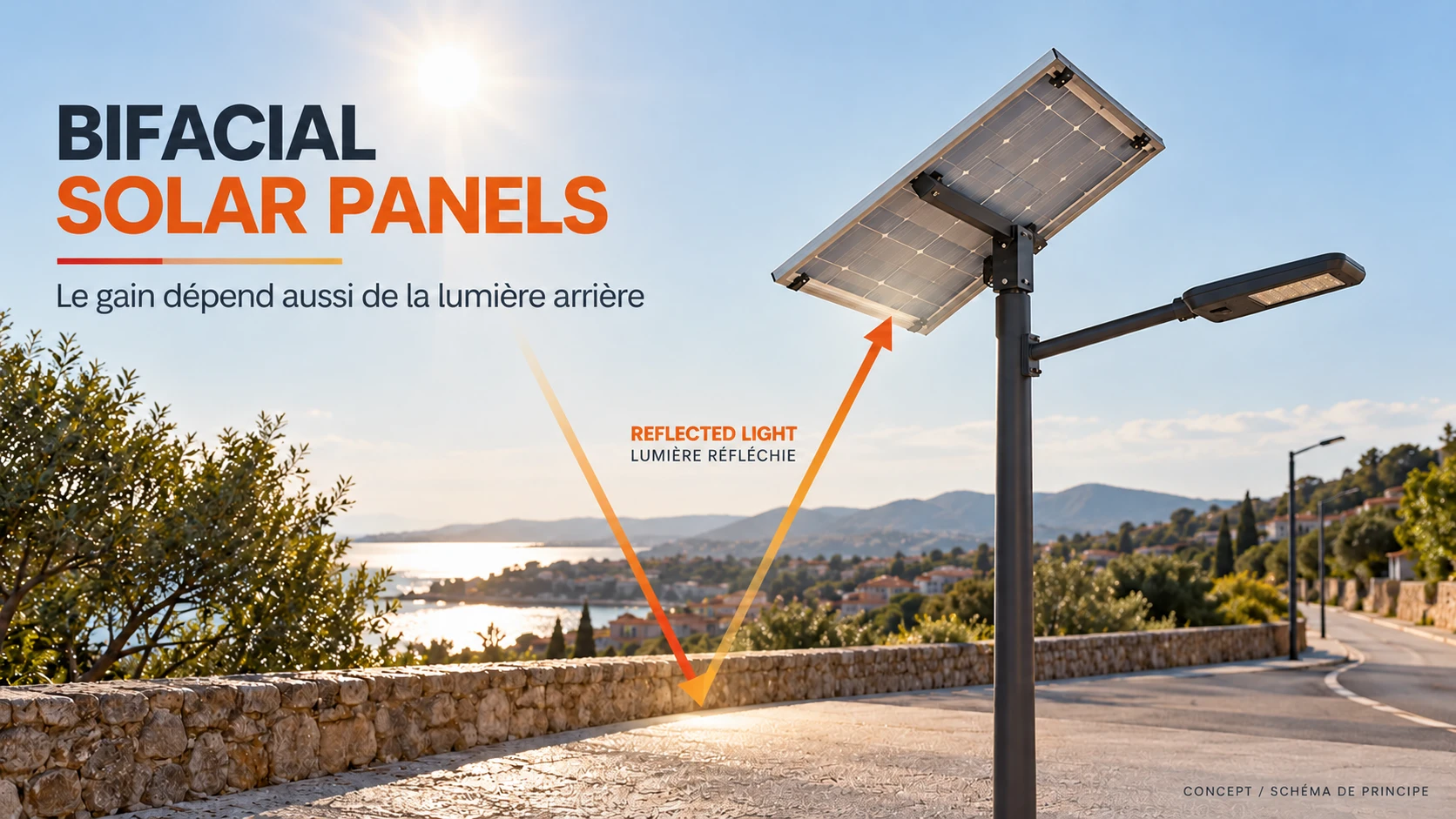
Bifacial solar panels are not the opposite of monocrystalline
The terms answer different questions. Monocrystalline describes the silicon cell technology; monofacial or bifacial describes the module’s light-collection capability. A monocrystalline module can also be bifacial. Comparing “mono versus bifacial” without identifying the actual products can therefore compare overlapping categories rather than competing choices.
| Quotation wording | What it tells you | What it does not settle |
|---|---|---|
| Monocrystalline | The stated cell technology | Whether the module harvests rear-side light |
| Bifacial | Both module faces can contribute under suitable illumination | The energy gain on your pole assembly |
| Front-side rated power | Power at the declared reference conditions | Daily energy or a fixed rear-side bonus |
| Bifaciality factor | Relative rear-to-front response under its stated definition | The percentage increase in project energy |
Keep the existing Inlux mono-versus-poly module guide for the cell-technology comparison. The separate decision here is whether a bid’s rear-side contribution is physically credible in the proposed lighting arrangement. Neither a transparent-looking rear nor a photograph replaces the exact module identification and data sheet.
Look behind the module before accepting a gain claim
Ask for a rear view of the complete proposed assembly, not just the bare module. Locate the lamp head, battery enclosure, support rails, junction box and other obstructions. The front may be clear while much of the rear faces a housing. In that situation, a gain quoted for an open-rack module should not simply be transferred to the finished street light.
Ground reflectance, orientation, surrounding geometry and changing shadows all belong in the assessment. The official bifacial_radiance software description identifies site reflectance, clearance, spacing, tilt and orientation as model inputs, with hourly or annual irradiance profiles. A road or parking site needs assumptions appropriate to its own arrangement, not the inputs of an unrelated solar farm.
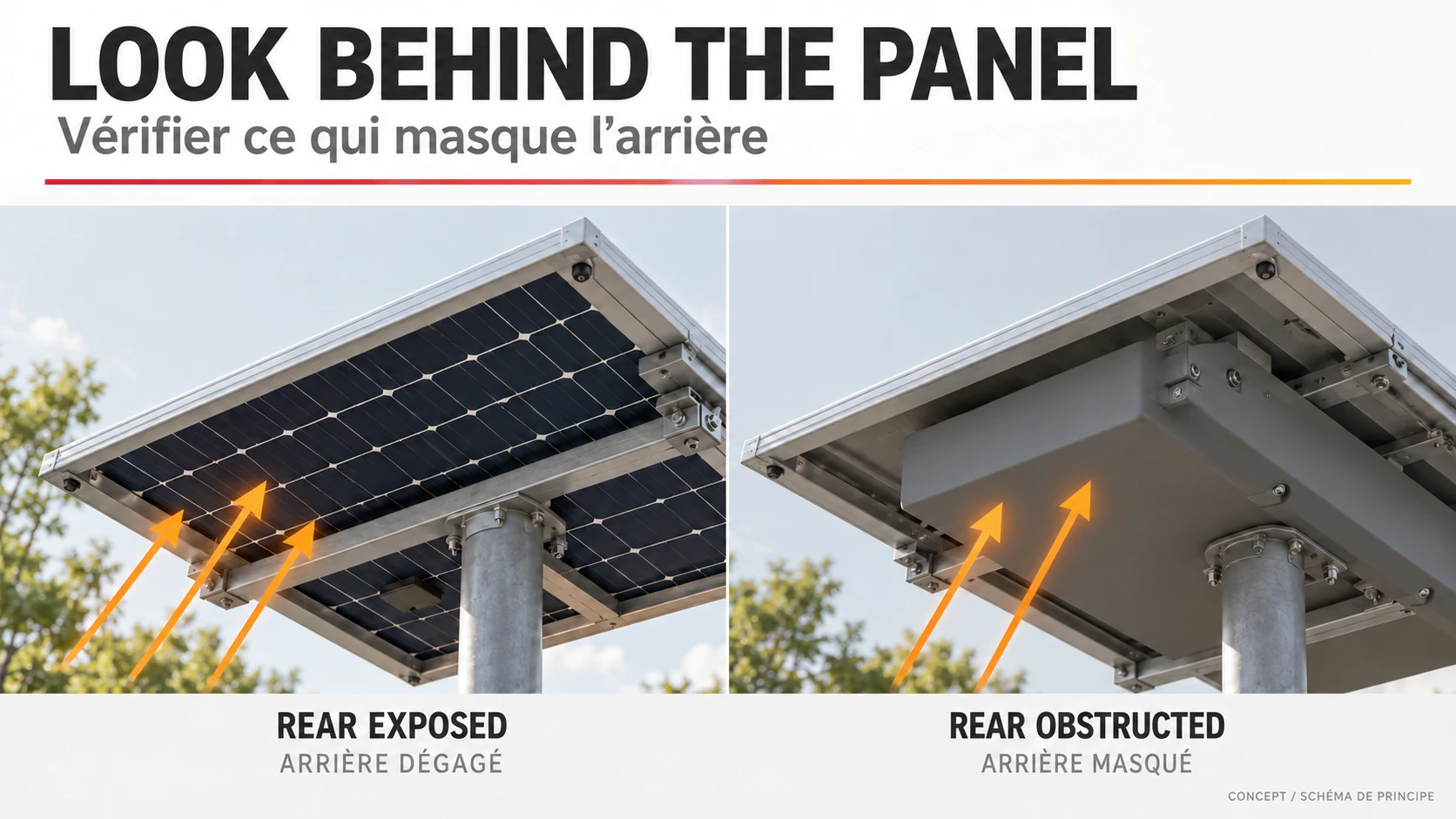
For a buyer, the useful test is simple: can the supplier show where the rear-side light comes from and what may block it? A plan with unexplained arrows is not enough. Ask which surface and shading assumptions underpin the estimate, and whether those assumptions remain reasonable after landscaping, parking occupancy, dust and normal maintenance are considered. Do not commission reflective ground treatment merely to reproduce a sales illustration.
Bifaciality is not your energy-gain percentage
According to the SAM module-model documentation, bifaciality is the ratio of rear-side to front-side efficiency. In its model, rear irradiance is weighted by that factor and combined with front irradiance before module power is calculated. A factor of 0.70 does not mean 70% more annual energy; it says nothing by itself about how much light reaches the rear.
Consider a deliberately simplified screening example. Assume front irradiance of 800 W/m², rear irradiance of 100 W/m² and a bifaciality factor of 0.70. The weighted rear term is 70 W/m², giving 870 W/m² combined effective irradiance. That is an 8.75% increase over the assumed front irradiance—not a measured power increase, a panel rating or an annual production forecast.
| Illustrative condition | Weighted rear term | Combined effective irradiance | Increase over assumed front |
|---|---|---|---|
| Front 800 W/m²; rear 100 W/m²; factor 0.70 | 70 W/m² | 870 W/m² | 8.75% |
| Front 800 W/m²; rear 20 W/m²; factor 0.70 | 14 W/m² | 814 W/m² | 1.75% |
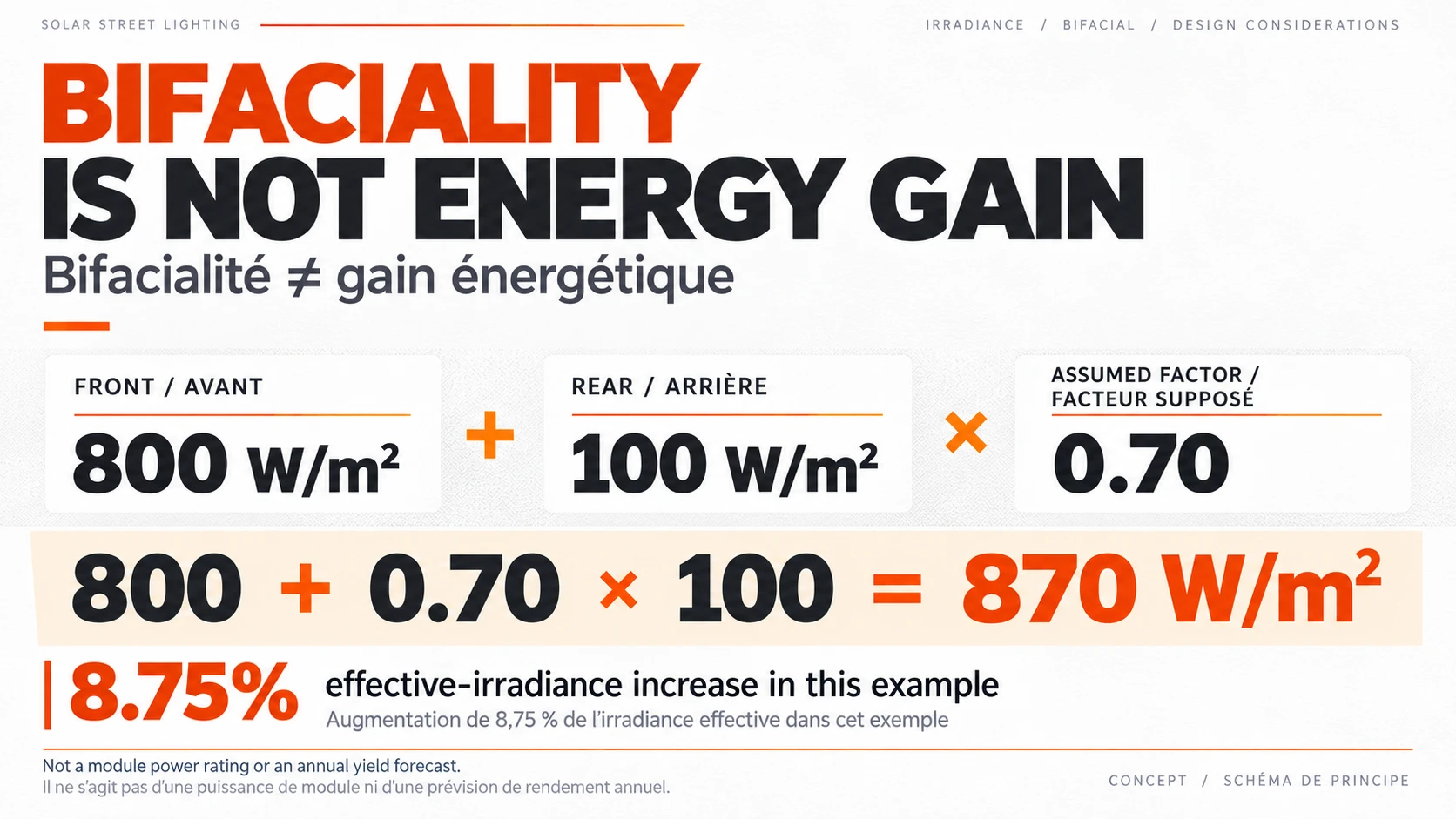
Only the rear-irradiance assumption changed in those two rows. Neither row is an Inlux configuration or a result from our projects. Temperature, non-uniform illumination, electrical losses and the controller’s behaviour still separate that screening arithmetic from usable battery-charging energy. The point is to expose the assumption behind the bonus, not to size a system from this table.
Make the quotation separate the base module from the claimed bonus
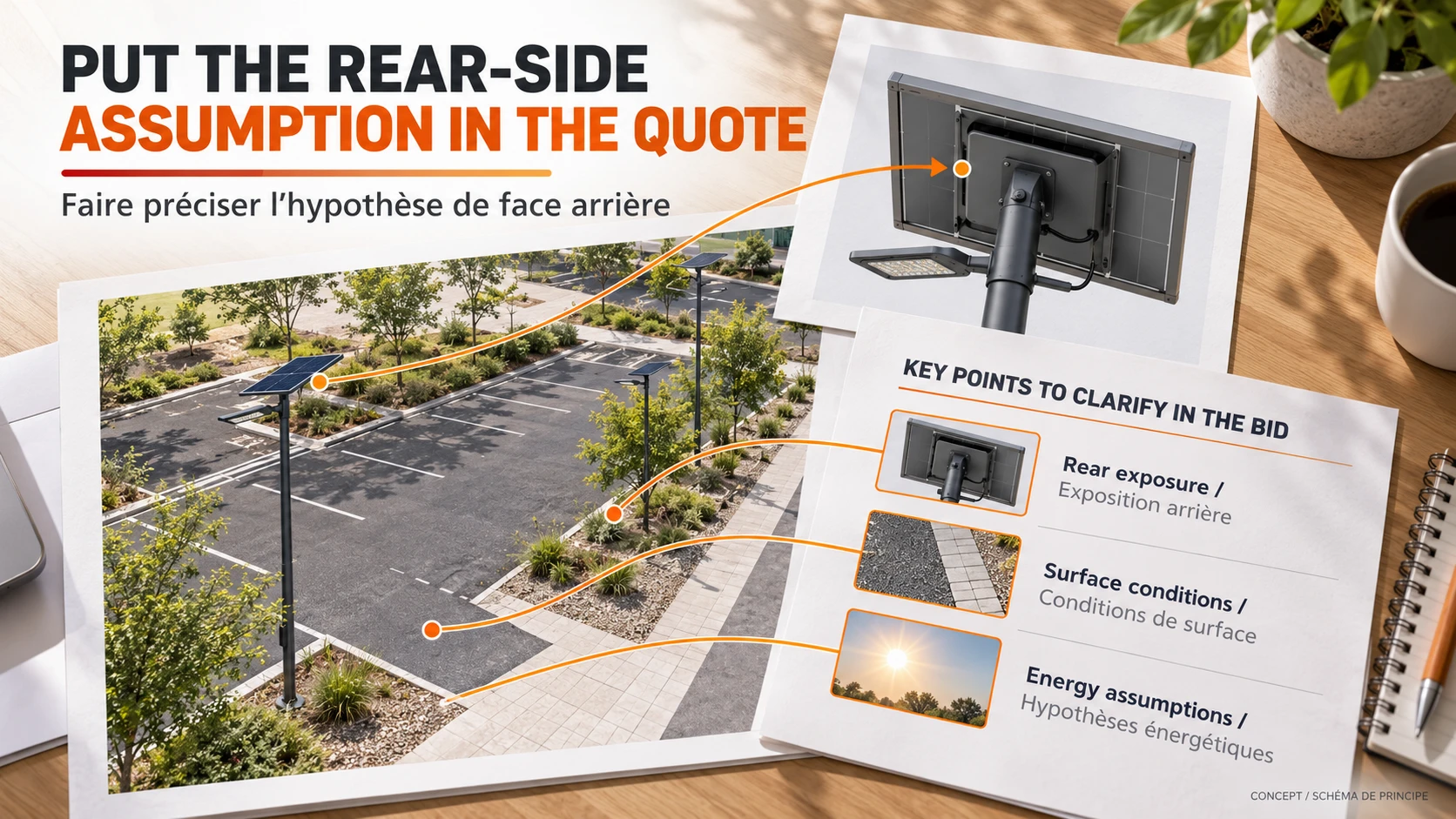
A useful offer identifies the front-side rating and its test conditions, then explains any additional rear-side assumption separately. Otherwise, two suppliers may appear to quote the same watts while one is using a reference module rating and the other is including an optimistic site-dependent contribution. Read the guía de potencia del panel solar alongside the offer rather than comparing the largest number on the cover.
Ask whether a quoted gain refers to an instant, a month or a year, and what is being compared. The reference should be identified: the same module with rear contribution excluded, a different monofacial module, or another complete system. A different panel area, front rating or lighting schedule can explain part of an apparent improvement. A percentage without that baseline is difficult to use in a buying decision.
For an off-grid street-light project, request a sensitivity comparison with a conservative rear contribution as well as the proposed case. Keep the required lighting duty unchanged. If the design only works when a generous rear bonus is assumed, that dependency belongs in the decision record. A favourable annual percentage should not silently become permission to reduce storage or relax the agreed service requirement.
Which solar-lighting arrangements deserve a closer look?
The current PV materials overview on the Material Excellence page lists optional bifacial architectures among its PV choices. That is a starting point for a configuration discussion, not confirmation that every catalogue model or order includes a bifacial module. Ask for the exact proposed module and complete mounting arrangement in the project quotation.
| Proposed lighting arrangement | Main buying question | Reason to pause |
|---|---|---|
| All-in-One with a compact combined housing | How much of the module rear can actually receive light? | A free-standing-module bonus is quoted without the housing |
| All-in-Two with a separate panel | Does the panel/support arrangement leave a useful rear light path? | Only a front view is supplied |
| Split Type with separate components | Are module, supports, enclosure positions and site assumptions assessed together? | The panel option changes but the mechanical/electrical review does not |
| Commercial parking site | Do the ground, shading and operating assumptions match the actual parking layout? | A solar-farm gain is copied without site justification |
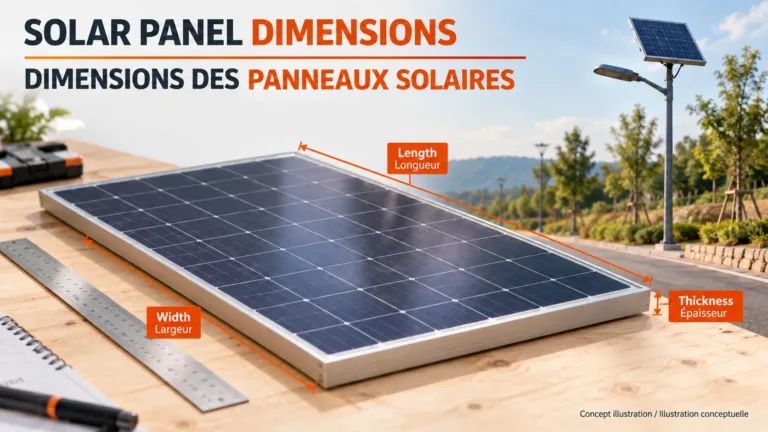
A separate panel can make rear access easier to assess, but that does not automatically approve a bifacial substitution. Confirm mounting interfaces, mass, wind-related design checks and the controller’s electrical limits for the exact module. Our panel dimensions and fit guide covers the mechanical questions that a front photograph cannot answer. Do not remove structural parts or move an enclosure just to expose the rear.
Preguntas frecuentes
Is a bifacial solar panel better?
It can be the better choice when its rear contribution is useful and the complete arrangement is suitable. It is not automatically better for a rear-obstructed street light. Compare the same lighting duty, documented module conditions and installed cost; a generic gain headline is not a project result.
What are the disadvantages of bifacial solar panels?
The potential extra collection comes with a site-dependent assessment. Rear shading, uncertain surface assumptions and additional mounting constraints can weaken the expected benefit. Module construction, handling and cost vary by product. Ask what changes in the complete delivered system rather than assuming every bifacial option carries the same premium or weight.
Which is better: monocrystalline or bifacial?
That is not an either-or comparison: a monocrystalline panel can be bifacial. Identify cell technology and rear-side capability separately, then compare exact modules in the same installation. For a street light, the useful choice is the arrangement that meets the project requirement with justified assumptions, not the label with the strongest sales language.
Do bifacial solar panels produce twice as much electricity?
No fixed doubling follows from having two active sides. The rear does not generally receive the same light as the front, and module response is not the same as system energy delivered. Any added-output claim needs defined conditions and a clear baseline. The example above illustrates that distinction; it is not a performance promise.
Can bifacial panels replace part of the battery capacity?
Do not reduce a street light’s specified storage simply by applying a quoted bifacial percentage. Generation and storage perform different jobs. The complete design must still meet the agreed operating programme and autonomy under the assessed conditions. Request a revised, identified configuration if a supplier proposes a smaller battery.
Can I retrofit a bifacial module to an existing solar street light?
Only after the exact replacement has been assessed for the existing mechanical and electrical arrangement. Matching watts or outside dimensions alone is insufficient. Obtain the manufacturer-approved configuration and qualified installation assessment; do not alter a factory harness, bracket or enclosure from a general article.
Discuss the complete lighting arrangement, not just the panel
For a factory-integrated option, review the Inlux All-in-One solar street light collection. For a separately positioned module, compare the Inlux All-in-Two solar street light collection. For a fully separated arrangement, review the Inlux Split Type solar street light collection. These product paths do not mean that a bifacial option is confirmed for every series.
For the wider shortlist, use the Inlux solar street light range. For a commercial site, review our solar parking lot lighting options. To assess a proposed bifacial arrangement, send Inlux the site location, lighting duty and front/rear layout. Ask the quotation to state the exact module, mounting constraints and rear-side energy assumptions separately.