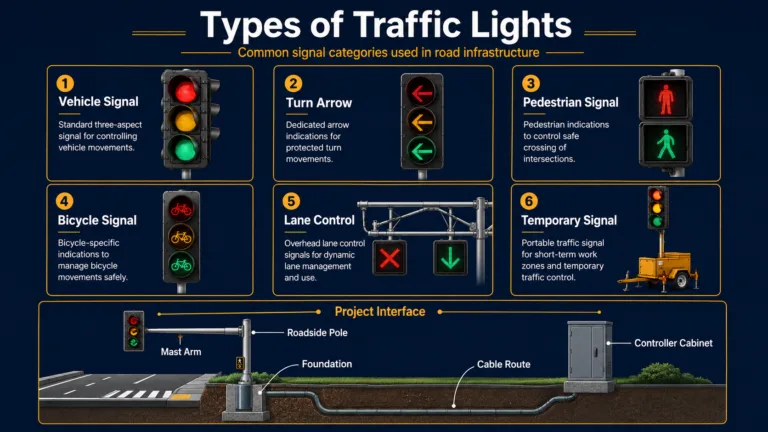
At a familiar three-light signal, traffic light colors give a simple starting instruction: red tells traffic to stop, yellow or amber is a transition signal, and green allows a movement only when the way is clear. The longer answer matters more. An arrow applies to one movement, a flashing indication has its own rule, and the exact meaning is set by the road authority where the signal is installed.
That last point is not legal fine print. A signal plan for a junction in one country should not be copied into another simply because the lenses use the same colors. This article explains the common visual logic and the engineering boundary around it. For actual driving conduct, installation approval, timing and signal sequence, follow the applicable local traffic authority.
Scope note: Inlux Solar’s relevant public product scope is traffic-light poles and outdoor-infrastructure support. This page does not claim to supply signal heads, controllers, detectors or traffic-law advice.
The short answer: a color is an instruction, not just a color
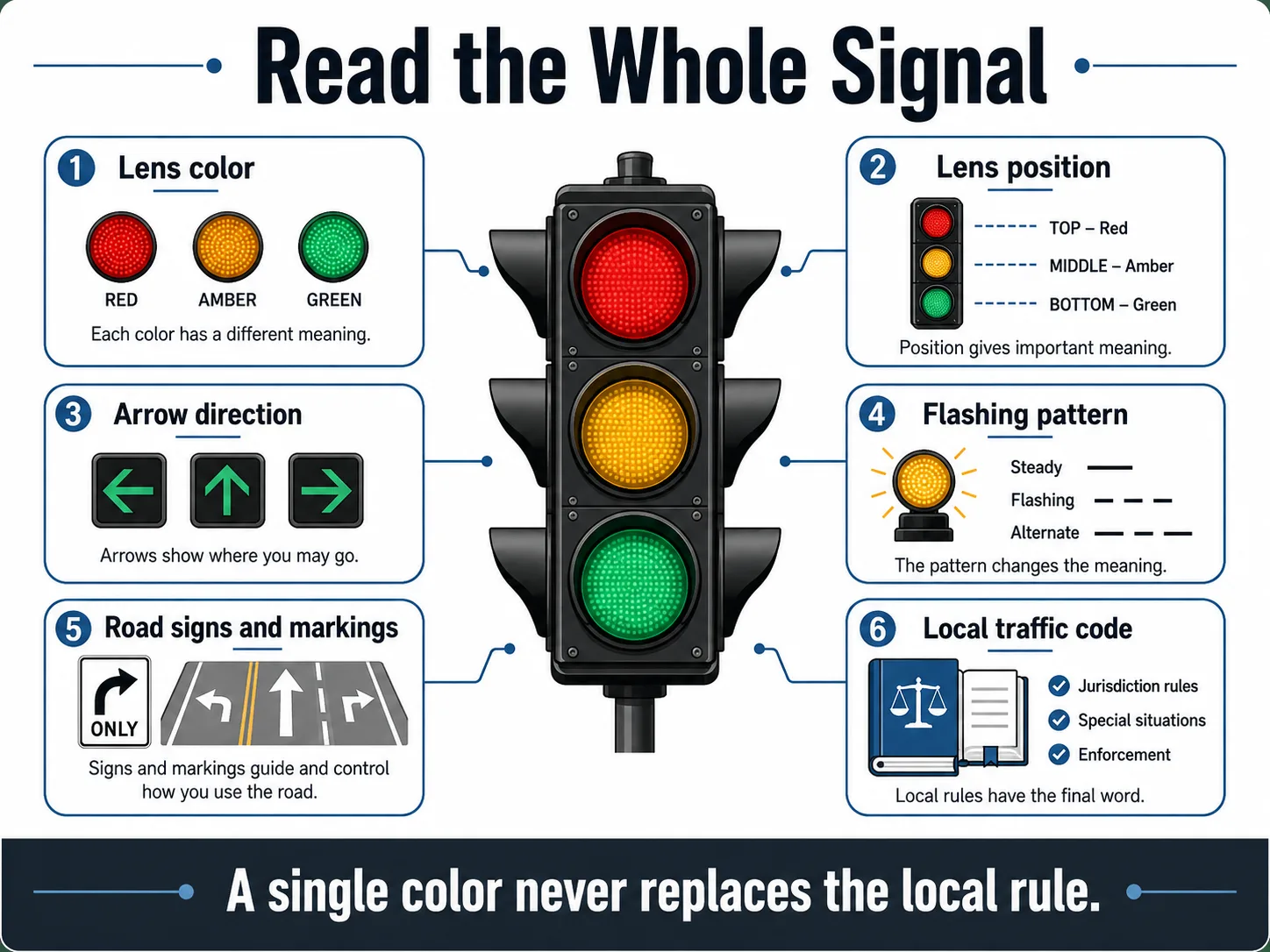
The appearance of a traffic signal is designed to communicate a movement decision quickly. A common vehicle signal uses red, amber/yellow and green, but the decision is never based on color alone. Drivers also read the lens position, an arrow shape, a flashing pattern, signs, road markings and the local rulebook.
| Signal appearance | Common purpose | Important boundary |
|---|---|---|
| Steady red | Stop the movement facing the signal. | The stop line, turning movements and exceptions are jurisdiction-specific. |
| Steady amber/yellow | A change or stopping transition. | It is not a universal instruction to accelerate through the junction. |
| Steady green | A movement may proceed when the route is clear. | It does not remove the need to yield where local rules require it. |
| Arrow indication | Controls only the direction shown. | A green arrow and a circular green are not interchangeable instructions. |
| Flashing indication | Used for a special operating mode or warning. | Meanings vary materially by country, road type and installation. |
The UK Highway Code is a useful example of why a one-line answer has limits: it defines red, amber, red-and-amber, green and green-arrow indications separately, and it also distinguishes flashing red lights and lane-control signals. The U.S. MUTCD likewise treats steady and flashing indications, including yellow arrows, as separate signal states. Neither document should be treated as a global rulebook; both show why the local standard must be the final reference.
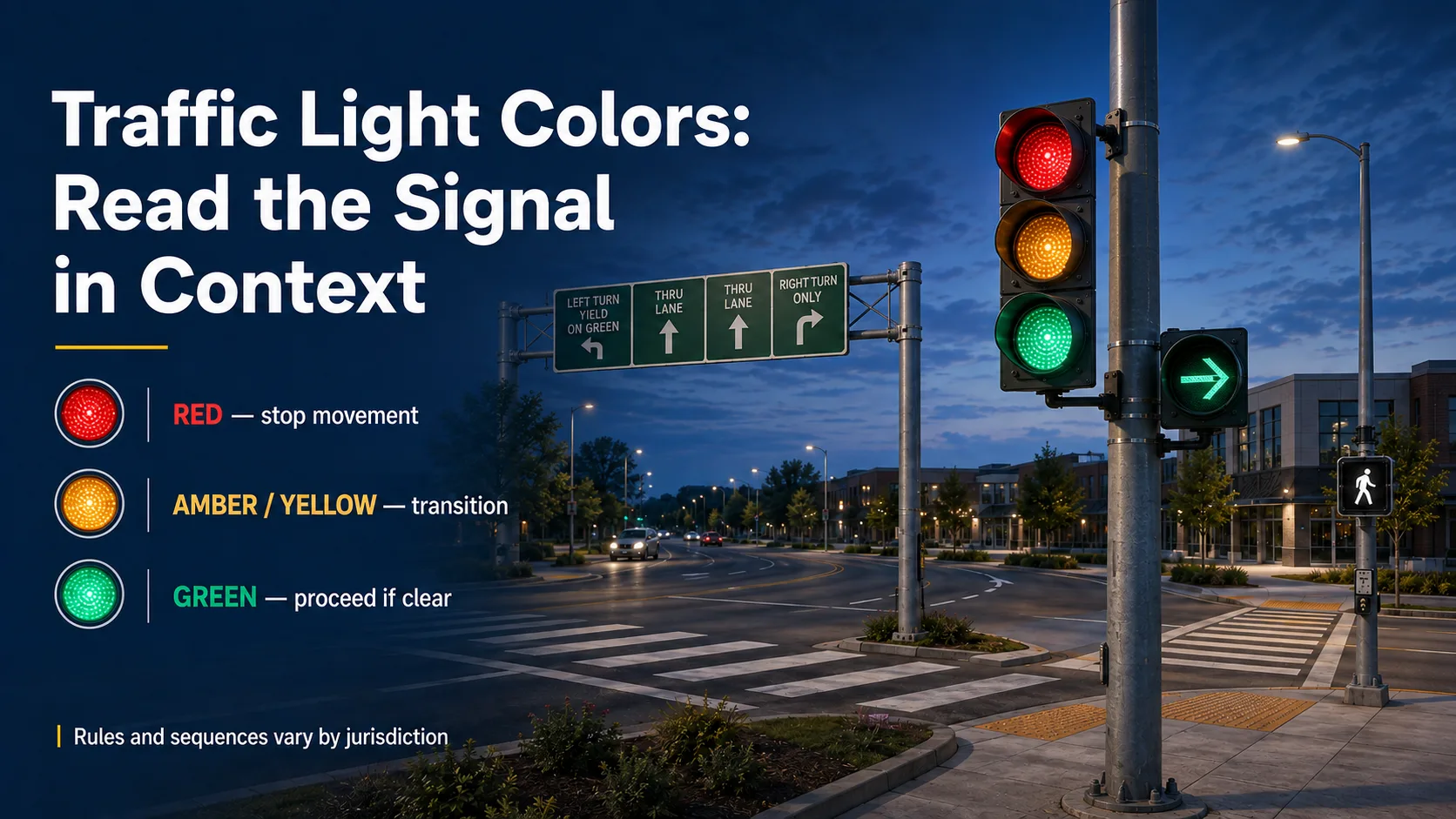
What red means: stop, then read the rest of the junction
Red is normally the clearest instruction in the signal face: stop the movement facing the signal. On a real junction, the operational detail comes from the stop line, turn controls, pedestrian phase, signs and the authority’s rule set. A red indication in a lane with a separate turn arrow is not the same situation as a single circular signal at a simple intersection.
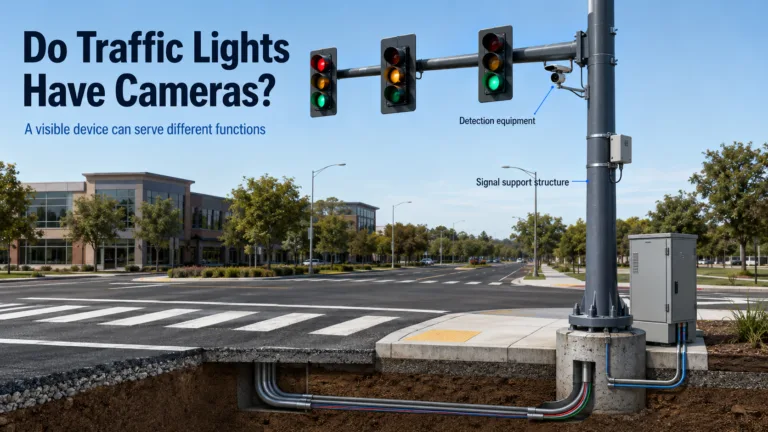
For a project team, red also changes the physical support question. A signal face may be mounted on a roadside pole, a mast arm, a span wire or a gantry. The color does not determine the structure; the approved drawing, the signal-head load, arm geometry, wind exposure, cable routing and access requirements do.
What amber or yellow means: a transition that needs context
Amber in British usage and yellow in much of North American usage describe the familiar middle signal. It marks a change in the signal phase, but the exact instruction, timing and permitted movement depend on local rules.
This is where generic explainers often become unhelpful. Saying “yellow means slow down” skips the real decision: Can the road user stop safely? Is there a dedicated arrow? Is this a temporary work-zone signal? Does the local code define a special flashing sequence? The answer belongs in the governing traffic-control plan, not in a supplier’s generic web page.
What green means: permission to move, not a guarantee that the route is clear
Green commonly permits the traffic facing the signal to move, subject to the road being clear and to any local yielding requirements. It is not a blanket right-of-way statement. Pedestrians, bicycles, opposing traffic and separately controlled turns can all change what a driver must do.
The same distinction matters when a project is being scoped. A green phase is a controller and operation question. The pole or mast that carries the signal is a structural-support question. Keeping those two packages separate prevents a quotation from quietly assuming undefined signal hardware or authority approvals.
Arrows change the meaning from “this approach” to “this movement”
An arrow is more specific than a circular lens. It normally applies to the direction shown—such as a protected left or right turn—rather than to every vehicle facing the signal. Arrow assemblies, backplates, visors and mounting brackets can change the projected area and arrangement on the support structure.
That is why a traffic-light-pole RFQ needs more than “one pole for traffic lights.” It should identify the signal layout, number of heads, mast-arm or roadside mounting, clearance, wind and corrosion conditions, foundation/anchor design, cable path and the approved drawing. The Poste de semáforo product path is relevant to that structural package; it is not a substitute for the signal-control package.
Flashing signals and unusual colors: do not infer a rule from a photo
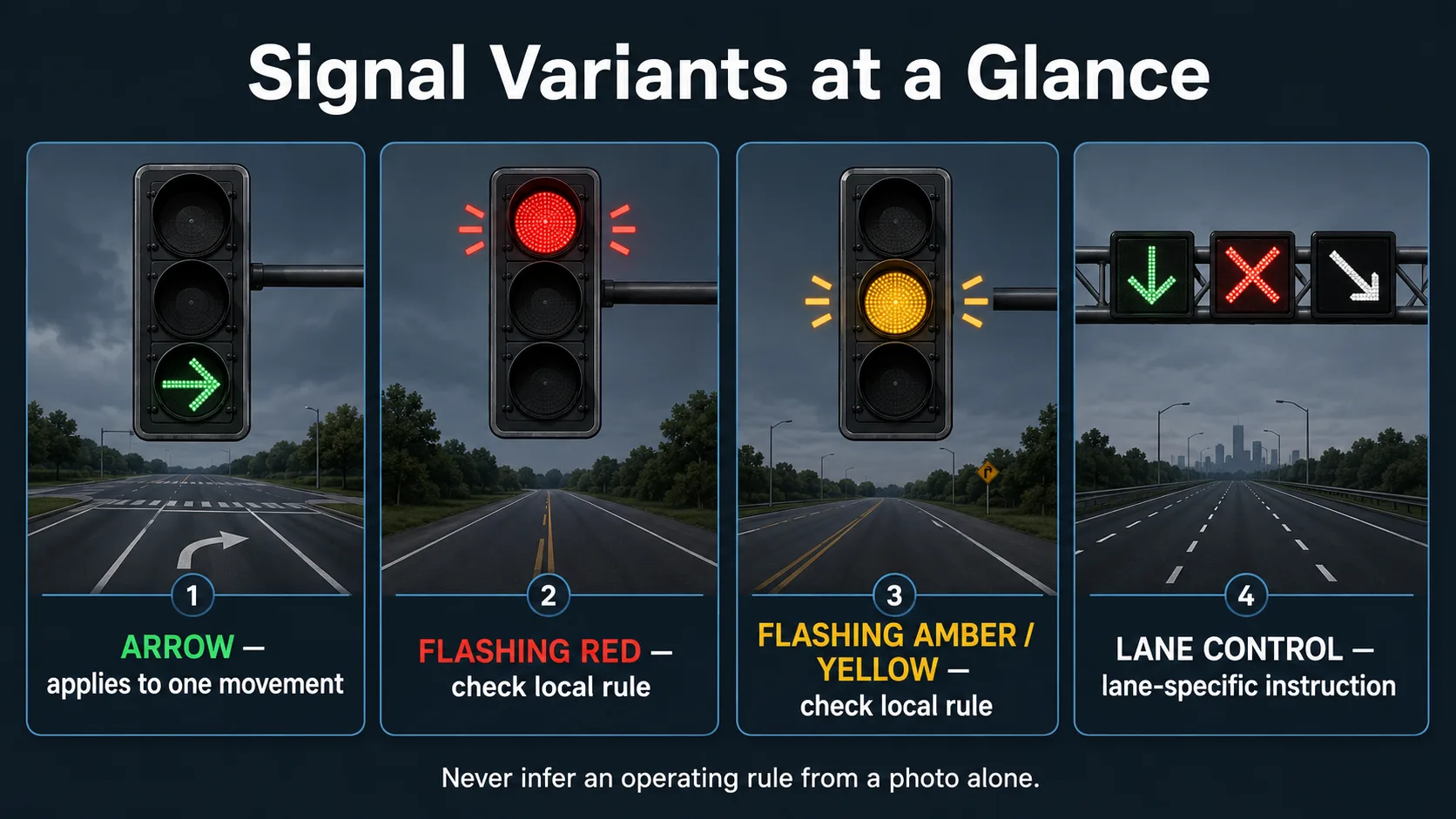
Flashing red, flashing amber/yellow, flashing arrows, lane-control symbols and pedestrian indications are easy to misread when they are separated from their location. A flashing pattern can mean warning, stop, a permitted movement, a lane closure or another authority-defined condition. Temporary sites, rail crossings and managed lanes bring further differences.
The safest editorial rule is simple: use an official local source for the meaning of a live signal. Use a project drawing and its governing standard for equipment selection. A photograph from another country is not an engineering specification.
For a broader map of vehicle, pedestrian, bicycle, lane-control, beacon and temporary signal categories, see Types of Traffic Lights. For the separate question of controller logic and detection, see How Traffic Signals Work.
The part a lighting or pole supplier can actually help define
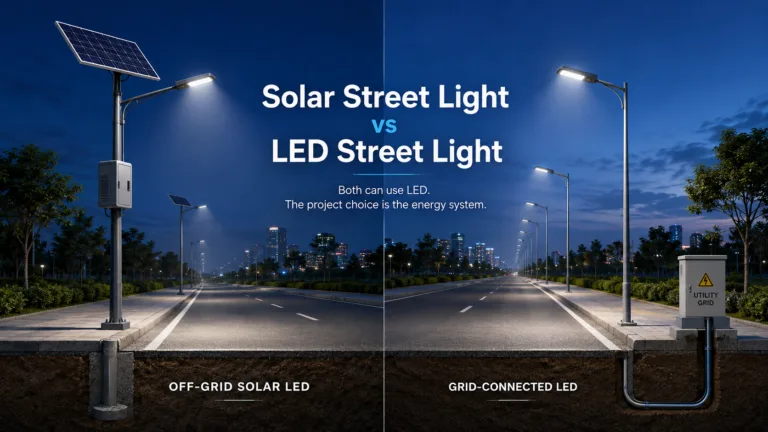
Traffic signals and road lighting often share a corridor, but they are different systems. Signals manage movements through an approved control plan. Road lighting is designed around visibility, geometry, photometry, energy and maintenance. A solar street light does not replace a traffic signal, and a traffic-signal pole does not automatically carry a lighting layout.
Where a road project includes both, make the interfaces explicit:
- Traffic-control scope: signal heads, controller, detection, timing, communications, signs and authority compliance.
- Structural-support scope: pole, mast arm, brackets, foundation, coating, anchors and load confirmation.
- Lighting scope: luminaires, photometric design, poles, energy/solar sizing and lighting controls.
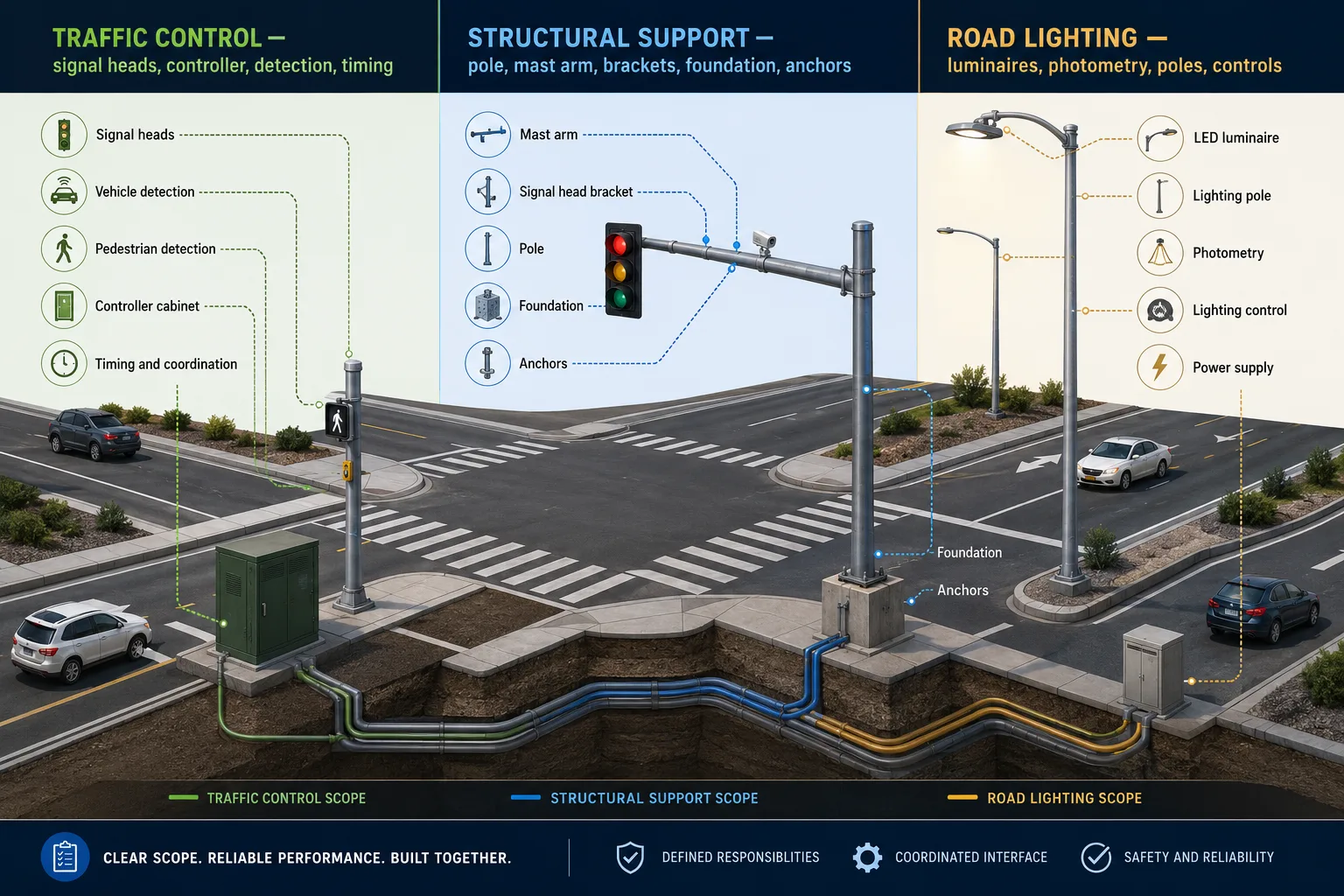
If you are coordinating the lighting package alongside the intersection works, use the Alumbrado público solution path. It addresses outdoor lighting decisions without pretending to approve the traffic-control plan.
Why signal layout matters before a pole is quoted
People often search for the meaning of the colors because the signal is the visible part of a junction. The support design starts with less visible facts. A three-section roadside head, a five-section arrow assembly on a long mast arm and an overhead lane-control installation do not impose the same loads or foundation demands.
Before asking for a structural-support quotation, provide the approved drawing, pole height, arm length, signal-head count and mounting arrangement, estimated equipment loads, local wind and corrosion data, cable/duct route, finish, destination and delivery date. For physical dimension context, How Big Are Traffic Lights? explains typical size variables; it does not replace the load schedule.
Questions people usually have
Does yellow always mean the same thing as amber?
They are common regional names for the middle signal color, but the operational rule comes from the local traffic code. Do not use the name alone to infer a permitted movement or timing rule.
Does a green light mean a driver always has the right of way?
No generic page can safely make that claim. Green commonly permits movement when safe, but turning movements, pedestrians, bicycles, signs and local rules can create yielding duties.
Why are some traffic lights horizontal and others vertical?
The layout can reflect local standard, clearance, visibility, wind exposure, support arrangement and maintenance considerations. Signal position may also help people distinguish indications; the approved local design governs.
Can a solar street light be used instead of a traffic signal?
No. A solar street light provides area illumination. A traffic signal controls traffic movements through approved signal hardware and operating logic. A project can include both systems, but they need separate engineering and approval paths.
What should be in a traffic-light-pole enquiry?
Include the approved drawing, pole and arm geometry, signal-head/support loads, mounting details, foundation/anchor requirements, wind and corrosion conditions, cable route, finish, quantity, destination and delivery date. That gives the structural-support scope a real basis.
Need the structural support package for a road project?
Send the approved support drawing, mast-arm geometry, equipment load schedule, installation country, environmental conditions, quantities and required delivery date. The Inlux engineering team can review the structural scope for a poste de semáforo and coordinate it with the separate road-lighting package where relevant.
Editorial sources and limitations
This is a general explainer, not a substitute for a traffic code or site-specific design. For examples of official signal guidance, consult the UK Highway Code: Light signals controlling traffic y el U.S. FHWA MUTCD, Part 4.