






This project covers the supply of 85 solar street lights for a desert camp in Jordan, an off-grid site with no practical connection to the utility network. Inlux Solar supplied the complete lighting package — luminaires, solar panels, batteries and poles — which was installed on site by the owner’s own team. The installation was completed in 2019 for a private-sector client under private funding.
Site Conditions and Lighting Requirement
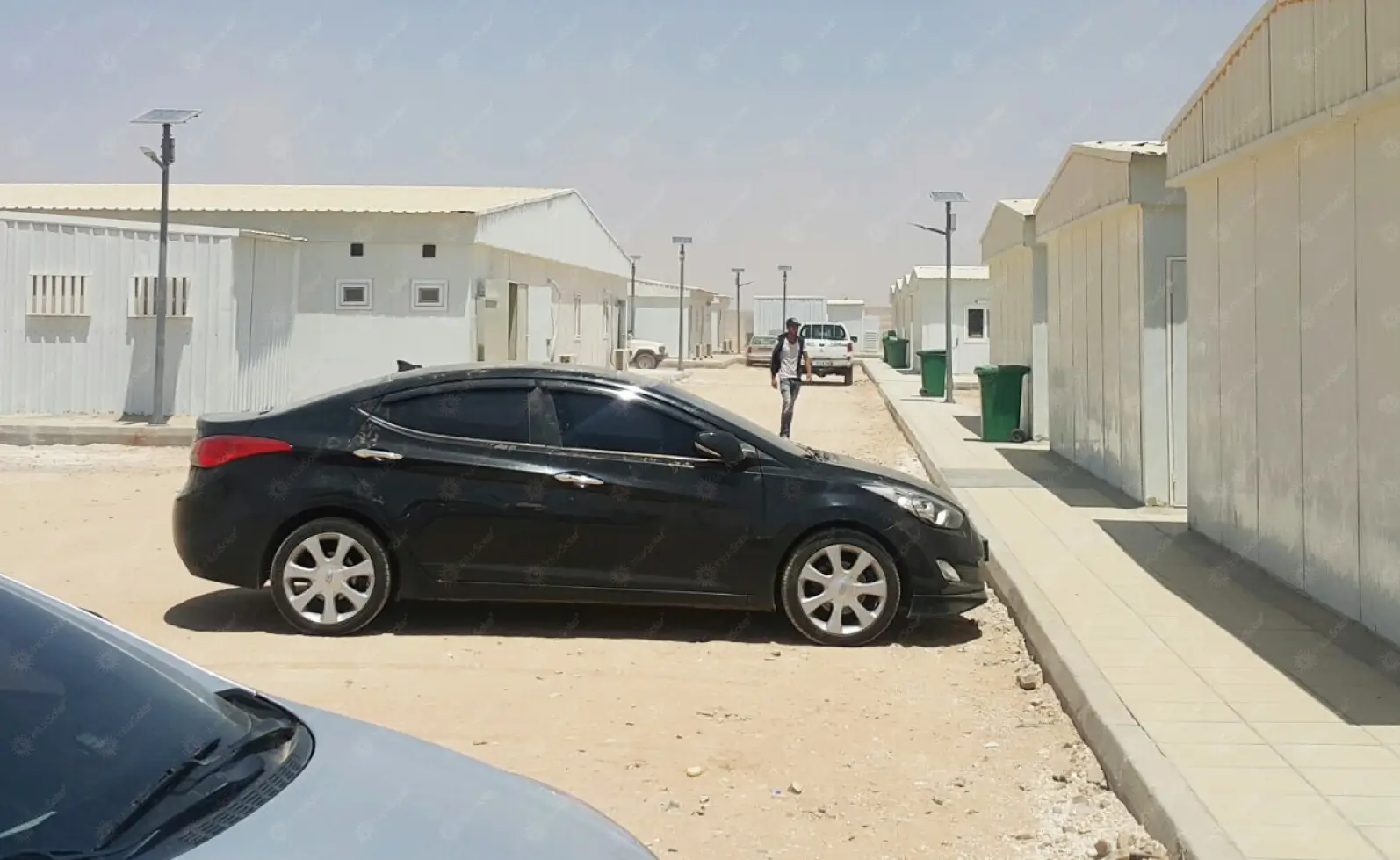
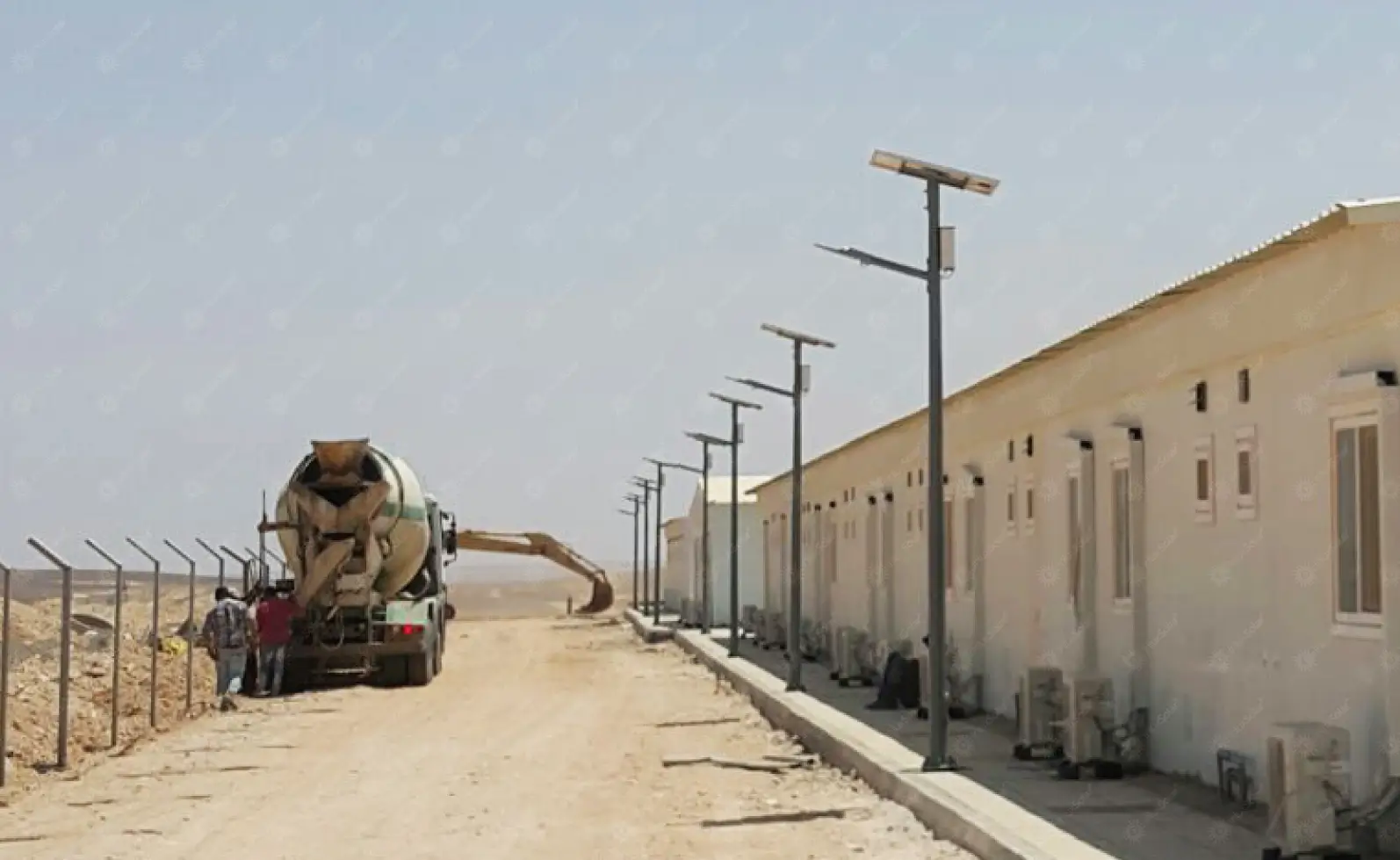
The camp is a cluster of prefabricated accommodation blocks laid out along unpaved access roads in open desert terrain, with a perimeter fence and construction still underway during part of the delivery. Distance from the nearest grid connection made a cable extension impractical, so every lighting point had to be self-contained.
The lighting requirement was straightforward but unforgiving: continuous night-time visibility along building frontages, walkways and internal roads, using equipment that could survive sand abrasion, high daytime surface temperatures and wide day-night temperature swings without a maintenance crew on permanent standby. Because the camp was occupied while other areas were still being built, the lighting also had to be installed progressively rather than commissioned in a single handover.
Why This Configuration Was Selected
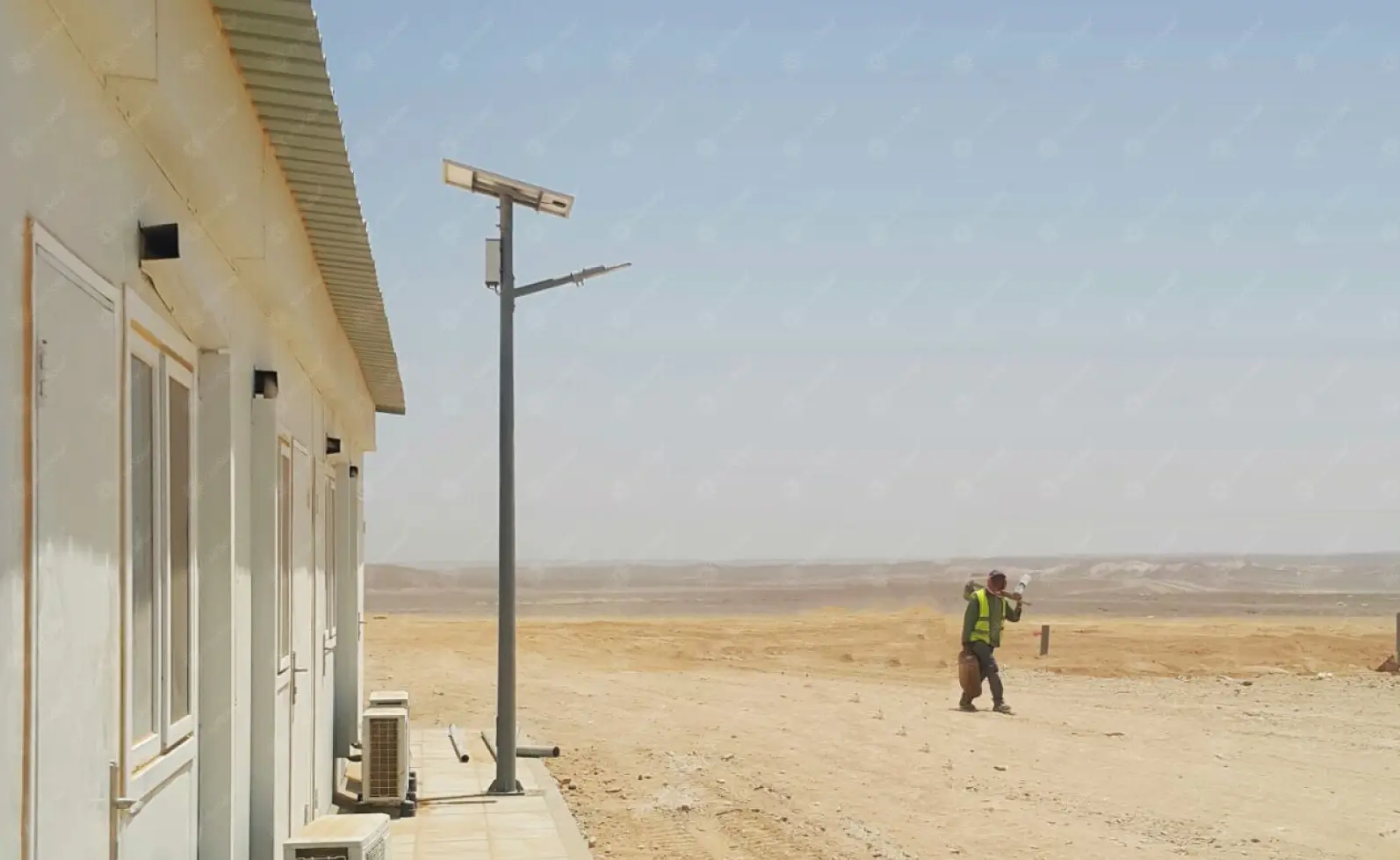
Each unit is a Split Type Solar Street Light – APOLLO Lithium Battery with a 20W LED at 6000K, paired with a LiFePO₄ 12V 30Ah battery and mounted on a 4 m pole. The luminaire carries an IP66 / IK09 rating.
The 4 m mounting height was chosen to match the scale of the site. Camp roads and walkways are narrow and traffic is slow, so a taller pole would have widened the beam spread without adding useful light where people actually walk. At 4 m, a 20W luminaire covers the frontage of a prefabricated block and the adjacent path without over-lighting the accommodation windows.
O split type configuration matters more than it might appear. Keeping the panel on its own bracket lets each unit be aimed for sun exposure independently of where the luminaire needs to point — useful on a site where lights follow building lines rather than a single road axis. LiFePO₄ chemistry was specified over lead-acid for its tolerance of high ambient temperatures and its longer cycle life, which directly reduces how often a remote site needs to be revisited for battery replacement.
Poles were Q235 steel with a hot-dip galvanized finish, rated to 120 km/h wind. In desert conditions the finish specification is not a cosmetic decision: wind-driven sand strips paint-only coatings, and once the steel is exposed, corrosion follows quickly at the base.
Delivery and Logistics for a Remote Site
The complete scope — 85 sets including poles — shipped in a single 40HC container, with sea freight taking about 30 days. Total elapsed time from contract to installed lighting was roughly 3.5 months.
Consolidating into one container was a deliberate part of the specification rather than a lucky outcome. Split shipments to remote sites create two problems for buyers: clearance and inland haulage costs are duplicated, and partial deliveries leave incomplete sets on site where components are easily mismatched or damaged. Because the client’s own team handled installation, Inlux Solar supplied the units pre-configured so that mounting and connection could be carried out without specialist commissioning equipment.
Procurement Value for Similar Buyers
For camps, compounds, remote worksites and similar off-grid facilities, this project is a useful reference point on sizing. A 20W luminaire on a 4 m pole is a modest specification by roadway standards, and that is precisely why it works here — the budget goes into unit count and coverage continuity rather than into over-specified individual fixtures.
The more common procurement error on this type of project is specifying to a road-lighting standard that the site does not need, then reducing quantity to stay within budget. That produces bright pools with dark gaps between them, which is worse for perceived safety than uniform moderate lighting. Where a project does need to meet a formal lighting class, Inlux Solar can provide IES files and DIALux studies for the actual layout before commitment.
Inlux Solar has supplied over 300,000 solar street lights for NGO and municipal projects in 60+ countries, and off-grid camp and compound lighting of this type is a recurring application across that base. Related deployments in the region are listed under Middle East projects, including a separate Jordan theme park installation using all-in-two units.
What Similar Project Buyers Should Confirm
- Mounting height against actual road width. Confirm pole height against the width of the surface being lit and the spacing you can physically achieve, not against a generic product recommendation.
- Battery chemistry versus site temperature. Ask for the rated operating temperature range and expected cycle life at your site’s peak ambient temperature, not at 25 °C laboratory conditions.
- Pole finish and wind rating. Confirm the galvanizing specification and the wind load the pole is rated for, and check it against local structural requirements.
- Container consolidation. Ask how many complete sets fit per container before finalising quantity — adjusting quantity slightly can avoid a second container.
- Installation responsibility. Establish early whether your own team, a local contractor or the supplier performs installation, since this changes what documentation and pre-configuration you need.
- Spares and replacement lead time. On remote sites, agree a spares package up front rather than ordering individual replacement parts later.
Related Solar Lighting Solutions
For projects with similar off-grid constraints, the split type solar street light range is usually the starting point where panel orientation needs to be set independently of the luminaire. Buyers comparing system architectures can review the full solar street light range, or work through specification methodology in the guias de iluminação pública solar.
Perguntas frequentes
Why was a split-type solar street light used instead of an all-in-one unit?
A split-type layout keeps the solar panel on a separate adjustable bracket, so the panel can be tilted toward the best sun angle independently of the luminaire position. On this camp the lights sit along building frontages and access roads with different orientations, and the split layout allowed the same 20W luminaire and 4 m pole to be reused across all of those positions without compromising panel exposure.
How many solar street lights fit into one shipping container?
All 85 sets for this project, including poles, were consolidated into a single 40HC container. Container utilisation is worth checking early on camp and compound projects, because a configuration that ships complete in one container avoids split shipments and simplifies customs clearance on remote sites.
How long did the project take from contract to installation?
The full cycle from contract to delivery and installation ran about 3.5 months, of which roughly 30 days was sea freight. For remote off-grid sites, buyers should plan the schedule around production plus shipping rather than production alone.
What pole specification was used for this desert installation?
The lights were mounted on 4 m Q235 steel poles with a hot-dip galvanized finish, rated to 120 km/h wind. Hot-dip galvanizing is the practical baseline for desert and coastal sites, where abrasive wind-blown sand and large day-night temperature swings shorten the life of painted-only finishes.
Is this configuration suitable for other off-grid camps and compounds?
The 20W / 4 m combination suits pedestrian routes, building frontages and low-speed internal roads rather than public highways. For wider carriageways or higher mounting heights, luminaire output and battery capacity both need to be recalculated, and we can issue an IES or DIALux study for the specific layout before an order is placed.
Localização do projeto
Configurações principais
Produtos aplicados
Galeria de projetos
About Me