







High Mast Light Systems for Large-Area Commercial & Infrastructure Projects
Inlux Solar supplies high mast light systems for highways, interchanges, ports, airports, industrial yards, and large-area facilities where tall-pole lighting and controlled beam distribution are required. This page helps project teams compare system types, mast configurations, and design considerations before procurement.
Quick Specs (Manufacturer Overview)
- Typical pole height: 25–50 m (custom by project)
- Mounting: ring-mount or directional flood arrays
- Ótica: 30° / 60° / 90° / 120° (project-based)
- Proteção contra ingresso: IP65–IP66 (model dependent)
- Finish: hot-dip galvanizing, optional powder coating
- Deliverables: IES/LDT, layout, drawings, BOM, packing specs
Factory Capabilities (Built for B2B Procurement)
- Engineering support: photometrics + aiming notes + layout verification
- Quality control: incoming inspection, in-process checks, final inspection, aging test (per project requirements)
- Documentação: datasheets, test reports, drawings, packing list, spare parts plan
- OEM/ODM: optics, CCT, surge options, branding, packaging, accessories
Product Lineup
Choose the right configuration based on application footprint, aiming needs, and maintenance constraints.
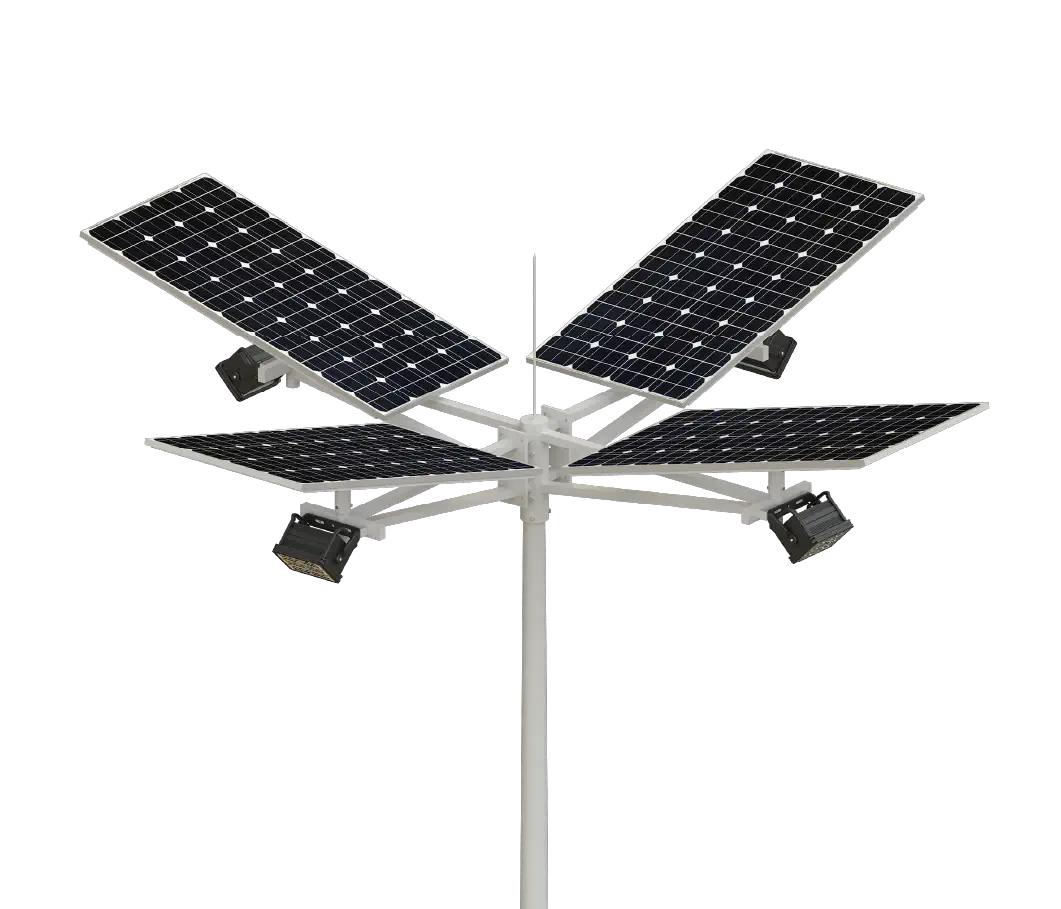
Luz solar de mastro alto
Off-grid high mast lighting sized by worst-month PSH, autonomy nights, and dimming profile—ideal where grid access is costly or unavailable.

Luz de mastro alto AC
Grid-powered high mast systems (25–50 m) with ring or directional flood arrays, optics options, glare control, and tender-ready documentation.

Mastro de luz do estádio
Project-specific uniformity, spill-light and glare targets, aiming plans, optional cut-off shields, and a documented maintenance arrangement; verify the quoted configuration and photometric report.
How to Choose Between AC, Solar, and Stadium Mast Systems
The right high mast lighting system depends on power availability, site footprint, maintenance strategy, and lighting target.
Choose AC high mast light when:
- Grid power is available
- Large-area lighting is required
- Long operating hours are expected
- The project prioritizes high-output lighting with centralized infrastructure
Choose solar high mast light when:
- Grid extension is costly or unavailable
- The site is remote
- Trenching and utility coordination should be minimized
- The operating profile can be optimized with dimming or scheduled control
Choose stadium mast light when:
- Vertical illuminance and directional aiming matter
- Spill-light control is critical
- Sports or venue-specific uniformity targets apply
- Maintenance safety and aiming precision are project priorities
Technical Parameter Comparison Table
Use this table as a quick comparison reference before requesting a detailed photometric layout, BOM, and project proposal. Final configuration should always be confirmed by application footprint, target illuminance, wind environment, and maintenance requirements.
| System Type | Altura típica do poste | Fonte de energia | Aplicações típicas | Mounting Configuration | Optics / Distribution | Maintenance Strategy | Melhor ajuste |
|---|---|---|---|---|---|---|---|
| Luz de mastro alto AC | 25–50 m | Grid-powered AC | Highways, interchanges, ports, airports, industrial yards | Ring-mount or directional flood arrays | Symmetric or asymmetric, project-based beam selection | Optional winch-lowering system or lift-based servicing | Large-area sites with available grid power and high-output lighting demand |
| Luz solar de mastro alto | 6–25+ m (project-dependent) |
Off-grid solar | Remote yards, border sites, temporary infrastructure, areas with costly grid extension | Integrated or split solar mast configuration | Distribution based on autonomy target, dimming profile, and site footprint | Battery / PV system sized by worst-month solar resource and runtime profile | Projects prioritizing off-grid deployment and reduced trenching |
| Mastro de luz do estádio | 20–50 m | Usually grid-powered AC | Sports fields, stadium perimeters, training grounds, event venues | Directional aiming with floodlight arrays | Vertical + horizontal illuminance control, glare and spill-light management | Precise aiming and safer maintenance planning are critical | Venue projects requiring directional control, uniformity, and spill-light limitation |
| Mini mastro de luz | 6–18 m | AC or solar, depending on configuration | Smaller yards, parking areas, internal roads, mixed-use sites | Lower-height mast with targeted area coverage | Project-based beam and layout selection | Simpler servicing than full-height mast systems | Sites needing wider-area coverage than standard poles, but not a full high-mast solution |
Observação: The values above are reference ranges only. Final specification should be confirmed by pole height, target lux and uniformity, wind-speed / EPA assumptions, optic orientation, maintenance method, and project footprint.
Guia de seleção
How to Specify a High Mast Lighting System
Start from site class and target illuminance/uniformity. Choose pole height (mini 6–18 m; standard 25–50 m), ring vs directional mounting, beam options (narrow–wide) and roadway distributions (II/III/V), plus glare control. Confirm local wind-speed/EPA and seismic category; specify HDG + powder coat. Add a winch-based lowering device if bucket-truck access is limited.
Related components: high mast light poles (polygonal/conical, HDG + powder coat) and modular high mast lamps (flood arrays with precise optics).
If your project does not require a tall-mast solution across the whole site, compare lower-height roadway and area-lighting options on our iluminação pública solar comercial page. For factory capability, proposal documentation, and project-support workflow, visit our Fabricante de lâmpadas solares para iluminação pública page. If the application is a retail lot, campus, warehouse yard, or mixed-use parking area rather than a true high-mast site, see our luzes solares para estacionamentos página.
What Is High-Mast Lighting?
High-mast lighting uses tall poles and clustered luminaires to illuminate large areas such as highways, interchanges, ports, airports, yards, and stadium perimeters. Unlike conventional roadway poles, high-mast systems rely on controlled optics, aiming orientation, and photometric verification to achieve safe average levels and uniformity across a wide footprint.
High Mast Light System Components (Tender-Ready)
- Mast pole: height selection + wind-speed / EPA capacity check + corrosion protection (HDG, optional powder coat).
- Luminaire mounting: ring-mount (symmetric coverage) or directional carriages (long-throw targeting).
- Luminaires / flood arrays: optic options, glare/spill control, and rotatable aiming when required.
- Lowering device (optional): winch-based system for safe ground-level maintenance where lift access is limited.
- Foundation: engineered per soil and wind load assumptions, aligned to pole class and anchor-bolt design.
Optics & Photometrics: Symmetric vs Asymmetric (Why Orientation Matters)
- Asymmetric optics are used for roadway-like distributions and must be oriented consistently around the ring to aim light where it’s needed.
- Symmetric optics are used for circular-area coverage around a pole and are less dependent on rotation.
- Always verify with IES/LDT + simulação (Avg/Min/Uniformity + grid + assumptions).
Layout & Spacing (No “Universal Rule”)
High-mast spacing depends on mounting height, number of luminaires, optics distribution, aiming/orientation, target average level, and uniformity requirements. Require IES/LDT files and a photometric layout so spacing and aiming are defensible.
What to Request in Every Bid (Copy/Paste)
- Arquivos IES/LDT para a luminária/óptica proposta
- Simulation outputs: Avg, Min, uniformity + calculation grid
- Layout drawing with assumptions: height, spacing, aiming notes, tilt limits
- Wind-speed & EPA check + pole/foundation recommendation
- BOM + shop drawings + method statement (installation & maintenance)
Guias e recursos de engenharia (prontos para licitação)
Stadium projects require vertical illuminance considerations, aiming notes, and glare/spill control—validated with photometrics.
Centros de recursos
- Folha de entrada do projeto (pronta para licitação)
- Centro de fotometria (IES/LDT + DIALux)
- Definições de especificações
- Kit RFQ/BOQ + Rubrica
Most Relevant Guides for Stadium Mast
- Iluminância horizontal versus vertical
- Controle de brilho e derramamento
- IES/LDT: O que solicitar
- Lista de verificação de comissionamento e aceitação
Pacote Run Stadium → Solicitação de proposta de iluminação do estádio →
Request a Quote (RFQ Checklist)
- Project location + wind environment (basic requirement)
- Target area type (highway / port / airport / yard) + approximate dimensions
- Preferred pole height range (or existing pole constraints)
- Target average lux + uniformity requirement (if available)
- Power supply (AC voltage range) and control needs
- Corrosion environment (coastal / chemical / normal)
- Required deliverables: IES/LDT, layout, drawings, BOM, packing
High Mast Light FAQs
Related Large-Area Lighting Pages
For more specific large-area lighting solutions, continue to:
- Luz solar de mastro alto
- Mini mastro de luz
- Poste de luz com mastro alto
- Poste de luz de mastro de estádio
- Luzes solares para estacionamentos
60+ Patents and 300+ Certifications Across the Company Portfolio
Qualidade garantida com certificações confiáveis
Company-level certificates do not prove compliance for every high mast system. Request the applicable report or certificate for the exact quoted model, component, test standard, issuing body and validity period, and confirm the project-specific structural and photometric scope.


