This road lighting project supplied 50 all-in-one solar street lights to a small town in Zambia, mounted on 6-metre hot-dip galvanized Q235 steel poles and completed in July 2026. The order was placed through an EPC contractor, and Inlux Solar’s scope covered manufacturing, supply and the supporting technical documentation, with the client’s own team carrying out installation on site. The units are drawn from the GALAXY Series all-in-one solar street light, an integrated platform that houses the LED module, solar panel, LiFePO4 battery and MPPT controller in a single body.
Site Conditions and Lighting Requirement
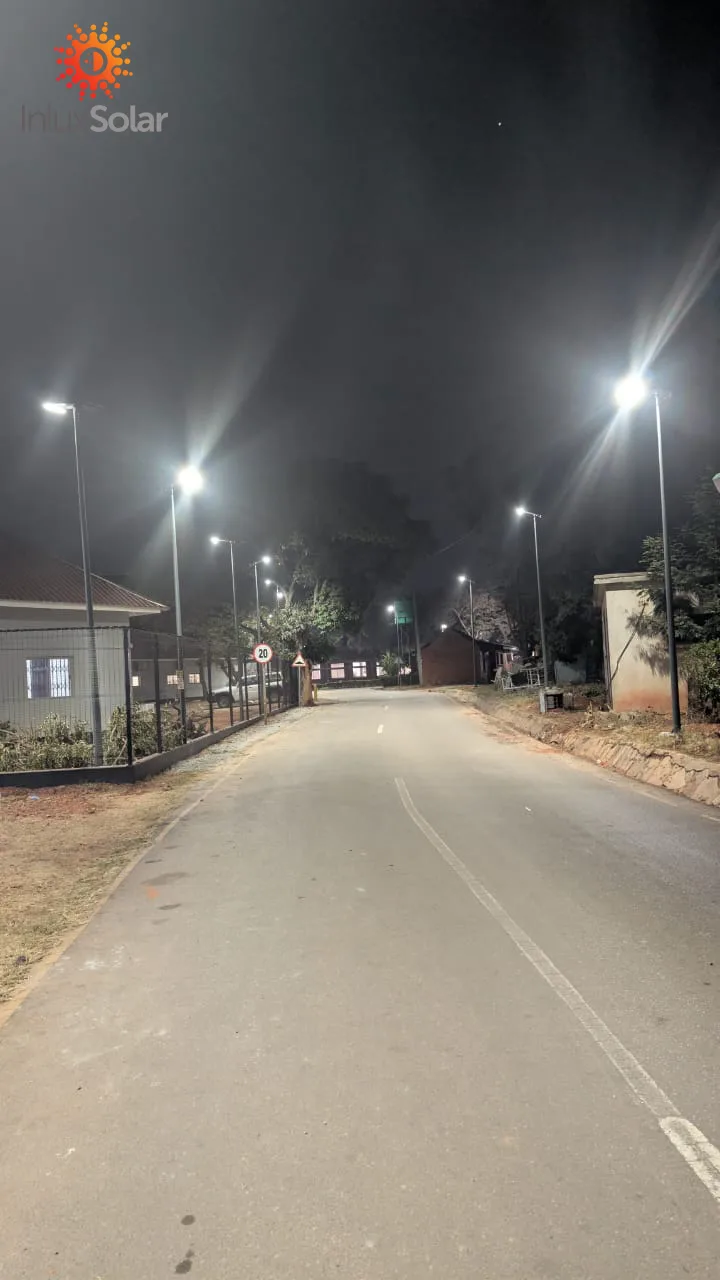
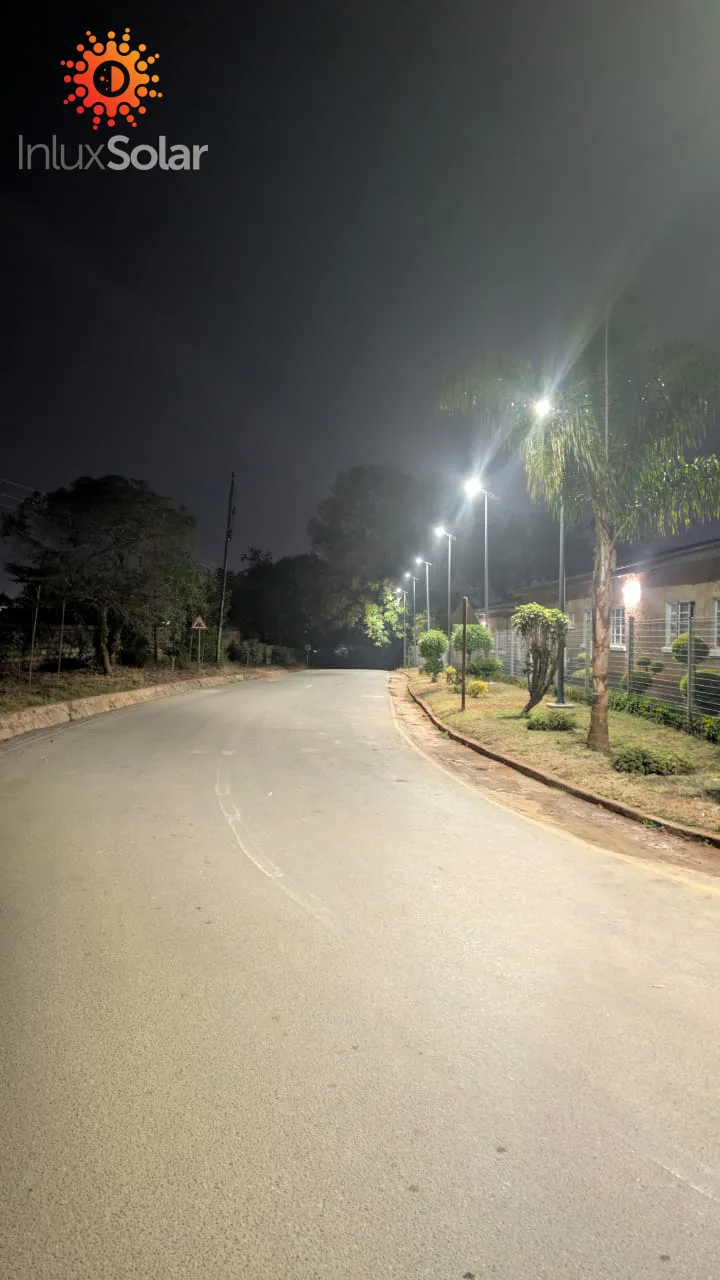
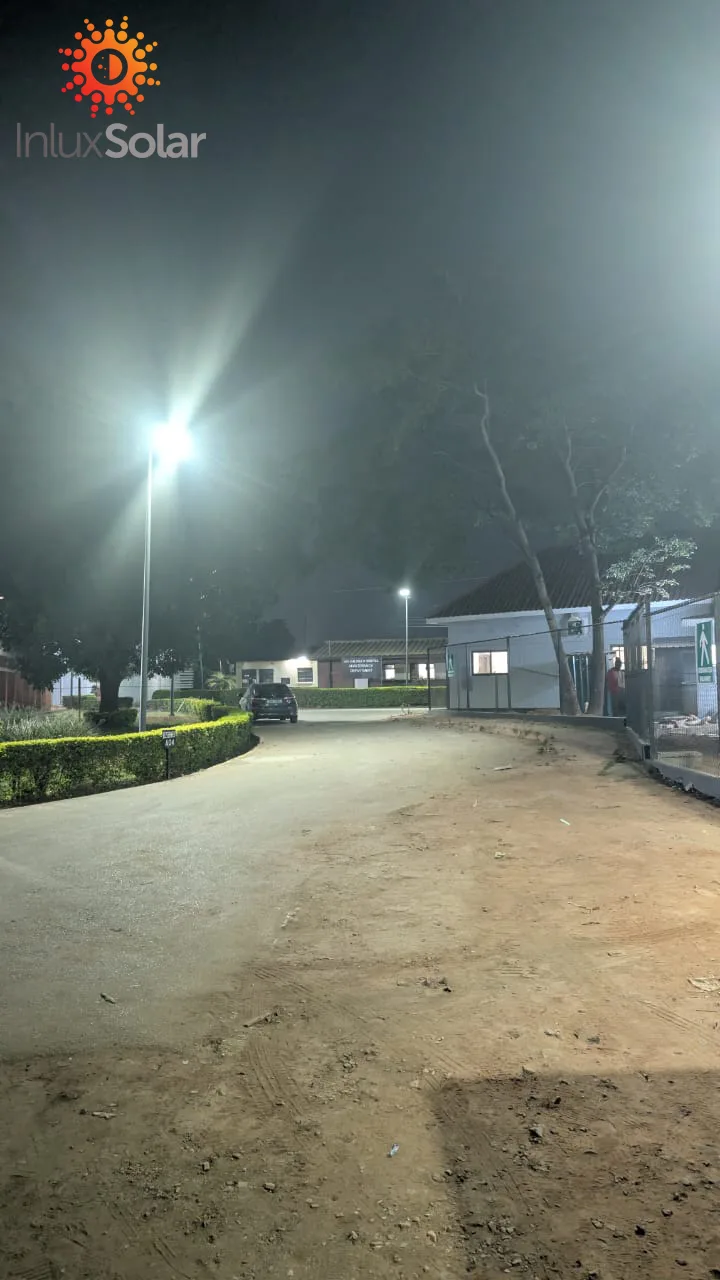
The installation covers a mixed set of road surfaces rather than a single uniform carriageway. Part of the route is an unpaved earth and gravel access road serving low-rise buildings and fenced compounds; the rest is sealed two-lane road with painted centre lines and a posted 20 km/h limit through the built-up section. That mix is typical of small-town networks in the region, where a surfaced main street feeds directly into unsurfaced side roads.
The two conditions pull in slightly different directions. On the unpaved sections, dust in the dry season is the main durability concern, which is why an IP66 / IK09 rated luminaire body matters more here than it would on a clean urban street. On the sealed section, the priority shifts to consistent longitudinal uniformity so that drivers and pedestrians are not moving through alternating bright pools and dark gaps. Because an all-in-one unit carries its own generation and storage, pole positions can follow the geometry of the road and the actual pedestrian desire lines instead of being pulled toward the nearest available power connection — a practical advantage on road and street lighting routes that were never trenched for a distribution network.
Two pole arrangements were used across the site. Along the curved sealed section, luminaires run single-side, which keeps the lit band on the inside of the bend where the footway sits. On the wider straight section through town, poles are set on both sides in an opposing arrangement, giving broader coverage across a two-lane cross-section than a single-side run could reach at this mounting height.
Why This Configuration Was Selected
At 6 metres, the mounting height sits in the middle of the band this platform is designed for, and it is a deliberate choice for local and secondary roads rather than a compromise. Going taller widens the spacing a designer can achieve, but it also demands more output per unit and a heavier pole and foundation. At 6 metres with a Type II distribution, a small-town street can be lit with closer, lower-cost poles that stay within reach of a basic ladder or light vehicle for cleaning and battery service — which matters when there is no local crew with an elevated work platform on standby.
The pole specification carries as much weight as the luminaire in this climate. Q235 steel with a hot-dip galvanized finish is the practical baseline for outdoor African deployments, because galvanizing protects the section from the inside of the wall outward rather than sitting on top of it as paint does. Where repainting on a maintenance cycle is unrealistic, that difference is what determines whether the poste de luz outlives the electronics it carries or fails before them.
On the storage side, the 3,500-cycle LiFePO4 rating is the number worth reading closely. At one charge and discharge cycle per night, 3,500 cycles corresponds to roughly nine to ten years of nightly cycling before the rated end of cycle life — which is why lithium iron phosphate has displaced lead-acid and gel chemistries on this class of project, even though the up-front cell cost is higher. For a buyer, the relevant comparison is not the purchase price of the battery but how many replacement visits are avoided over a decade.
The 6000K colour temperature is worth flagging as a decision rather than a default. Cool white gives strong perceived brightness and edge contrast on unlit roads, and it is the common preference for security-led public lighting. Some municipalities now specify 4000K instead, for lower glare and better colour rendering in residential streets. This platform covers 3000K to 6500K, so the choice is a specification question, not a product limitation — worth settling before a tender is priced, since it cannot be changed after the fixtures are cast.
Delivery, Shipping and Installation Scope
The full cycle from contract signature through delivery to installation ran to about five months. For buyers building a programme schedule, that figure is more useful than a factory lead time on its own, because it absorbs photometric design sign-off, production, ocean freight to Southern Africa and inland transport to a landlocked destination.
The consignment moved as loose break-bulk cargo rather than a full container load. At 50 sets with 6-metre poles, that is often the more economical route, since pole length drives the cut-off between break-bulk and containerised freight more than unit count does. It also changes what a buyer should check on arrival: break-bulk handling means more individual lifts, so packaging and shipping protection and a careful damage inspection at discharge carry more weight than they would with a sealed container. Inlux Solar packs luminaires in cartons with EPE foam and protects poles with felt and bubble wrap, and lithium batteries ship under SDS, UN38.3, IMDG and IATA DGR documentation.
Installation was carried out by the client’s own team rather than a supervised crew from the factory. For client-installed projects, Inlux Solar supplies installation documentation and remote support so local crews can set out foundations, fix brackets and commission units without a supervisor on site. Buyers running this model should confirm the installation and after-sales scope in writing at the order stage, because it determines who is accountable if a unit underperforms in its first season.
Procurement Value for Similar Buyers
A 50-unit order is a realistic reference point for municipal and EPC buyers, and that is precisely what makes it useful. Many programmes begin with a single street or one district as a pilot before a wider rollout is funded, and a pilot at this scale still has to answer the same questions a 500-unit contract does: does the configuration match the road class, will the poles survive local conditions, and can the supplier document the system well enough to satisfy a tender review. Inlux Solar has supplied over 300,000 solar street lights for NGO and municipal projects in 60+ countries, which is the delivery record behind an order of this size.
Where an all-in-one platform earns its place is in installation economics rather than headline efficiency. There is no separate panel bracket to align, no external battery cabinet to secure against theft, and no inter-component cabling to terminate in the field — which is what allows a client’s own team to install a run without specialist commissioning labour. The trade-off is that the panel, battery and driver share one thermal envelope and one service access point, so battery replacement later in life means working at the luminaire rather than at ground level. That is a genuine consideration to price into a ten-year maintenance plan, not a reason to avoid the format.
For projects that go out to tender, the documentation package usually decides the bid. Inlux Solar supports tender submissions with datasheets, IES and DIALux files, drawings, BoM and QC plans, plus pole and wind-load matching for the specific site, and photometric design against a target lighting class such as EN 13201. The supplied equipment carries a standard five-year warranty. Buyers comparing offers on this class of project will find the solar street light buyer’s guide useful for structuring a like-for-like comparison.
What Similar Project Buyers Should Confirm
- LED power against a lighting class, not against a competitor’s wattage. Ask for the luminous flux in lumens and a photometric calculation to your target class. Wattage alone says nothing about whether the road is lit to specification.
- Pole spacing and arrangement. Confirm whether the design assumes single-side or opposing layout, and whether the quoted spacing was verified for your actual carriageway width and any curves on the route.
- Autonomy in real conditions. Specify the number of consecutive overcast days the system must ride through, and have it sized against local irradiation data rather than a generic backup figure.
- Wind load at the installed site. Pole and bracket selection should be matched to the wind zone and mounting height for your location. A general product figure is not a structural calculation for your site.
- Battery service access and warranty split. Clarify the warranty term for the luminaire, the battery and the pole separately, and how a battery is replaced at height once the system is in service.
- Freight mode for the order size. Have the supplier price both break-bulk and containerised options against pole length and quantity, and agree the damage inspection procedure at discharge.
- Installation responsibility and documentation. Settle whether your team or the supplier commissions the units, and what drawings, torque figures and commissioning records you receive.
- Colour temperature as a written specification. Fix the CCT before pricing, especially where residential streets and security areas sit on the same route.
Related Solar Lighting Solutions
For similar road and street lighting programmes, the all-in-one solar street light range covers the integrated format used here, while the wider luz de rua solar catalogue includes all-in-two and split-type systems for higher output or separate panel orientation. Further deployment references are collected on the projects página.
Perguntas frequentes
Which solar street light system was used for this project in Zambia?
The project uses the GALAXY Series all-in-one solar street light, which combines the LED module, solar panel, LiFePO4 battery and MPPT controller in a single integrated body. Fifty units were supplied on 6-metre hot-dip galvanized Q235 steel poles, at 6000K colour temperature, with IP66 / IK09 rated luminaires.
How long did the project take from contract to installation?
The full cycle from contract signature through delivery to installation took about five months. Buyers planning a similar programme should allow time for photometric design sign-off, production, ocean freight to Southern Africa and inland transport to site.
How were the 50 units shipped to Zambia?
The order moved as loose break-bulk cargo rather than a full container load, which is often more economical at this quantity because 6-metre pole length drives the freight decision more than unit count. Inlux Solar packs luminaires in cartons with EPE foam and protects poles with felt and bubble wrap, and lithium batteries ship under SDS, UN38.3, IMDG and IATA DGR documentation.
Who carried out the installation on site?
Installation was carried out by the client’s own team. For client-installed projects, Inlux Solar supplies installation documentation and remote support so local crews can set out foundations, fix brackets and commission the units without a supervisor on site.
Can the same configuration be quoted for other African road projects?
Yes. The same all-in-one platform can be re-specified for other road and street lighting projects, with pole and wind-load matching for the installed location and IES or DIALux photometric design against a target lighting class such as EN 13201.
What warranty applies to the supplied equipment?
The supplied equipment carries a standard five-year warranty with documented RMA handling. For municipal and EPC contracts, confirm the warranty scope for the luminaire, the battery and the pole separately, since each has a different expected service life.
Localização do projeto
Configurações principais
Produtos aplicados
Galeria de projetos
About Me