







SENEGAL · 2025 DEPLOYMENT REFERENCE
Solar Street Lights in Senegal: A 460-Unit Engineering & ROI Reference
Senegal is accelerating its energy transition: continuously rising SENELEC tariffs, national decarbonization targets, and pressure to extend public lighting to peri-urban neighborhoods, fishing ports and residential corridors are pushing municipalities, EPC agencies and private developers toward off-grid solar street lighting.
For Senegalese procurement officers and EPC contractors, the question is no longer whether solar will replace conventional grid-powered poles, but how to deploy it against Atlantic salt air, the four-month wet season, and harmattan dust — without inflating civil CAPEX or maintenance OPEX.
Inlux Solar’s APOLLO Split-Type systems are designed precisely for this context: solar lighting that survives 700 km of salty coastline, the rainy season from June to October, and harmattan from December to February. Our deployment of 460 APOLLO street lights across Senegalese ports, communities and fishing zones (2025) demonstrates this fit. This guide gives you the technical, financial and logistical building blocks to specify a solar lighting project in Senegal without surprises.
Engineering Analysis: The Challenge of Lighting Senegal
Senegal presents a combination of environmental constraints rare in West Africa: 700 km of Atlantic coastline loaded with salt spray, a marked wet season (June–October) which can deposit 600–2,000 mm of rain depending on the region, and a dry, dusty Saharan harmattan from December to February. From an engineering standpoint, three environmental vectors dominate solar street light design:
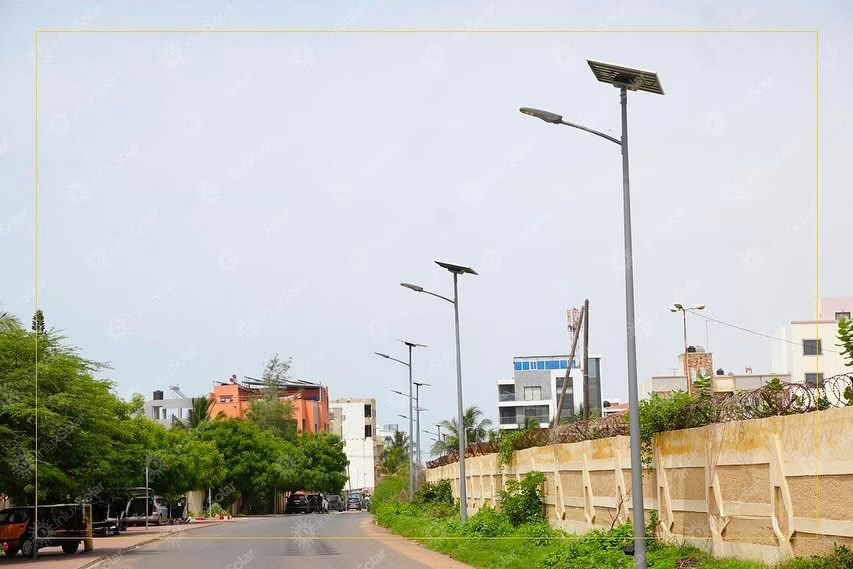
Solar Resource
5.0–5.5 peak sun hours (PSH) per day annual average on the coast (Dakar, Saint-Louis, Mbour);
5.5–6.5 PSH inland (Tambacounda, Kédougou). But the wet season cuts effective PSH to 3.5–4.0 for 3 to 4 consecutive months, requiring battery autonomy sizing of ≥4 days.
Tropical Coastal Climate
ambient temperatures 22–32 °C on the coast, up to 42 °C inland (Tambacounda, Matam). Relative humidity 75–90 % in rainy season.
The combination of heat, humidity and salt air severely stresses Li-ion batteries without thermal management and LEDs without oversized heatsinks.
Topography & Soils
sandy coastal soil (Dakar, Saint-Louis), inland laterite (Thiès, Kaolack), deltaic clay (Sine-Saloum region).
Atlantic marine air introduces chloride ions that accelerate corrosion; harmattan dust deposits 50–100 µm on panels, reducing transmittance by 10–20 %.
These conditions interact in ways that generic "catalog" solar street lights are not designed to handle.
Why Generic Solar Street Lights Fail in Senegal
When conventional or low-grade solar lights are deployed in Senegal, several interlinked mechanisms cause premature failures:

Standard galvanized or powder-coated steel mounts develop microcracks where chloride ions penetrate, causing pitting corrosion within 2–3 years, especially at welds and bolts. Panels misalign, wiring oxidizes, water infiltrates junction boxes.

Over 3–4 consecutive months, irradiance drops. Undersized batteries (typically 30–40 Ah for 60 W) operate in chronic partial-state-of-charge, accelerating degradation. After 12–18 months, real-world autonomy falls below one night.

Panels at low tilt (10–15°) accumulate dust without rain or gravity self-cleaning. Effective PSH drops from 5.5 to 4.0–4.5.

Batteries housed in the luminaire head exceed 50 °C on hot afternoons. For LiFePO₄, every +10 °C above 25 °C halves cycle life.

Saint-Louis, Dakar, and the Petite Côte experience constant 5–15 m/s winds with rainy-season gusts at 25–40 m/s. Generic poles sized for 100 km/h without topographic amplification factor deform or topple.
Em resumo, salty coast + long wet season + harmattan create a coupled system of mechanical, electrical and environmental stresses that generic solar lights — designed for flat terrain and low salinity — cannot absorb.
Inlux Solar Technical Solution: APOLLO Split-Type Adapted to Senegal
In 2025, Inlux Solar delivered 460 APOLLO Split-Type solar street lights across Senegal, covering streets, fishing ports, residential communities and commercial nighttime activity. This field reference directly informs the recommended configuration for new Senegalese projects:
- High-efficiency monocrystalline panels (Tier-1 cells: Jinko, Trina, LONGi, JA Solar), self-cleaning panel tilt 20–25°
- LiFePO₄ battery 50 Ah / 25.6 V (1.28 kWh) with multi-protection BMS, mounted in a ventilated enclosure separate from the luminaire (Split-Type configuration)
- LED module 80 W (5050 SMD, brands Lumileds, OSRAM or CreeLED)
- In-house MPPT controller (efficiency >99 %, thermal derating above 80 °C)
- Pole in Q345/Q355 steel hot-dip galvanized ≥70 µm (ISO 1461), 44 m/s wind certified
- Marine-grade hardware (A4/316 stainless steel or anodized aluminum) on exposed fastening points
The Senegalese wet season (June–October) creates 3 to 4 consecutive months of reduced irradiance. Our LiFePO₄ BMS handles:
- Autonomy ≥4 days without sun via the 50 Ah / 25.6 V battery and depth-of-discharge (DoD) limited to 80 %
- Cycle life >3,000 cycles at 80 % DoD, approximately 10 years of typical service
- Adaptive dimming profile: 100 % power before midnight, dimming to 50 % between midnight and 5 a.m., extending autonomy without compromising public safety
- Thermal protection: if battery temperature exceeds 55 °C, automatic charge derating to prevent accelerated degradation
Our standard mast in Q345/Q355 steel with hot-dip galvanizing ≥70 µm for 3–6 mm thicknesses (≥85 µm above 6 mm) is certified for reference winds of 44 m/s — comfortably covering expected rainy-season gusts on the Petite Côte (25–40 m/s) and at Saint-Louis. For sites exposed to permanent sea breeze, we offer optional secondary epoxy powder coating over galvanizing, compliant with ISO 12944 C4 (moderate coastal atmosphere). The mast is engineered for >30 years structural service life.
Summer peaks of 35–38 °C ambient combined with 80 % humidity in the Dakar region require an oversized cast-aluminum LED heatsink. Our 80 W LED module uses 5050 SMD packages (Lumileds, OSRAM or CreeLED) with 195–235 lm/W efficiency. LED module warranty is 5 years standard, aligned with L70 lifetime expectation for outdoor commercial luminaires. The IP66/IP67 + IK09/IK10 enclosure protects against tropical rain and salinity.
ROI Calculation: SENELEC Tariff vs Off-Grid Solar Street Light
The professional SENELEC tariff published in the 2025 grid breaks down as follows:
| Tariff category | Tier 1 | Tier 2 | Tier 3 |
|---|---|---|---|
| Professional Small Power (PPP) | 147.43 F CFA/kWh | 189.84 F CFA/kWh | 208.63 F CFA/kWh |
| Professional Medium Power (PMP) | 165.01 F CFA/kWh | 191.01 F CFA/kWh | 210.81 F CFA/kWh |
Source: SENELEC, 2025 tariff grid (senelec.sn/grille-tarifaire/)
For a grid-powered 80 W LED street light operating 11 hours per night at 65 % average dimming (effective consumption ~52 W), annual consumption is approximately 209 kWh per pole. At PMP tier 2 (191 F CFA/kWh), the annual electricity cost per pole reaches ~39,919 F CFA (~67 USD at 600 F CFA/USD).
10-Year Comparison (per 80 W street light)
| Cost item | SENELEC Grid + LED | Off-Grid APOLLO Solar |
|---|---|---|
| Equipment CAPEX | ~250 USD (LED luminaire + pole) | ~620 USD (complete APOLLO system) |
| Civil CAPEX (grid connection) | 800–2,500 USD/pole (non-urban areas) | ~80 USD (concrete foundation) |
| 10-year OPEX electricity | ~670 USD (39,919 F CFA × 10 years) | 0 F CFA |
| 10-year OPEX maintenance | ~150 USD (lamp + ballast) | ~80 USD (panel cleaning, battery year 8–10) |
| Total 10 years (non-urban zone) | ~2,070–3,770 USD | ~780 USD |
Solar vs grid ROI in Senegal typically falls between 4 and 6 years for peri-urban and rural deployments. For dense urban corridors with existing grid connection, ROI extends to 7–9 years but remains favorable beyond that.
Supply Chain and Logistics for Senegal
Shipping Routes to Port of Dakar
The Autonomous Port of Dakar (PAD) is the main maritime hub of French-speaking West Africa. For a solar lighting project originating from our Yangzhou factory in Jiangsu Province, China, typical logistics parameters are:
- Maritime transit time: Yangzhou (port of Shanghai) → Dakar via the Cape route, 28 to 35 days depending on rotation
- Embalagem: SKD (Semi-Knocked-Down) or CKD (Completely-Knocked-Down) on request, optimizing ECOWAS customs duties and enabling local assembly for project value-add
- Container volume: ~120 sets APOLLO Split-Type 80 W per 40' HC standard (panel + mast + battery + LED head)
- Documentação: Certificate of origin, packing list, BL, SGS/TÜV/Intertek certificates included in import dossier
Standard Production Lead Times
- Sample: 5 to 10 days for client validation before series order
- Series production: 15 days for standard quantities
- OEM customization: 20 days (logo, special configuration)
Installation and Maintenance Guide for Senegalese Soil
Senegalese Soil Conditions
Senegalese subsoil varies significantly from one region to another. Mast foundations must adapt accordingly — sandy coast requires deeper anchorage, clay deltas need drainage layers, sandstone plateaus allow shallower footings.
Sandy Coast
Dakar · Saint-Louis · Mbour
- Foundation depth
- 1.2 – 1.5 m
- Concrete spec
- C25/30
- Footing size
- 60 × 60 × 60 cm
Loose substrate, deeper anchorage required.
Inland Laterite
Thiès · Diourbel · West Kaolack
- Foundation depth
- 0.8 – 1.0 m
- Concrete spec
- C20/25
- Footing size
- 50 × 50 × 50 cm
Dense, cohesive — standard footing sufficient.
Deltaic Clay
Sine-Saloum · Kaolack Delta
- Foundation depth
- 1.5 m + drainage
- Concrete spec
- C25/30
- Drainage layer
- 30 cm gravel bed
Waterlogged — drainage layer mandatory.
Sandstone Plateau
Tambacounda · Kédougou
- Foundation depth
- 0.7 – 0.9 m
- Concrete spec
- C20/25
- Anchoring
- Optional chemical
Solid bedrock — shallow footing acceptable.
Maintenance Schedule for Senegalese Climate
- March (post-harmattan): freshwater panel cleaning + joint and bolt inspection. Harmattan typically deposits 50–100 µm of Saharan dust, reducing transmittance by 10–20 % if not cleaned.
- October (post-wet season): IP66 seal inspection, corrosion check on coastal fastening points, BMS test and battery state after 4 months of intensive cycling.
- Annual (all regions): firmware update for controller (if IoT version), telemetry test, structural visual check.
- Year 8–10: LiFePO₄ battery replacement recommended (cycle life reached), retaining the rest of the system.
Project Reference
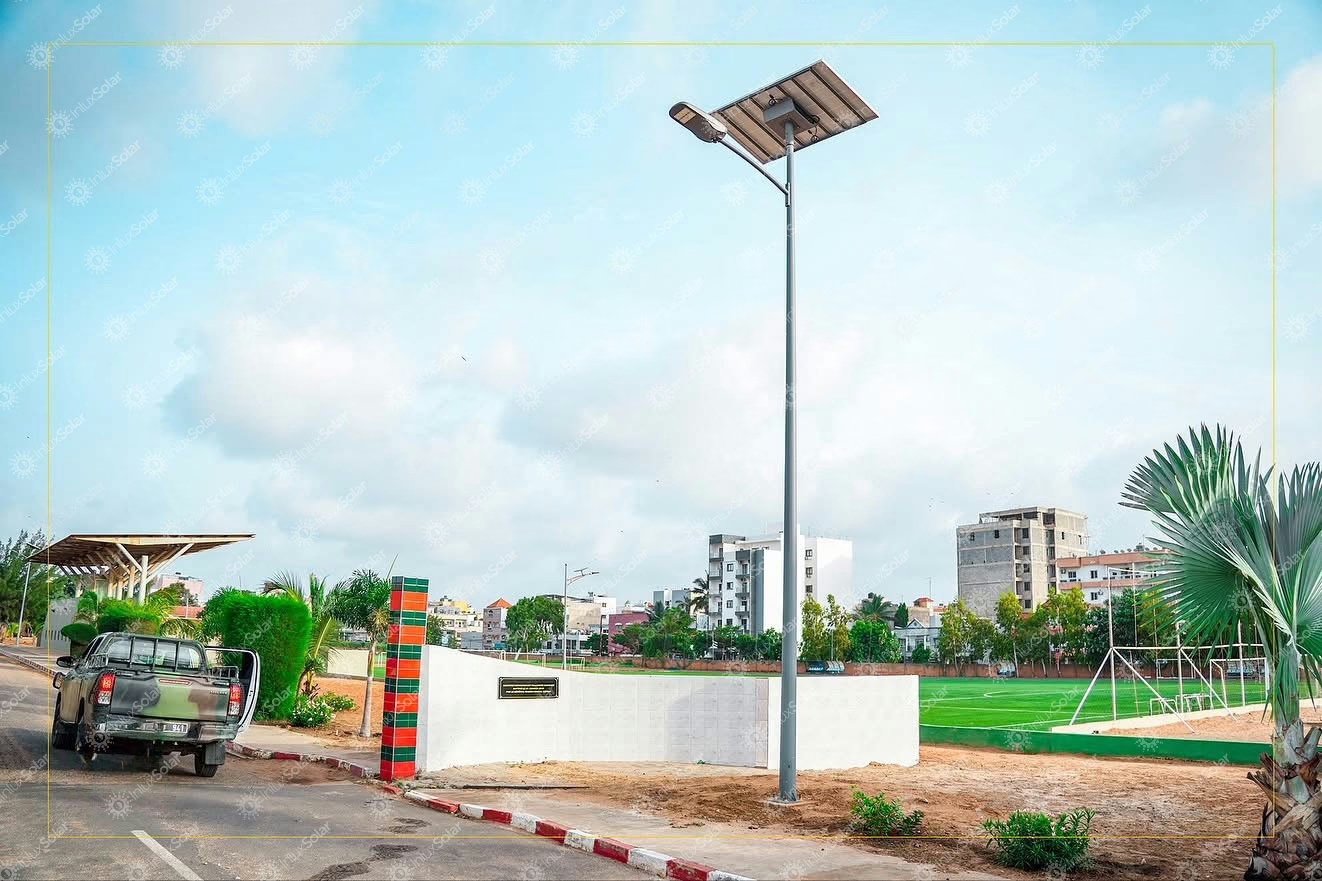
460 APOLLO Split-Type
Luzes de rua solares
Republic of Senegal · 2025
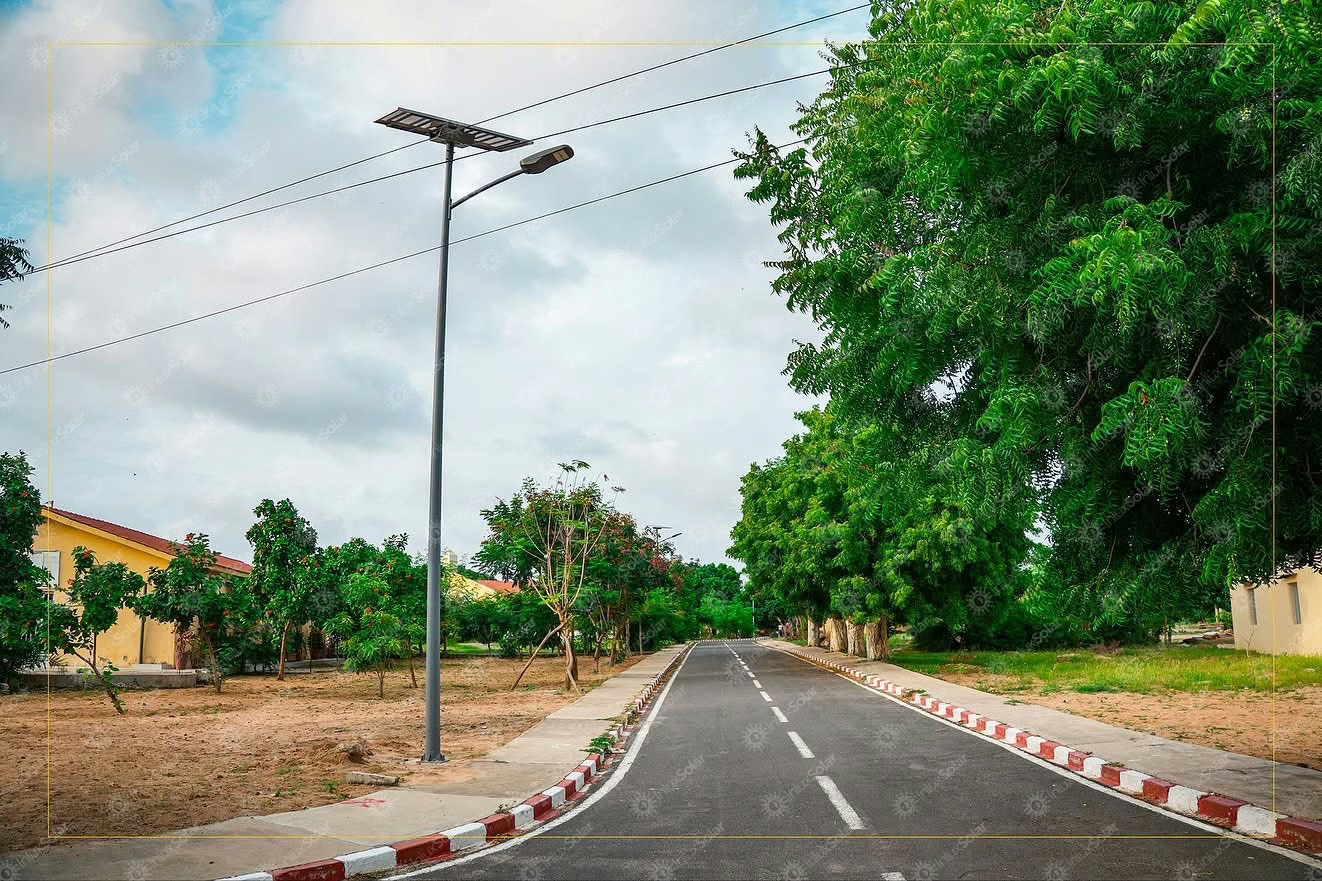
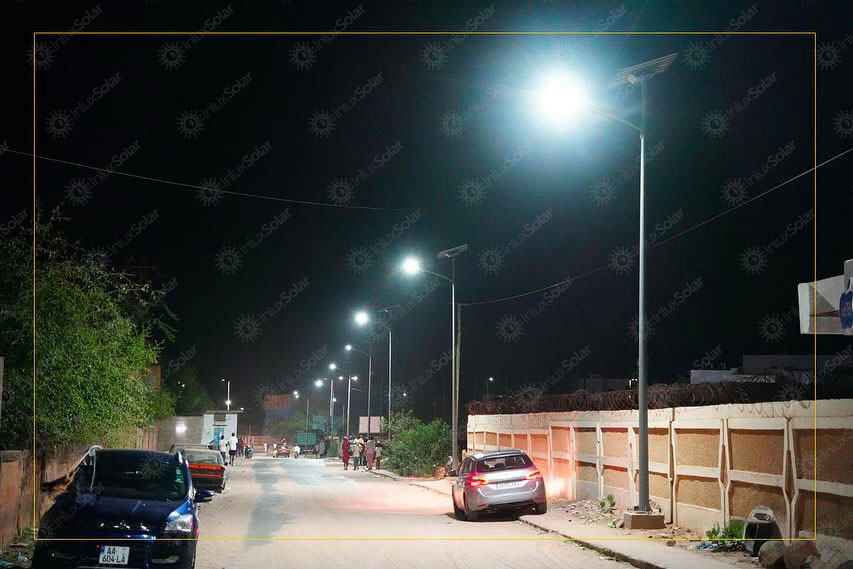
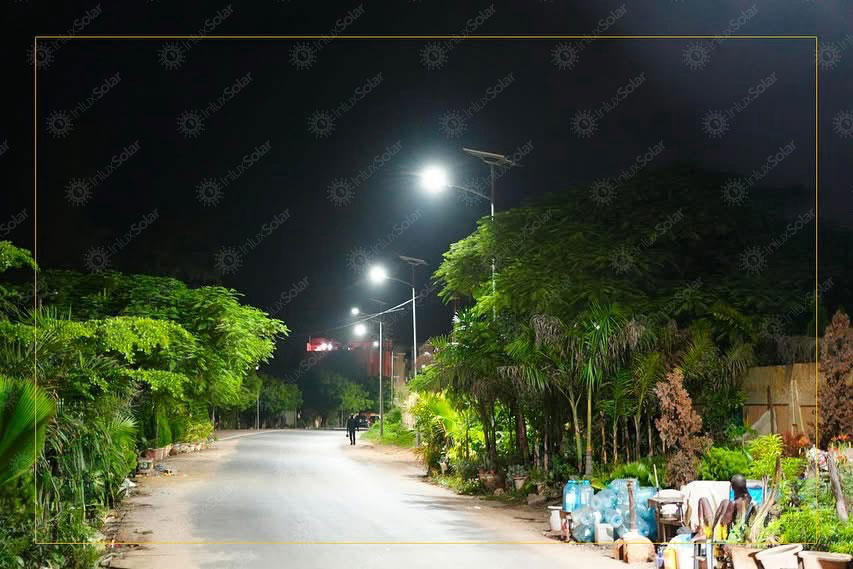
This project was designed to address specific Senegalese requirements: ensure stable public lighting in zones where SENELEC grid connection is either absent or economically unrealistic. The Split-Type configuration was chosen specifically for two reasons:
- Easier maintenance: the LiFePO₄ battery is mounted separately from the luminaire, accessible from ground level for inspection and replacement, without requiring a lift or extended service interruption.
- Thermal adaptation: separating battery from LED module reduces thermal coupling, which is critical under tropical Senegalese sun where the luminaire head can reach 60–65 °C during the day.
Integration of the >99 % tracking efficiency MPPT controller with LiFePO₄ chemistry ensures stable autonomy through the wet season, when average irradiance drops by 30 to 40 %. The deployment covers areas as diverse as urban residential streets, port zones (where salt air is most aggressive), and peripheral neighborhoods where grid extension would have cost 5–10 times more than the off-grid solution.
Other French-Speaking African Country Deployments
- Mali (Bamako, 3,162 units, 2025)
- Burkina Faso (Sahel, 1,095 units, 2024)
- Niger (Diffa, 1,750 units, 2021)
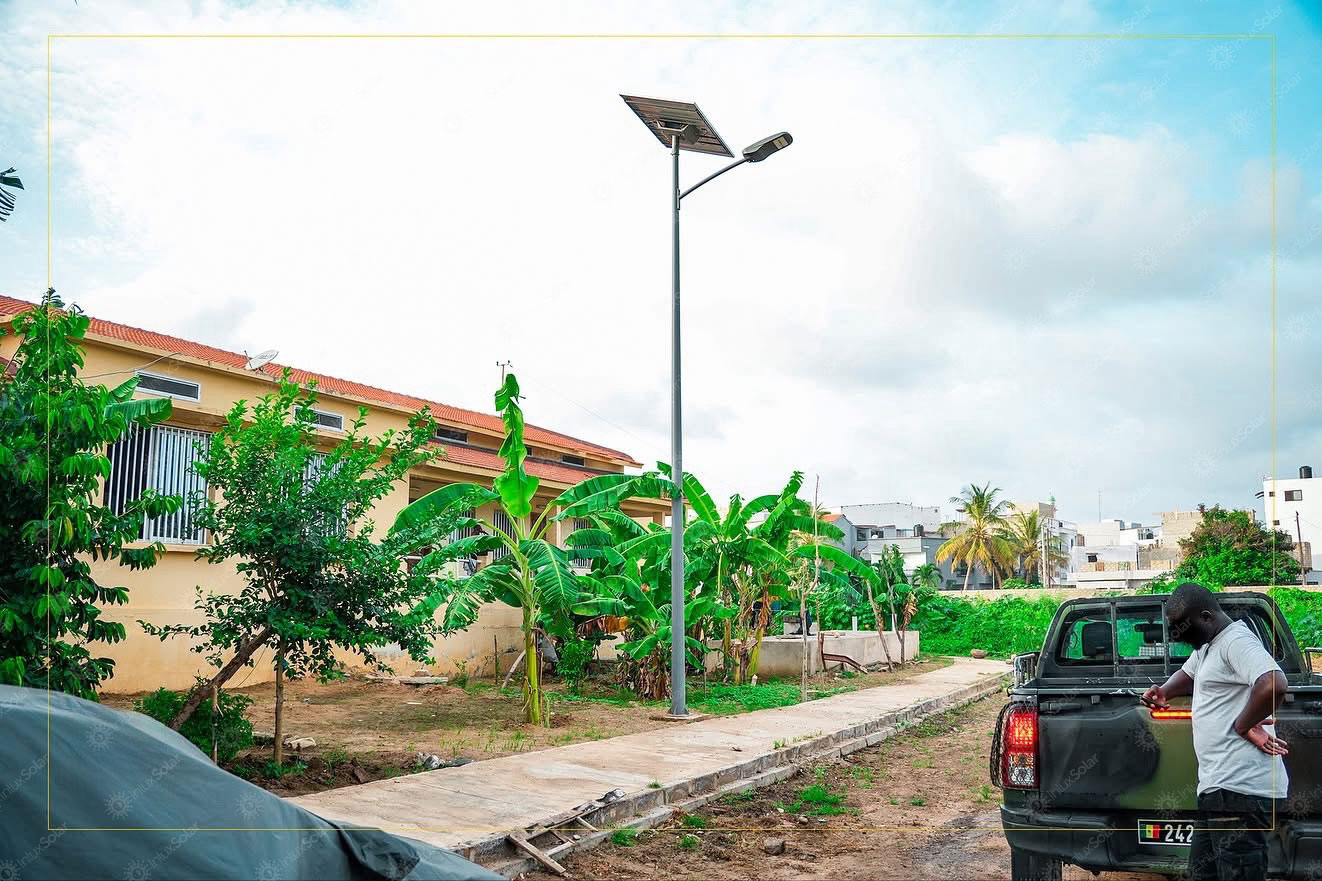
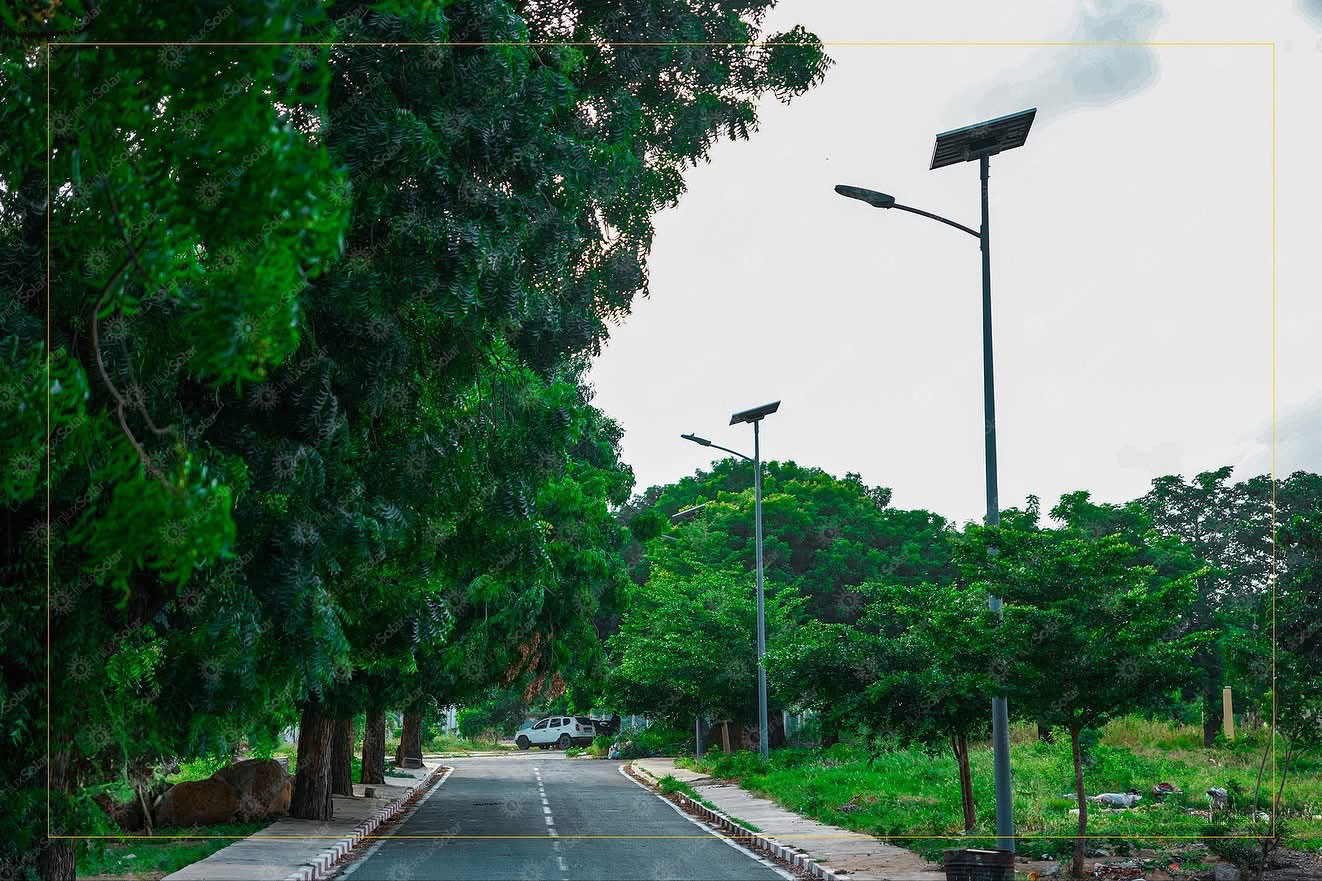
Field Documentation · Senegal 2025
Get Your Senegal Project Quote Today
Whether your project covers 50 lights for a Dakar peri-urban neighborhood, 200 lights for a fishing port, or 1,000+ lights for an entire commune — our engineering team produces a site-specific BOM at step 4 of our tender qualification process. For the complete component-by-component spec sheet — Tier-1 PV cells, 5050 LED modules, LiFePO₄ chemistry and pole metallurgy — see our materials & components reference.