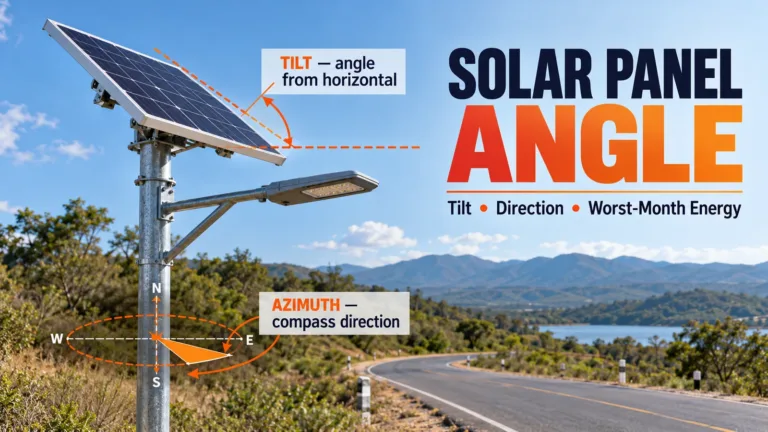
Solar panel wattage is the module’s rated electrical power under specified test conditions. It is not the wattage of the lamp below it, the energy stored in a battery, or a promise of daily generation. For a solar street light, buy those three things as a matched configuration. A large number on the quotation cannot substitute for a clear description of what each number measures.
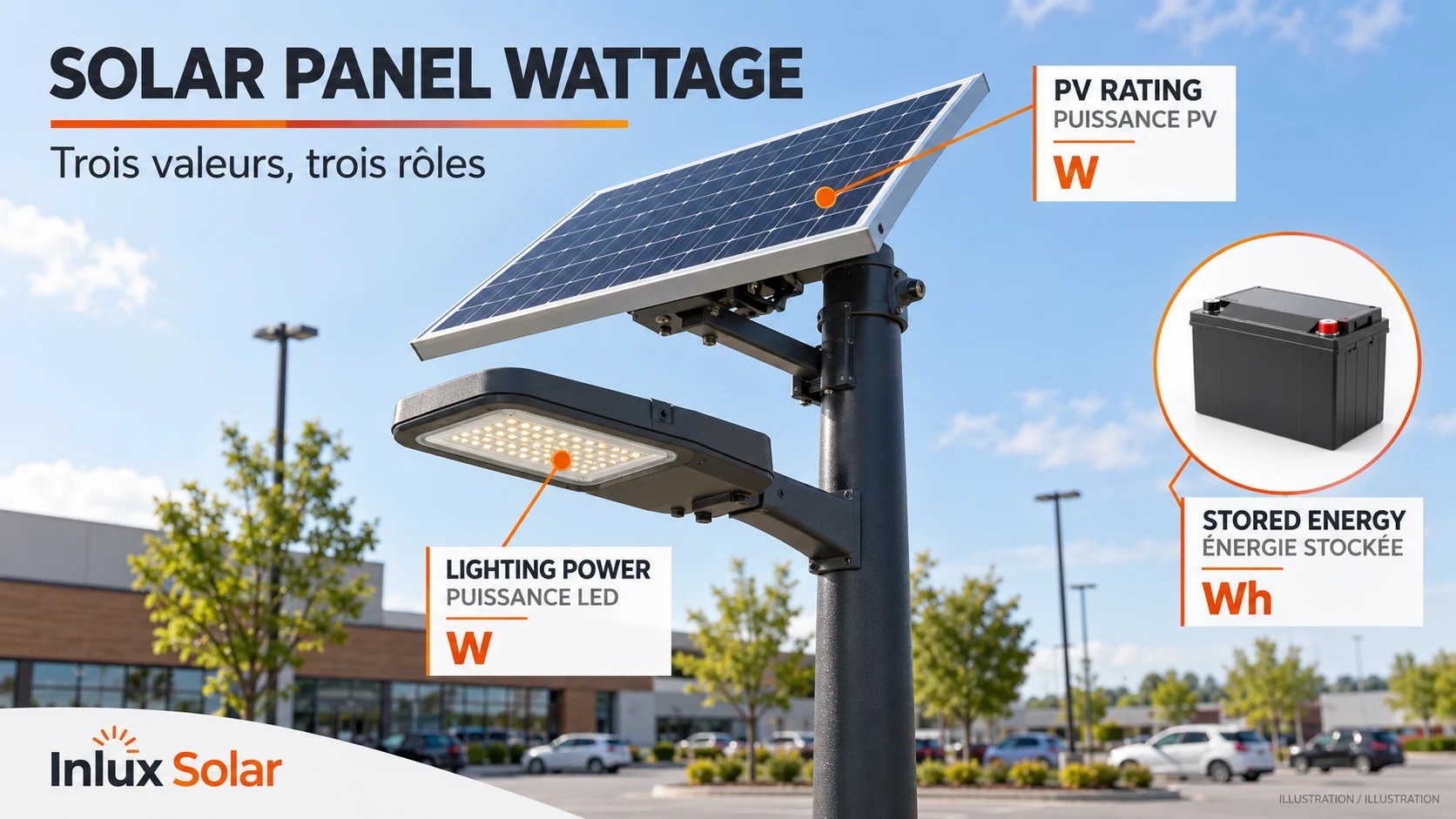
The useful buying question is not simply “How many watts?” It is “Which module, supplying which controller and battery, under which site conditions?” Start with the rating, then check the electrical match, available energy, mounting envelope and agreed delivered configuration. These five checks keep a low-priced substitution from quietly changing the system you thought you ordered.
1. Read solar panel wattage at the correct reference point
Look for Pmax, Pmpp or rated maximum power on the module datasheet. Under Standard Test Conditions, the reference irradiance is 1000 W/m², cell temperature is 25°C and the reference spectrum is AM1.5. Wp means watt-peak: it identifies a rated PV power, not a separate kind of energy. Cell temperature is not the same measurement as the air temperature in a weather forecast.
Consult the Victron BlueSolar current-model datasheet, which separates maximum-power voltage and current from open-circuit voltage and short-circuit current. Keep those distinctions when reading any supplier’s offer. Pmax is approximately Vmp × Imp, allowing for published rounding; multiplying Voc by Isc does not give the panel’s rated operating power.
| Value on a lighting quotation | Meaning of this quoted value | Limit of this quoted value |
|---|---|---|
| PV module: W or Wp | Rated generation power at stated conditions | Daily energy or night-time lighting service |
| LED or luminaire: W | Electrical power at a defined operating setting | Delivered road illuminance or battery autonomy |
| Battery: Wh | Energy on a stated nominal or usable basis | PV charging rate or the lighting distribution |
| PV yield: Wh/day | Energy over a defined day or modelling period | Performance at every site or season |
Ask where luminaire power is measured: at the LED board, at the driver output or at the complete luminaire input. Auxiliary consumption and conversion losses can make these different. Do not add panel watts to LED watts to describe a “total light power”; generation capacity and consumption are opposite sides of the energy balance, not two lighting outputs.
2. Convert watts to a daily energy estimate—not a guarantee
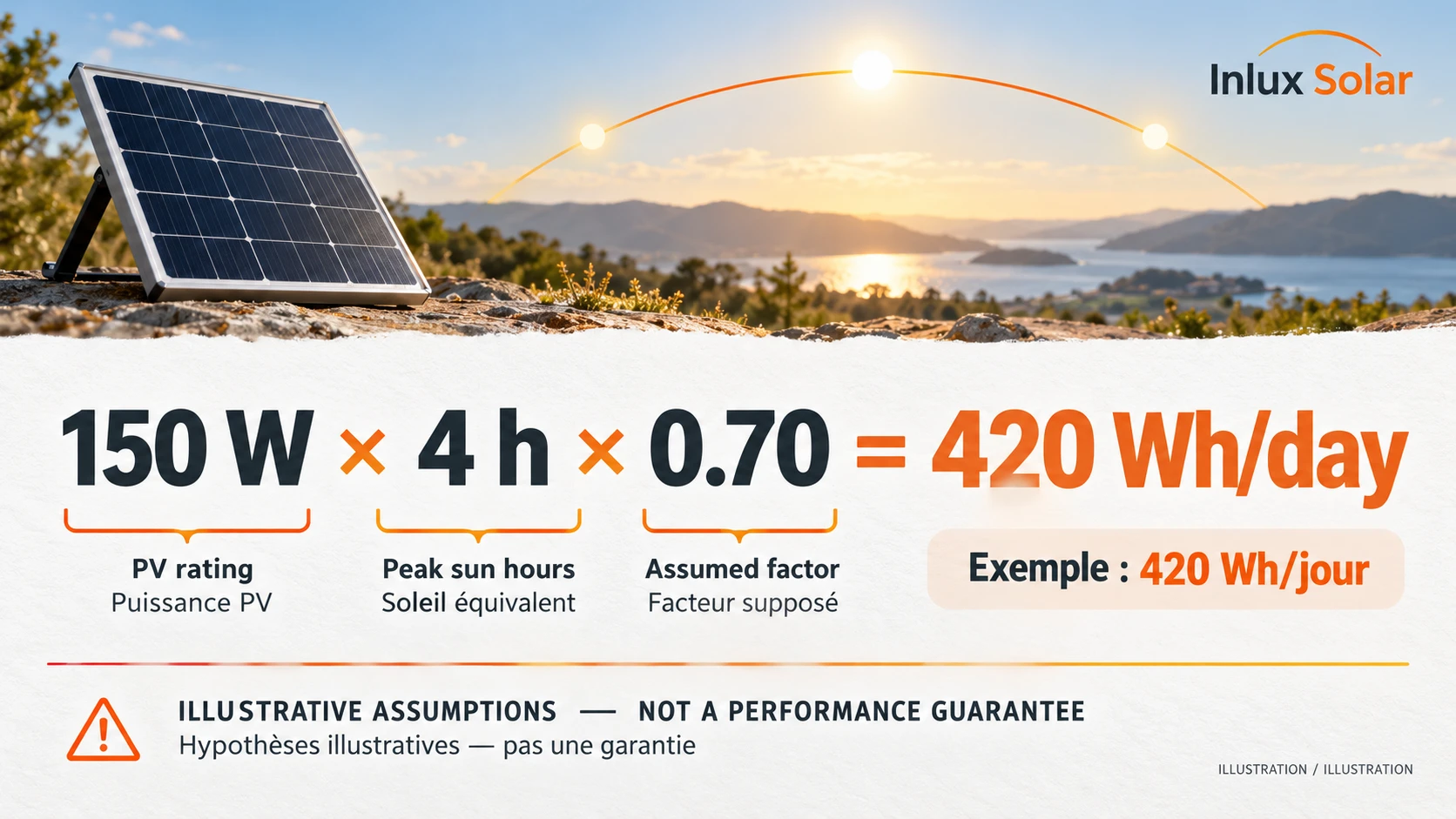
A simple screening calculation is rated PV watts × peak sun hours × a stated net factor = estimated daily energy. Define the endpoint first. Energy at a module’s terminals, energy entering a battery and energy eventually delivered to the lamp are different quantities. The factor must represent the losses up to the chosen endpoint, rather than an unexplained percentage copied from another project.
For illustration only, a 150 W module with 4 peak sun hours and an assumed 0.70 net factor gives 420 Wh/day at the chosen endpoint. At the same assumptions, 100 W gives 280 Wh/day and 200 W gives 560 Wh/day. These are arithmetic examples, not Inlux model specifications, a recommended loss allowance or a site yield forecast. Four peak sun hours also does not mean four clock hours with the module constantly at full output.
For location-based generation estimates, PVWatts makes its modelling assumptions and uncertainty explicit. A production estimate is not, by itself, approval of an off-grid street light’s battery reserve or nightly operating schedule. Use the existing solar street light sizing calculator to organise the project inputs, then have the proposed configuration checked against the site and operating requirement.
3. Compare equal watts without assuming equal compatibility
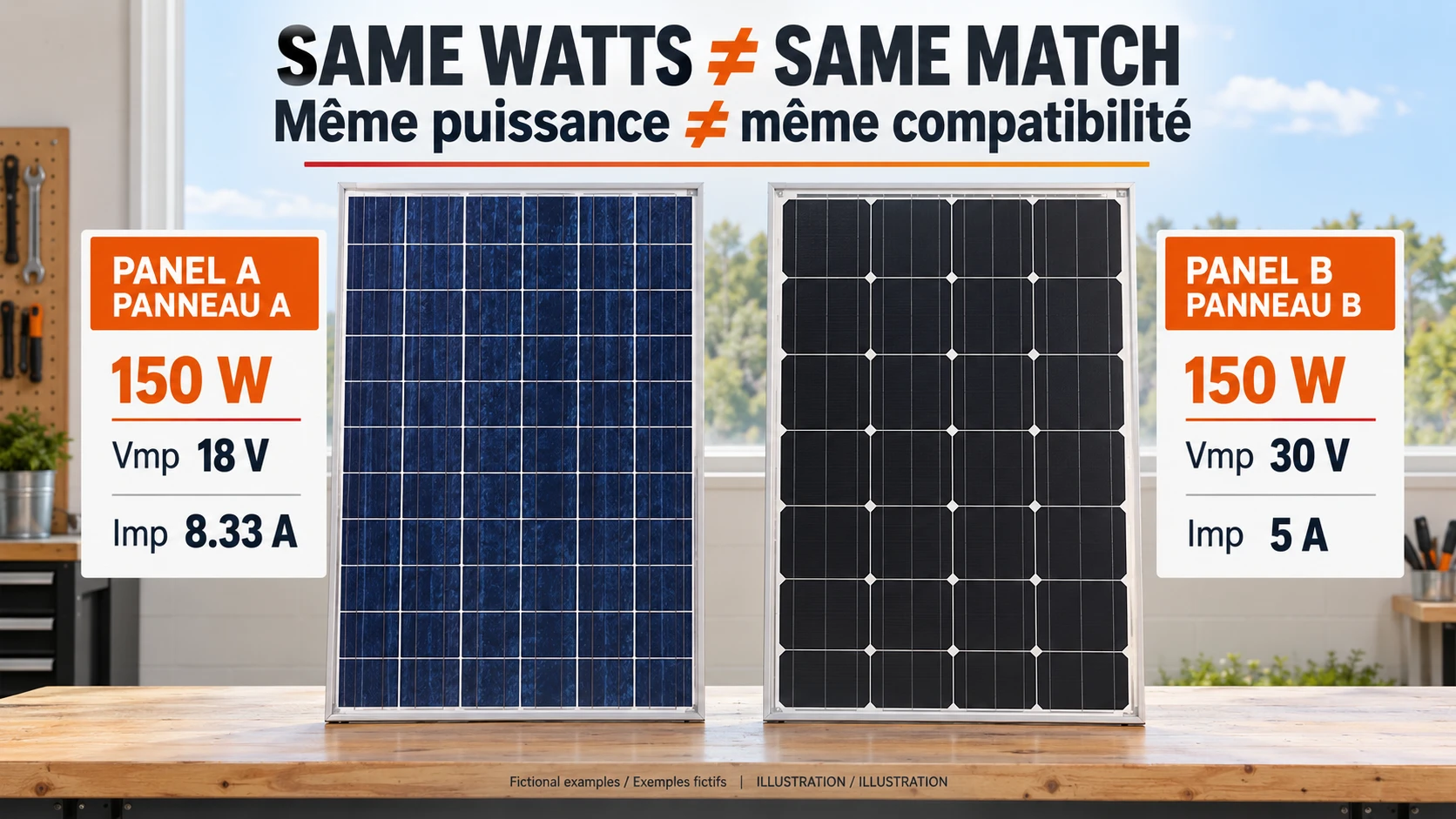
Two modules can have the same solar panel wattage yet present different voltage and current to the controller. This matters when replacing a panel, changing a supplier or approving a “similar” module after a quotation has been accepted. Equal watts do not prove that the existing controller will track, charge or protect the system correctly.
| Fictional module comparison | Panel A example | Panel B example |
|---|---|---|
| Declared PV rating | 150 W | 150 W |
| Voltage at maximum power, Vmp | 18 V | 30 V |
| Current at maximum power, Imp | 8.33 A | 5 A |
| Calculated Vmp × Imp | About 150 W | 150 W |
| Procurement conclusion | Controller match still required | Not an automatic replacement for A |
Have the system designer check the module’s full voltage and current data against the controller’s permitted inputs, the battery charging requirements and the relevant temperature range. Vmp alone is not enough: cold-weather open-circuit voltage and maximum input-current limits also matter. Controller technology and permitted oversizing differ by product. A connector that physically fits is not electrical approval.
This is a document-screening step, not an instruction to open equipment or test live circuits. Keep the original module reference, revision and approved replacement reference in the purchase record. If the label cannot be reconciled with the paperwork, resolve the identity before accepting the substitution rather than guessing from its size or appearance.
4. Check the physical envelope before increasing panel wattage
Higher solar panel wattage may come from more cell area, higher efficiency or both. It does not identify the module dimensions, mass or mounting pattern. On a pole, those are practical purchasing constraints: the bracket, pole, fixings, transport package and access for maintenance must suit the exact module. A bigger panel is not automatically a better street-light configuration.
For the Inlux All-in-One range, review the panel and luminaire as one integrated assembly. For the Inlux All-in-Two range, confirm the separately mounted panel’s dimensions, orientation allowance and support arrangement. Neither architecture has a universal “best wattage.” Select the installation format that can meet the project requirement without an unapproved mechanical or electrical change.
For a commercial car park, one open area does not mean every pole receives identical sunlight. Buildings, trees, nearby signs and the proposed module position can change the usable solar exposure. Record the site layout and obstruction locations before treating a standard panel package as suitable for the whole lot. Do not promise that an extra nominal wattage increment will cancel an unassessed shadow.
5. Compare the delivered configuration, not the headline number
A quotation can be incomplete without containing a false number. Consider these fictional offers for the same project. None should be ranked by the headline alone. The question is whether the supplier has defined enough of the configuration to make the technical comparison meaningful; price comes after the missing information is resolved.
| Illustrative offer | What is actually known | Next buying decision |
|---|---|---|
| “200 W solar light” | The component and rating basis are undefined | Identify PV watts, LED operating power and battery Wh separately |
| “150 W PV + 40 W LED” | Two power ratings, but not the complete operating system | Confirm battery energy basis, nightly profile, controller and site assumptions |
| “150 W module, exact reference and approved system configuration” | A traceable component and a defined system basis | Check suitability, delivery scope and substitution control before comparing price |
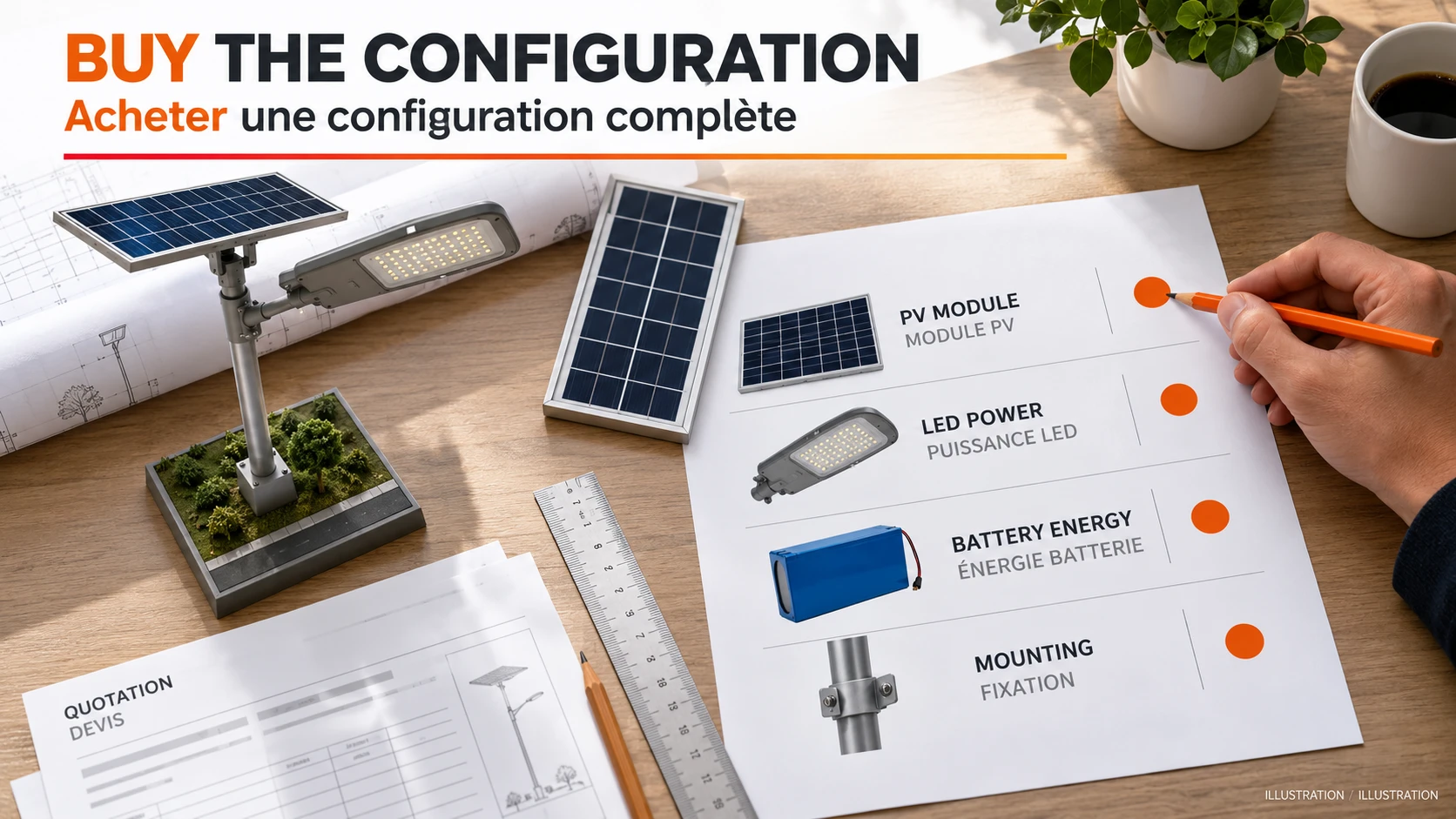
For the PV line, request the exact part reference and revision, Pmax and its tolerance, Vmp/Imp, Voc/Isc, module dimensions and mass, mounting details and the matched controller reference. Then identify who must approve a change. A substitute with the same watts but a different voltage, frame or connector is a changed configuration, not merely an administrative update.
Separate a module power-output warranty from the complete lighting system’s warranty. Inlux Solar’s standard warranty is 5 years; that fact does not promise that a PV module will retain a particular output percentage or that every project has the same coverage conditions. Put the agreed configuration, applicable terms and service responsibilities in the order rather than inferring them from a panel wattage label.
Perguntas frequentes
What is a good solar panel wattage for a street light?
There is no single correct wattage. It depends on the nightly consumption profile, solar resource, losses, recharge requirement and permitted mounting arrangement. A nominal panel rating becomes useful only after those inputs are defined. Ask for a matched system proposal rather than selecting a panel from LED wattage alone.
How much energy can a 500 W solar panel produce in a day?
Using illustrative assumptions of 4 peak sun hours and a 0.70 net factor gives 500 × 4 × 0.70 = 1400 Wh/day, or 1.4 kWh/day. Different site conditions or endpoint losses change the result. This arithmetic is not a production guarantee and does not mean a 500 W module is appropriate for a particular lighting pole.
Does a 100 W panel supply 100 W throughout the day?
No. The rating describes power at reference test conditions, while actual power varies with sunlight, temperature and operating conditions. Daily energy is the accumulation of that changing power over time. Neither daylight duration nor one instantaneous meter reading establishes the total energy available for night-time lighting.
Can I replace a panel with another of the same wattage?
Only after the replacement is approved for the complete system. Check the exact module’s voltage and current limits, controller compatibility, dimensions, mounting, connections and warranty implications. The same solar panel wattage is not proof of interchangeability. Qualified personnel should carry out any physical replacement under the manufacturer’s procedures.
Is panel wattage the same as solar street light wattage?
Not necessarily. A quotation may use “street light wattage” for LED power, complete luminaire input or an undefined marketing label. Require separate PV rated watts, luminaire operating watts and battery energy in Wh. Also state the lighting setting used for the power figure, because dimming changes consumption.
How do I check the wattage of an existing panel?
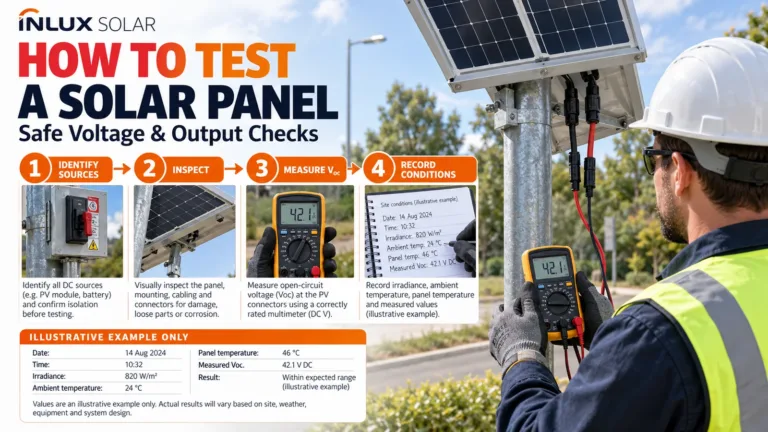
Start with the accessible label and the manufacturer’s datasheet for the exact model. If the task is diagnosing output rather than comparing specifications, follow the boundaries in our solar panel testing guide. Do not improvise a short-circuit test or treat an open-circuit voltage reading as proof of rated watts.
Turn the panel rating into a complete lighting enquiry
For commercial solar parking lot lighting, send the location, layout, lighting hours, intended dimming profile and any pole or panel-size restrictions. For road projects, start with our solar street light product range. Include the panel and luminaire references from any existing quotation so the comparison addresses a real configuration rather than a headline wattage.