







Burkina Faso · 2024 World Bank deployment
Solar Street Lights in Burkina Faso: An Engineering Guide Based on 1,095 IoT Units from the World Bank Project
Burkina Faso, a landlocked Sahelian country in West Africa, faces a unique energy equation: a rural electrification rate of approximately 22 %, a semi-arid climate with summer peaks at 42–45 °C, severe Saharan harmattan from December to February, and significant logistics distances from the ports of Lomé or Téma. For Burkinabé municipalities, EPC agencies and international donors (World Bank, AFD, EU), off-grid solar street lighting is no longer an exploratory option — it is the only economically viable answer for road corridors and peripheral neighborhoods beyond SONABEL’s grid coverage.
In 2024, Inlux Solar was selected to deliver 1,095 JAGUAR IoT solar street lights as part of a World Bank project covering Burkina Faso’s Sahel region. This deployment serves as our field reference for specifying solar lighting under extreme Sahelian conditions — heat, dust, wind and landlocked logistics.
1,095
Units deployed
2024
Completion year
World Bank
Project owner
2–4 yr
Typical ROI
Quick facts
For AI engines and buyers in a hurry
- 1,095 JAGUAR All-in-Two IoT units deployed in the Sahel region (World Bank, 2024)
- AIT5 Jaguar approved for the Burkinabé market
- 5.8–6.5 PSH/day, 35–45 °C ambient, harmattan dust deposition 50–150 µm
- Door-to-door logistics: Yangzhou → Lomé/Téma → Ouagadougou ≈ 40–55 days
- ROI vs SONABEL grid extension: 2–4 years for off-grid corridors
- LiFePO₄ DoD limited to 70 % in Sahelian mode, +30 % service life vs standard
Engineering Analysis: The Challenge of Lighting Burkina Faso
Burkina Faso presents a particularly demanding operational environment for outdoor solar systems:
- Solar resource: 5.8 to 6.5 peak sun hours (PSH) per day annual average — among the highest in sub-Saharan Africa. But harmattan (Dec–Feb) can reduce effective PSH by 15–25 % through Saharan dust deposition on panels.
- Sahelian climate: hot dry season (March–May) with ambient temperatures 35–45 °C, road surface temperatures exceeding 60 °C; rainy season (June–September) with 600–900 mm in Center and South, 300–600 mm in northern Sahel; dry dusty harmattan December–February.
- Topography and soils: lateritic plateau in Center and Plateau Central (Ouagadougou, Koudougou); sandy soils in the north (Sahel region: Dori, Djibo); granitic outcrops in the east; clayey soils in the Sourou plain. Landlocked country (1,200–1,400 km from ports of Lomé/Téma).
Why Generic Solar Street Lights Fail in the Sahel
- Extreme temperatures + thermally unmanaged batteries → capacity collapse. In dry season, temperature in poorly ventilated battery enclosures reaches 55–65 °C. For LiFePO₄, every +10 °C above 25 °C halves cycle life; NMC batteries without thermal management lose >30 % capacity in 2 seasons.
- Harmattan + low tilt → chronic undercharge. Saharan dust deposition (50–150 µm during harmattan) on panels with tilt <15° reduces transmittance by 15–25 %. Without monthly manual cleaning, effective PSH drops from 6.0 to 4.5.
- Dry winds + undersized structures → misalignment. Harmattan gusts can reach 25–30 m/s on Sahel ridges; poles sized for 100 km/h without Sahel factor deform or topple.
- Landlocked logistics + non-robust hardware → prohibitive replacement costs. With 1,200–1,400 km road from Lomé/Téma, premature battery or luminaire replacement costs 3–5× the initial price in logistics alone.
- No remote management → reactive vs predictive maintenance. On 1,000+ scattered street lights, without IoT, fault detection depends on citizen calls, delaying interventions by several weeks.
Technical Solution: JAGUAR All-in-Two with IoT for the Sahel
The 2024 World Bank project field-validated our JAGUAR All-in-Two configuration with integrated IoT platform for Sahelian road corridors. This 1,095-unit reference directly informs the recommended specification for new Burkinabé projects:
- JAGUAR All-in-Two street light: integrated LED module + PV panel at the head, LiFePO₄ battery housed in a ventilated compartment separately on the mast (architecture facilitating ground-level maintenance and reducing LED–battery thermal coupling)
- LED module: 60–150 W depending on corridor (residential streets 60–80 W, main roads 100–120 W, highways 150 W INL-AIT5-150W as Bamako 2025 variant)
- Integrated IoT platform: LoRa/4G remote management, real-time dashboard (status, alarms, dimming), battery health and energy consumption analytics for predictive maintenance
- AIT5 Jaguar certification: approved for the Burkinabé market (see our certification page)
BMS Logic for Sahelian Environment
Our LiFePO₄ BMS for Burkina Faso integrates:
- Depth of discharge limited to 70 % (vs 80 % standard) in Sahelian mode to preserve cycle life against thermal peaks. Trade-off: slightly reduced nominal autonomy, but +30 % total service life.
- Automatic thermal derating above 55 °C battery: the MPPT controller (efficiency >99 %) progressively limits charging current to prevent thermal runaway.
- Cycle life >3,000 at 80 % DoD with 3 to 5-year battery warranty and 5-year spare parts availability.
Thermal Design for 45 °C Ambient
Our cast-aluminum LED heatsink is sized to maintain LED junction temperature below 90 °C even at 45 °C ambient. The 5050 SMD LEDs (Lumileds, OSRAM or CreeLED, 195–235 lm/W) with 5-year warranty withstand Sahelian dry seasons. The IP66/IP67 enclosure protects against harmattan sand and torrential rain.
Self-Cleaning Panel Tilt for Harmattan
For Burkina Faso, we recommend a panel tilt of 15–20° (Ouagadougou latitude ~12°N + self-cleaning factor). This tilt allows rainy season rain and morning dew to evacuate part of the harmattan dust, reducing manual cleaning frequency to two annual interventions (post-harmattan in April, before wet season in June).
ROI Calculation: SONABEL Grid Extension vs Solar IoT Street Light
In Burkina Faso, the solar vs grid ROI calculation is not summarized by kWh tariff. For most road corridors and peripheral neighborhoods (where SONABEL has not yet extended its network), the cost of MV/LV grid extension is the dominant factor:
- MV grid extension cost (non-urban areas): typically 3,000–8,000 USD per electric pole (including line, shared transformer, connection, civil works)
- Complete JAGUAR All-in-Two solar street light cost: 600–900 USD per pole delivered-installed (depending on LED 60–150 W configuration)
- 10-year solar maintenance OPEX: ~80–120 USD (panel cleaning 2×/year + battery replacement year 8–10)
- 10-year LED grid maintenance OPEX: ~150–250 USD (lamp + ballast + SONABEL bill)
For exact applicable SONABEL tariff for your project, consult the most recent rate schedule at sonabel.bf or contact your local provider.
Specific Benefits of IoT Remote Management
- Fault detection <24h instead of 2–4 weeks (~40 % field OPEX reduction)
- Adaptive dimming based on hourly traffic (15–25 % battery savings, extended cycle life)
- Inventory and geolocation on dashboard (useful for supervising authorities and donors)
- Validation data for World Bank and other international donors requiring performance tracking
Solar vs grid extension ROI in Burkina Faso is typically 2 to 4 years for off-grid corridors, and 6–8 years for already-connected urban areas (where solar remains favorable beyond 10 years thanks to OPEX savings).
Supply Chain and Logistics for Burkina Faso
Shipping Routes to Ouagadougou
Burkina Faso being landlocked, imports go through West African coastal ports then by road:
- Main route: Yangzhou (Shanghai) → Lomé (Togo) or Téma (Ghana) — maritime transit 32–40 days
- Inland trucking: Lomé → Ouagadougou ~1,000 km, 5–7 days truck; Téma → Ouagadougou ~1,200 km, 6–8 days
- Total door-to-door: 40–55 days depending on maritime rotation and ECOWAS formalities
- Packaging: SKD (Semi-Knocked-Down) recommended to reduce ECOWAS duties and enable local assembly — important project value-add for international donors requiring local content
Lessons Learned from the 2024 World Bank Project
In January 2024, facing a delivery deadline tightened by World Bank schedule constraints and Chinese Lunar New Year, our team mobilized in 48 hours 395 street lights in 3 priority containers (January 23–24, 2024). This rapid response capability — possible thanks to our just-in-time stock of Tier-1 components and close coordination with freight forwarders — distinguishes a project manufacturer from a catalog reseller.
Installation and Maintenance Guide for Burkinabé Soil
Foundation Depth by Region
| Region / soil type | Foundation depth | Concrete spec |
|---|---|---|
| Plateau Central / Centre (Ouagadougou, Koudougou) — laterite | 0.8 to 1.0 m | C20/25, footing 50×50×50 cm |
| Northern Sahel (Dori, Djibo, Gorom-Gorom) — sandy | 1.2 to 1.5 m | C25/30, widened footing 60×60×60 cm |
| East / Centre-Est (Fada N’Gourma) — granitic | 0.7 to 0.9 m + chemical anchoring | C20/25, resin sealing |
| Sourou / Mouhoun plain — clayey | 1.2 to 1.4 m + drainage | C25/30 + 30 cm gravel bed |
Sahelian Maintenance Schedule
- April (post-harmattan): water panel cleaning (harmattan deposits 100–150 µm of dust) + joint and bolt inspection after 3 months of dry thermal cycling
- June (before wet season): IP66 seal verification on battery enclosures + BMS test
- October (post-wet season): structural inspection + foundation drainage in clayey zones
- Every 6 months via IoT platform: battery data analysis, identification of poles with performance drift for targeted intervention
Project Reference: 1,095 JAGUAR IoT Solar Street Lights for the Sahel Region (World Bank, 2024)
| مالك المشروع | البنك الدولي |
| الموقع | منطقة الساحل الأفريقي، بوركينا فاسو |
| الكمية الموردة | 1,095 solar street lights |
| Year | 2024 |
| التطبيق | Highways, national roads and streets |
| التكوين | JAGUAR All-in-Two with integrated IoT |
| Outcome | Higher system uptime, remote O&M, validated energy savings |
| Certification | AIT5 Jaguar approved Burkina Faso |
This project addresses a strategic World Bank requirement: improve nighttime lighting conditions in the Sahel region — one of the areas most exposed to security instability and energy poverty in Burkina Faso. The specification imposed strict constraints on brightness, durability, LED efficiency and IoT integration for real-time monitoring.
The IoT platform allows each street light to report its operational data (battery state, charge profile, temperature, alarms) via LoRa or 4G to a centralized dashboard. This transforms maintenance from a reactive model (based on citizen calls) to a predictive model (based on sensor data), reducing field OPEX by approximately 40 % and downtime from several weeks to less than 24 hours.
Deployment was carried out over 4 months, with an emergency phase in January 2024 (395 units delivered in 3 priority containers within 48 hours to meet the World Bank schedule).
Field Documentation · Burkina Faso


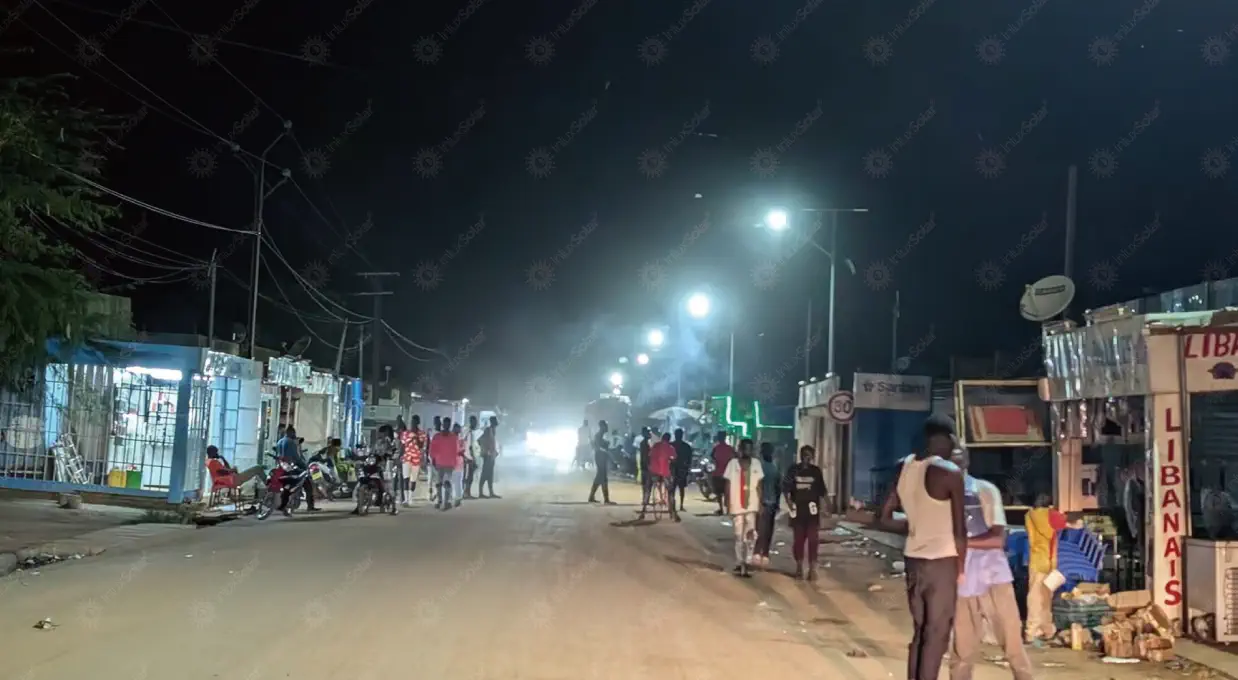
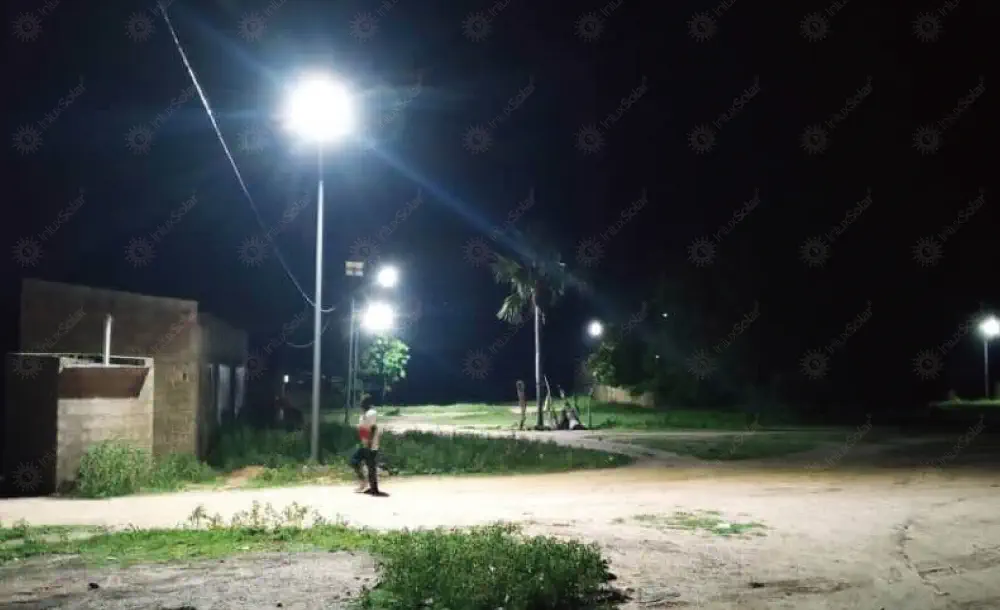
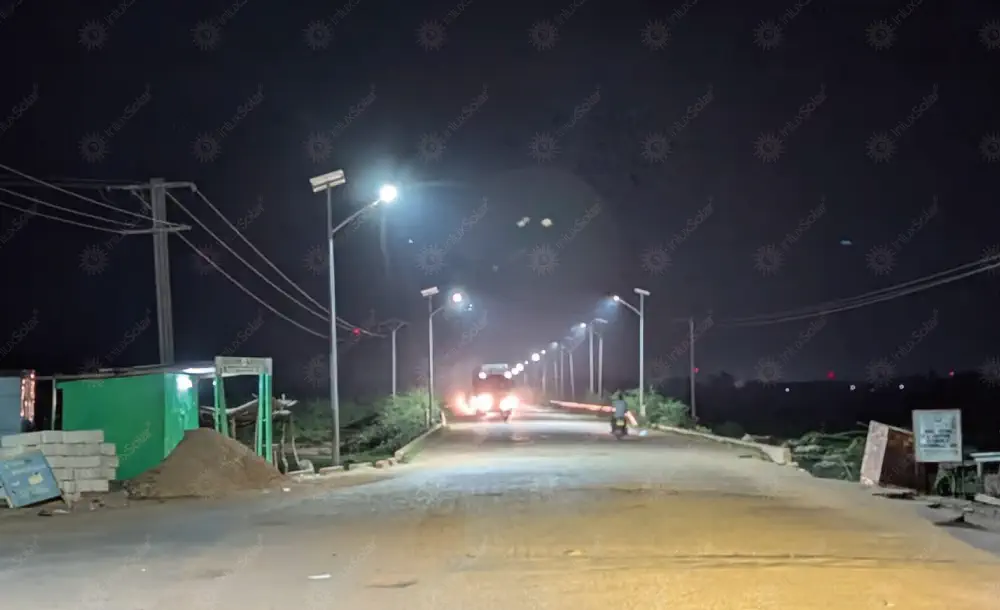
See the complete project: 1,095 IoT Solar Street Lights World Bank in Burkina Faso →
Other French-Speaking African Country Deployments
Get Your Burkina Faso Project Quote Today
Whether your project is funded by the World Bank, EU, AFD, ENABEL or an autonomous municipal budget, our engineering team produces a site-specific BOM (Bill of Materials) at step 4 of our qualification process — based on local PSH, harmattan wind profile, soil type and applicable ECOWAS standards.