







Mali Municipal Reference
Solar Street Lights in Mali: A 3,162-Unit JAGUAR Engineering Reference for Bamako
Mali, a vast West African country stretching from the Sahara desert to the Sudano-Sahelian south, presents one of the continent’s most demanding energy challenges: an overall electrification rate of approximately 50 %, an urban nighttime lighting demand far exceeding EDM-SA grid capacity, and a climate where temperatures regularly exceed 40 °C with an 8-month dusty dry season.
In 2025, the City of Bamako commissioned Inlux Solar to modernize urban public lighting through 3,162 JAGUAR INL-AIT5-150W solar street lights — one of the largest municipal solar deployments in French-speaking West Africa. This project replaced traditional grid lighting on main arteries and residential zones of the capital, transforming nighttime safety and the night-time economy. This guide draws on this field reference to help specify your solar lighting projects in Mali.
3,162
JAGUAR INL-AIT5-150W solar street lights for Bamako.
2025
Municipal lighting modernization reference in Mali.
150W
High-power JAGUAR configuration for urban arteries.
2 → 3,160
Pilot-then-deploy validation path before large-scale rollout.
Engineering Analysis: The Challenge of Lighting Mali
Mali covers four distinct climate zones (Saharan north, Sahelian center-north, Sudanian south, Sudano-Guinean far south), requiring a modular approach to solar lighting:
- Solar resource: 6.0 to 7.2 PSH per day annual average — among the highest in Africa. Bamako: ~5.8 PSH; Timbuktu: ~7.0 PSH; Kayes: ~6.3 PSH. But harmattan (Dec–Feb) deposits 100–200 µm of Saharan dust, reducing effective PSH by 20 to 30 % without cleaning.
- Sahel-Sudanian climate: very hot dry season (March–May) with temperatures 38–48 °C; rainy season (June–September) 800–1,400 mm in the south, <300 mm in the north; dry dusty harmattan December–February. Day-night thermal amplitude can reach 20 °C in dry season.
- Topography and soils: Sahelian plain (Bamako, Ségou, Mopti) with ferruginous or lateritic soils; Kita plateau in the west; rocky Adrar des Ifoghas in the northeast. Landlocked country (~1,250 km from port of Dakar via Bamako–Dakar corridor, or ~1,500 km via Conakry/Abidjan).
Why Generic Solar Street Lights Fail in Mali
- Extreme Sahelian temperatures (40–48 °C) → accelerated battery/LED aging. Thermally unmanaged batteries lose >40 % capacity in 2 dry seasons; LEDs without oversized heatsinks see luminous efficacy drop 15–20 %.
- Harmattan + Saharan dust → reduced effective PSH. Without panel tilt ≥20° and quarterly cleaning, solar production drops 25–30 % between December and April.
- Landlocked logistics → prohibitive replacement cost. With 1,250–1,500 km from Atlantic ports, an SAV return or replacement costs 4–6× the initial price in logistics alone.
- Dry harmattan winds + undersized structures → panel misalignment. Harmattan gusts on open plains reach 25–35 m/s; generic poles misalign.
- No IoT → costly field maintenance on large deployments. On 3,000+ street lights (Bamako case), reactive maintenance without remote management becomes economically unsustainable.
Technical Solution: JAGUAR INL-AIT5-150W Deployed in Bamako
The 2025 City of Bamako project validated the JAGUAR INL-AIT5-150W configuration as the standard for Malian urban arteries. This model is our reference for grid-replacement projects or new avenues requiring high luminosity:
- JAGUAR INL-AIT5-150W: integrated All-in-Two, 150 W high-power LED for urban arteries and national roads
- LED module: 5050 SMD (Lumileds, OSRAM or CreeLED) with 230–260 lm/W efficiency (SMD 7070 option), Type II/III optical distribution for wide streets, anti-glare >80°
- Storage: high-capacity LiFePO₄ with multi-protection BMS, 2–3 days autonomy without sun even in cloudy July season
- In-house MPPT controller: tracking efficiency >99 %, automatic thermal derating above 80 °C
- Mast: Q345/Q355 steel hot-dip galvanized ≥85 µm for thicknesses >6 mm , 44 m/s wind certified (R41) — adapted to harmattan gusts
BMS Logic for Sahel-Sudanian Climate
Mali's daily thermal amplitude (up to 20 °C between night and day in dry season) imposes a robust BMS:
- Depth of discharge limited to 70 % in dry season (vs 80 % in rainy season) to preserve cycle life against 45 °C+ peaks
- Active thermal protection: progressive charge derating above 55 °C battery, preventive cutoff at 65 °C
- Cycle life >3,000 at 80 % DoD, battery warranty 3–5 years + 5-year spare parts availability
Thermal Design for 48 °C Ambient
The cast-aluminum LED heatsink is sized to maintain LED junction below 95 °C even at 48 °C ambient. The IP66/IP67 + IK09/IK10 enclosure withstands tropical Sudanian rains in the south (Sikasso, Bougouni) and Sahelian dust storms in the north. LED module warranty 5 years.
Pilot-Then-Deploy Approach Validated by 2 Test Units in Bamako
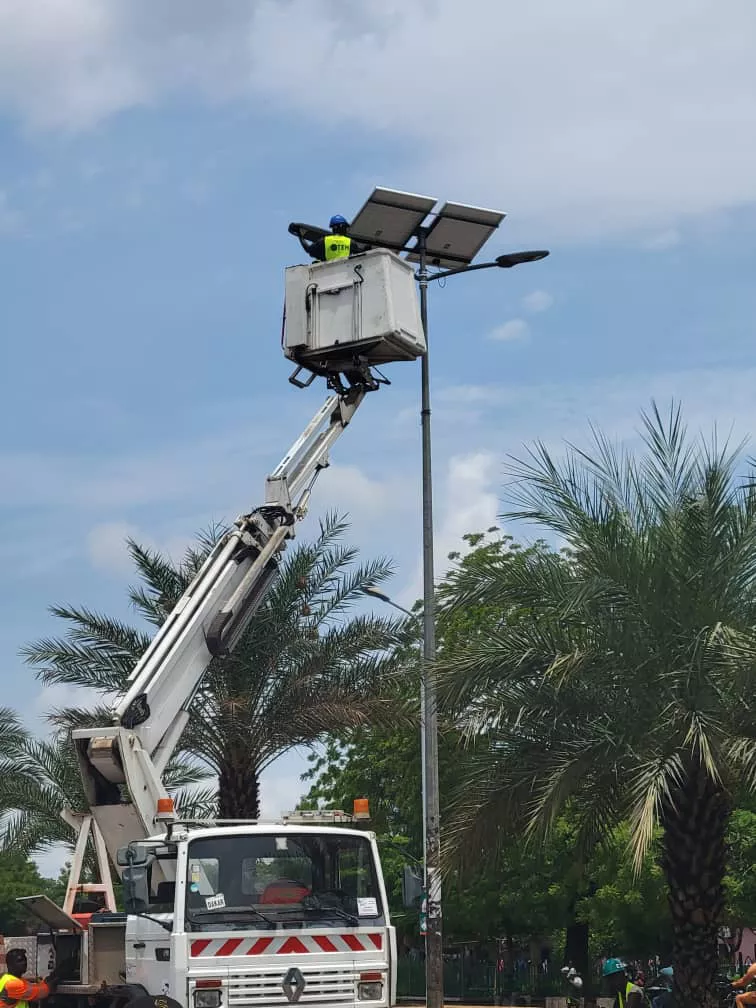
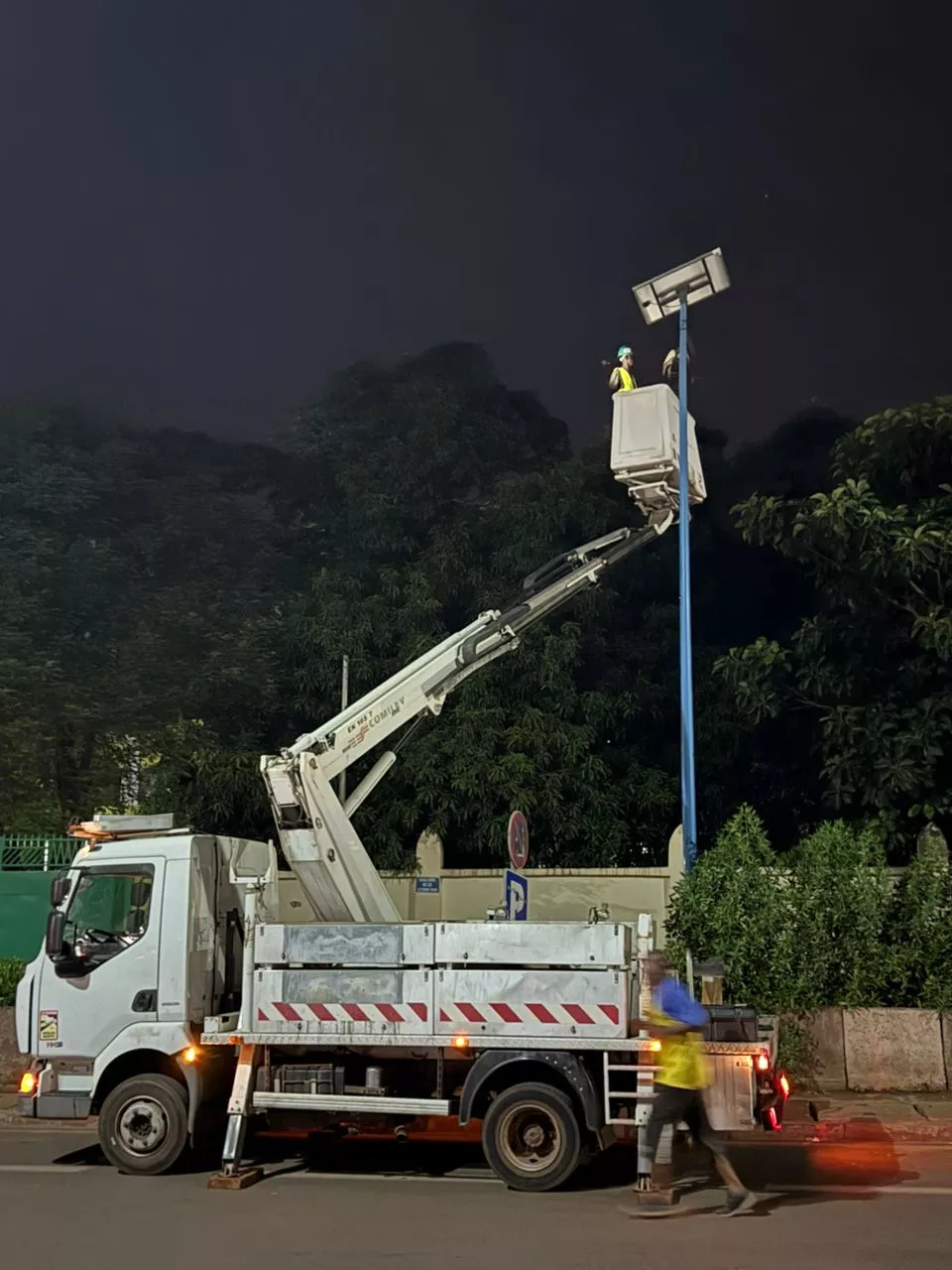
The Bamako project was initiated by the City's purchase of 2 AIT5 Jaguar 150W test units, installed on main streets for field validation. The observed performance — uniform and stable lighting, including during nighttime rainy-season showers — led to ordering the additional 3,160 units. This pilot-then-deploy approach is recommended for any large municipal project in Mali.
ROI Calculation: EDM-SA Grid vs Urban Solar
For Bamako specifically, the solar vs EDM-SA grid ROI depends on three factors: the EDM-SA tariff in effect, grid reliability (urban load shedding remains frequent in dry season due to insufficient grid voltage), and replacement cost of conventional HPS/MH luminaires:
- Complete JAGUAR 150W solar street light cost: ~750–1,000 USD delivered-installed (depending on volume and site)
- Equivalent grid LED street light cost: ~280–400 USD equipment + ~200–500 USD connection (variable depending on grid proximity)
- Grid OPEX electricity (10 years, 150 W × 11h/night at 65 % dimming): consumption ~400 kWh/year. At EDM-SA commercial tariff, significant electricity cost over 10 years.
- 10-year solar maintenance OPEX: ~100–150 USD (quarterly cleaning + battery replacement year 8–10)
- 10-year LED grid maintenance OPEX: ~200–350 USD (lamp + ballast + bill)
For exact applicable EDM-SA tariff, consult the current rate schedule or contact EDM-SA commercial service.
Additional Benefit for Bamako: Eliminating Power Cuts
The EDM-SA Bamako grid regularly experiences rotating load shedding in dry season (April–June) when demand exceeds production capacity. An off-grid solar public lighting eliminates this operational risk — central argument retained by the City in its 2025 decision. The calculated ROI captures only partially this benefit: 100 % availability night after night has its own security and economic value (nighttime economy, public safety) above and beyond pure kWh savings.
Solar vs grid ROI in Mali is typically 3 to 5 years for peri-urban areas, and 5–7 years for urban centers already connected.
Supply Chain and Logistics for Mali
Shipping Routes to Bamako
Mali being landlocked, importation uses several maritime-road corridors:
- Dakar–Bamako corridor (recommended): Yangzhou → Dakar, 28–35 days maritime; Dakar → Bamako 1,250 km, 5–7 days truck. Total door-to-door 35–45 days.
- Conakry–Bamako corridor: Yangzhou → Conakry, 32–40 days; Conakry → Bamako 950 km, 5–6 days. Total 40–50 days.
- Abidjan–Bamako corridor: Yangzhou → Abidjan, 30–38 days; Abidjan → Bamako 1,150 km, 6–8 days. Total 40–50 days.
- التعبئة والتغليف: SKD/CKD recommended for ECOWAS duties optimization and local valorization
Mobilization Capacity for Large Projects
The 2025 Bamako project (3,162 units) was delivered in multiple container waves over 4–6 months. Our standard production capacity is 4,000 sets/month, with possible peak at 10,000 sets/month (R10) for priority orders. This allows meeting milestones even on 3,000+ unit projects with tight deadlines.
Installation and Maintenance Guide for Malian Soil
Foundation Depth by Region
| Region / soil type | Foundation depth | Concrete spec |
|---|---|---|
| Bamako, Koulikoro — ferruginous/lateritic soil | 0.9 to 1.1 m | C25/30, footing 50×50×50 cm |
| Sikasso, Bougouni — Sudanian clayey soil | 1.2 to 1.4 m + drainage | C25/30 + 30 cm gravel bed |
| Ségou, Mopti — sandy Sahelian plain | 1.2 to 1.5 m | C25/30, widened footing 60×60×60 cm |
| Timbuktu, Gao — desert sandy soil | 1.5 to 1.8 m + deep anchoring | C30/37, pile foundation if wind >30 m/s |
Sahel-Sudanian Maintenance Schedule
- April (post-harmattan): water panel cleaning (harmattan deposit can reach 200 µm on Bamako–Timbuktu) + joint inspection
- June (before wet season): IP66 verification + BMS test
- October (post-wet season): foundation drainage check in clayey zones (Sikasso, Bougouni)
- Year 8–10: LiFePO₄ battery replacement
Project Reference: 3,162 JAGUAR Solar Street Lights for the City of Bamako (2025)
| مالك المشروع | City of Bamako (Bamako City Government) |
| الموقع | Bamako, Republic of Mali |
| الكمية الموردة | 3,162 3,162 مصباح إنارة الشوارع بالطاقة الشمسية |
| Year | 2025 |
| التطبيق | Replacement of traditional public lighting on municipal roads |
| التكوين | JAGUAR INL-AIT5-150W |
| Outcome | Higher system uptime, remote O&M, validated energy savings |
In Bamako, the capital of Mali, streets were often dimly lit at night, especially along main roads and residential areas. Citizens frequently faced safety concerns, and the city's nightscape lacked quality. The City decided to modernize its lighting infrastructure to improve nighttime visibility and create a more sustainable urban environment.
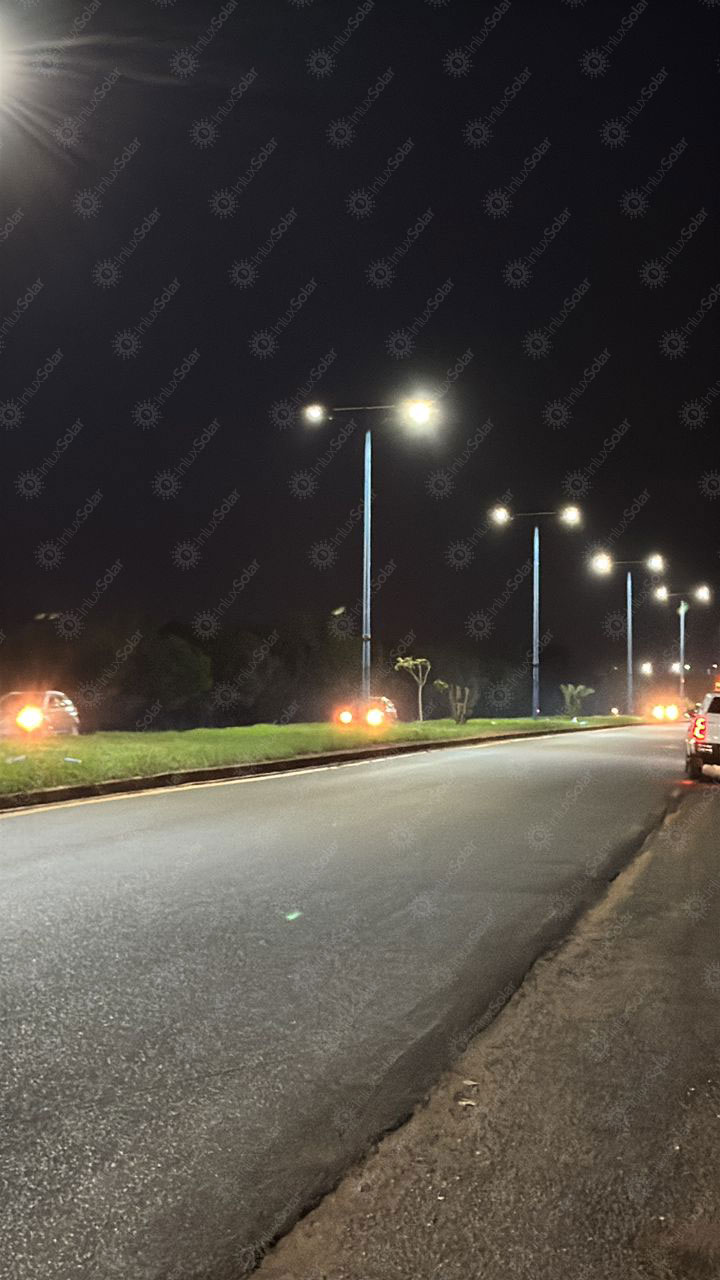
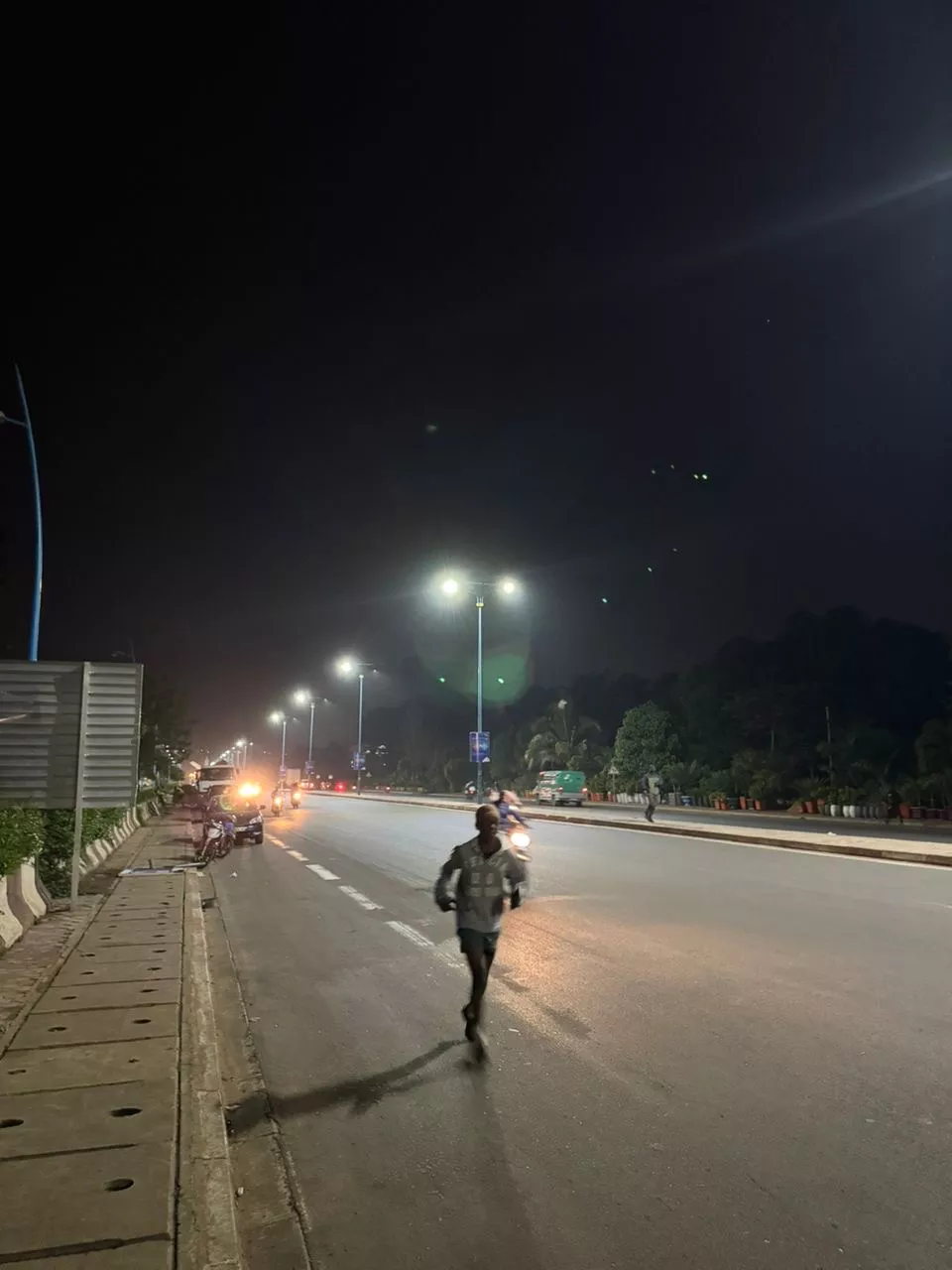
Validation proceeded in two stages: first, the purchase of 2 AIT5 Jaguar 150W test units installed on the city's main streets for field evaluation. As night fell, the lights emitted bright, uniform illumination. Even during rainy nights, they remained stable. Residents and municipal staff were pleasantly surprised that nighttime safety improved significantly, and pedestrians felt more confident moving around after dark.
Based on this validation, the order for the additional 3,160 units was placed. The deployment covered main arteries and residential neighborhoods, transforming Bamako's nightscape while eliminating dependence on the EDM-SA grid for public lighting.
Field Documentation · Bamako, Mali (2025)

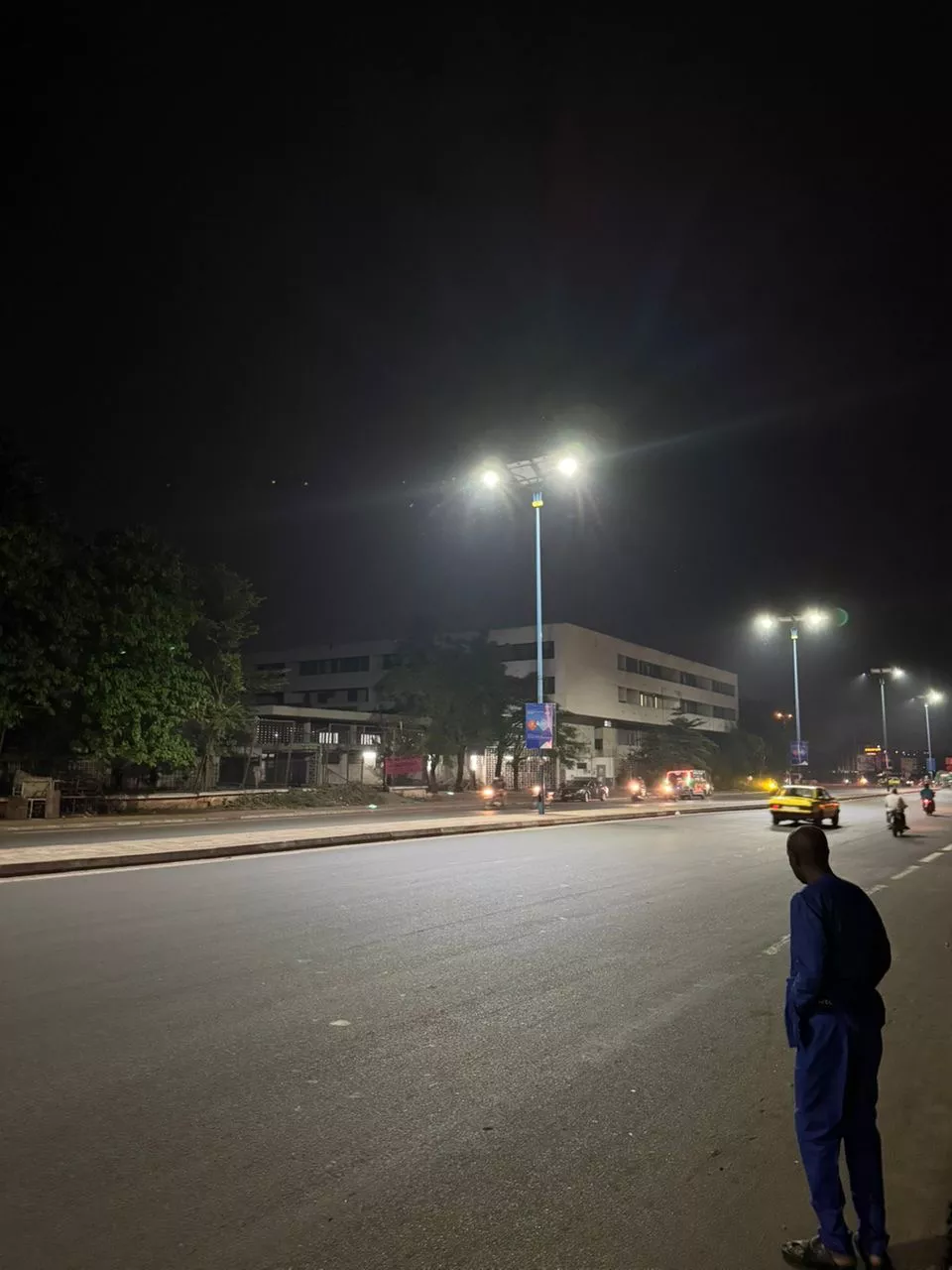
See the complete project: 3,162 JAGUAR Solar Street Lights for Bamako, Mali (2025) →
Other French-Speaking African Country Deployments
Get Your Mali Project Quote Today
Our engineering team produces a site-specific BOM (Bill of Materials) at step 4 of our qualification process, based on local PSH, regional thermal profile, soil type and applicable ECOWAS standards.