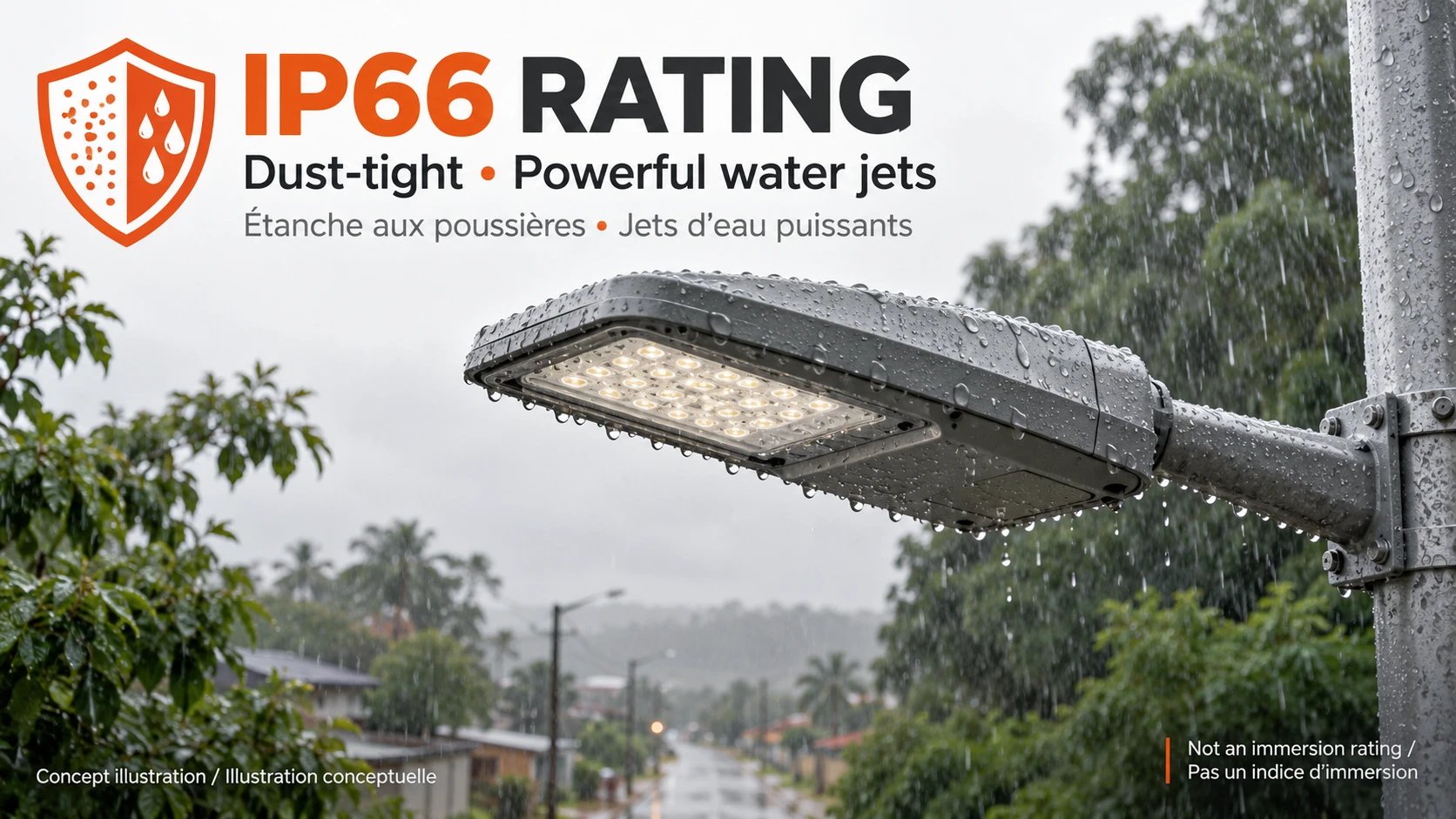
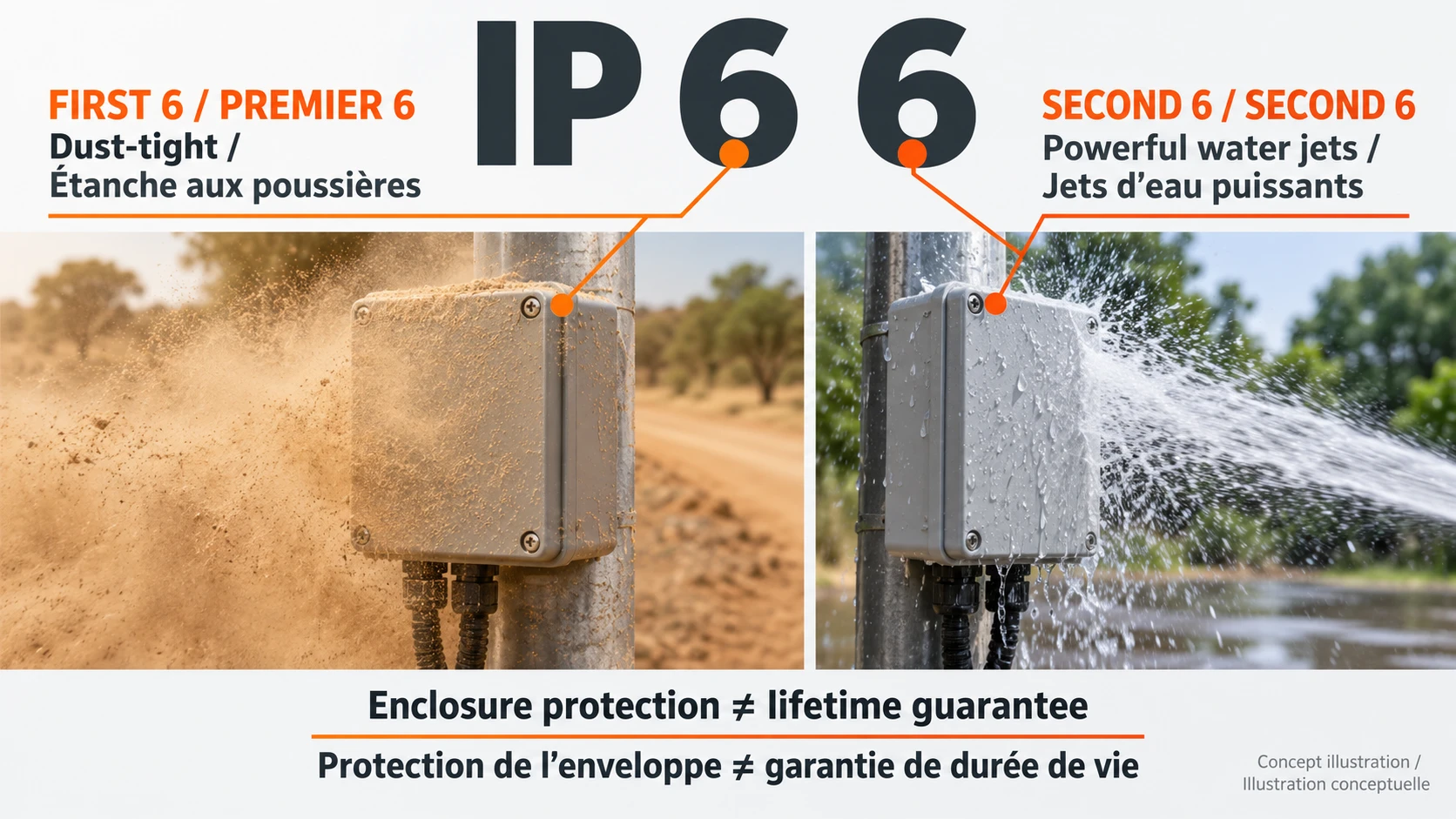
An IP66 rating describes an enclosure that is dust-tight and protected against powerful water jets under the specified test conditions. The first 6 concerns solid ingress; the second 6 concerns water. It is a useful outdoor-lighting specification, but it is not a promise that a light can be submerged, pressure-washed without limits or left unmaintained forever.
For a street-light or parking-lot purchase, the important question is not simply “Does the brochure say IP66?” Ask which enclosure was assessed, in what assembled condition, and whether that condition matches the equipment you will receive. A sealed lamp head does not automatically settle the protection of a separate battery box, field connector or pole-base connection.
How to read the IP66 rating correctly
IP stands for ingress protection. The two digits address different exposures, so read them separately rather than as the number sixty-six. A higher second digit can also change the kind of water test instead of simply extending the same test.
| Part of the IP66 code | Meaning for the enclosure | What not to infer |
|---|---|---|
| First digit: 6 | Dust-tight protection | Proof of corrosion resistance or explosive-atmosphere suitability |
| Second digit: 6 | Protection against powerful water jets | Approval for immersion or every cleaning process |
| Both digits together | Protection of the assessed enclosure configuration | The same protection for every part of an installed lighting system |
The official Schneider Electric explanation of the IP code makes the scope important: enclosure protection does not replace assessment of hazards such as corrosive conditions or explosion risk, and different parts of equipment can have different protection levels. For a lighting project, name the component before using its rating as a selection criterion.
Is IP66 waterproof enough for outdoor lighting?
IP66 can be a relevant enclosure requirement where outdoor equipment faces dust and water jets. Rain exposure, however, is only one part of a site assessment. A luminaire high on a pole, a connector under a panel and a battery enclosure near ground level can encounter different conditions on the same project.
If floodwater could reach equipment, do not treat an IP66 rating as immersion evidence. Review the equipment location and the actual flood scenario with the designer, then specify the necessary protection and installation measures. Moving vulnerable equipment away from the exposure can be more useful than changing a catalogue number without checking the assembly.
At coastal or industrial sites, state corrosion, material and coating requirements separately. In hot, dusty locations, consider temperature and cleaning access as well as ingress. None of these site decisions can be reduced to one universal rule that every solar street light must carry the highest available IP number.
IP65, IP66 and IP67 are not one simple ranking
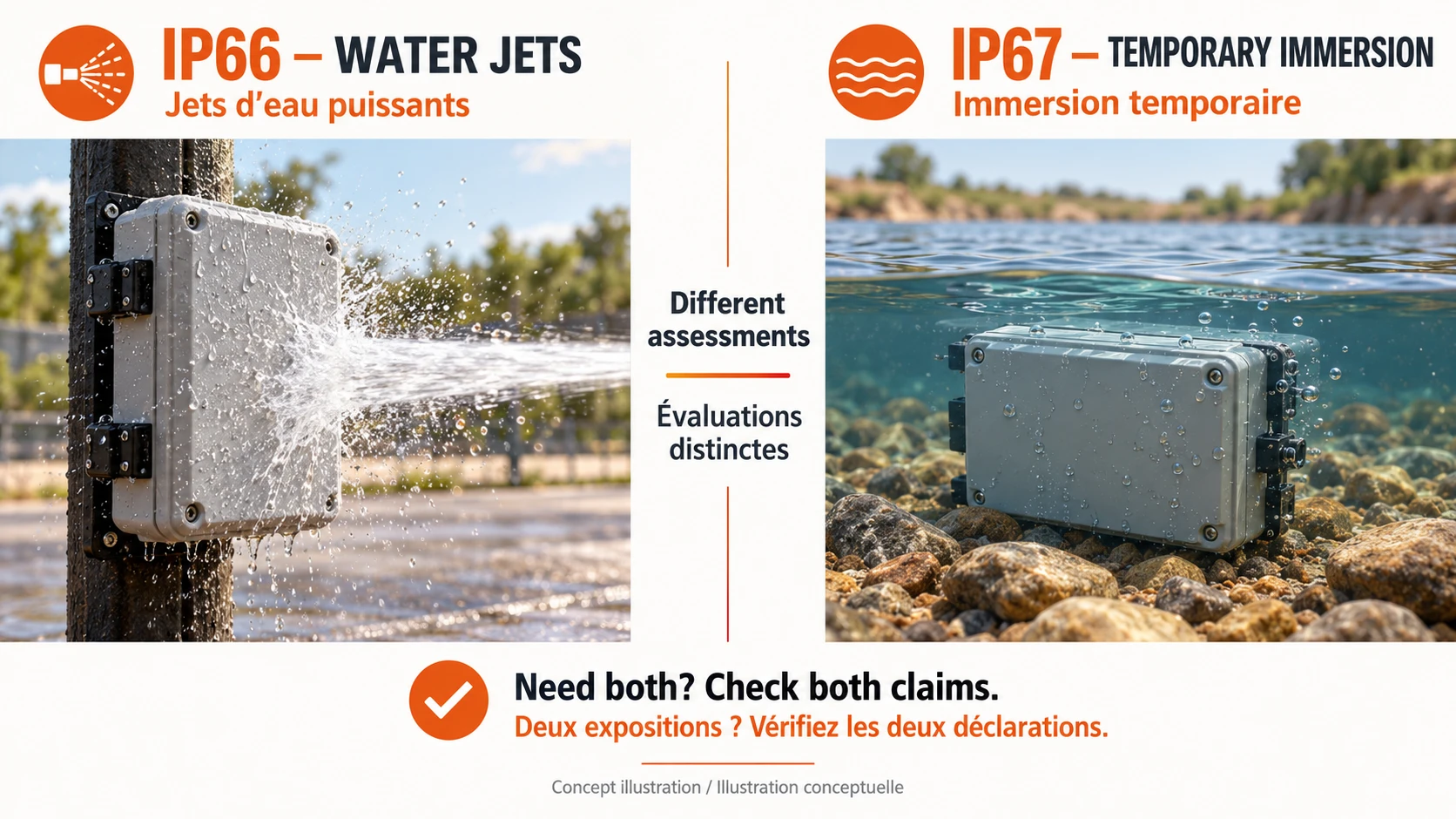
IP65 and IP66 both use 6 for dust-tight protection. Their water digits distinguish water jets from powerful water jets. IP67 addresses temporary immersion under its defined test conditions. It must not be assumed to include the IP66 jet assessment just because 67 is a larger number.
| Declared protection | IP water exposure assessed | Practical buying question |
|---|---|---|
| IP65 | Water jets | Does this match the required exposure for the named enclosure? |
| IP66 | Powerful water jets | Does the supporting evidence cover the delivered assembly? |
| IP67 | Temporary immersion | Is jet protection also required and separately supported? |
| IP66 / IP67 | Both declared conditions, when supported | Do both claims apply to the same configuration? |
| IP68 | Immersion conditions specified for the product | What depth, duration and operating conditions are documented? |
Schneider Electric’s explanation of this common misconception explicitly separates immersion from resistance to powerful jets. Where both exposures matter, ask for both claims and their evidence. Do not replace that check with the word “waterproof.”
For the other comparison questions, use our dedicated IP65 vs IP67 procurement guide و IP67 vs IP68 explanation. This page focuses on interpreting and accepting an IP66 claim, not repeating those complete comparisons.
Follow the IP66 claim from the drawing to the delivered light
Consider an illustrative quotation review. Two offers both say IP66. Offer A identifies the luminaire variant, enclosure and cable-entry arrangement covered by its evidence. Offer B attaches a report for a bare enclosure but proposes a different opening and gland in the supplied assembly. The labels look equal; the configuration evidence is not yet comparable. Ask B to resolve that mismatch before treating the offers as equivalent.
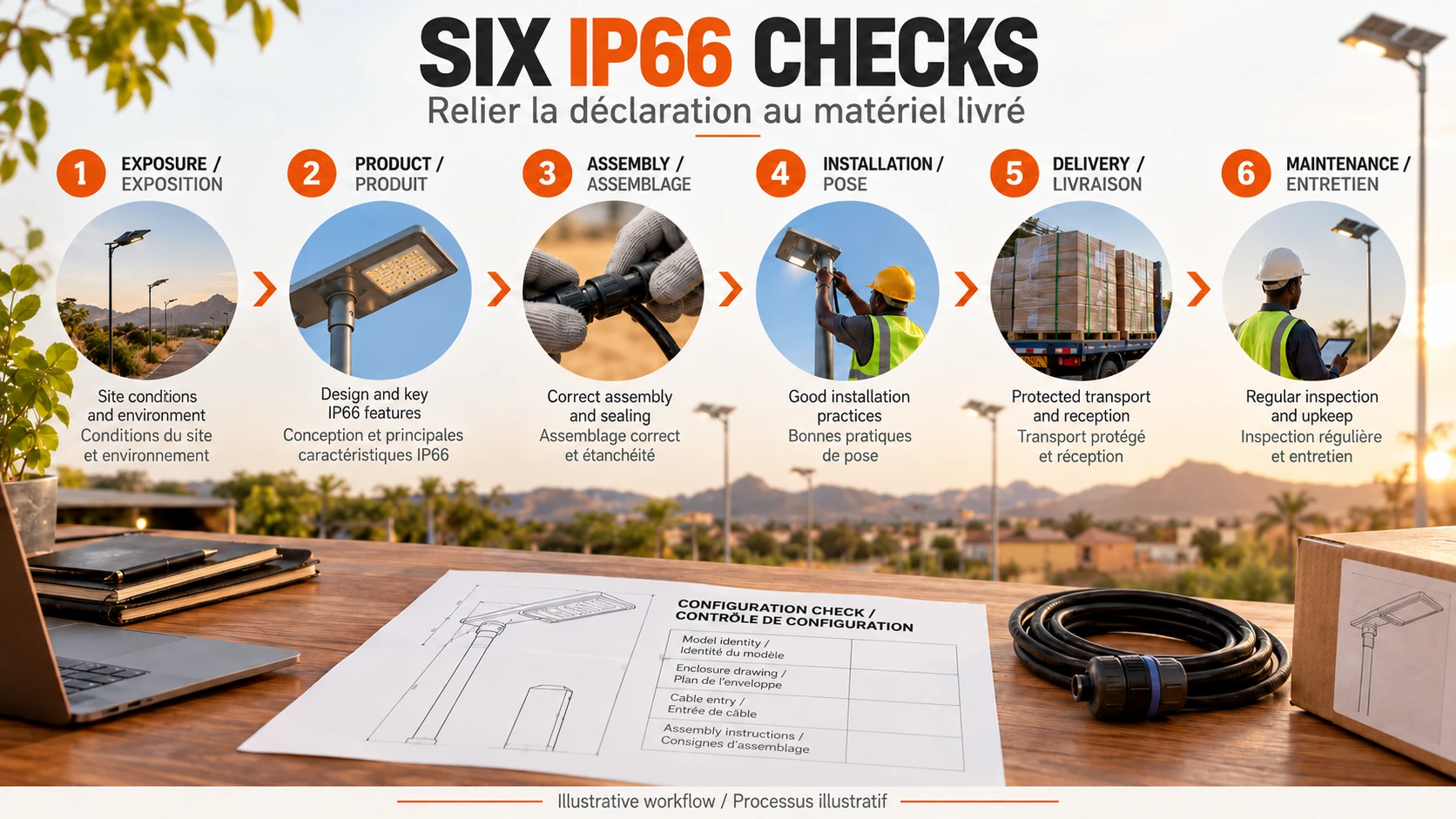
| Six IP66 procurement checks | Record to connect | Unresolved issue to raise |
|---|---|---|
| 1. Exposure | Named location and water/dust scenario | The requirement refers to a whole site, not a component |
| 2. Product identity | Model, variant and enclosure drawing | The report shows a different body or revision |
| 3. Assembly | Gland, cable range, seals, plugs and orientation | Delivered accessories differ from the assessed arrangement |
| 4. Installation | Specified orientation and entry/closure instructions | The planned installation differs from the documented arrangement |
| 5. Delivery | Approved model and accessory list | An enclosure, gland or plug is substituted without assessment |
| 6. Maintenance | Approved opening and reassembly procedure | The original protection is assumed after an undocumented repair |
This is a document-and-configuration check, not a substitute for laboratory testing. Record discrepancies on the submittal so purchasing, installation and maintenance teams work from the same approved version. If evidence is not available for a proposed variant, mark the claim as pending confirmation rather than filling the gap with a family brochure.
At goods receipt, keep the model labels and supplied-accessory list with the approved configuration record. If installation accessories come from another supplier, identify that responsibility explicitly. The aim is traceability, not a paperwork contest: someone should be able to explain why the enclosure arriving on site is the one the buyer approved. A photograph of a generic IP66 symbol cannot answer that question.
The installed cable entry deserves its own check
A cable gland works as part of an assembly. Its thread, sealing parts and compatible cable geometry matter alongside the enclosure. Phoenix Contact’s connector-assembly white paper explains how gaps around unsuitable cable arrangements can compromise ingress protection. A gland’s individual rating is not enough to approve an unspecified field installation.
Before delivery, identify who supplies the glands, cables and unused-entry plugs. If these are sourced locally, agree the compatible parts and acceptance evidence before installation. Do not improvise a seal by adding tape or silicone and then assume the original rating still applies. Any change should follow the manufacturer’s approved method and the project’s change-control process.
The same logic applies when a technician opens a serviceable compartment. Use the specified sealing and reassembly procedure, including any required replacement parts and tightening instructions. A visual inspection can identify an obvious damaged seal or missing plug; it cannot certify that the enclosure passes an IP test.
What an IP66 rating does not prove
Keep the rest of the lighting specification visible. IP66 does not state the impact rating, resistance to salt exposure, operating temperature range, surge performance, light distribution or battery autonomy. It also does not define a service life. A five-year warranty and an ingress-protection classification answer different questions; Inlux Solar’s standard warranty is five years, but the proposed product configuration and applicable terms still need to be identified.
Avoid a false shortcut with NEMA ratings, too. They use a different classification framework; do not convert IP66 into a NEMA type by treating a comparison chart as a two-way certification. If a tender requires a particular NEMA or other approval, obtain evidence addressing that actual requirement.
Neither an IP66 mark nor a brief hose demonstration should be used as an electrical-safety assessment. Do not spray energised equipment or attempt a homemade jet test from this article. Where verification testing is required, use the applicable standard, a competent test provider and a controlled procedure agreed for the product.
Apply the requirement to the solar-light architecture
Start with the site task, then identify the enclosures in the proposed All-in-One system أو All-in-Two configuration. Do not assume that integration gives every internal component a separate IP66 rating, or that a split arrangement is automatically less protected. Compare the actual assembly and evidence.
For a parking project, review the proposed solar parking-lot lighting against the site’s cleaning practices, equipment height and potential vehicle splash. Keep protection decisions separate from the photometric calculation: choosing a better-supported enclosure claim does not establish the required light level or uniformity.
FAQs about the IP66 rating
Is IP66 fully waterproof?
Not in every condition. It describes dust-tight protection and resistance to powerful water jets under the specified assessment. It is not an immersion rating, a permanent seal guarantee or permission to use any cleaning process.
Can IP66 lighting withstand heavy rain?
The rating can be relevant to rain-exposed equipment, but check the exact enclosure, installation orientation and manufacturer’s instructions. Flooding, damaged seals, unsuitable cable entries and other site conditions require their own assessment. The label alone does not approve an entire installation.
Is IP67 better than IP66?
Not as a universal rule. IP66 concerns powerful water jets; IP67 concerns temporary immersion. If both conditions matter, require the appropriate supported claims for the same configuration rather than assuming an immersion rating includes jet protection.
What is the difference between IP65 and IP66?
Both are dust-tight classifications. Their water protection differs: IP65 addresses water jets, while IP66 addresses powerful water jets. Select against the actual exposure and the delivered assembly, not only the larger number.
Can an IP66 light be pressure-washed?
Do not assume so. Cleaning temperature, chemicals, nozzle, pressure, distance and exposure time may differ from the assessment behind the rating. Follow the product’s approved cleaning instructions; request clarification if the planned maintenance process is outside them.
Does an IP66 enclosure make the whole system IP66?
No. Identify the luminaire, battery/controller enclosure, connectors and other relevant interfaces separately. A component label must not be extended to equipment or arrangements that its supporting evidence does not cover.
Send a defined exposure, not just an IP number
For an Inlux Solar project enquiry, include the site environment, the enclosure locations, any flood or cleaning exposure and the required protection evidence. Ask which configuration is proposed and which points remain to be confirmed. That produces a more useful purchasing conversation than asking for “the most waterproof solar light.”