LiFePO4 vs lithium ion is not quite a comparison between two separate battery families: LiFePO4, also called LFP, is a type of lithium-ion battery. In a real quotation, the useful comparison is LFP against a named alternative such as NMC or NCA. For solar street lighting, choose the complete pack and its controller compatibility—not the word “lithium” on a sales sheet.
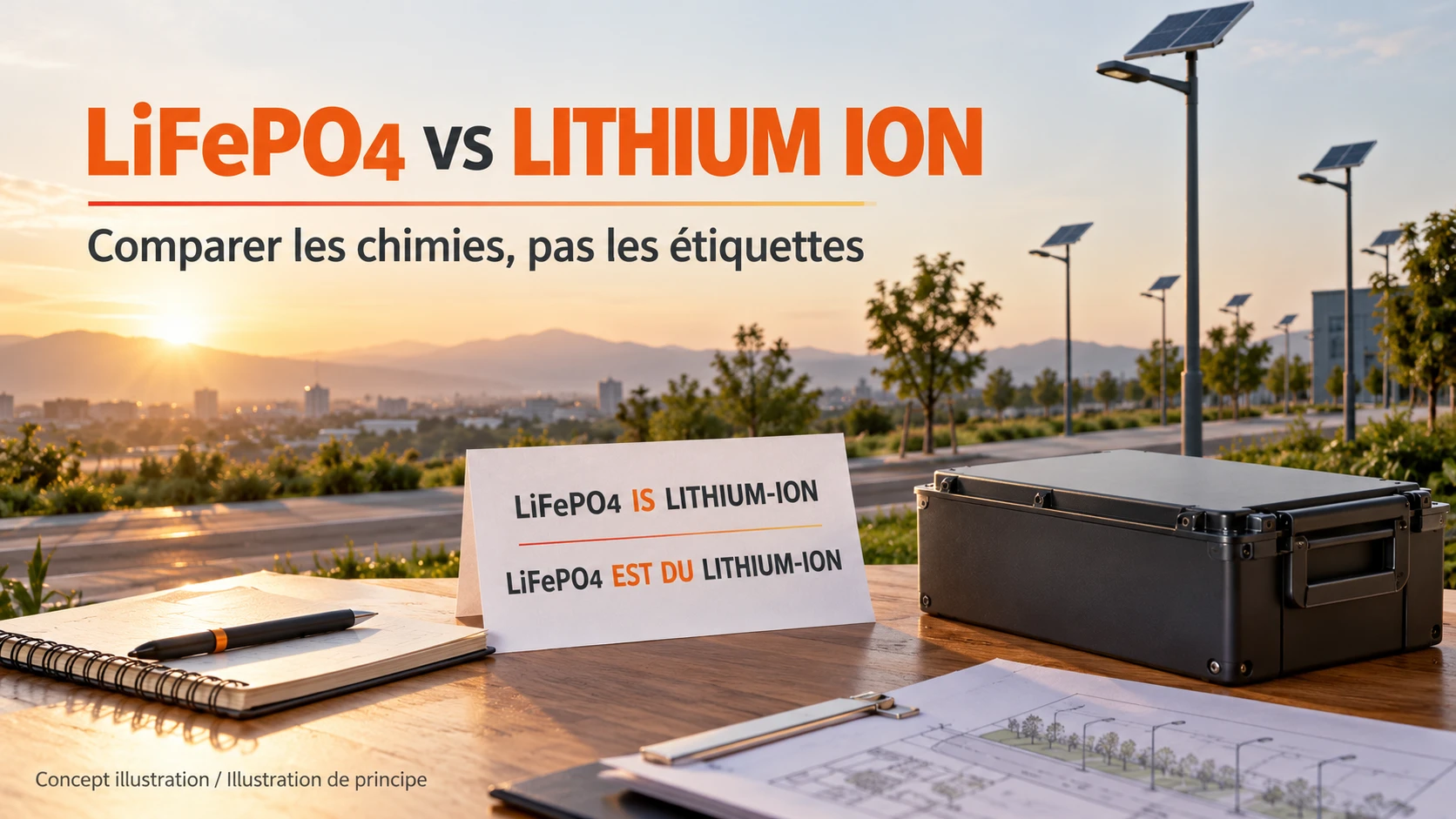
LFP is a sensible starting point for many daily-cycle solar-lighting projects, but the chemistry name does not approve a particular product. The pack still has to fit the light, accept the intended charging regime, protect itself under the site conditions and deliver the agreed energy. A poorly specified LFP pack is not rescued by a good chemistry label.
First, ask what “lithium-ion” means in the offer
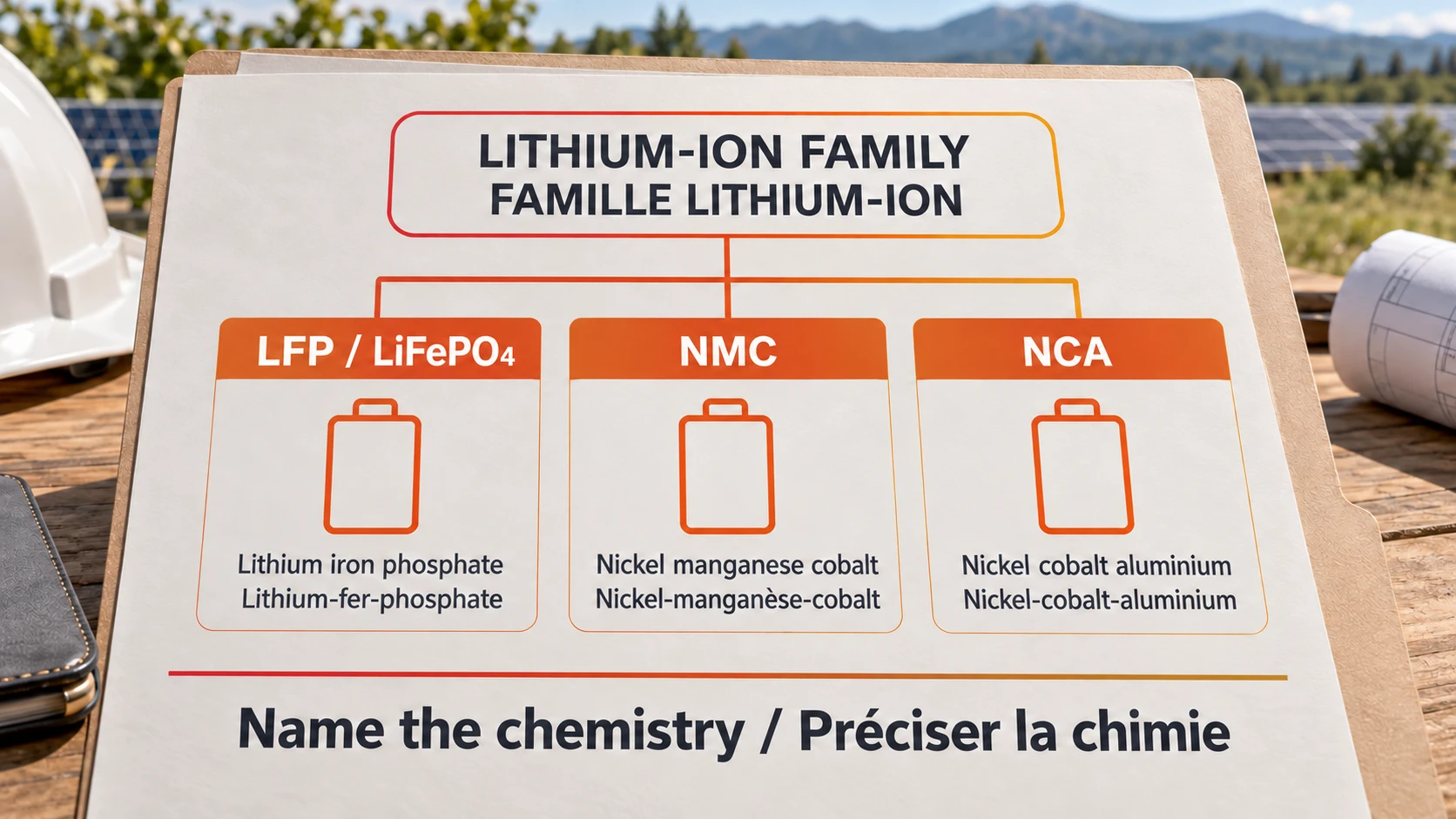
LFP means lithium iron phosphate. NMC refers to nickel-manganese-cobalt chemistry, and NCA to nickel-cobalt-aluminium chemistry. They belong within the lithium-ion family; the abbreviation does not identify the cell maker, cell model, series/parallel arrangement or finished-pack quality. The U.S. Department of Energy’s 2024 energy-storage safety plan discusses these cathode families and their different characteristics.
If one bidder writes “LiFePO4” and another writes only “Li-ion,” the comparison is incomplete. Ask the second bidder to identify the proposed chemistry and pack reference. It may even be another LFP product. Do not award a supposed chemistry advantage until both offers describe the same level of information.
LiFePO4 vs lithium ion: the differences that change a purchase
| Purchase issue | LFP compared with a named NMC/NCA alternative | What to compare in the quotation |
|---|---|---|
| Energy density and fit | LFP generally trades some energy density for other priorities | Finished-pack Wh, dimensions and mass—not a cell-only headline |
| Thermal behavior | LFP has a thermal-stability advantage, not immunity to failure | Pack protections, installation limits and evidence for that product |
| Life claims | A chemistry label alone does not establish service life | Test conditions, retained capacity and warranty scope |
| Charging and controls | Different packs are not automatically electrically interchangeable | Approved controller, voltage limits, protection and recovery behavior |
| Project value | A cheaper pack is not necessarily a cheaper lighting system | Required energy, installation fit, service access and replacement plan |
Use this table to open the technical comparison, not to declare a universal winner. A light with a tight battery compartment presents a different decision from a pole with generous storage space. A project with difficult service access also puts more weight on the consequences of a replacement. These are project constraints, not reasons to invent a fixed lifetime for an entire chemistry.
Compare complete packs at the same required energy
The practical disadvantage of lower energy density is usually space or mass for the energy required. Check the enclosure, mounting arrangement and service route before accepting either offer. A cell-level Wh/kg figure excludes the casing, BMS, interconnections and other pack components. It cannot tell you whether the finished battery fits an All-in-One light or can be removed safely for service.
A simple quotation example shows why Ah is not enough. Suppose fictional pack A is rated 12.8 V, 40 Ah and pack B is rated 11.1 V, 40 Ah. Their nominal energies are 512 Wh and 444 Wh respectively, calculated as voltage × amp-hours. Both are “40 Ah,” but the nominal energy differs by 68 Wh. Neither value establishes usable energy, runtime or permission to substitute one pack for the other.
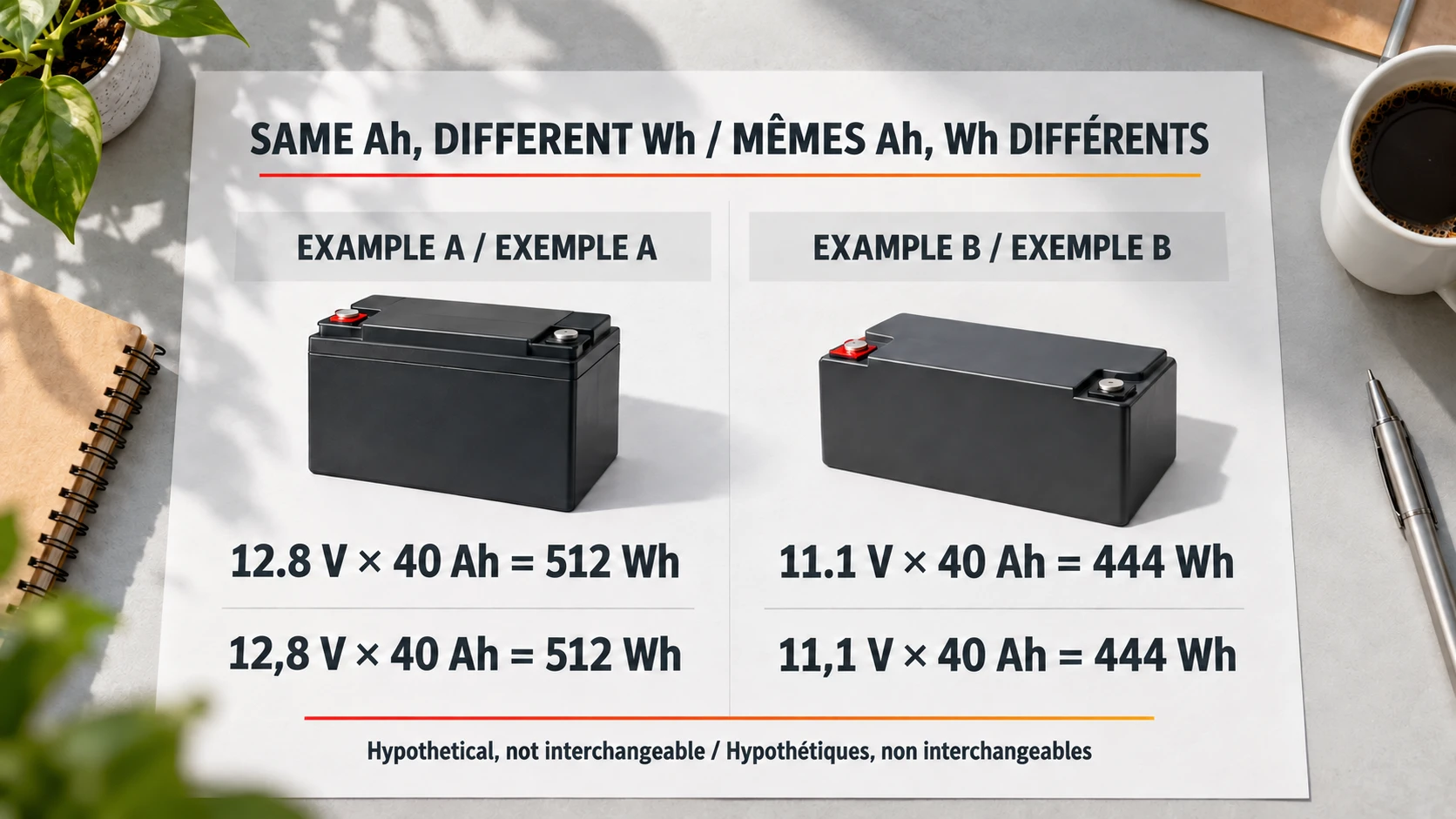
These are arithmetic examples, not Inlux configurations or recommended operating voltages. Start a real project with the night-time load and the solar street light battery sizing guide. Then compare offers against that same requirement. Do not compare a larger LFP pack against a smaller NMC pack and attribute the entire energy difference to chemistry.
Treat thermal stability as an advantage, not a safety certificate
DOE identifies improved thermal stability as a reason for LFP adoption, while also recording that failures have occurred in LFP systems. The purchasing consequence is straightforward: reject “cannot catch fire” as a substitute for product evidence. Chemistry, pack construction, protection and the installation all remain relevant. The DOE document concerns energy-storage systems; it is not a street-light certification checklist.
Ask which temperature limits apply to charging, discharging and storage, and where temperature is monitored in the proposed pack. A wide discharge range does not automatically approve charging over the same range. For a hot enclosure or a site with cold mornings, request the supplier’s declared operating envelope rather than a slogan about “all-weather lithium.”
The BMS and solar controller must agree
إن Victron Lithium Smart manual provides a useful real-product example: its LFP batteries have internal cell monitoring and balancing that must work with an external BMS. That does not describe every LFP battery. It demonstrates why “has a BMS” is not a complete system architecture, and why the proposed protection and charger-control interfaces must be identified.
Its installation instructions also define product-specific charging and temperature conditions. Do not copy those settings into an unrelated street-light controller. Obtain the approved settings and compatibility statement for the actual battery/controller combination; a generic “lithium mode” on a charger is not enough to prove a match.
For a new solar-lighting quotation, have the supplier identify the protection response and the route back to normal operation after a protective shutdown. The solar charge controller guide explains the controller’s wider role. This chemistry comparison does not replace its configuration review, and it is not a procedure for changing charging thresholds yourself.
Do not buy lifetime from an unsupported cycle number
Cycle-life claims are useful only when the comparison states the conditions and the end point. The retained-capacity threshold, temperature, depth of discharge and charge/discharge rates all belong with the number. A generic comparison that assigns every LFP pack one cycle count and every NMC pack another is too coarse for a public-lighting purchase.
Keep the detailed life assessment in the LiFePO4 battery lifespan guide. For this purchase comparison, record which claim is supported by the offered product and which is only a chemistry-level expectation. Warranty coverage, site service costs and the agreed lighting schedule still need to be compared separately; a hypothetical ROI table is not an offer from either supplier.
When a battery substitution needs a new approval
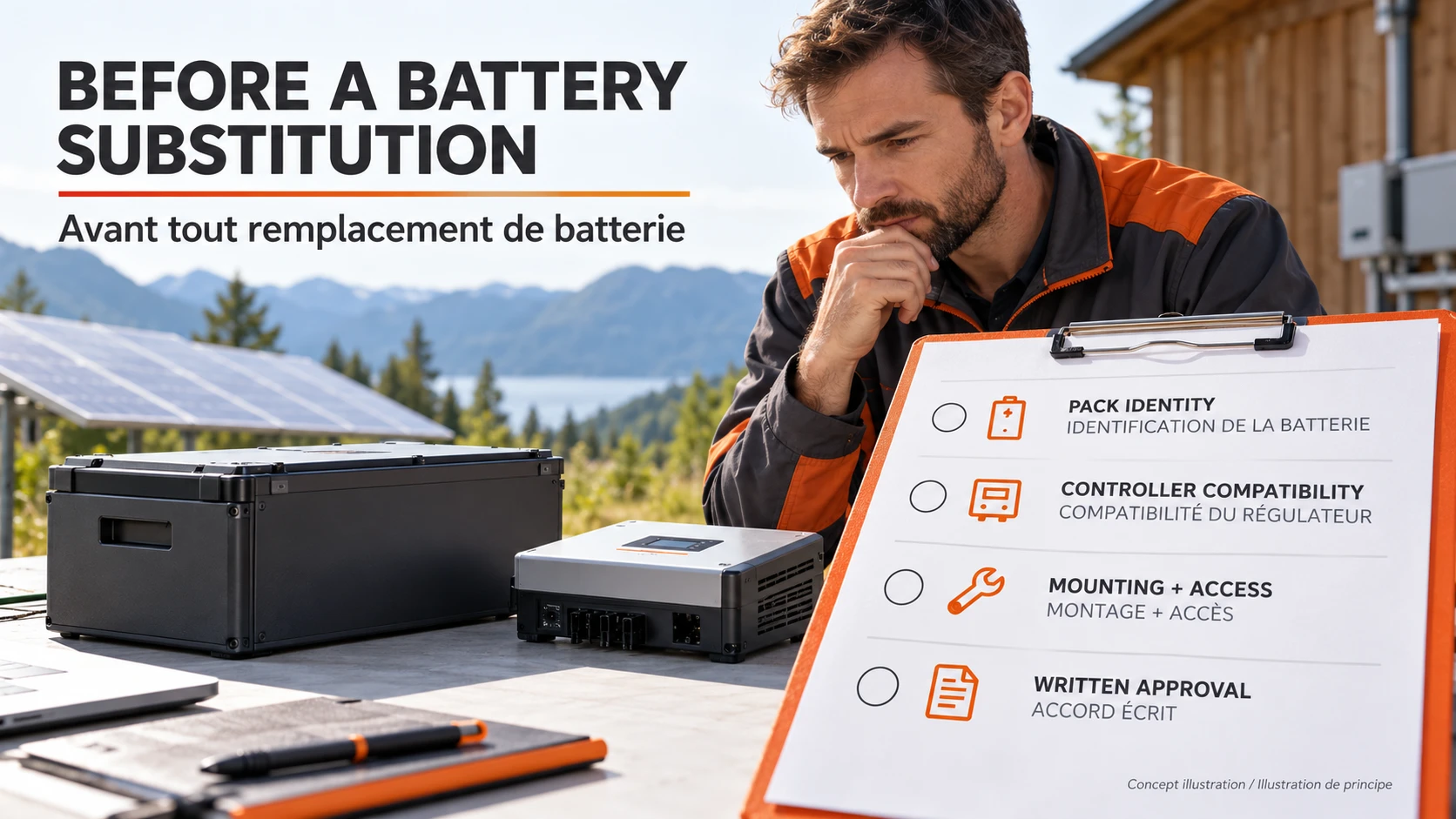
The point at which a comparison becomes risky is often replacement, not initial selection. A matching connector, similar enclosure or “12 V” description does not establish compatibility. Even replacing one LFP pack with another can change its electrical limits, protective behavior or mechanical fit. Record the exact substitute and its impact on the original system before approving it.
| Proposed change | Purchasing disposition | Evidence before acceptance |
|---|---|---|
| Same approved pack reference and revision | Check identity and service instructions | Traceable part reference and confirmation of the intended application |
| Different pack, same chemistry or nominal-voltage label | Do not assume a drop-in replacement | Battery/controller compatibility, operating limits, connector/polarity and fit confirmation |
| Different chemistry | Treat as a system change | Manufacturer-approved assessment of charging, protection, load behavior and installation |
This is an acceptance framework, not a wiring guide. Battery replacement and electrical work belong to qualified personnel following the product manuals and site safety procedures. Do not rebuild packs, mix unidentified cells, bypass protection or use a charger merely because its plug fits.
Turn the chemistry choice into a comparable solar-lighting offer
For an Inlux quotation, the materials and battery-pack overview identifies LiFePO4 battery packs and BMS as parts of the lighting system. That is a starting point for specifying an offer, not proof that every model has identical cells or settings. Ask for the configuration applicable to the model being quoted, especially where an enclosure or maintenance-access restriction is fixed.
For an integrated fixture, review the Inlux All-in-One range. Where the project calls for a separate solar-panel arrangement, examine the Inlux All-in-Two range. For a vehicle site, start with commercial solar parking lot lighting and use the same night-time lighting requirement across battery offers. Neither layout name establishes a universal battery capacity or chemistry-independent interchangeability.
الأسئلة المتداولة
Which is better, LiFePO4 or lithium-ion?
LiFePO4 is lithium-ion. Name the alternative chemistry first. LFP is often attractive for stationary daily cycling, while a named NMC/NCA pack may offer a different size or mass trade-off. Compare the offered complete packs against the same lighting requirement and verified operating conditions.
What are the downsides of LiFePO4 batteries?
Lower energy density can make pack size or mass more demanding for a fixed energy requirement. Charging limits and cold-weather protection also remain product-specific constraints. LFP does not remove the need for a suitable BMS, controller, enclosure or service plan.
Can a regular lithium charger charge a LiFePO4 battery?
Not on that description alone. Use only a charger or solar controller approved for the exact pack and its required charging profile and protection arrangement. Do not infer compatibility from a “lithium” label, nominal-voltage name or matching plug.
Can I replace another lithium-ion pack with LiFePO4?
Only after the manufacturer-approved compatibility review for the actual system. It must cover the controller, charging and protective limits, load behavior, mechanical fit and service instructions. It is a system change, not an automatic upgrade.
Are two 40 Ah lithium batteries equivalent?
Not necessarily. The nominal voltage must accompany Ah, and nominal Wh still differs from usable energy under the agreed load. Compare the same energy basis, operating envelope and system compatibility before comparing price.
Does LiFePO4 mean maintenance-free or fireproof?
No. A thermal-stability advantage is not a guarantee against all failures. Follow the product’s inspection, protection, installation and service requirements. Reject absolute safety or lifetime promises that are not supported for the offered pack.
Ask for the system configuration with the price
For a new road project, use the solar street light product range to frame the application. When you send an Inlux project RFQ, include the lighting schedule, site climate, required energy basis, enclosure restrictions and whether the request concerns new supply or a replacement. Require the named chemistry and approved battery/controller combination in the response. That turns “LiFePO4 vs lithium ion” into a buying decision the supplier can actually answer.