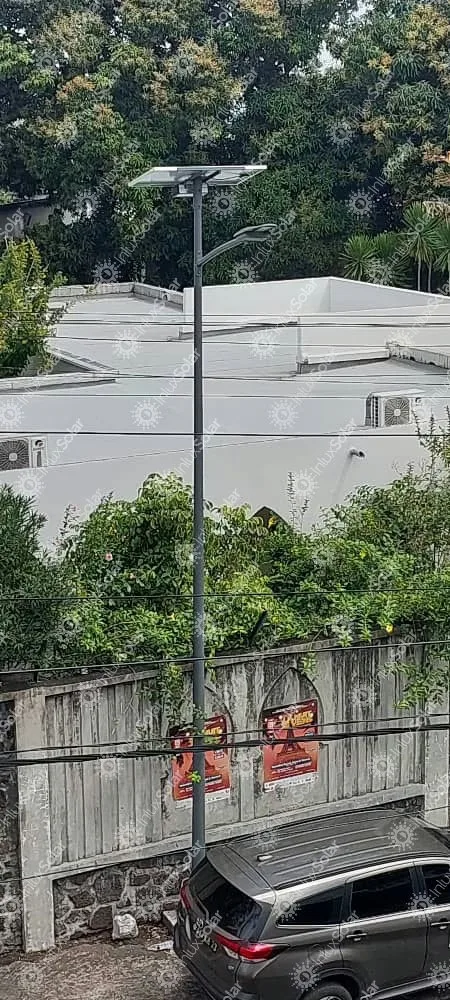
This Moroni, Comoros public lighting project uses 186 APOLLO split type solar street lights for road and urban-area lighting. The configuration combines 30W LED power, an 8m hot-dip galvanized pole, and a 60Ah / 12.8V LiFePO4 battery, giving similar NGO, EPC, and public-sector buyers a practical reference for solar street light solutions where quantity control, installation access, battery autonomy, and maintenance planning need to be settled before procurement.
Site Application & Lighting Requirement
The project site is Moroni, Comoros, with public lighting as the confirmed application. For a buyer planning road and street lighting, the key requirement is not only fixture wattage. Pole height, spacing, battery capacity, local installation responsibility, and the number of lighting points all need to match the road layout and approval process.
In this case, the 8m pole height and 30W LED power create a reference configuration for public road lighting where the buyer needs a repeatable system across many installation points. The 186-set scope also means packaging, spare parts, and installation documentation should be considered early in the RFQ, not after production starts.
Why This Configuration Was Selected
The APOLLO model is a مصباح الشارع الشمسي من النوع المنفصل, so the luminaire, battery, solar panel, and pole can be planned as project components rather than treated as a sealed all-in-one unit. For public lighting work in Moroni, this helps align the lighting system with 8m pole installation, battery access, and long-term maintenance needs.
The confirmed battery configuration is 60Ah / 12.8V LiFePO4. Buyers evaluating similar split type solar street lights should confirm autonomy requirements, local solar conditions, foundation design, and whether the installation team needs drawings, packing lists, or commissioning guidance before shipment.
Procurement Value for Similar Buyers
For NGO, municipal, EPC, and commercial buyers, this project is useful because it shows how a mid-power solar street light configuration can be standardized across 186 lighting points. A clear configuration makes it easier to prepare a comparable bill of materials, control spare parts, and keep the RFQ focused on the items that affect delivery and installation risk.
Before requesting pricing for a similar project, buyers should define the number of lighting points, pole height, LED power, target application, installation responsibility, shipping destination, and documentation required for internal approval. The solar street light buyer’s guide can help procurement teams structure these requirements before sending drawings or a tender file.
What Similar Project Buyers Should Confirm
- Road type, pole spacing, mounting height, and whether 8m poles are suitable for the site.
- Required LED power, battery autonomy, and local solar conditions.
- Whether hot-dip galvanized poles, IP66 / IK09 protection, or other compliance requirements must be stated in the RFQ.
- Installation responsibility, foundation preparation, lifting access, and on-site commissioning workflow.
- Packing plan, container loading, spare parts, and documents needed for customs or project approval.
Related Solar Lighting Solutions
For projects with similar public road lighting requirements, start with the APOLLO product page, then compare the broader split type range and the road lighting application page. Buyers planning multiple sites can also review أدلة إضاءة الشوارع بالطاقة الشمسية and other Africa project references before preparing an RFQ.
الأسئلة الشائعة
What configuration was used for the Moroni, Comoros solar street light project?
The project uses 186 APOLLO split type solar street lights with 30W LED power, an 8m hot-dip galvanized pole, and a 60Ah / 12.8V LiFePO4 battery.
Why use a split type solar street light for public road lighting?
A split type system lets the solar panel, battery, luminaire, and pole be planned as separate project elements, which helps EPC, NGO, and municipal buyers align the system with road layout, installation access, and maintenance requirements.
Is the 8m pole height suitable for every road?
No. The 8m pole height is specific to this project, not a universal rule. Buyers should confirm road width, spacing, target brightness, foundation conditions, and local wind requirements before ordering.
What information should be included in an RFQ for a similar solar lighting project?
Provide country, city, road type, pole height, LED power target, battery autonomy requirement, quantity, installation responsibility, shipping destination, and any tender or QC documents needed for approval.
Can this project be used as a reference for Africa public lighting tenders?
Yes. It can be used as a conservative reference for public lighting configuration and procurement planning, but each tender should still confirm local road layout, approval documents, battery autonomy, pole requirements, and installation conditions.
موقع المشروع
التكوينات الرئيسية
معرض المشاريع
About Me