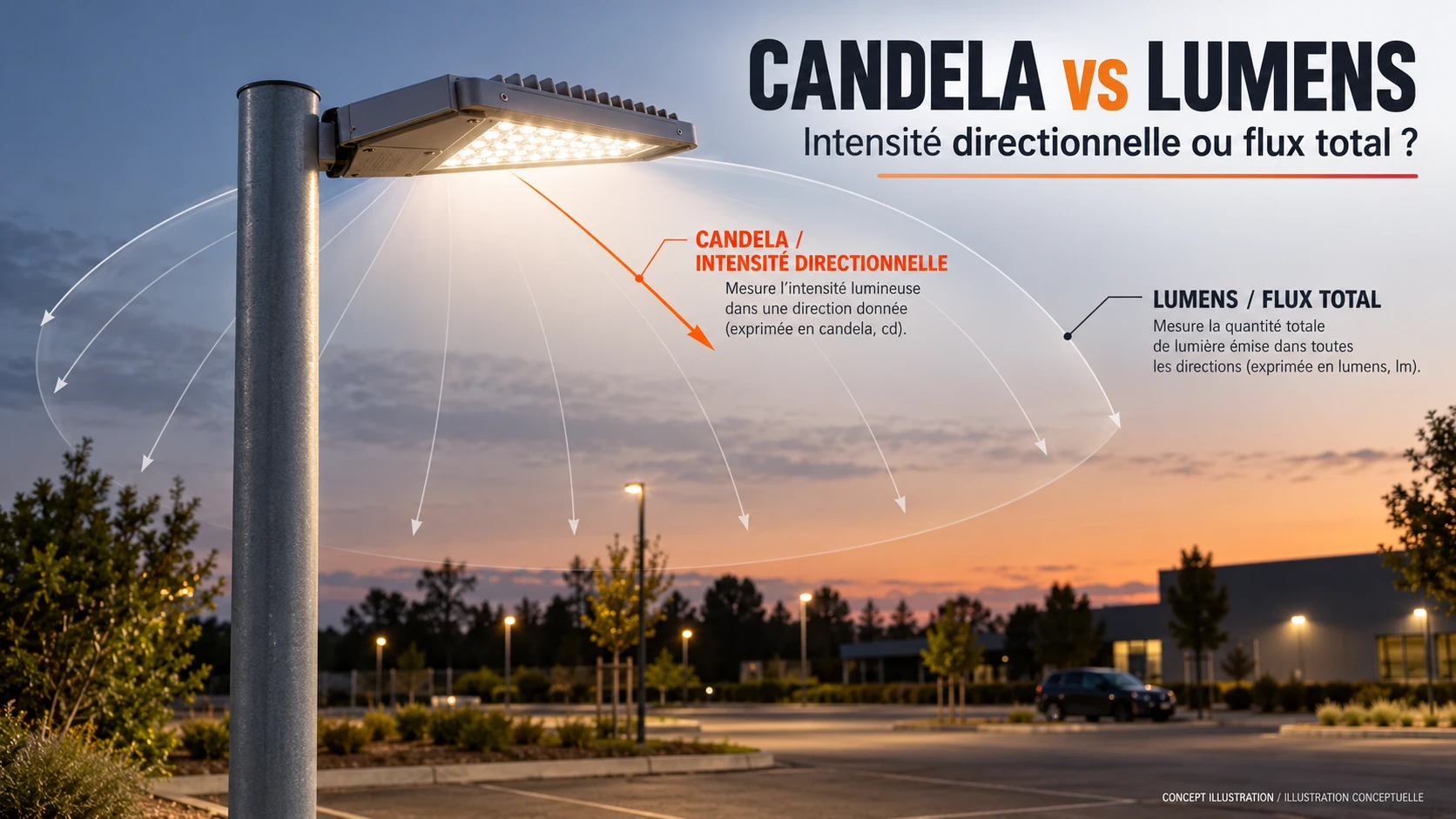
Candela vs lumens is a comparison of directional intensity y total light output. Candela (cd) tells you how strongly a source emits light in a specified direction. Lumens (lm) tell you the total visible-light flux emitted. There is no universal number of lumens in one candela: the missing information is how light is distributed over solid angle.
A street-light quotation can look stronger simply because it features a bigger peak-candela figure. That does not establish better lighting between poles, across parking bays or along a pedestrian route. This guide separates the units, works through the conversion assumptions, and shows which conclusions you can actually use when comparing outdoor luminaires.
Candela vs lumens: the difference at a glance
| Lighting quantity | Unidad | Useful question | Not established by that number |
|---|---|---|---|
| Total luminous flux | Lumen (lm) | How much visible light leaves the complete luminaire? | Its distribution across a site |
| Directional luminous intensity | Candela (cd) | How much flux per solid angle is emitted in this direction? | Total lumens or road coverage |
| Surface illuminance | Lux (lx) | How much light reaches a specified surface? | Total source output without further information |
| Luminancia | cd/m² | How bright is a source or surface in a specified viewing direction? | The same quantity as candela |
As explained by the NIST, the NIST explanation of the candela distinguishes intensity in a direction from total output. Do not compare a luminaire’s lumen value directly with another product’s candela value as if both were scores on one brightness scale. They describe different quantities, not competing definitions of the same rating.
For light arriving on pavement, use the separate lux vs lumens guide. For the complete measurement-to-design chain, use our photometry guide. Here, the narrower task is deciding what a candela-to-lumen claim really means.
Trap 1: treating one candela as a fixed number of lumens
The unit relationship is 1 lm = 1 cd × 1 sr, where sr means steradian, the unit of solid angle. This is not permission to drop the steradian and write “1 cd = 1 lm.” A solid angle describes a three-dimensional spread of directions; it is not an area in square metres and not an ordinary angle in degrees. The relationship appears in NIST’s SI unit tables.
For a deliberately uniform distribution within a specified solid angle, use lumens = candela × steradians, o candela = lumens ÷ steradians. The intensity must be the same throughout that region for this simple multiplication to apply. A peak intensity measured in just one direction is not automatically the average intensity over the beam.
| Ideal distribution only | Uniform intensity | Solid angle | Flux in that region |
|---|---|---|---|
| One-steradian region | 1,000 cd | 1 sr | 1,000 lm |
| Wider region, same total flux | 500 cd | 2 sr | 1,000 lm |
| Uniform in every direction | 1 cd | 4π sr | About 12.57 lm |
| Uniform full sphere, higher intensity | 300 cd | 4π sr | About 3,770 lm |
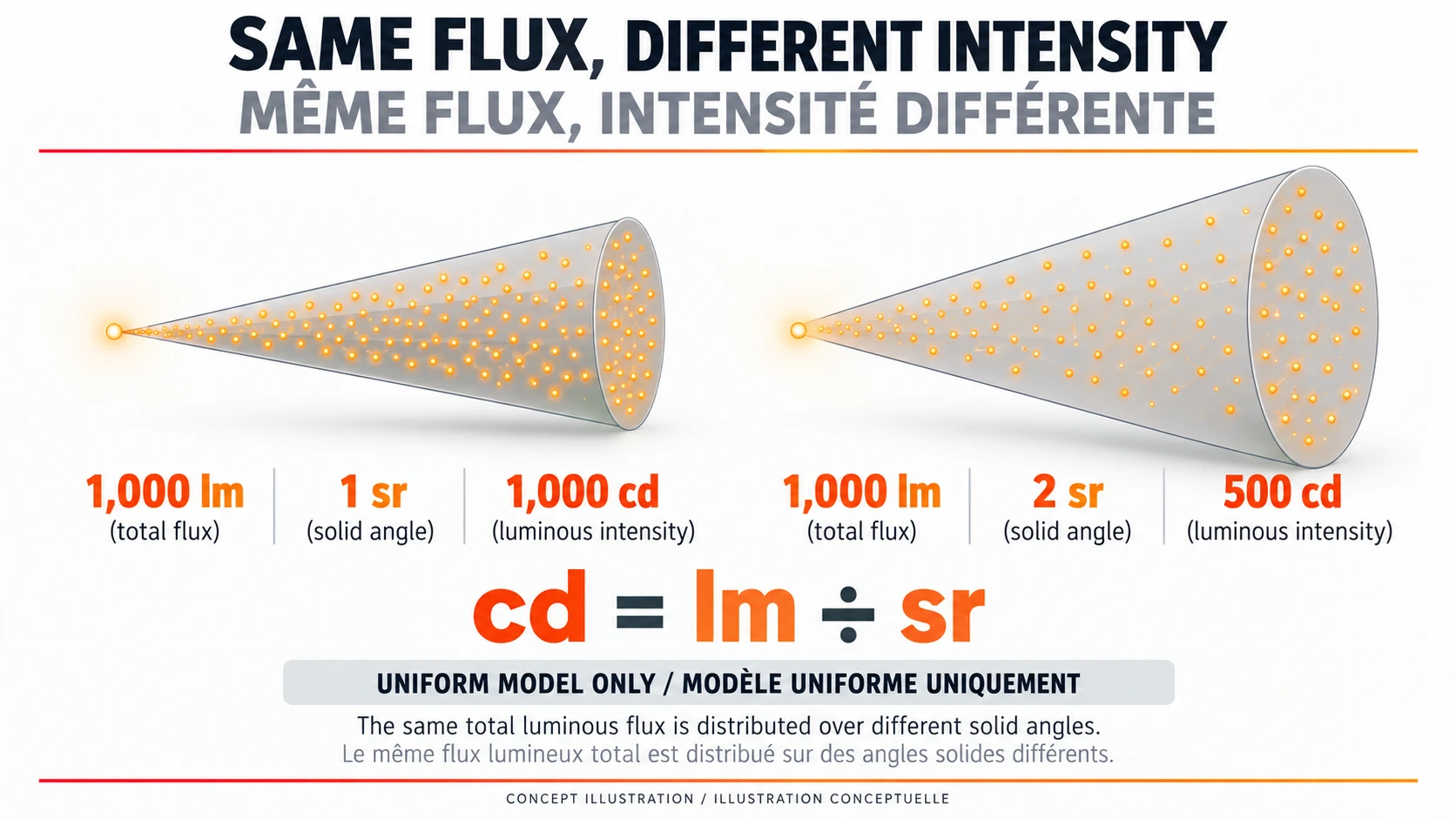
These are independently calculated teaching examples, not Inlux specifications or photometric test results. The second row halves intensity while preserving total flux. The last two rows assume a full sphere with identical intensity in every direction. Most road luminaires do not meet that assumption. The familiar 12.57 multiplier is therefore conditional, not a general candela vs lumens conversion factor.
For a real luminaire, intensity normally changes with direction. Total flux is found by adding the directional contributions over solid angle—mathematically, integrating the intensity distribution. If all you have is one peak-candela value, you do not have enough information to recover that total. A calculator that quietly assumes a uniform sphere can return an exact-looking answer to the wrong question.
Trap 2: treating beam angle as the edge of all emitted light
For beam-angle terminology, the IES definition of beam angle uses the directions at 50% of maximum intensity in a plane through the nominal centreline. That is a half-maximum boundary, not a statement that intensity stays flat inside it and becomes zero outside. Light can continue beyond the quoted beam angle.
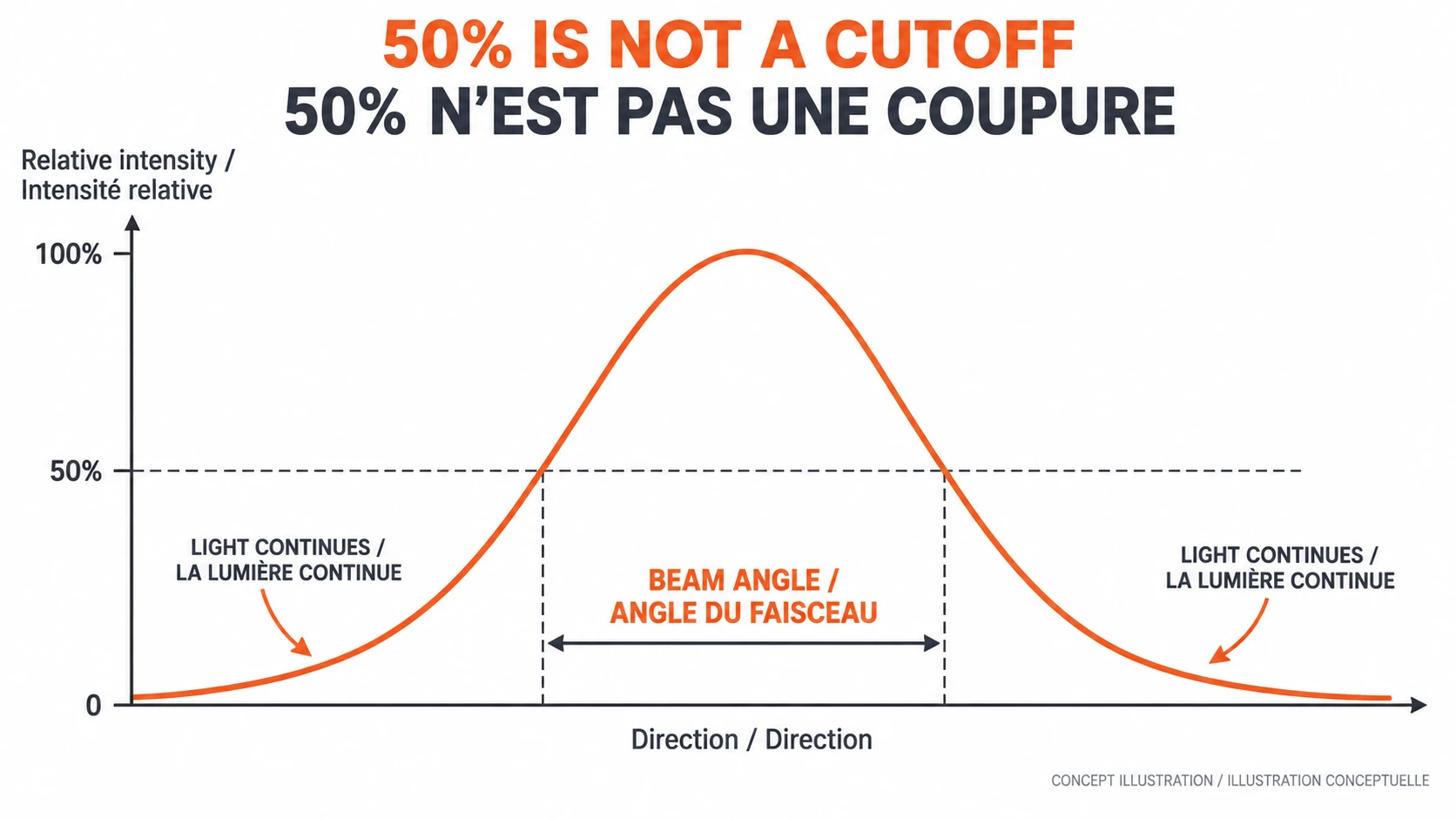
This matters when an online converter asks for lumens and a beam angle. The calculation may model a circular cone filled with uniform intensity. Your actual optic may have a hot centre, soft edges, side lobes or an asymmetric road pattern. In that case, entering a single catalogue angle does not turn total lumens into a verified peak-candela value.
For a non-rotationally-symmetric beam, the stated plane also matters. Two perpendicular beam angles can describe different spreads, but even that pair is not the whole intensity distribution. Before using a converted number to eliminate a supplier, ask whether the number is a measured peak, an average over a stated region, or an ideal-model estimate. Keep those categories separate in your comparison sheet.
Trap 3: choosing a road optic by the largest peak
Peak candela answers “where is this luminaire most intense?” It does not tell you whether that direction serves the road, falls just beneath the pole, reaches a parking aisle or points toward a neighbouring property. A lower peak may be part of a more useful distribution; it may also be insufficient. Neither conclusion can be settled from the peak number alone.
| What a buyer receives | What it can establish | Decision still missing |
|---|---|---|
| Total lumens only | Reported total flux on the stated basis | Where the output goes |
| Peak cd only | The maximum reported directional intensity | Its direction and the rest of the distribution |
| Lumens plus one beam angle | A partial description of output and spread | Actual intensity shape, asymmetry and spill |
| Configuration-matched distribution applied to the site | Predicted lighting for the stated geometry and operating scene | Review against project criteria and installed verification |
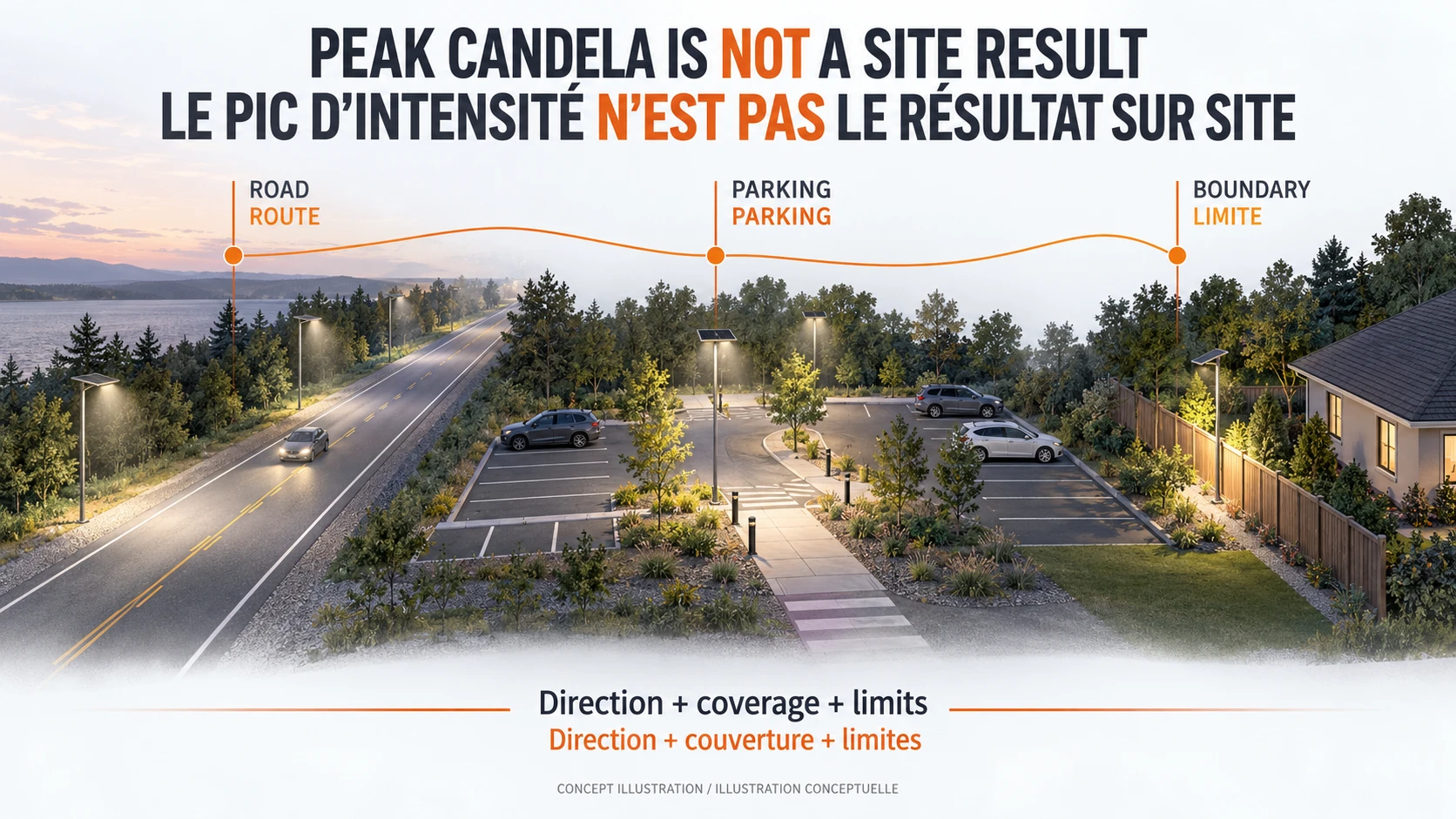
Start with the area that needs useful light. A narrow road, a broad car park and a boundary beside homes have different tasks. Ask where the peak lies relative to the luminaire’s reference axes and installed orientation. Then check the parts of the distribution that serve the far side, pedestrian route and sensitive boundary—not just its maximum. Changing tilt to chase one bright point can redirect light elsewhere.
When you already have a data file, the next task belongs to our IES file reading guide. This page does not replace that file review or a site calculation. In particular, the candela vs lumens distinction does not supply a universal pole spacing, road-width limit or guaranteed minimum illuminance.
Using the comparison in a solar street-light enquiry
Keep the lighting claim attached to the operating condition being offered. A maximum-output lumen figure is not the same as the output delivered during a dimmed night-time scene. If the optic is unchanged, reducing output can reduce intensity too; that does not mean the solar array, battery or control schedule has been sized adequately. Optical suitability and overnight energy sufficiency are separate checks.
For system selection, compare the Inlux All-in-One range con the Inlux All-in-Two range according to the site and system configuration, not an assumed relationship between housing format and candela. For commercial solar parking lot lighting, identify entrances, vehicle aisles and pedestrian routes before treating one brightness number as a selection rule.
A useful first enquiry states the application, site location, approximate dimensions, existing or proposed pole positions, mounting heights and required night-time operation. If the brief contains “minimum candela,” identify the direction, measurement basis and reason for that criterion. Do not silently substitute lumens. If it contains only “high brightness,” clarify the required site outcome before asking suppliers to price it.
Inlux Solar’s standard warranty is 5 years. That company policy is separate from optical acceptance: a warranty term does not demonstrate a particular candela distribution or make the example values above product specifications. Confirm the offered configuration and contractual scope for the project rather than inferring either from this educational comparison.
Preguntas frecuentes
How many lumens is 1 candela?
There is no fixed answer without a distribution. If intensity is uniformly 1 cd within 1 sr, the flux in that region is 1 lm. If the source is uniformly 1 cd over a full sphere, total flux is 4π lm, about 12.57 lm. Neither assumption follows from a single candela rating on its own.
How bright is 100,000 candela?
It means a luminous intensity of 100,000 cd in the stated direction and condition. It is not 100,000 lumens, a guaranteed viewing distance or a safe distance for looking at the source. A peak figure alone does not establish eye safety, glare control or useful road coverage. Do not judge it by staring into the luminaire.
What is 300 candela in lumens?
Uniform 300 cd throughout 1 sr gives 300 lm in that region. Uniform 300 cd over the full 4π sr sphere gives about 3,770 lm. A real lamp rated at a peak of 300 cd could have a different total flux because the intensity outside that peak direction is unknown.
Can lumens and beam angle give an exact candela value?
Only for a sufficiently specified model with valid assumptions—not for every real luminaire. A uniform-cone estimate cannot generally reproduce a measured peak from a half-maximum beam angle. Use the actual directional data when a selection or acceptance decision depends on candela.
Is higher candela better for solar street lights?
Not automatically. The useful direction, full distribution, site geometry and required operating scene matter. A concentrated peak may help one task while leaving another area poorly served. Review the site result rather than ranking complete solar systems by peak intensity alone.
Is candela the same as cd/m²?
No. Candela is luminous intensity. Candela per square metre is luminance. Adding “per square metre” changes the quantity. Do not use display-luminance figures or road-surface luminance as if they were the luminaire’s directional intensity.
Turn the brightness claim into a clear project brief
Use candela vs lumens to ask a better question, not to manufacture a single winning number. Start with the solar street light product range, then send Inlux Solar your project enquiry with the application and site constraints. State what the lighting must achieve and which figures still need confirmation. That is a stronger basis for a comparable proposal than “the highest candela available.”