When were street lights invented? There is no honest one-date answer. London required residents to hang lanterns outside in winter in 1417, but that was a lighting rule, not a city-owned network. Gas street lighting entered public use on London’s Pall Mall in 1807. Charles F. Brush installed a practical electric arc-lighting system in Cleveland in 1879. White LED street lighting came much later, after efficient blue LEDs were developed in the late 1980s and early 1990s.
So the answer depends on what you mean by “street light”: a public lighting rule, a gas-lit street, a practical electric system or the modern LED luminaire. The timeline below separates those milestones instead of crediting the whole story to one inventor.
When Were Street Lights Invented? The Short Timeline
For a quick answer to “when were street lights invented,” first decide which technology milestone you mean.
| Milestone | Date | What actually happened | Por qué es importante |
|---|---|---|---|
| Seasonal lantern rule in London | 1417 | Mayor Henry Barton ordered lanterns with lights to be displayed during winter evenings | An early municipal rule for shared nighttime lighting, but not a centrally operated street-light system |
| Public gas lighting on Pall Mall | 1807 | Thirteen gas lamps were installed along Pall Mall in London | A visible start of networked gas street lighting in a major city |
| Practical electric arc street lighting | 1879 | Charles F. Brush installed a commercial electric-light system in Cleveland | Electric light could illuminate large public areas without individual gas flames |
| Incandescent lamp and power distribution | 1879–1882 | Thomas Edison demonstrated a carbon-filament lamp; the Pearl Street station followed in 1882 | Smaller electric lamps and central distribution made electric lighting easier to scale |
| Mercury-vapor street lighting | 1930s | More efficient discharge lamps began replacing older incandescent systems | Higher output and efficiency changed road-lighting economics |
| High-pressure sodium era | 1970s onward | HPS became widely used for roads and outdoor areas | High efficacy and long life produced the familiar orange-yellow street scene |
| Practical white LED era | 1990s onward | Efficient blue LEDs made efficient white LED lighting possible | Better optical control, instant switching and digital dimming enabled modern street-light networks |
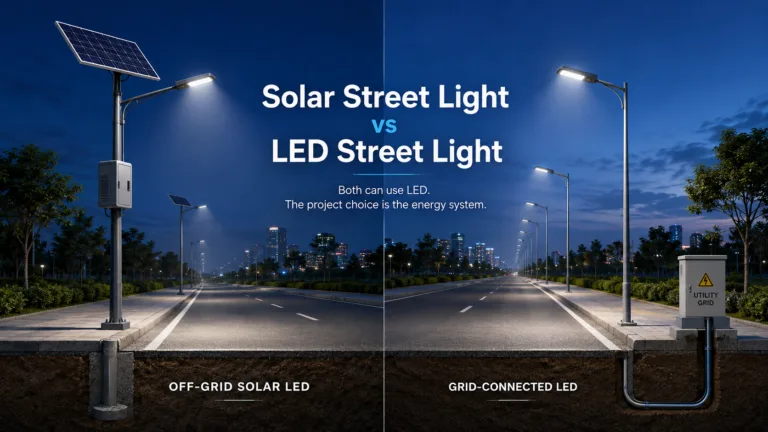
| Solar and connected street lighting | 2000s onward | LEDs, photovoltaic modules, batteries and controllers were combined into practical off-grid systems | Lighting no longer required a continuous trench-and-grid connection at every pole |

1417: A Lighting Rule, Not the Invention of the Modern Street Light
The 1417 date is often described too casually as “the invention of street lighting.” A Reading Museum learning resource records that London mayor Sir Henry Barton ordered lanterns to be hung outside on winter evenings between Hallowtide and Candlemas. The light came from private lanterns and depended on householders carrying out the rule.
That distinction matters. The ordinance showed that a city could treat nighttime visibility as a shared responsibility, but it did not create the kind of standardized, centrally powered and maintained lighting network we would recognize today. Earlier societies also used fire, oil lamps and torch bearers. The useful historical milestone in 1417 is municipal coordination, not the invention of the lamp itself.
If someone asks when were street lights invented and expects “1417,” the careful answer is: 1417 is an early documented London street-lighting mandate. The modern street light emerged through several later technologies.
1807: Gas Lighting Turns Individual Flames into Urban Infrastructure
Gas lighting changed the scale of public illumination. William Murdoch developed practical gas-lighting applications in the late eighteenth century, and Frederick Albert Winsor promoted public gas lighting in London. According to English Heritage’s history of lighting, thirteen gas lamps were installed along Pall Mall in 1807. By the 1820s, more than 40,000 gas lamps were burning along 215 miles of London streets.
This was more than a brighter lantern. Gasworks, pipes, burners, lamp posts and teams of lamplighters formed an urban service network. Streets could be illuminated on a repeatable schedule, which supported evening movement and commerce.
Gas still came with real drawbacks. It required fuel distribution, regular ignition and maintenance. Flames, combustion products and leaks created hazards. Light output and color were also limited compared with later electric sources.
For readers using 1807 as the answer to when were street lights invented, the precise meaning is the start of public gas lighting on a prominent London street—not the first lamp ever made.

1879: Electric Street Lighting Becomes Practical
Electric light did not arrive as one neat replacement for gas. Early arc lamps produced light by sustaining an electrical arc between electrodes. The light was intense—useful for streets and large public spaces, but harsh for smaller areas.
Charles F. Brush made the arc-light system commercially practical. The National Inventors Hall of Fame records that Brush installed the first electric-light system in the United States in Cleveland in 1879. His dynamo and system design were as important as the lamp: a street-light network needs power generation, control and distribution, not just a glowing source.
Thomas Edison belongs in the story, but he did not single-handedly invent every form of electric street lighting. He demonstrated a carbon-filament incandescent lamp in 1879, covered by U.S. Patent 223,898, and developed a distribution system suited to many smaller lamps. The National Inventors Hall of Fame’s Edison record notes that the Pearl Street central station was completed three years later.
Other inventors also improved filaments, dynamos, arc lamps and distribution. That is why “who invented street lights?” has no single-name answer. Brush is central to practical arc street lighting; Edison is central to incandescent lighting and power distribution; gas-light pioneers belong to an earlier stage.
If the intended question is when were street lights invented with electricity, 1879 is the clearest practical milestone in this timeline.
From Incandescent to Mercury and Sodium Lamps
The twentieth-century story was driven by a practical question: how could cities get more useful light from each unit of electricity while reducing maintenance?
Discharge lamps passed current through a gas or vapor instead of heating a filament. Peter Cooper Hewitt’s mercury-vapor lamp became an important predecessor to later outdoor-lighting technologies; his inventor record notes its widespread use for street and outdoor lighting. The U.S. Department of Energy’s history of the light bulb explains how discharge lamps became the basis for technologies including low-pressure sodium and fluorescent lighting.
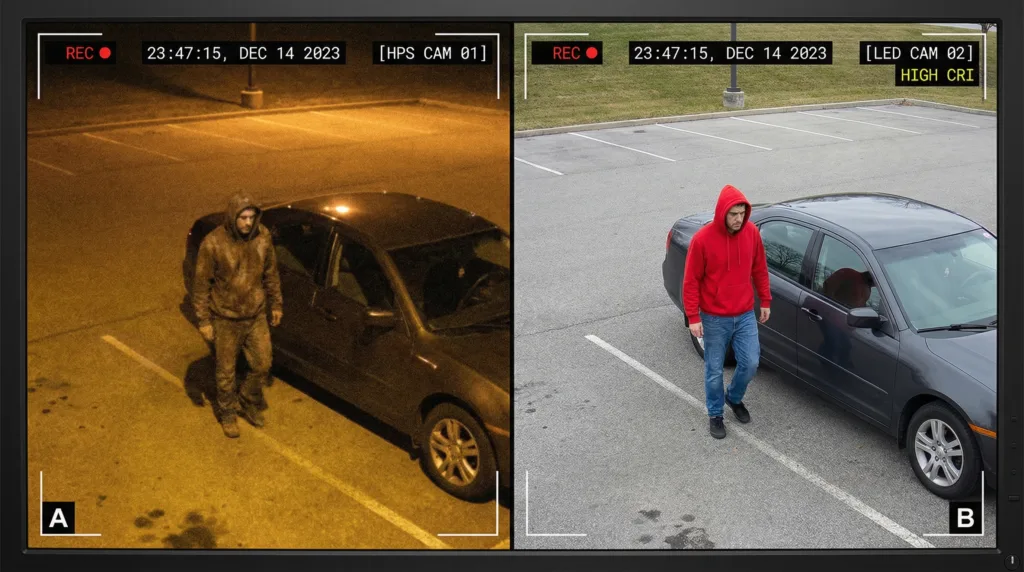
By the 1970s, high-pressure sodium lamps were being deployed for street and area lighting. Their efficiency and service life made them attractive to municipalities, while their orange-yellow appearance became a defining feature of night streets. The trade-off was color rendering: objects can be harder to distinguish accurately under narrow-spectrum or low-CRI light.
That orange glow was therefore not an aesthetic decision alone. It came from a technology chosen largely for operating efficiency. The detailed explanation is in our guide to why street lights are orange, and the engineering trade-offs are covered in HPS vs LED street lights.
This middle chapter also explains why when were street lights invented is not answered fully by the gas or electric-arc dates: the technology kept changing long after cities had street-light networks.
When Did Street Lights Become LED?
Red and green LEDs existed before efficient blue LEDs. Blue was the missing piece needed for practical white LED light. Isamu Akasaki, Hiroshi Amano and Shuji Nakamura developed efficient blue LEDs using gallium nitride during the late 1980s and early 1990s. They received the 2014 Nobel Prize in Physics for that work; 2014 was the award year, not the year the blue LED was invented.
Street-light conversion did not happen everywhere at once. Cities began testing and adopting LED roadway luminaires at different times, with deployment accelerating during the 2010s. LED systems offered several capabilities that older lamps could not combine as easily:
- controlled optical distribution rather than sending light in every direction
- instant on/off operation without a long warm-up period
- dimming and scheduling through electronic drivers
- selectable color temperature and improved color rendering
- compatibility with monitoring, fault reporting and central management
- lower maintenance demand when the luminaire and thermal design are sound
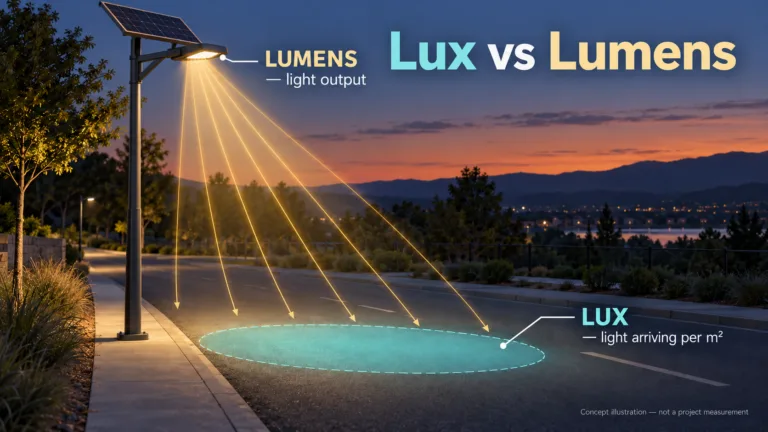
LED does not automatically mean good street lighting. Poor shielding, excessive output, unsuitable color temperature or a bad layout can still cause glare, spill light and dark patches. The U.S. Department of Energy’s work on application-specific outdoor lighting emphasizes intensity, distribution, spectrum and controls—not just replacing one lamp with another.
For current product architecture, see our LED street light guide y smart street-lighting system guide.
So when were street lights invented does not have “2014” as the answer. That was the Nobel Prize year; the enabling blue-LED work occurred earlier, and municipal adoption followed gradually.
Solar Street Lights Are a System Milestone, Not a Single Invention Date
When were street lights invented in the solar era? Again, there is no single useful date. A practical solar street light combines technologies developed on different timelines: photovoltaic modules, rechargeable batteries, charge controllers, efficient LEDs, optics and programmable controls.
The engineering shift is significant. A conventional grid light receives energy through fixed electrical infrastructure. A solar street light has to collect, store and budget its own energy through the night. The panel, battery, controller, LED output and dimming schedule must be sized as one system for local weather and the required operating profile.
That makes modern solar street lighting especially relevant where trenching, grid extension or unstable utility supply would be costly. It also means a buyer should not compare systems by fixture wattage alone. The useful questions are about maintained ground-level light, worst-month solar resource, battery operating limits, autonomy, pole geometry, wind design and service access.
Inlux Solar has delivered 300,000+ cumulative units across 60+ countries and completed 1,000+ projects. Those company-level figures do not replace project engineering; the quoted model still needs its own photometric file, energy balance, structural basis and warranty scope. Review the solar street-light product family for the current all-in-one, all-in-two and split-system paths.
What Changed Besides the Light Source?
The history of street lighting is also the history of better control over where, when and how light is used.
| Design question | Early systems | Modern project approach |
|---|---|---|
| Where does the light land? | Broad output with limited optical control | Photometric distribution matched to road width, pole spacing and mounting height |
| When does it operate? | Manual lighting or fixed switching | Photocells, astronomical timers, dimming schedules and central control |
| How is performance checked? | Visual impression and basic output | Maintained illuminance or luminance, uniformity, glare and model-specific photometric files |
| How is energy supplied? | Oil, gas or centralized electricity | Grid, solar, hybrid or managed connected systems |
| What happens after a fault? | Manual inspection | Driver diagnostics, controller logs and optional remote fault alerts |
Modern standards matter because more light is not always better light. A useful design limits glare and uplight, avoids severe bright-to-dark transitions and puts sufficient light on the actual task. Security applications may also need vertical illuminance for faces and cameras, while road projects must fit the applicable road-lighting class and local rules.

Preguntas frecuentes
When were street lights invented?
When were street lights invented depends on the definition: 1417 for an early London lantern mandate, 1807 for public gas lighting on Pall Mall, 1879 for Charles Brush’s practical electric arc-lighting system, and the 1990s for the efficient blue-LED breakthrough behind modern white LED lighting.
Who invented street lights?
No single person invented the whole category. Henry Barton’s 1417 London rule is an early municipal milestone. William Murdoch and Frederick Albert Winsor are associated with practical gas lighting. Charles F. Brush made electric arc street lighting commercially practical, while Thomas Edison and other inventors advanced incandescent lamps and electrical distribution.
When were gas street lights invented?
Gas lighting was developed in the late eighteenth century. A widely cited public milestone is 1807, when thirteen gas lamps were installed along Pall Mall in London. Gas street networks then expanded during the nineteenth century.
When were electric street lights invented?
Electric arc-light experiments predated commercial systems, but 1879 is a useful practical milestone: Charles F. Brush installed an electric-light system in Cleveland. Electric street lighting spread during the 1880s as generation and distribution systems improved.
Did Thomas Edison invent the street light?
No. Edison made major contributions to incandescent lighting and electrical distribution, but electric arc street lighting and gas street lighting already had separate histories. Street lighting evolved through the work of many inventors, engineers, utilities and cities.
When did street lights become common?
There is no global date. Gas lighting expanded through major cities during the nineteenth century, electric lighting spread from the 1880s onward, discharge lamps dominated much of the twentieth century, and LED conversion accelerated in the 2010s. Adoption depended on local infrastructure and budgets.
When were LED street lights invented?
The enabling breakthrough was the efficient blue LED developed in the late 1980s and early 1990s, which made practical white LED lighting possible. Street-light products and city conversions followed gradually rather than appearing in one invention year.
Are street lights and traffic lights the same invention?
No. Street lights illuminate roads and public areas. Traffic lights control vehicle and pedestrian movements using signal indications. Garrett Morgan is often mentioned in traffic-signal history, but that is a different keyword and a different invention story.
The Best Answer Is a Timeline, Not a Name
So, when were street lights invented? Use 1417 for an early London lighting mandate, 1807 for public gas lighting on Pall Mall and 1879 for a practical electric arc-lighting system. Add the 1990s for the efficient blue LED breakthrough that enabled modern white LED lighting. Each date answers a different version of the question.
The same lesson applies to a current street-lighting project: the lamp is only one part of the system. The result depends on the power source, optical distribution, pole layout, controls, maintenance and the performance target on the ground.
If you are moving from history to a real road, campus or public-space specification, send the site location, road dimensions, pole plan, operating schedule and target lighting class. The Inlux engineering team can review the inputs before an RFQ is finalized.
Request a street-lighting project review
Sources and Further Reading
- Reading Museum: Lamplighter learning resource
- English Heritage: The illuminating history of lighting
- National Inventors Hall of Fame: Charles F. Brush
- National Inventors Hall of Fame: Thomas A. Edison
- National Inventors Hall of Fame: Peter Cooper Hewitt
- U.S. Department of Energy: The history of the light bulb
- Nobel Prize: The 2014 Nobel Prize in Physics