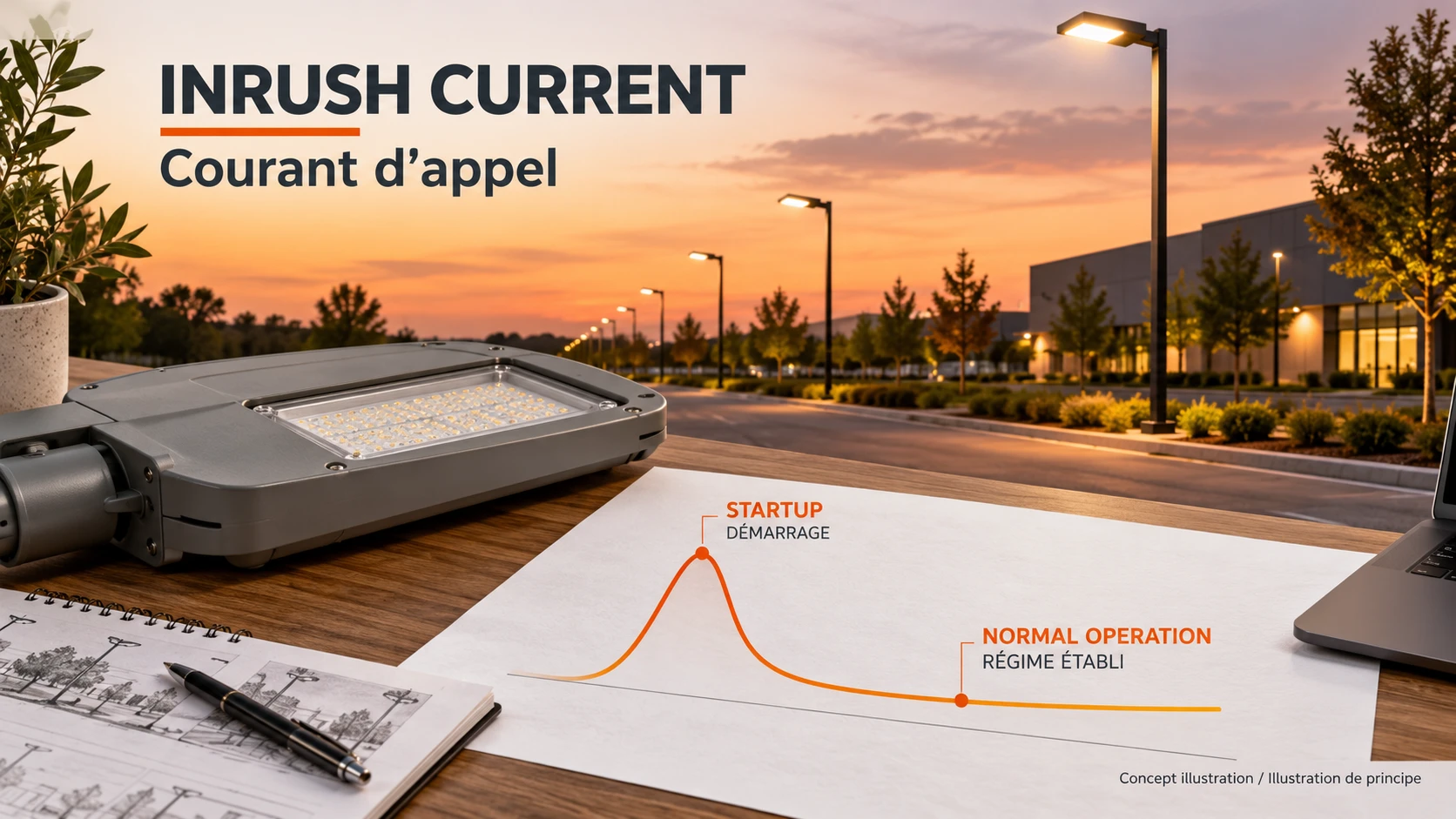
Inrush current is the brief, higher-than-normal input current drawn when equipment is energized. In LED lighting, it can determine whether a group of luminaires starts reliably—even when its normal running load looks comfortably within the circuit rating. Read the peak together with its duration and test conditions; a number in amperes on its own is not a usable compatibility check.
For a street or commercial parking project, the buying question is not simply “Does this driver have a low startup current?” It is “Will this exact group of drivers, controls and protection work together at this site?” This guide separates that question from ordinary wattage sizing, lightning protection and the very different startup path of battery-fed solar lights.
Why LED lights draw inrush current
An LED is not connected directly to the AC supply in a complete mains luminaire. Its driver contains power-conversion circuitry and energy-storage components. Charging those components at energization can draw a short pulse before normal operation settles. The precise behavior belongs to the driver design and the supply feeding it, not to a universal rule for all LEDs.
Keep the terms separate. The normal input current and power factor describe established operation. Inrush concerns startup. A surge-protection rating addresses another event, such as a transient overvoltage. A high PF or a surge-protection claim therefore does not prove that a controller can switch a large group of drivers. Use the LED driver guide for the broader driver-selection task.
1. Read the complete inrush current specification
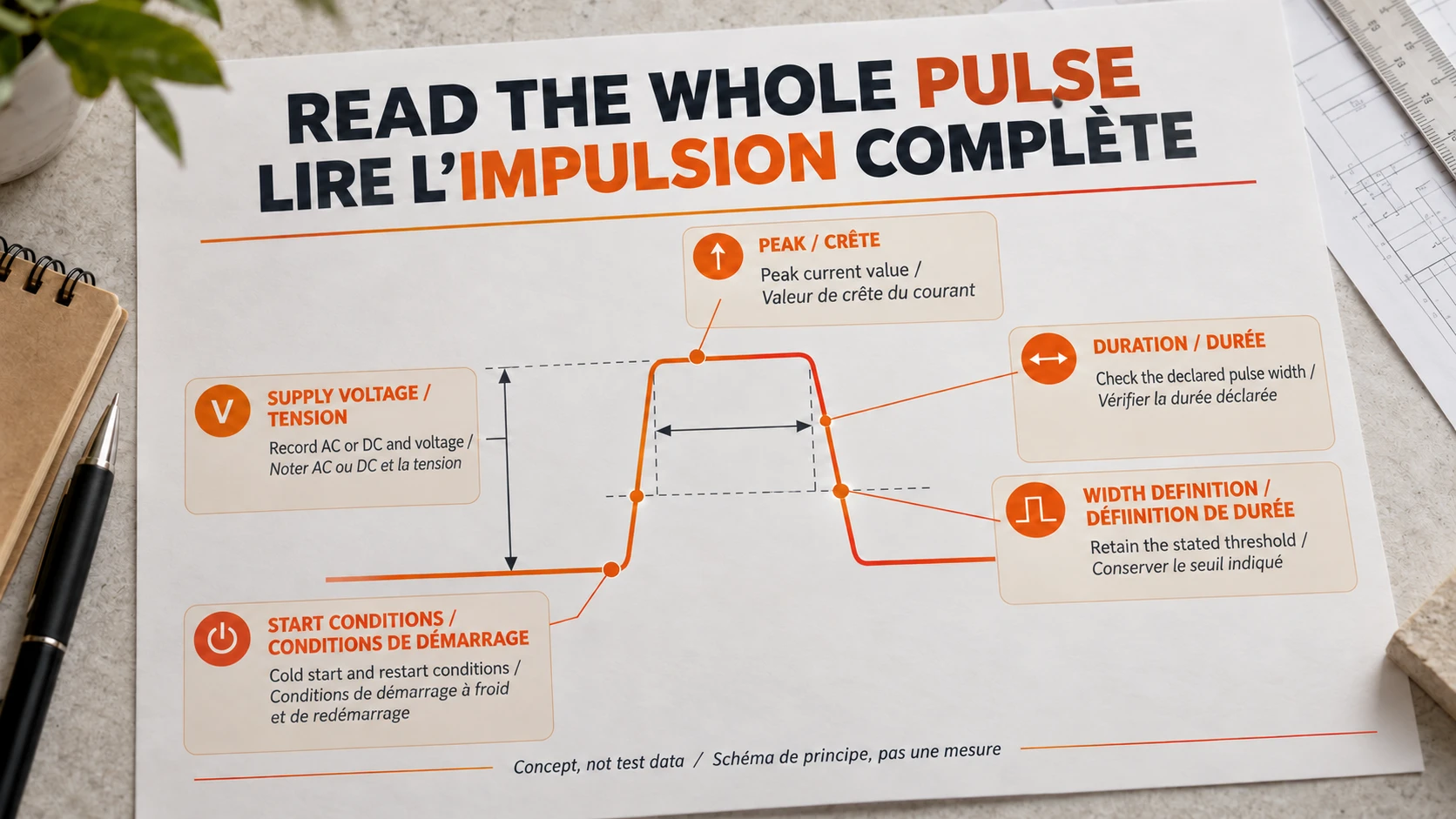
Before comparing two offers, put their startup declarations side by side. If one gives only a peak and the other also states pulse width, they are not equally documented. Ask what the width means: the thresholds used to measure a pulse can change the reported duration. Do not silently replace a missing definition with one taken from a different brand.
| Startup data field | What the buyer needs | Do not substitute |
|---|---|---|
| Peak current | Value, unit and whether typical or maximum | Normal AC input current |
| Pulse width | Duration and its measurement threshold | Time until the light becomes visibly bright |
| Supply | AC/DC, voltage and relevant test conditions | A result at a different input voltage |
| Starting state | Cold start, restart interval and applicable temperature | An unqualified “soft start” label |
| Exact identity | Driver code, revision and luminaire configuration | A similar-looking driver or a family headline |
A real datasheet example—not an Inlux model claim
For a documented example, read the MEAN WELL HLG-150H datasheet, revision 2026-07-24. It lists a typical cold-start peak of 65 A at 230 VAC, with a width of 425 µs measured at 50% of peak. On the same specification page, the typical AC operating current at 230 VAC is 0.75 A. Those figures describe different parts of operation; neither should be substituted for the other.
425 µs equals 0.425 ms, not 425 ms. A unit transcription error would change the duration by a factor of 1,000. Copy the condition and unit with the value, and keep the original document revision in the submittal. This outside-manufacturer example illustrates how to read a specification; it does not establish that an Inlux luminaire contains this driver.
2. Do not calculate driver quantity from watts alone
A running-load calculation is necessary, but it does not answer the startup question. Dividing installed watts by supply voltage cannot produce an inrush-current peak. Equally, dividing a breaker’s rated current by one driver’s peak is not an approved method for deciding how many luminaires it can supply. Duration, protective-device behavior and the complete circuit matter.
The HLG-150H example publishes separate maximum quantities for a 16 A circuit breaker at 230 VAC: four units for type B and seven for type C. These are that manufacturer’s stated limits for that documented combination—not a recommendation to install either device, and not a rule for other drivers. The final designer must also check continuous loading and the applicable installation requirements.
For mixed drivers or an undocumented quantity, request a written combination assessment rather than adding individual peak numbers and calling the circuit approved. Tridonic’s LED driver functional description, version 1.2 (01.2024), discusses maximum circuit-breaker loading through pulse characteristics and simulation. Its examples are not permission to transfer a count between manufacturers.
3. Include the photocell, relay or contactor
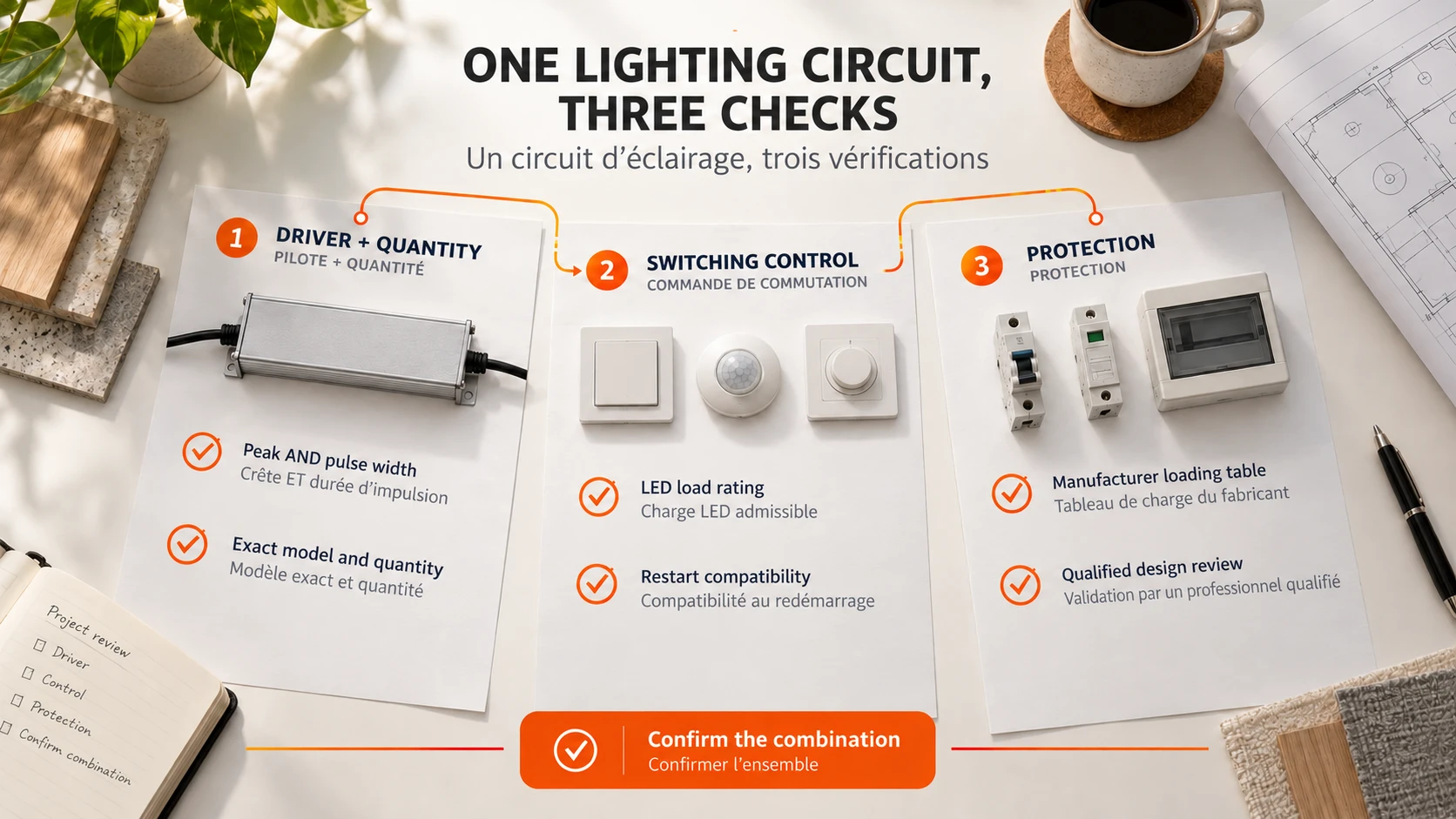
A parking lot may have many luminaires that appear individually modest but switch on together at dusk. The upstream switching device sees the group, not just one lamp. An ordinary current rating printed on a relay is not, by itself, evidence of its capacity to make an electronic LED load. Ask for the device’s declared LED or capacitive-load capability and the allowed quantity for the specified driver.
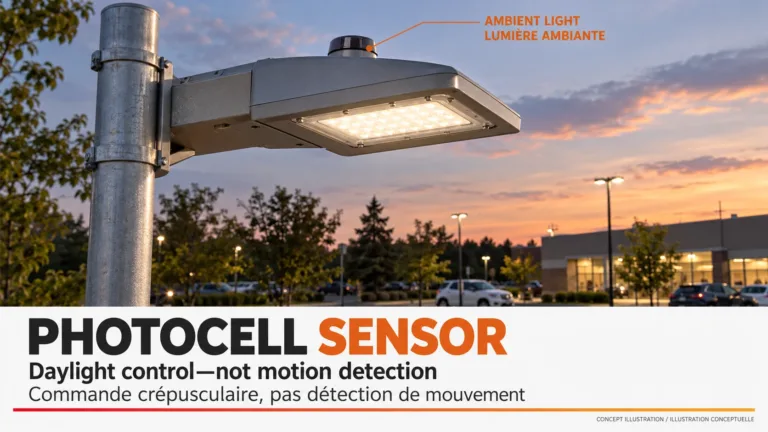
Describe whether the control actually disconnects driver input power or sends a dimming/control signal while input power remains present. Those are different operating arrangements. The photocell sensor guide covers the control-selection side; this startup review checks the resulting combination. Do not assume that a compatible dimming interface automatically establishes switching-contact compatibility.
4. Ask what happens after a short power interruption
One clean first start does not describe every restart. Ask the supplier which recovery conditions were assessed: a normal cold energization, restoration after a brief interruption, and the relevant ambient conditions for the installation. Use the product manufacturer’s defined intervals. Do not invent an off-time or promise that a streetlight group will always restart because one sample did.
For example, RECOM’s inrush-current technical guide explains that a simple NTC limiter depends on temperature and may not provide the same limitation when power is reapplied before it cools. This is a reason to request restart evidence, not to open a sealed driver or add a homemade limiter. A supplier proposing sequencing or a limiter should validate the complete arrangement.
5. Separate AC lighting from battery-fed solar lighting
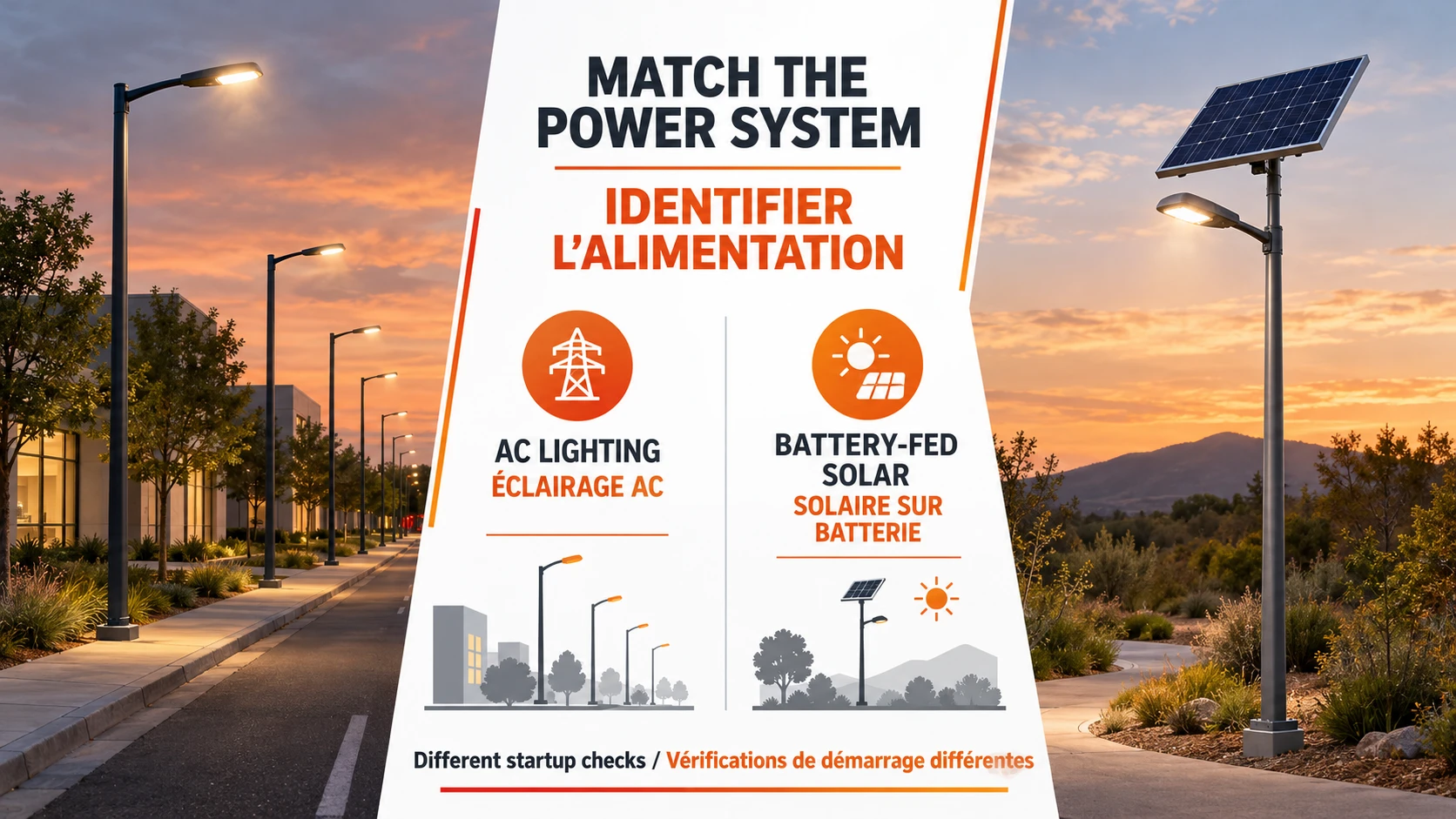
An AC street-light feeder with a common switching device is not the same system as an independent solar pole supplied by its own battery and controller. A battery-fed DC converter can also have startup behavior, but an AC breaker-loading table does not become a DC controller or battery-protection specification. Establish the power architecture before asking for numbers.
| Project arrangement | Startup question to resolve | Evidence to request |
|---|---|---|
| AC LED road or parking circuit | Can the group energize through the specified control and protection? | Exact driver quantities, input pulse data and combination assessment |
| Standalone battery-fed solar pole | Can the specified battery, protection, controller and LED load start together? | System-level startup and recovery compatibility for the quoted configuration |
| Hybrid or shared backup supply | Which source and switching path supply the driver in each mode? | Defined operating modes and compatibility for each relevant startup path |
For mains-powered luminaires, begin with the LED street light range. For independent solar systems, compare the Inlux All-in-One range com the Inlux All-in-Two range and confirm the actual controller/battery architecture in the quotation. The housing layout alone does not establish startup performance.
Put a usable startup requirement in the RFQ
Use this requirement as a procurement starting point: “Identify the proposed driver and control models, supply type and voltage, number of luminaires switched together, startup peak and pulse-width definition, applicable conditions, and the basis for compatibility with the specified switching and protective devices. State the assessed restart conditions and identify any exclusions.” It requests evidence without pretending to be a completed electrical design.
Keep the accepted configuration attached to the order. A driver substitution after approval can invalidate the earlier quantity or switching assessment, even when the replacement has the same output wattage. Record the substitute model and obtain a renewed compatibility confirmation before accepting the change. Treat a missing declaration as an open technical item, not as a zero-amp startup result.
Safety boundary: this is a specification-reading guide, not an energized test procedure. Startup measurements and protection coordination belong to qualified personnel using the manufacturer’s instructions and site safety procedures. Do not bypass protection, increase a breaker rating to stop tripping, or alter sealed drivers based on this article.
Perguntas frequentes
How long does inrush current last in an LED driver?
There is no universal duration. Read the exact driver’s declared pulse width, units and measurement threshold. The HLG-150H example above states 425 µs at 50% of peak under its specified cold-start condition; that is not a default duration for all LED lights.
How do you calculate inrush current from watts?
You cannot obtain a reliable startup peak from output watts alone. A steady-state current equation describes another operating condition. Request the manufacturer’s startup declaration or a qualified assessment of the exact design, then check the group against the relevant control and protection.
How can I test for inrush current safely?
Ask qualified personnel to define the test and suitable transient-capture equipment for the exact system. A normal running-current reading does not establish the startup peak. Procurement staff should request the waveform or declared result with its conditions rather than attempting a live measurement from a general web guide.
Does high inrush current mean the LED driver is faulty?
Not necessarily. Startup charging can be normal. A declared pulse still needs to be compatible with the actual circuit. Repeated tripping or failure to restart calls for a qualified investigation; it does not establish inrush as the cause without excluding other faults.
Does a surge protector reduce LED inrush current?
Do not assume so. Surge protection and startup-current limitation address different events. Only rely on a declared inrush-limiting function for the specified product and conditions. One protection label cannot replace a complete driver, switching and circuit assessment.
Does an off-grid solar street light need the same AC check?
No. First identify whether its LED load is fed directly through a battery/controller DC path or through another architecture. Check startup compatibility for that complete system. Do not apply an AC circuit-breaker quantity table to a standalone DC solar pole.
Specify the lighting system, not just the lamp
Inlux Solar supplies lighting projects in 60+ countries. For a road scheme, start with the solar street light product range; for a vehicle site, use the commercial solar parking lot lighting selection path. Include the site, supply arrangement, proposed switching groups and operating schedule when you send an Inlux project RFQ. Ask for compatibility confirmation for the quoted configuration—not a generic claim copied from another driver.