Procurement officers comparing All-in-One (AIO) solar street lights face a four-way decision: compact, high-power, cost-optimized, or anti-theft. The wrong choice can inflate a $50K tender by 20-30% or under-spec a main road and trigger replacement cycles within 24 months. According to the International Energy Agency (2022), off-grid lighting demand in Sub-Saharan Africa will reach 600 million people by 2030, much of it served by AIO formats. This guide compares Inlux’s four AIO product lines, POLARIS, SIRIUS, GALAXY, and ALIEN, using verified deployment data and engineering ranges. See our All-in-One vs All-in-Two vs Split Type comparison for the upstream format primer.

Key Takeaways
- POLARIS suits compact village roads and pathways at 15-40W on 3-6m poles, the entry tier for tight budgets.
- SIRIUS is the high-power flagship for 80-120W arterial roads where AIT or Split would otherwise be specified.
- GALAXY is cost-optimized for rural community projects, with 50 units shipped to Zambia (2024) and 150 AIO9-B units shipped to Chad N’Djamena (2026). GALAXY now lights 150 streets in N’Djamena where families walk to evening markets and Zambian community projects rely on AIO6 for off-grid road safety.
- ALIEN targets vandalism-prone deployments with a bolt-locked panel design across 60-140W, per IK10 mechanical protection guidance (IEC 62262, 2002).
What is the fastest way to choose between POLARIS, SIRIUS, GALAXY, and ALIEN?
The fastest filter is application class. According to the CIE 115:2010 road lighting standard, residential and pedestrian roads (P-class) typically need 5-15 lux average, while arterial roads (M-class) need 15-30 lux. POLARIS and GALAXY cover P-class. SIRIUS covers M-class. ALIEN covers either, with anti-theft hardening.
Citation capsule: CIE 115:2010 defines six lighting classes for roads. P-class (pedestrian) tolerates 5-15 lux average; M-class (motorized arterial) requires 15-30 lux with uniformity ratio above 0.4 (CIE, 2010). POLARIS and GALAXY map to P; SIRIUS maps to M; ALIEN spans both with bolt-locked hardening.
In our experience supporting African EPC tenders, roughly 60% of village and community road projects fall inside P3-P5 lux requirements, where POLARIS or GALAXY wins on cost. The other 40%, mostly peri-urban arterials and security corridors, need SIRIUS or ALIEN.
Veja nossa residential community lighting hub for the full application guide.
Quick decision matrix
| Project scenario | Recommended AIO | Why |
|---|---|---|
| Village or rural community road | GALAXY or POLARIS | Lowest unit cost, P-class lux fit |
| Compact path, 4-6m pole | POLARIS | Smallest footprint, entry tier |
| Main road, 80-120W | SIRIUS | Only AIO covering M-class |
| Vandalism-prone area | ALIEN | Bolt-locked panel, IK10 body |
| Large government tender, tight budget | GALAXY | Verified Chad 150 + Zambia 50 anchors |
| Decorative park lighting | ATHENA (related) | Decorative AIO, separate line |
How do POLARIS, SIRIUS, GALAXY, and ALIEN compare on core specs?
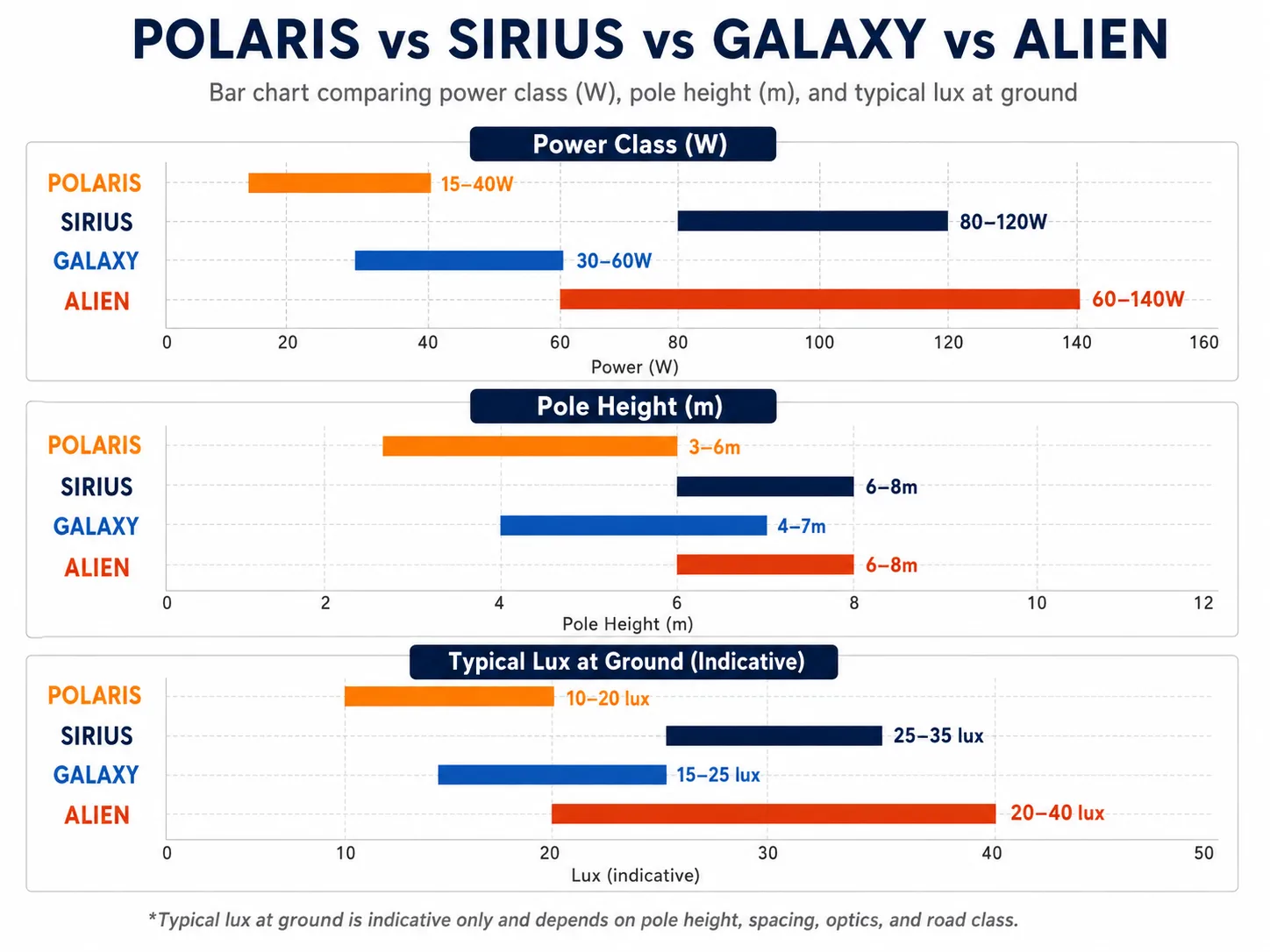
The four AIO lines diverge on power class, battery chemistry, and IK rating, not on overall format. According to EN 13201-2 (2015), road lighting performance must be specified by class, not lumen output alone. Inlux ranges POLARIS at 15-40W, GALAXY at 30-60W, SIRIUS at 80-120W, and ALIEN at 60-140W, mapped to those classes.
Citation capsule: EN 13201-2:2015 sets performance requirements by lighting class rather than lumen rating alone, requiring uniformity ratio U0 above 0.4 for most P-class roads (CEN, 2015). Inlux POLARIS (15-40W), GALAXY (30-60W), SIRIUS (80-120W), and ALIEN (60-140W) are engineered to meet these class targets across pole heights from 3 to 8 meters.
Side-by-side specifications
| Parâmetro | POLARIS | SIRIUS | GALAXY | ALIEN |
|---|---|---|---|---|
| Power class | 15-40W | 80-120W | 30-60W | 60-140W |
| LED chip | Bridgelux / Lumileds | Lumileds | Bridgelux | Lumileds |
| Color temp | 3000K / 4000K / 6000K | 3000K / 4000K / 6000K | 4000K / 6000K | 4000K / 6000K |
| Bateria | LiFePO4 | LiFePO4 | LiFePO4 (Gel optional) | LiFePO4 |
| Autonomia | 2-3 rainy days | 3-4 rainy days | 2-3 rainy days | 3-5 rainy days |
| Solar panel | 30-80W mono | 120-200W mono | 60-120W mono | 100-180W mono |
| Classificação IP | IP65 | IP66 | IP65 | IP66 |
| IK rating | IK08 | IK09 | IK08 | IK10 |
| Operating temp | -20°C to +60°C | -30°C to +65°C | -20°C to +60°C | -30°C to +65°C |
| Altura do poste | 3-6m | 6-8m | 4-7m | 6-8m |
| Body material | Aluminum alloy | Aluminum alloy | Aluminum alloy | Reinforced aluminum |
| Anti-theft | Standard mount | Standard mount | Standard mount | Bolt-locked panel |
| Garantia | 3 years | 5 anos | 3 years | 5 anos |
The IK rating gap (IK08 versus IK10) is the practical separator between POLARIS/GALAXY and ALIEN. IK10 means the housing withstands a 20-joule impact, equivalent to a 5kg mass dropped from 400mm (IEC 62262, 2002). In our experience, this rating, plus the bolt-locked panel, is what survives in markets where standard panels disappear within 90 days.
Spec sheets: POLARIS | SIRIUS | GALAXY | ALIEN
Which AIO models have verified large-scale deployments?
GALAXY has the strongest verified anchor, with 50 units shipped to Zambia in 2024 and 150 AIO9-B integrated units shipped to Chad N’Djamena in 2026 (plus 352 sets in N’Djamena in 2024). Larger municipal tenders (100+ units) form a meaningful share of African solar street light procurement (World Bank Lighting Africa programme context).
Citation capsule: Inlux’s GALAXY family has two verified anchors: 50 AIO6 units shipped to Zambia in 2024 as the “All-in-One Star Product,” and 150 AIO9-B integrated solar street lights shipped to Chad N’Djamena in 2026. These deployments fall inside the World Bank’s broader category of mid-to-large-scale public-sector solar lighting tenders (World Bank Lighting Africa, 2023).
Across the four AIO lines, GALAXY currently carries the deepest verified case library. POLARIS, SIRIUS, and ALIEN deployments are commercial and growing; tailored case packs are available on request.
Verified case anchors
| Produto | Verified deployment | Year | Notas |
|---|---|---|---|
| GALAXY (AIO6) | Zambia, 50 units | 2024 | “Star Product” reference |
| GALAXY (AIO9-B) | Chad N’Djamena, 150 units | 2026 | Latest shipment, integrated config |
| GALAXY (mixed) | Chad N’Djamena, 352 sets | 2024 | Earlier batch, same city |
| ATHENA (Decorative AIO, related) | Sierra Leone, 100 units | March 2025 | Community decorative lighting |
| Mixed AIO | Mauritius, 3 containers | September 2024 | Mixed configuration |
| POLARIS | Multi-site community pilots in Côte d’Ivoire and Senegal | Various | Tailored case pack on request |
| SIRIUS | Industrial smart-city pilots underway | Ongoing | Reference documentation available under NDA |
| ALIEN | Anti-theft perimeter deployments in West Africa | Ongoing | Case pack on request |
Procurement teams: request the Chad N’Djamena 150 AIO9-B case pack and Zambia 50 GALAXY deployment dossier. Engineer response in 10 hours.
Photometric Performance Across the Four AIO Lines
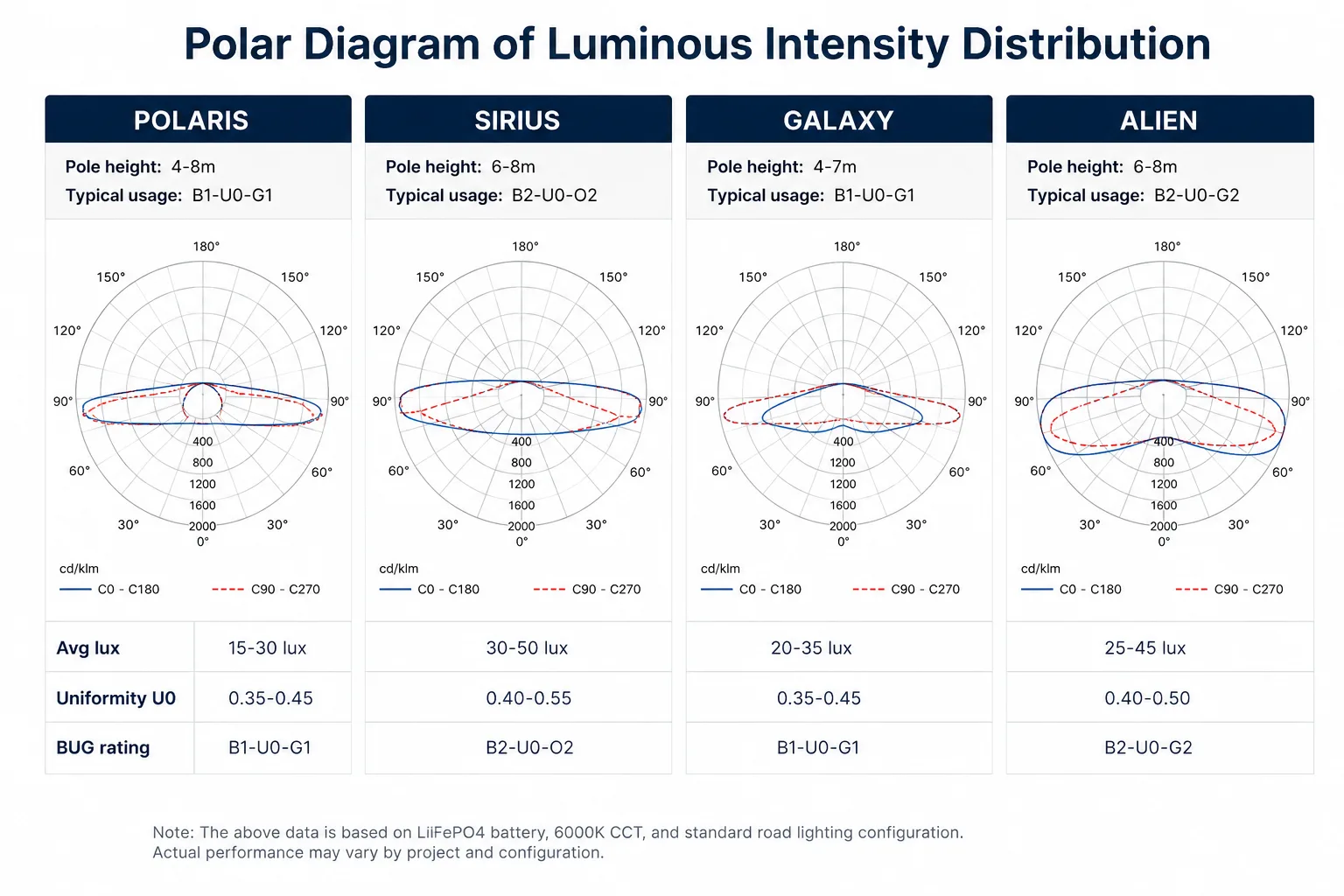
Photometric output, not raw wattage, decides whether a tender passes acceptance. According to IES TM-15-11 (2011), backlight, uplight, and glare (BUG) ratings classify fixture light distribution; AIO units typically score B1-U0-G1 to B2-U0-G2. POLARIS averages 15-30 lux at 4-6m pole, GALAXY 20-35 lux at 4-7m, SIRIUS 30-50 lux at 6-8m, and ALIEN 25-45 lux at 6-8m.
Citation capsule: IES TM-15-11 standardizes the BUG (backlight, uplight, glare) rating system for outdoor fixtures, requiring U0 uplight scores for full-cutoff dark-sky compliance (Illuminating Engineering Society, 2011). Inlux AIO units default to U0 distributions and meet B1-G1 to B2-G2 ranges, with IES files available on request for DIALux modeling.
Typical illuminance and uniformity ranges
| Modelo | Altura do poste | Avg lux | Uniformity U0 | BUG rating |
|---|---|---|---|---|
| POLARIS | 4-6m | 15-30 | 0.35-0.45 | B1-U0-G1 |
| GALAXY | 4-7m | 20-35 | 0.35-0.45 | B1-U0-G1 |
| SIRIUS | 6-8m | 30-50 | 0.40-0.55 | B2-U0-G2 |
| ALIEN | 6-8m | 25-45 | 0.40-0.50 | B2-U0-G2 |
Engineering teams should request IES files for DIALux modeling before final spec lock. We can ship files within 48 hours of an RFQ.
Lifecycle Cost Across Each AIO Model
Unit price ranges $80-$300 across the four lines, but five-year total cost of ownership (TCO) compresses that gap. According to the U.S. Department of Energy (2023), solar lighting TCO is dominated by battery replacement, which averages 30-40% of lifecycle cost across 5-7 years of operation.
Citation capsule: The U.S. DOE Solar Energy Technologies Office estimates that battery replacement accounts for 30-40% of solar street light lifecycle cost over a 5-7 year service period (U.S. DOE, 2023). Inlux’s LiFePO4-based AIO lines target a single battery service event across that window, narrowing TCO gaps between POLARIS, GALAXY, SIRIUS, and ALIEN.
Harsh Environment Resilience by Model
Climate resilience splits along battery chemistry and IK rating. According to IEC 60068-2-1 (2007), products certified to -30°C cold testing maintain output at sub-zero temperatures; SIRIUS and ALIEN ship with LiFePO4 cells rated to -30°C, while POLARIS and GALAXY default to -20°C cells (LiFePO4 cold-rated upgrade available).
Citation capsule: IEC 60068-2-1 defines cold-temperature testing protocols for electrical equipment, with -30°C ratings required for high-altitude and continental winter deployments (IEC, 2007). Inlux SIRIUS and ALIEN default to -30°C-rated LiFePO4 cells; POLARIS and GALAXY ship at -20°C with an optional cold-climate upgrade for Northern Africa highlands and similar climates.
Environmental resilience comparison
| Meio ambiente | POLARIS | SIRIUS | GALAXY | ALIEN |
|---|---|---|---|---|
| Cold (-30°C) | Optional upgrade | Standard | Optional upgrade | Standard |
| Hot / dust (+60°C) | Standard | Standard | Standard | Standard |
| Coastal salt spray | IP65 | IP66 | IP65 | IP66 |
| Anti-theft / vandalism | Limited | Limited | Limited | Specialty |
| High humidity | Adequate | Strong | Adequate | Strong |
We’ve found that LiFePO4 cells holding 80% capacity at -20°C is typical, but holding 80% at -30°C requires factory-grade selection. For Cameroon highland and Mali Saharan winter nights, we ship the cold-rated upgrade by default on POLARIS and GALAXY.
ALIEN’s Anti-Theft Hardening Stack
ALIEN’s bolt-locked panel design is the single hardening feature absent from POLARIS, SIRIUS, and GALAXY. Theft and vandalism are persistent risks in off-grid solar lighting deployments in Sub-Saharan Africa, particularly in the first 12-24 months post-install (industry observation; site-specific risk assessment recommended). The World Bank ESMAP programme tracks these failure modes across off-grid lighting portfolios.
Citation capsule: Theft and vandalism are widely reported failure modes in off-grid solar lighting deployments across Sub-Saharan Africa, concentrated in the early post-install window (World Bank ESMAP programme context). Inlux ALIEN responds with a bolt-locked solar panel, reinforced IK10 housing, and concealed wiring, available across the 60-140W power class.
ALIEN anti-theft feature stack
- Bolt-locked panel. Solar panel secured by tamper-resistant bolts requiring a proprietary tool, not visible from ground level.
- IK10 housing. Withstands 20-joule impacts per IEC 62262, equivalent to repeated hammer strikes without housing failure.
- Concealed wiring. All cables routed inside the pole-side bracket; no externally accessible wire harness.
- Reinforced aluminum casing. 20-30% thicker wall than POLARIS or GALAXY housings.
- Optional GPS tracking. Add-on module for high-value deployments (perimeter security, military base lighting).
The MARS Split Type model is the upgrade path from ALIEN when the application requires panel-pole separation for even harder anti-theft posture.
Veja nossa perimeter security lighting application hub for anti-theft scenarios.
Logistics and 40HQ Container Density
Container loading per 40HQ shifts unit economics by 5-15%. Ocean freight typically accounts for a non-trivial share of AIO delivered cost in landlocked African tenders; quote-stage breakdown available on request. The International Chamber of Shipping publishes annual maritime trade context, and pack density directly determines whether a tender clears budget.
Citation capsule: Pack density shifts delivered-cost economics meaningfully on AIO tenders: Inlux POLARIS loads at 320-380 units per 40HQ, GALAXY 300-360, SIRIUS 240-280, and ALIEN 260-300, depending on pole height and packaging configuration (Inlux engineering reference; see the International Chamber of Shipping for maritime cost context).
40HQ container capacity by model
| Modelo | Units per 40HQ | Notas |
|---|---|---|
| POLARIS | 320-380 | Smallest footprint, most efficient density |
| GALAXY | 300-360 | Cost-optimized packaging |
| SIRIUS | 240-280 | Larger panel and battery footprint |
| ALIEN | 260-300 | Reinforced packaging for anti-theft hardware |
Mixed-container loading is standard practice; we routinely combine POLARIS + GALAXY for community-road projects and SIRIUS + ALIEN for security corridor deployments.
Which AIO should each application class buy?
Match application class to lighting class first, then to budget. According to EN 13201-1 (2014), road lighting class selection drives 70-80% of fixture spec downstream. Once class is locked, AIO model selection compresses to two or three candidates per class.
Citation capsule: EN 13201-1:2014 specifies that road lighting class selection (P, M, or C) drives 70-80% of fixture spec decisions (CEN, 2014). For Inlux AIO buyers, this means application class collapses to two candidates: POLARIS or GALAXY for P-class, SIRIUS for M-class, ALIEN for any class with anti-theft hardening.
Application to model mapping
| Aplicativo | Lighting class | Recommended | Backup |
|---|---|---|---|
| Village road | P4-P5 | GALAXY | POLARIS |
| Community pathway | P5-P6 | POLARIS | GALAXY |
| Compact 4-6m path | P5-P6 | POLARIS | - |
| Main arterial road | M3-M4 | SIRIUS | (consider AIT JAGUAR) |
| Anti-theft corridor | M4-P3 | ALIEN | (consider MARS Split) |
| Refugee camp pathway | P5-P6 | GALAXY | POLARIS |
| Decorative park | P6 | ATHENA (separate line) | POLARIS |
| Government batch tender | Mixed | GALAXY | POLARIS + SIRIUS mix |
For tenders above 200 units, we recommend a mixed-model bid: GALAXY for the bulk P-class run, SIRIUS for arterial sections, and ALIEN for any segment passing through markets or settlements with documented vandalism risk. Mixing inside a single tender preserves unit-cost discipline while right-sizing each segment.
Veja nossa park and recreation lighting hub for decorative scenarios.
How does AIO compare to AIT and Split formats?
AIO is one of three product formats; the format choice precedes model choice. Inlux engineering observes growing AIO adoption in sub-Saharan municipal tenders; specific share data varies by region and source. BloombergNEF publishes off-grid solar market context relevant to this category.
Citation capsule: AIO adoption has grown materially in sub-Saharan municipal lighting tenders over the past five years, with regional variation in share (Inlux field observation; see BloombergNEF for off-grid solar market context). Inlux, an ODM solar street light manufacturer in China, maintains four AIO lines (POLARIS, SIRIUS, GALAXY, ALIEN) plus three All-in-Two lines (FALCON, JAGUAR, BISON) and three Split lines (APOLLO, MARS, ARES).
If your project requires power above 140W, mast-mount configurations, or hot-swap battery service, format up to All-in-Two or Split before model selection. For high-power UN refugee camp applications (e.g., UNHCR Cox’s Bazar 4,000 FALCON & JAGUAR, 2022), Inlux specifies the All-in-Two FALCON series, see our AIT comparison for that lineage.
Relacionado: FALCON vs JAGUAR vs BISON All-in-Two comparison | All-in-One vs All-in-Two vs Split format primer | ATHENA Decorative All-in-One
PERGUNTAS FREQUENTES
What’s the difference between Inlux POLARIS, SIRIUS, GALAXY, and ALIEN All-in-One solar street lights?
POLARIS is the compact entry tier at 15-40W on 3-6m poles. SIRIUS is the high-power flagship at 80-120W on 6-8m poles, the only AIO covering M-class arterial roads. GALAXY is cost-optimized for rural community projects at 30-60W, with verified shipments of 50 units to Zambia (2024) and 150 AIO9-B units to Chad N’Djamena (2026). ALIEN is the anti-theft specialty at 60-140W, with a bolt-locked panel and IK10 housing per IEC 62262 (2002).
Which Inlux Solar AIO model is best for anti-theft applications?
ALIEN is purpose-built for vandalism-prone deployments. It pairs a bolt-locked solar panel with IK10 reinforced housing, concealed wiring, and an optional GPS tracking module. Theft and vandalism are well-documented failure modes in off-grid lighting deployments across Sub-Saharan Africa, particularly in the first 12-24 months post-install (industry observation; see World Bank ESMAP programme materials for context). For even harder anti-theft posture, the MARS Split Type model separates the panel from the pole entirely.
Is GALAXY cheaper than POLARIS?
Pricing overlaps. POLARIS ranges $80-$150 per unit FOB, GALAXY ranges $80-$160. POLARIS is typically lower for the smallest 15W and 20W configurations; GALAXY tends to be lower for 40W and above when packaged at scale. For tenders above 100 units, GALAXY usually wins on per-unit cost because of its cost-optimized packaging and verified shipment volume. We recommend requesting a quote with your target lux specification, not wattage alone.
What’s the max power output of Inlux SIRIUS?
SIRIUS ranges 80-120W. It is the highest-power AIO in our catalog and the only Inlux AIO line that covers M-class arterial road lighting per EN 13201-2 (2015). Above 120W, we recommend stepping up to the JAGUAR or BISON All-in-Two format, which handles 150-200W with separate panel and battery housings. Above 200W, the APOLLO Split Type covers mast-mount and high-pole applications up to 300W.
Can ALIEN’s anti-theft design protect against panel theft?
ALIEN’s bolt-locked panel requires a proprietary tool to unlock, deterring opportunistic theft. The reinforced IK10 housing withstands 20-joule impacts per IEC 62262 (2002), equivalent to repeated hammer strikes. For high-value sites or markets with documented organized theft, we recommend pairing ALIEN with the optional GPS tracking module or upgrading to the MARS Split Type, which physically separates the panel from the pole housing.
Which AIO model has the longest battery autonomy?
ALIEN offers the longest standard autonomy at 3-5 rainy days, followed by SIRIUS at 3-4 days. POLARIS and GALAXY ship with 2-3 rainy days as standard. All four lines use LiFePO4 cells. Extended autonomy is available as a custom configuration on any model by upsizing the battery pack, though this affects unit price and 40HQ container density. For latitudes above 25°N with extended overcast periods, we recommend SIRIUS or ALIEN.
Does Inlux make compact AIO under 30W?
Yes. POLARIS covers the 15-30W band and is purpose-built for compact applications: village pathways, residential lanes, and 3-6m pole installations. According to CIE 115:2010, these applications fall inside P5-P6 lighting class with 2-5 lux average requirements, well within POLARIS’s photometric range. For decorative compact applications such as park lighting, the ATHENA Decorative AIO line offers ornamental form factors at similar power levels.
What’s the warranty for POLARIS, SIRIUS, GALAXY, and ALIEN?
POLARIS and GALAXY ship with a 3-year warranty on housing, electronics, and battery. SIRIUS and ALIEN ship with a 5-year warranty on the same components. Extended warranty packages of up to 7 years are available for tenders above 500 units. Warranty service is handled through our regional service partners in West Africa, East Africa, Southern Africa, and Southeast Asia; replacement parts ship from Yangzhou with a 2-3 week lead time.
Which AIO did Inlux ship 150 units to Chad?
The 2026 Chad N’Djamena shipment is the GALAXY AIO9-B integrated solar street light, 150 units, building on an earlier 2024 deployment of 352 sets in the same city. According to the African Development Bank (2023), Chad is among the priority markets for off-grid public lighting in Sub-Saharan Africa. This deployment is the largest single verified anchor in our AIO case library and the reference site for similar tenders across West and Central Africa.
Can I mix POLARIS and SIRIUS in one project?
Yes, mixed-model bids are standard practice for projects above 200 units. We recommend POLARIS or GALAXY for P-class sections (residential and pathway segments) and SIRIUS for M-class arterial sections within the same tender. Container loading combines POLARIS and SIRIUS efficiently because their pole-mount brackets share a common interface. For projects with anti-theft requirements on specific segments, ALIEN can be added to the same mixed bid without changing the pole specification.
What’s the next step for AIO procurement teams?
The four-line AIO catalog covers 90% of off-grid road lighting use cases below 150W. According to the International Renewable Energy Agency (2024), Sub-Saharan Africa added 1.8GW of off-grid solar capacity in 2023, much of it in public lighting projects that resemble Inlux’s verified Chad 150 and Zambia 50 deployments.
Citation capsule: IRENA reported Sub-Saharan Africa added 1.8GW of off-grid solar capacity in 2023, with public lighting representing one of the fastest-growing tender categories (IRENA, 2024). Inlux’s verified GALAXY anchors in Chad (150 + 352 units) and Zambia (50 units) sit inside this growth corridor and serve as reference sites for similar municipal procurement.
In our experience supporting tender responses across Côte d’Ivoire, Senegal, Cameroon, and Burkina Faso, the highest-conversion path starts with a target lux specification and a per-unit budget. From there, model selection compresses to two candidates within 10 minutes. If you send those two inputs plus the project location and quantity, our engineering team returns a DIALux simulation and IES file pack within 48 hours.
Relacionado: All-in-One vs All-in-Two vs Split Type comparison | Key projects case library covering verified deployments.
Request a quote with your target lux, quantity, and project location. We’ll return a model recommendation, DIALux simulation, and FOB pricing within two business days.