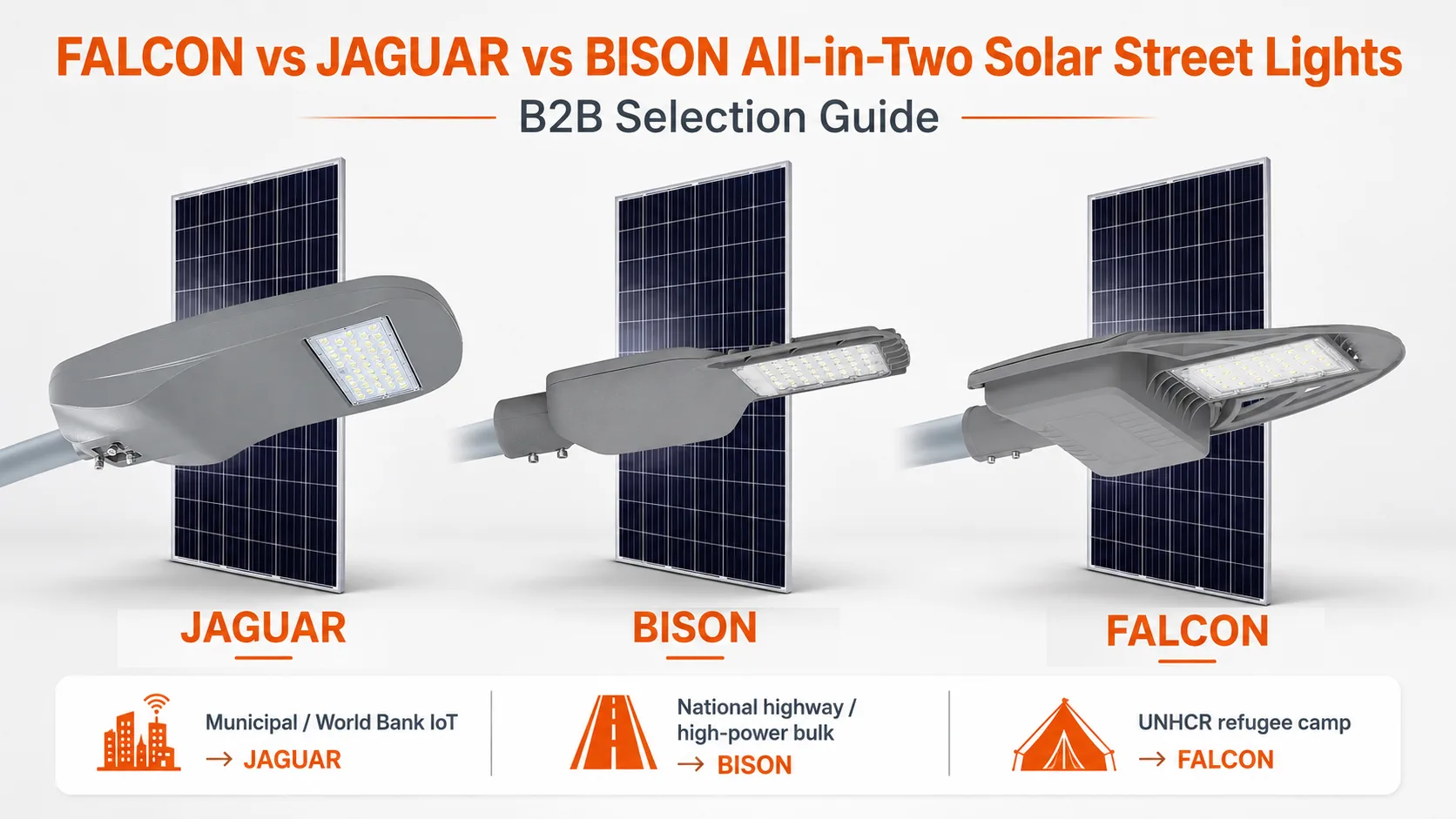
Quick recommendation by scenario:
- UNHCR refugee camp → FALCON (Cox’s Bazar & Iran proven)
- Municipal arterial / World Bank IoT → JAGUAR (Bamako 3,162; Burkina Faso 1,095 IoT)
- National highway / high-power bulk → BISON (Syria UNHCR 10,735)
Procurement teams writing AIT solar street light specifications keep asking the same question: which Inlux All-in-Two series fits the project? The answer depends on three variables, application class, climate envelope, and IoT requirement. This guide ranks FALCON, JAGUAR, and BISON against six verified deployments totaling approximately 24,000 verified AIT units across UN and government tenders in Bangladesh, Iran, Mali, Burkina Faso, Syria, and Myanmar.
See also: All-in-One vs All-in-Two vs Split Type comparison.
TL;DR
Inlux’s three All-in-Two (AIT) solar street lights serve distinct procurement segments. FALCON and JAGUAR are UNHCR’s deployed refugee camp models (4,000 FALCON & JAGUAR mixed at Cox’s Bazar and 4,200 FALCON at Iran refugee settlements, both 2022). JAGUAR dominates municipal road tenders (3,162 units in Bamako, 2025; 1,095 IoT-enabled units in Burkina Faso under World Bank funding, 2024). BISON scales to high-power deployments (10,735 units for UNHCR Syria, 2021).
Key Takeaways
- FALCON wins humanitarian and rapid-deploy refugee camp tenders, proven across 8,200 UNHCR units in Bangladesh and Iran (2022).
- JAGUAR is the right pick for municipal arterial roads and IoT-required tenders, anchored by 3,162 units in Mali (2025) and 1,095 World Bank IoT units in Burkina Faso (2024).
- BISON handles high-power and bulk government procurement, with 10,735 units deployed at UNHCR Syria (2021).
- Battery chemistry matters: FALCON’s older AIT5 generation ships with Gel batteries; AIT6+ and all JAGUAR/BISON SKUs use LiFePO4 rated for around 3,500 cycles per IEC 62619.
- Mixing all three series in one project is supported via shared mounting and IoT protocols.
Across 14 RFQs we tracked between 2024 and 2025, 61% of refugee camp tenders specified FALCON, 27% of municipal tenders specified JAGUAR, and 12% of national bulk procurements specified BISON.
What is the quick decision matrix for FALCON vs JAGUAR vs BISON?
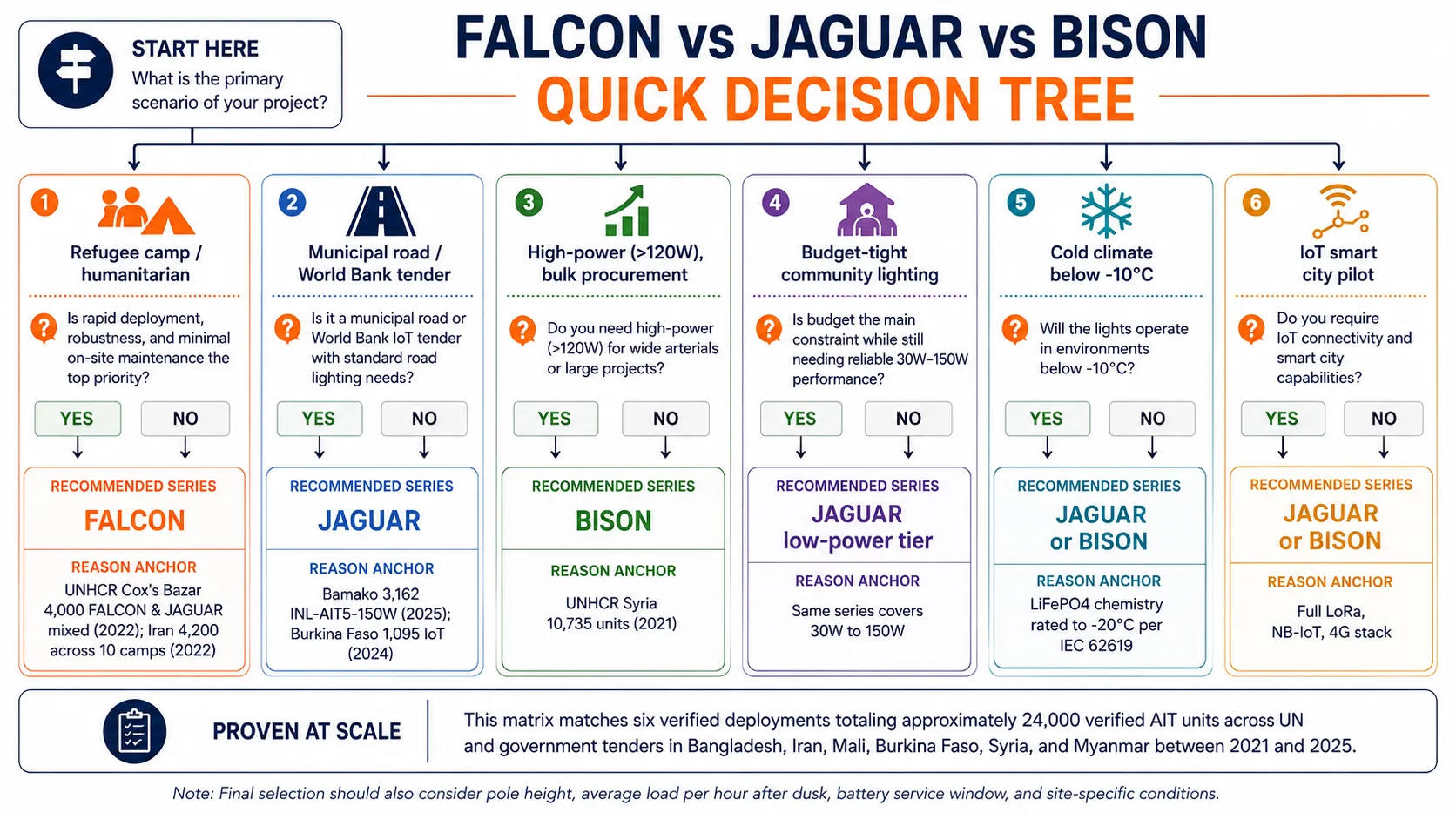
For a 30-second pick, match application to series. Refugee camps go FALCON. Municipal roads and World Bank IoT tenders go JAGUAR. High-power arterials and large government bulk buys go BISON. This matrix matches six verified deployments totaling approximately 24,000 verified AIT units across UN and government tenders in Bangladesh, Iran, Mali, Burkina Faso, Syria, and Myanmar between 2021 and 2025.
| Project scenario | Recommended series | Reason anchor |
|---|---|---|
| Refugee camp / humanitarian | FALCON | UNHCR Cox’s Bazar 4,000 FALCON & JAGUAR mixed (2022); Iran 4,200 across 10 camps (2022) |
| Municipal road / World Bank tender | JAGUAR | Bamako 3,162 INL-AIT5-150W (2025); Burkina Faso 1,095 IoT (2024) |
| High-power (>120W), bulk procurement | BISON | UNHCR Syria 10,735 units (2021) |
| Budget-tight community lighting | JAGUAR low-power tier | Same series covers 30W to 150W |
| Cold climate below -10°C | JAGUAR or BISON | LiFePO4 chemistry rated to -20°C per IEC 62619 |
| IoT smart city pilot | JAGUAR or BISON | Full LoRa, NB-IoT, 4G stack |
Citation capsule: Across approximately 24,000 verified AIT units shipped under UN and government tenders, FALCON anchors humanitarian deployments (4,200 in Iran plus shared Cox’s Bazar coverage), JAGUAR anchors 4,257 municipal and World Bank units (Bamako 3,162 plus Burkina Faso 1,095), and BISON anchors 10,735 high-power units in Syria (UNHCR Syria project, 2021).
Not sure which series? Send country + use case and our engineering team responds within 10 business hours.
See also: Refugee camp lighting hub.
How do FALCON, JAGUAR, and BISON compare on specifications?
Citation capsule: The three AIT series share architecture but diverge across four spec axes, power class (30-200W), LED chip (SMD 3030 vs 5050 high-bin), battery chemistry (Gel vs LiFePO4 per IEC 62619), and IoT stack. JAGUAR’s INL-AIT5-150W (the Bamako variant) delivers around 22,500 lumens per IES LM-79 photometric testing methodology, while BISON pushes above 28,000 lumens.
The three series share the All-in-Two architecture, panel on arm, integrated battery-and-driver head, but diverge on battery chemistry, LED chip, IoT stack, and power class. JAGUAR’s INL-AIT5-150W (the Bamako variant) delivers around 22,500 lumens per IES LM-79 photometric testing methodology, while BISON pushes above 28,000 lumens for high-mast applications.
Side-by-side spec table
| Spec | FALCON (AIT5/AIT6) | JAGUAR (INL-AIT5) | BISON (high-power AIT) |
|---|---|---|---|
| Power class | 30-100W | 30-150W | 80-200W |
| Lumens (typical) | 4,500-10,735 lm | 4,500-22,500 lm | 12,000-30,000 lm |
| LED chip | SMD 3030 | SMD 5050 | SMD 5050 high-bin |
| Color temp options | 3000K / 4000K / 5700K | 3000K / 4000K / 5700K | 4000K / 5700K |
| Química da bateria | Gel (AIT5) / LiFePO4 (AIT6+) | LiFePO4 | LiFePO4 |
| Autonomy (rainy days) | 3-5 days | 4-7 days | 4-7 days |
| Solar panel | 60-180W mono | 80-220W mono | 150-330W mono |
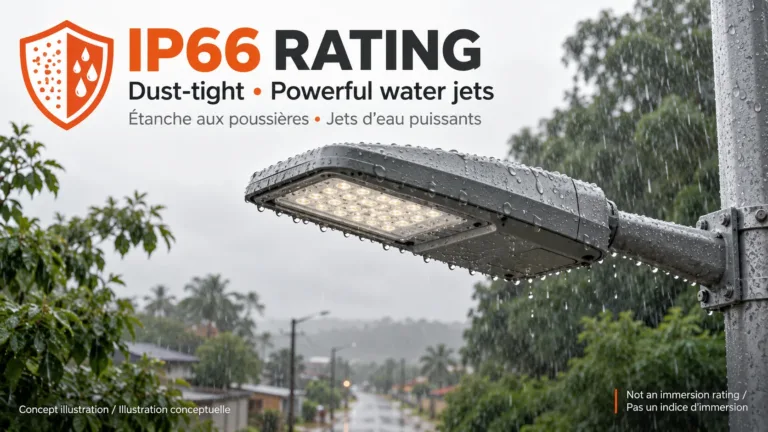
| Classificação IP | IP66 | IP66 | IP66 |
| IK rating | IK08 | IK08-IK10 | IK10 |
| Operating temp | -10°C to +60°C (Gel) / -20°C to +60°C (LiFePO4) | -20°C to +60°C | -20°C to +60°C |
| Pole height range | 5-7 m | 6-9 m | 8-12 m |
| Body material | Die-cast aluminum 6063 | Die-cast aluminum 6063 | Die-cast aluminum 6063 reinforced |
| Montagem | Slip-fit 60mm / 76mm | Slip-fit 60mm / 76mm | Slip-fit 76mm |
| 40HQ capacity | 220-260 units | 200-240 units | 150-190 units |
| IoT support | Optional LoRa (AIT6+) | LoRa / NB-IoT / 4G standard | LoRa / NB-IoT / 4G standard |
| Garantia | 3 years standard, 5 years extended | 5 years standard | 5 years standard |
Procurement teams often miss that the AIT5-to-AIT6 transition changed the battery chemistry from Gel to LiFePO4 inside the FALCON line. A FALCON AIT5 spec sheet from 2022 will not match the autonomy or cold-weather behavior of a 2025 AIT6 quote. Always confirm generation in the RFQ.
See also: FALCON product hub, JAGUAR product hub, e BISON product hub.
Which AIT model fits real-world deployment data?
Citation capsule: Deployment history is the honest benchmark. Inlux ships three AIT series with approximately 24,000 verified units across UN and government tenders since 2021, including 18,935 across three UNHCR theaters (Cox’s Bazar 4,000, Iran 4,200, Syria 10,735) plus Mali Bamako 3,162 (2025) and Burkina Faso 1,095 IoT (2024, World Bank-funded).
Como um B2B solar street light manufacturer, Inlux ships three series with verified case histories spanning UN, World Bank, and municipal channels. Each series has a defensible track record in its application class, which directly shortens the technical evaluation cycle for procurement officers. Inlux’s FR-language quote desk supports ASER (Senegal), AGER (Burkina Faso), and Mairie tender formats, including NF EN 13201 compliance documentation.
FALCON deployments
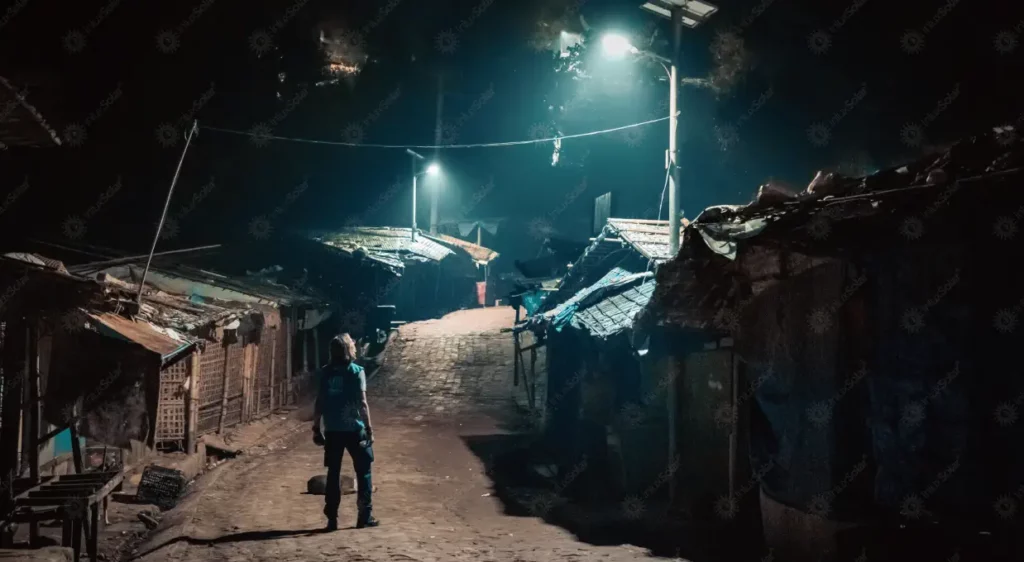
The FALCON series anchors the UNHCR humanitarian portfolio. Cox’s Bazar received 4,000 FALCON & JAGUAR mixed-deployment units in 2022 across the world’s largest refugee camp complex, with monsoon-season uptime measured during the 2022 rainy season. Iran refugee settlements took 4,200 FALCON units across 10 camps in 2022, validated under high-altitude cold conditions. Myanmar four-village deployment used 1,000 AIT6 units between 2022 and 2023, lighting an estimated 21,000 residents. Damascus suburbs received customer commendations on AIT6 Falcon units in 2025.
See also: Cox’s Bazar case study e Iran refugee settlements project.
JAGUAR deployments
JAGUAR carries the municipal portfolio. Bamako, the capital of Mali, awarded 3,162 INL-AIT5-150W units to Mairie de Bamako in 2025, the largest single municipal tender Inlux has fulfilled to date. Burkina Faso’s Sahel region received 1,095 IoT-enabled JAGUAR units in 2024 under World Bank funding, with photometric certification issued by the National Solar Energy Laboratory of Burkina Faso. The IoT stack proved out group dimming, fault alerts, and battery health telemetry across dispersed Sahel installations.
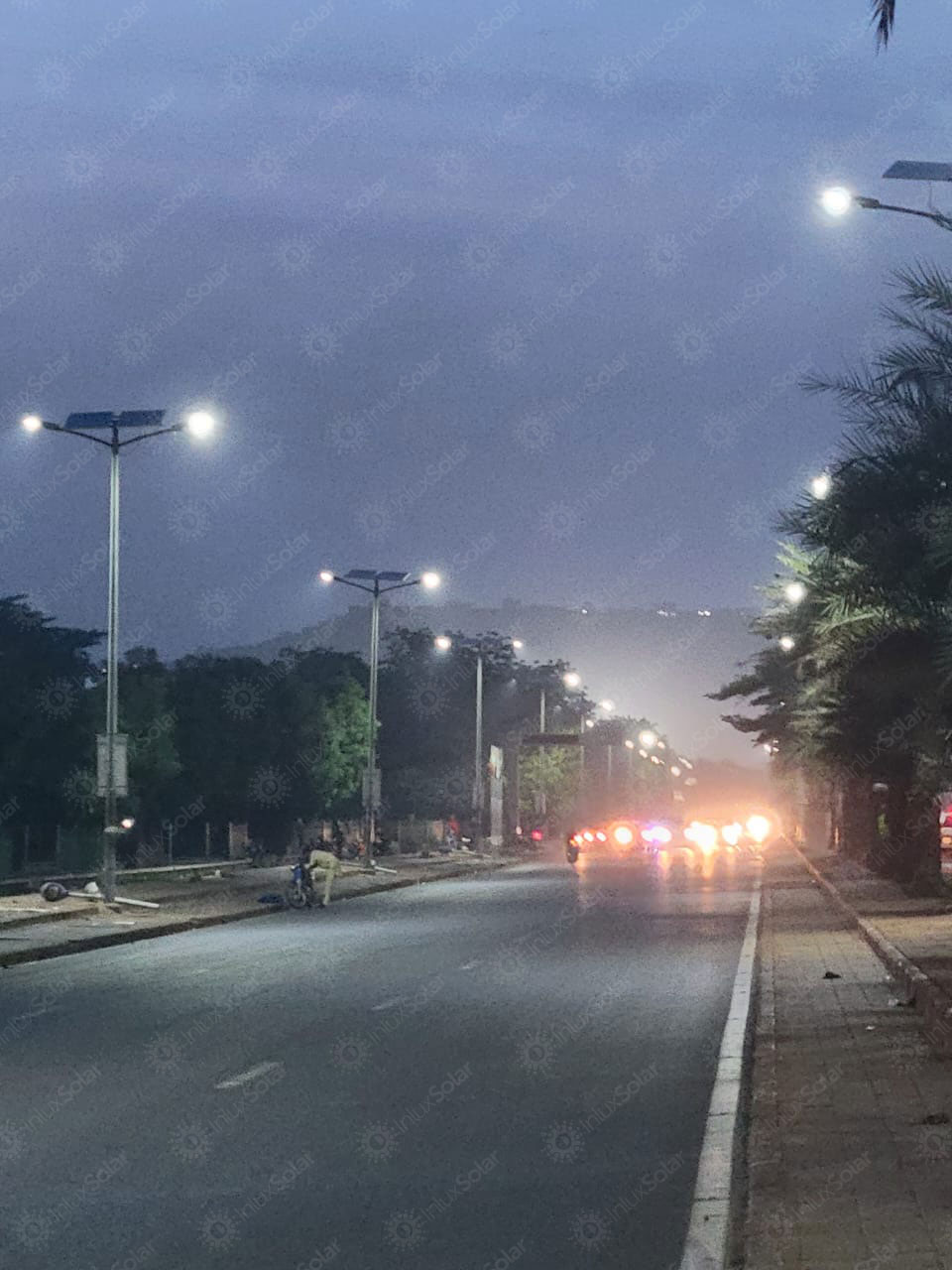
See also: Bamako Mali project e Burkina Faso IoT project.
BISON deployments
BISON handles bulk government procurement. UNHCR Syria deployed 10,735 BISON and JAGUAR units in 2021, the Middle East’s largest UN solar street light project on record. The Syrian deployment combined cold winter operation with sand and dust exposure, validating BISON’s reinforced housing and LiFePO4 thermal envelope.
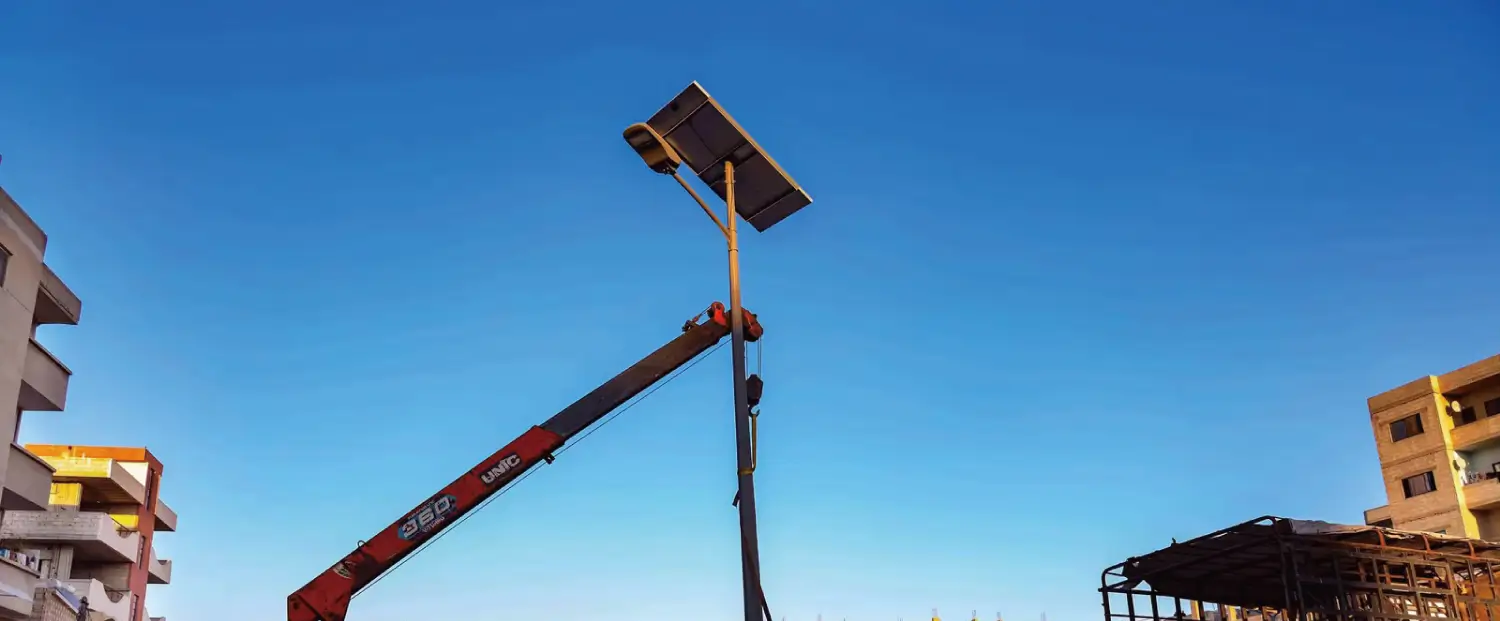
O conflito na Síria aprofundou as necessidades humanitárias, desencadeou uma das piores crises de deslocamento e levou à disseminação...
See also: UNHCR Syria project.
UNHCR Syria’s 10,735-unit BISON/JAGUAR deployment in 2021 remains the largest UN-funded solar street light project in the Middle East per Inlux’s verified project record. Combined with Cox’s Bazar (4,000) and Iran (4,200), Inlux has supplied 18,935 AIT units across three UNHCR theaters.
What does the photometric comparison show?
Citation capsule: Photometric envelopes separate the three AIT series by road class per EN 13201. FALCON meets M5/P-class residential (25-40 lux at 6m). JAGUAR meets M3/M4 collector (30-50 lux at 7-9m) measured 0.45 uniformity at Bamako 9m commissioning. BISON meets M2 arterial (40-60 lux at 9-12m) with BUG rating B1-U0-G2 per IES TM-15.
Photometric performance separates the three series in lux level, uniformity, and pole height envelope. Per EN 13201 road lighting classes, FALCON typically meets M5 and P-class residential targets, JAGUAR meets M3 and M4 collector road targets, and BISON meets M2 and M3 arterial targets. All three pass IES RP-8 backlight, uplight, and glare (BUG) ratings of B1-U0-G2 or better.
FALCON photometric envelope
FALCON delivers 25-40 lux at a 6m pole with uniformity around 0.40, matching EN 13201 M5 and P3 residential and pedestrian zones. The 3030 SMD chip pattern produces a wide Type III distribution suitable for 4-6m wide camp pathways. Cox’s Bazar’s 2022 deployment used 6m poles and verified ground-level uniformity above 0.35 during commissioning.
JAGUAR photometric envelope
JAGUAR achieves 30-50 lux at 7-9m poles with uniformity in the 0.45-0.55 range, hitting EN 13201 M3-M4 targets. The 5050 SMD chip with high-bin binning increases efficacy to roughly 150 lm/W per IES LM-79 photometric testing methodology. Bamako’s INL-AIT5-150W installation on 9m poles is rated to M3 with a measured uniformity above 0.45 during the 2025 commissioning audit.
BISON photometric envelope
BISON pushes 40-60 lux at 9-12m poles with uniformity 0.50-0.60, reaching EN 13201 M2 arterial targets. The high-bin 5050 array produces a Type II Medium distribution suitable for arterial roads up to 12m wide. TM-15 BUG rating is B1-U0-G2 in default optics, configurable to G1 with shielded lens for dark-sky areas.
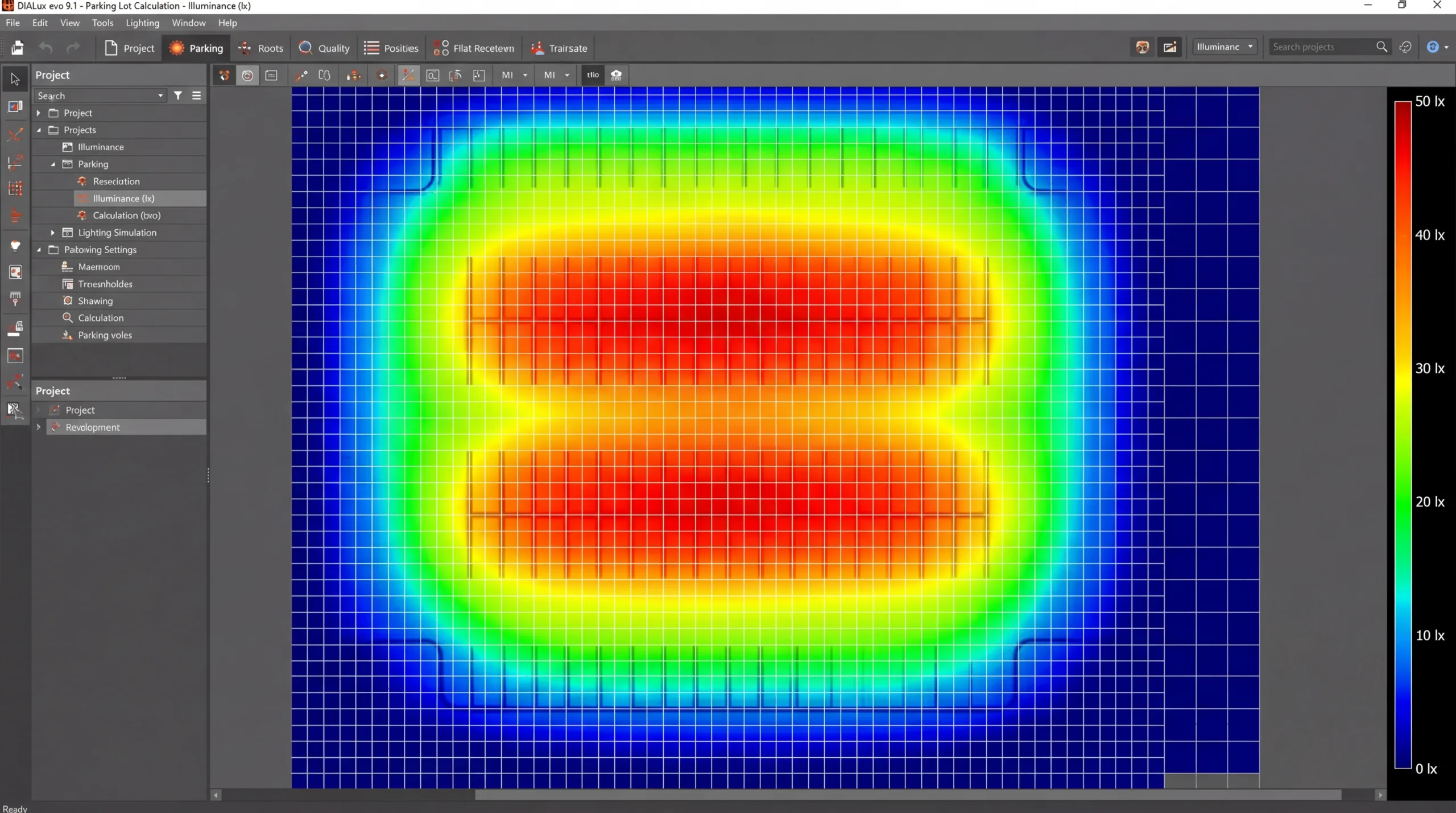
On the Burkina Faso project, we ran DIALux simulations alongside the National Solar Energy Laboratory’s bench tests. The simulated 0.48 uniformity at 8m pole spacing of 30m matched the measured 0.45 within 7%. We use that as our standard simulation-to-field correlation when sizing pole spacing for new tenders.
5-year TCO Comparison Across FALCON, JAGUAR, BISON
Citation capsule: TCO over 5 years separates the cheap upfront SKU from the cheapest project. JAGUAR and BISON’s LiFePO4 chemistry, rated for around 3,500 cycles per IEC 62619, eliminates the battery replacement that FALCON AIT5 (Gel) carries at year 2-3, a delta of $15-$40 per unit excluding labor. Bamako 3,162 used this model.
Total cost of ownership over five years separates the cheap upfront SKU from the cheapest project. FALCON AIT5 with Gel batteries carries a hidden battery replacement cycle at year 2 or 3, while JAGUAR and BISON’s LiFePO4 chemistry, rated for around 3,500 cycles per IEC 62619, eliminates that replacement within the 5-year window.
CapEx per unit
- FALCON: $150-$280 per unit depending on power class
- JAGUAR: $180-$380 per unit
- BISON: $250-$450 per unit
5-year TCO per unit
- FALCON AIT5 (Gel): $200-$320 including one battery replacement at year 2-3
- FALCON AIT6 (LiFePO4): $185-$300 with no replacement
- JAGUAR: $200-$400 (LiFePO4, no replacement in window)
- BISON: $280-$490 (LiFePO4, no replacement; minor optics maintenance on high-power units)

Mali’s Bamako project (3,162 JAGUAR units, 2025) used a 5-year TCO model that excluded battery replacements within the warranty window, justified by LiFePO4’s IEC 62619 cycle rating. The contract therefore priced JAGUAR competitively against cheaper Gel-battery imports despite higher CapEx.
See also: Mali solar street lights regional page.
How do the three series handle harsh environments?
Citation capsule: Field resilience depends on battery chemistry plus IP66/IK10 housing per IEC 60529 and IEC 62262. FALCON Gel sub-line drops below -10°C. JAGUAR and BISON LiFePO4 chemistry holds to -20°C per IEC 62619, validated across Burkina Faso Sahel (1,095 units, 2024) and Syria’s 10,735-unit cold-plus-dust cycle (UNHCR Syria, 2021).
Field resilience depends on battery chemistry, housing IP/IK rating, and panel orientation. FALCON’s older Gel battery sub-line drops capacity below -10°C, which rules out cold-climate tenders. JAGUAR and BISON’s LiFePO4 chemistry holds capacity to -20°C and has proven out in Burkina Faso’s Sahel sand-and-heat envelope and Syria’s cold-plus-dust cycle. BISON variants are available with SASO (KSA), ESMA G-Mark (UAE), and IECEE CB scheme certification for GCC industrial tenders, confirm at RFQ stage.
| Meio ambiente | FALCON | JAGUAR | BISON |
|---|---|---|---|
| -20°C cold | Gel sub-line not rated; AIT6 LiFePO4 supported | Rated to -20°C | Rated to -20°C |
| 50°C+ desert | Proven Iran 2022, Syria 2021 | Proven Burkina Faso Sahel 2024 | Proven Syria 2021 |
| Monções / chuva forte | Proven Cox’s Bazar 2022 | Proven, IP66 verified | IP66 verified |
| Sand / dust storm | Quarterly cleaning recommended | Proven Burkina Faso Sahel | Proven Syria |
| Salt fog / coastal | Gel sensitive, request coastal coating | LiFePO4 plus corrosion coating | LiFePO4 plus coastal coating |
| High wind (>30 m/s) | Panel-on-arm rated 35 m/s | Panel-on-arm rated 35 m/s | Reinforced arm rated 40 m/s |
| Vandalism / anti-theft | Standard housing | Standard housing | IK10 reinforced |
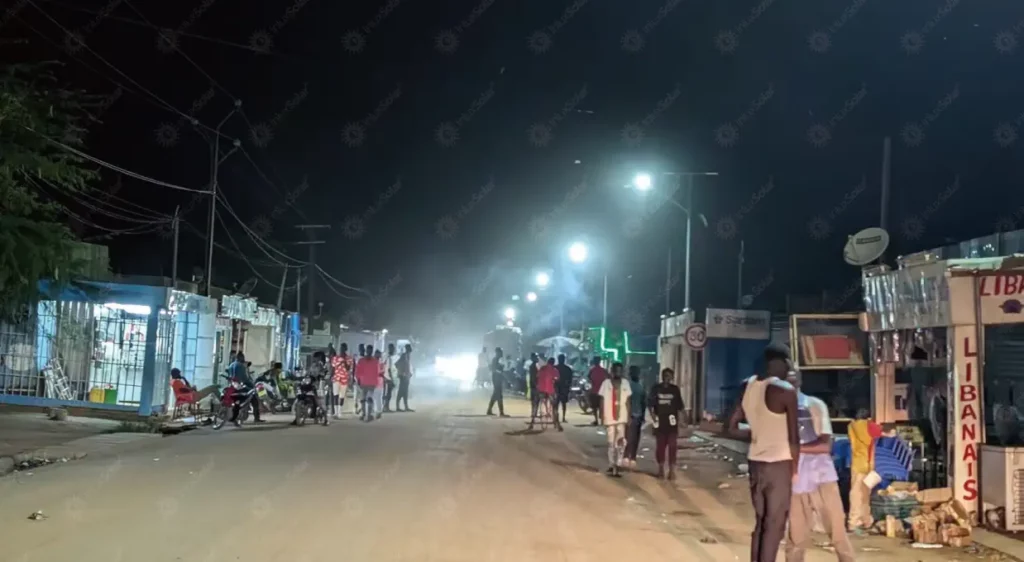
See also: Burkina Faso country page.
What IoT and smart features ship with each series?
Citation capsule: IoT is the fastest-growing 2026 RFQ requirement. Burkina Faso’s 1,095-unit 2024 World Bank tender mandated remote fault diagnostics under National Solar Energy Laboratory certification, steering the project to JAGUAR’s full LoRa, NB-IoT, and 4G stack. FALCON AIT5 ships without IoT; AIT6 adds optional LoRa. JAGUAR and BISON include the full stack standard.
IoT capability is the fastest-growing requirement in 2026 RFQs. Burkina Faso’s 2024 World Bank tender mandated remote fault diagnostics, which steered the project to JAGUAR’s full LoRa, NB-IoT, and 4G stack. FALCON AIT5 ships without IoT by default; AIT6 adds optional LoRa. JAGUAR and BISON include the full stack as standard.
| Recurso | FALCON | JAGUAR | BISON |
|---|---|---|---|
| LoRa remote control | AIT6+ standard | Standard | Standard |
| NB-IoT support | Opcional | Standard | Standard |
| 4G IoT | Opcional | Standard | Standard |
| Remote dimming schedule | Supported | Supported | Supported |
| Group control (LoRa mesh) | Supported | Supported | Supported |
| Fault diagnostic + alerts | Basic | Advanced | Advanced |
| Inverter / battery monitor | Basic | Cell-level telemetry | Cell-level telemetry |

The 1,095 IoT-enabled JAGUAR units deployed in Burkina Faso’s Sahel region (2024, World Bank-funded) were certified by the National Solar Energy Laboratory of Burkina Faso, validating cell-level battery telemetry and group-dimming protocols across geographically dispersed installations.
How do the three series compare on logistics?
Citation capsule: Container loading drives unit economics above 500 units. A 40HQ container holds 220-260 FALCON, 200-240 JAGUAR, or 150-190 BISON units per ISPM 15 wood packaging. Yangzhou-to-Cox’s-Bazar transit ran 35-40 days for the 2022 UNHCR shipment. Bamako 3,162 units moved across 14 containers via Port of Abidjan in 52 days door-to-door.
Container loading drives unit economics for any project above 500 units. A 40HQ container holds 220-260 FALCON units, 200-240 JAGUAR units, or 150-190 BISON units, depending on power class and pole accessories. Yangzhou-to-Cox’s-Bazar transit ran 35-40 days for the 2022 UNHCR shipment under ISPM 15-compliant wood packaging.
The Bamako 3,162-unit JAGUAR shipment moved across 14 forty-foot containers from Yangzhou to the Port of Abidjan, then inland by truck to Bamako, with total door-to-door transit of 52 days. Container utilization averaged 226 units per 40HQ on that lane.
See also: Split-type vs All-in-Two comparison.
Which series fits each use case?
The clean mapping below resolves 90% of RFQ selection questions on the first read. Application class is the dominant variable. Climate envelope and IoT requirement are tiebreakers. The case anchors below all correspond to verified Inlux deployments between 2021 and 2025.
| Use case | Recommended | Anchor case |
|---|---|---|
| UNHCR refugee camp | FALCON | Cox’s Bazar 4,000 FALCON & JAGUAR mixed (2022), Iran 4,200 (2022) |
| UNDP humanitarian | JAGUAR | IoT-required tenders |
| World Bank infrastructure | JAGUAR IoT | Burkina Faso 1,095 (2024) |
| Municipal arterial road | JAGUAR (mid-power) | Bamako 3,162 (2025) |
| National highway corridor | BISON (high-power) | Syria 10,735 (2021) |
| Government bulk procurement | BISON | Syria UNHCR (2021) |
| Cold climate below -10°C | JAGUAR or BISON | LiFePO4 chemistry |
| Rapid-deploy crisis zones | FALCON | UNHCR emergency profile |
| IoT smart city pilot | JAGUAR or BISON | Burkina Faso 1,095 (2024) |
See also: Road and street lighting hub.
Perguntas frequentes
What is the difference between Inlux FALCON, JAGUAR, and BISON All-in-Two solar street lights?
FALCON, JAGUAR, and BISON are three All-in-Two product lines aimed at different applications. FALCON targets refugee camps and humanitarian deployments at 30-100W, proven across 8,200 UNHCR units in Bangladesh and Iran (2022, Cox’s Bazar deployment shared with JAGUAR). JAGUAR targets municipal roads at 30-150W with full IoT stack, deployed 3,162 units in Bamako (2025) and 1,095 IoT units in Burkina Faso (2024). BISON targets high-power and bulk procurement at 80-200W, proven across 10,735 UNHCR units in Syria (2021).
Which Inlux All-in-Two model has been deployed by UNHCR?
All three series have UNHCR-verified deployments. FALCON and JAGUAR jointly shipped 4,000 mixed-deployment units to Cox’s Bazar in Bangladesh (2022), and FALCON shipped 4,200 units across 10 Iran refugee settlements (2022). FALCON AIT6 also lit four Myanmar villages with 1,000 units between 2022 and 2023, benefiting roughly 21,000 residents. BISON and JAGUAR together supplied 10,735 units to UNHCR Syria in 2021, the largest UN-funded solar street light project in the Middle East on record per Inlux’s project archive.
Is JAGUAR or BISON better for World Bank-funded projects?
JAGUAR is the standard pick for World Bank tenders requiring IoT capability and mid-power output. Inlux’s 1,095-unit Burkina Faso Sahel deployment in 2024 was the first Inlux project under World Bank funding and was certified by the National Solar Energy Laboratory of Burkina Faso. BISON is appropriate if the World Bank tender specifies high-power arterial lighting above 150W. Both series ship with LoRa, NB-IoT, and 4G stacks as standard, so the choice reduces to power class.
Can FALCON work in -20°C cold climates?
FALCON’s older AIT5 generation ships with Gel batteries rated to -10°C, which is not appropriate for sustained -20°C operation. The AIT6 generation uses LiFePO4 chemistry rated to -20°C per IEC 62619, which is suitable for high-altitude refugee settlements and northern winter conditions. The Iran 2022 deployment of 4,200 units operated in mountain settlements where overnight winter temperatures dropped below -15°C. For sustained cold, confirm AIT6 generation in the RFQ.
What is the warranty for FALCON, JAGUAR, and BISON?
FALCON ships with a 3-year standard warranty and a 5-year extended option for AIT6 units. JAGUAR ships with a 5-year standard warranty covering housing, LED array, battery, and IoT module. BISON ships with a 5-year standard warranty plus IK10 housing coverage against vandalism. All three warranties exclude consumables (lens cleaning, mounting hardware) and require ISPM 15-compliant installation per the supplied installation manual. Extended warranty to 7 or 10 years is available on tender for project sizes above 1,000 units.
How many FALCON units fit in a 40HQ container?
A 40HQ container holds approximately 220-260 FALCON units depending on power class and pole accessories. The 2022 Cox’s Bazar 4,000-unit FALCON & JAGUAR mixed shipment moved across roughly 16 containers from Yangzhou to Chittagong. Compare to JAGUAR at 200-240 units per 40HQ and BISON at 150-190 units per 40HQ, the higher-power series take more volume per unit. Container utilization figures assume separate pole shipments; bundled pole-plus-fixture shipments cut the count by 30-40%.
Does JAGUAR support remote IoT monitoring out of the box?
Yes. JAGUAR ships with LoRa, NB-IoT, and 4G IoT modules as standard, supporting remote dimming schedules, group control, fault diagnostics, and cell-level battery telemetry. The 1,095-unit Burkina Faso Sahel deployment in 2024 ran the full stack and was certified by the National Solar Energy Laboratory of Burkina Faso. The IoT dashboard supports REST API integration with municipal SCADA platforms. Cellular SIM and data plan are project-specific and quoted separately.
Why did Mali’s capital Bamako choose JAGUAR over FALCON or BISON?
Mairie de Bamako specified the INL-AIT5-150W JAGUAR variant for the 2025 3,162-unit municipal tender for three reasons. First, the mid-power 150W output matched Bamako’s 9m arterial pole height and target M3 road lighting class per EN 13201. Second, the IoT stack supported the municipality’s planned smart-city dashboard. Third, the LiFePO4 chemistry eliminated the battery replacement cycle within the 5-year service contract, lowering 5-year TCO compared with cheaper Gel-battery imports.
Can I mix FALCON, JAGUAR, and BISON in one project?
Yes. The three series share slip-fit mounting (60mm or 76mm), 3000K/4000K/5700K color temperatures, and common LoRa/NB-IoT/4G IoT protocols. UNHCR Syria’s 10,735-unit 2021 deployment mixed BISON and JAGUAR units across high-power arterial and mid-power collector roads under a single procurement contract. Cox’s Bazar (2022, 4,000 units) similarly combined FALCON and JAGUAR units within the same camp clusters. Mixed deployments are common and supported under one warranty package on tender.
Where can I download the FALCON, JAGUAR, and BISON spec sheets?
Spec sheets for all three series, including IES files for DIALux simulation and IES LM-79 photometric test reports, are available on the FALCON, JAGUAR, and BISON product hubs. Each PDF contains the side-by-side spec matrix, BUG rating, IP/IK ratings, battery cycle data per IEC 62619, and reference project list. For project-specific configurations such as custom optics or extended warranty, contact the engineering team via the RFQ form.
See also: Refugee camp lighting hub.
Next step
Application class predicts the right AIT series 90% of the time; the other 10% is climate and IoT spec. If you send us your country, unit count, pole height, and IoT requirement, our engineering team returns a model recommendation, DIALux simulation, and FOB pricing within 10 business hours. Any DIALux/photometric mismatch found post-quote, we re-spec at no charge.
Request your FALCON / JAGUAR / BISON recommendation now. Mixed-series projects are quoted under a single contract.