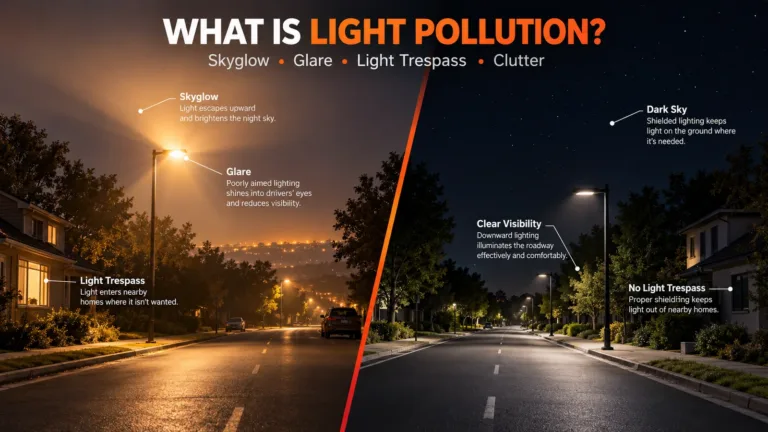
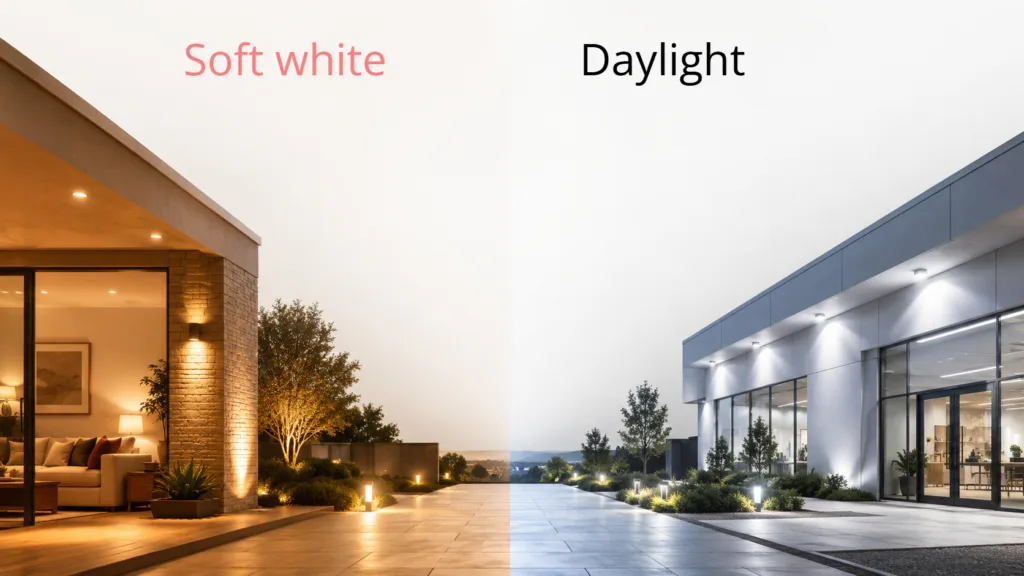
Soft white and daylight are two common LED light colors, but they are often misunderstood. Soft white does not automatically mean dim, and daylight does not automatically mean better. They describe the color appearance of the light, not the actual brightness.
The simple answer is this: choose soft white when you want a warm, comfortable space. Choose daylight when you need clearer visibility for tasks, work areas, or security. For outdoor lighting, especially streets, parking lots, parks, and solar lighting projects, the better choice usually depends on the application rather than personal preference.
For most homes, soft white around 2700K to 3000K feels more relaxed. For garages, workshops, and task areas, daylight around 5000K to 6500K looks clearer. For public roads and many commercial outdoor spaces, 4000K is often the practical middle ground because it looks clean without feeling too cold.
Quick Answer: Soft White vs Daylight
| Question | Best Answer |
|---|---|
| Which is warmer? | Soft white. It usually sits around 2700K to 3000K and has a warm yellow-white appearance. |
| Which looks brighter? | Daylight. It often looks brighter because it is cooler and whiter, even when the lumen output is similar. |
| Which is better for relaxing spaces? | Soft white. It works well in bedrooms, living rooms, dining areas, patios, hotels, and resorts. |
| Which is better for task visibility? | Daylight. It is useful for garages, workshops, offices, kitchens, warehouses, and security areas. |
| Which is better for outdoor lighting? | It depends. 3000K is warmer and more comfortable, 4000K is balanced, and 5000K is clearer for security or industrial spaces. |
| Which is better for solar street lights? | 3000K, 4000K, and 5000K can all work. The right choice depends on road type, pole height, glare control, dimming schedule, and project requirements. |
A Fast Decision Rule for Outdoor and Solar Street Lighting
For outdoor lighting, choose color temperature by application first, then confirm the result with the photometric design. A cooler Kelvin value can look sharper, but it does not replace sufficient lumens, controlled glare, correct optics, or adequate battery and solar-panel sizing.
| Project situation | Practical starting point | What to confirm before ordering |
|---|---|---|
| Residential road, park, resort, or pedestrian path | 2700K–3000K | Visual comfort, spill light, dark-sky or local requirements |
| Public road, campus, or general commercial street | Around 4000K | Road class, uniformity, mounting height, and optical distribution |
| Parking lot, logistics yard, industrial road, or security perimeter | 4000K–5000K | Glare control, vehicle and pedestrian visibility, and maintenance access |
| Selected task or security areas that require a very cool appearance | 5000K–6500K | Local requirements, blue-light concerns, glare, and the actual photometric result |
This is a starting framework, not a universal specification. For a solar street light project, the final choice should be checked together with road width, pole spacing, mounting angle, dimming schedule, battery autonomy, and the required lighting distribution.
What Soft White and Daylight Actually Mean
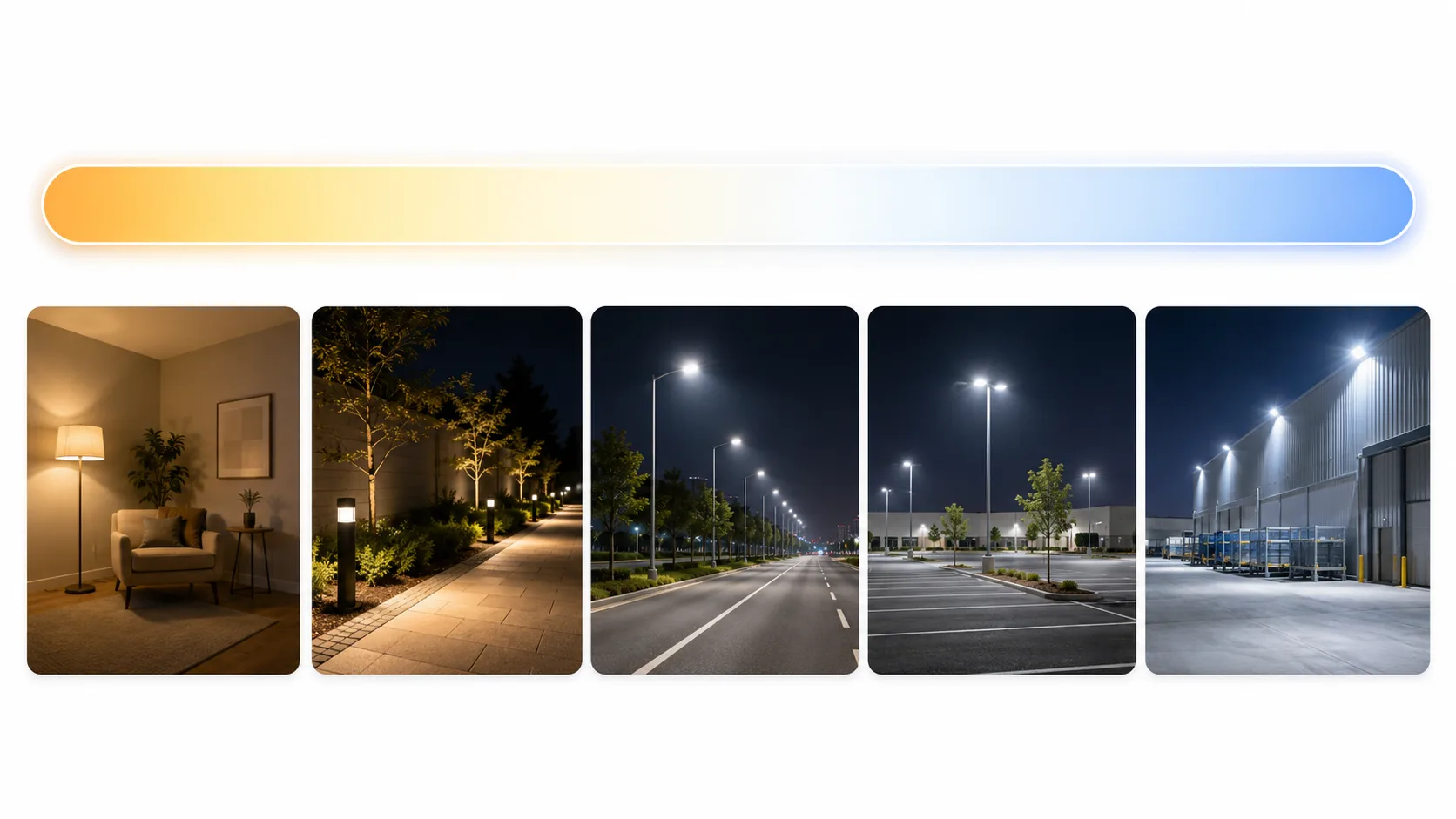
Color temperature is measured in Kelvin, usually shown as K on LED product labels. A lower Kelvin value looks warmer and more yellow. A higher Kelvin value looks whiter or bluer.
Soft white normally refers to warm LED light around 2700K to 3000K. Daylight usually refers to cooler LED light around 5000K to 6500K. Between them, you will often see warm white, neutral white, bright white, or cool white. These names are not always used in exactly the same way by every manufacturer, so the Kelvin number is more useful than the marketing name.
| Color Name | Common Kelvin Range | How It Looks | Typical Feeling |
|---|---|---|---|
| Soft White | 2700K–3000K | Warm yellow-white | Calm, relaxed, comfortable |
| Warm White | 3000K–3500K | Warm but cleaner than soft white | Comfortable, slightly clearer |
| Neutral White | 4000K–4500K | Balanced white | Clean, natural, practical |
| Daylight | 5000K–6500K | Cool blue-white | Sharp, clear, alert |
Soft White LED Lights
Soft white LED lights create a warm, yellowish glow. This is the color many people associate with older incandescent bulbs, table lamps, restaurants, hotels, and comfortable evening spaces.
Soft white is popular because it feels easy to live with. It does not make a room look clinical. It works well with wood, warm paint colors, soft fabrics, stone, plants, and traditional interiors. In outdoor spaces, it can also make patios, garden paths, resort walkways, and residential streets feel more welcoming.
The trade-off is that soft white may not feel sharp enough for some tasks. If you are working in a garage, sorting products in a warehouse, checking details at a workbench, or lighting a large parking area, soft white may feel too warm or visually soft.
Best places to use soft white
- Bedrooms
- Living rooms
- Dining rooms
- Restaurants and cafes
- Hotels and resorts
- Patios and balconies
- Garden paths
- Residential walkways
- Parks and leisure spaces
- Decorative outdoor lighting
Daylight LED Lights
Daylight LED lights look cooler, whiter, and more energetic. They are often used where people need to see details clearly. That is why daylight is common in garages, kitchens, workshops, offices, warehouses, parking lots, and security lighting.
Daylight can make a space feel brighter even when the lamp has the same lumen rating as a warmer LED. This is one reason many buyers choose it for work and utility areas. The light feels more active and can make contrast easier to see.
But daylight is not always the better choice. In a bedroom, restaurant, hotel, patio, or quiet street, it can feel too sharp. Outdoors, very cool white light may also make glare more noticeable if the fixture is not shielded well or if the beam angle is wrong.
Best places to use daylight
- Garages
- Workshops
- Offices
- Task lighting areas
- Warehouses
- Loading zones
- Estacionamentos
- Security areas
- Industrial yards
- Perimeter lighting
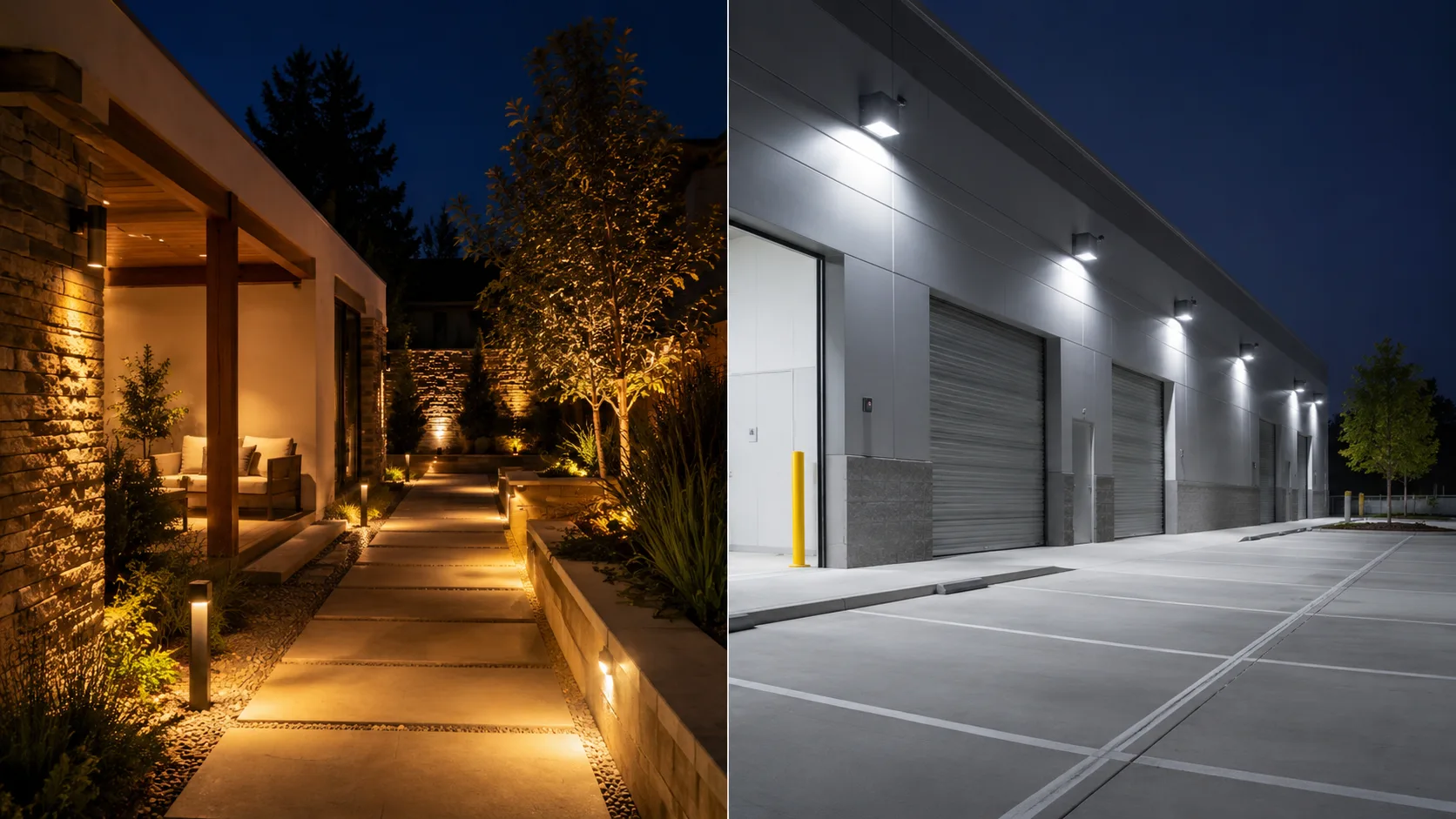
Soft White vs Daylight: The Real Difference
Most people compare soft white and daylight by saying one is warm and the other is cool. That is true, but it is not enough to make a good choice.
The better way to compare them is by asking what the space needs people to do.
| Ponto de comparação | Soft White | Daylight |
|---|---|---|
| Color appearance | Warm, yellow-white | Cool, blue-white |
| Typical Kelvin range | 2700K–3000K | 5000K–6500K |
| Visual feeling | Relaxed and comfortable | Clear and alert |
| Looks brighter? | Usually no | Often yes, even at similar lumens |
| Best for mood | Sim | Usually no |
| Best for task detail | Not always | Usually yes |
| Glare risk outdoors | Usually lower if designed well | Can feel stronger if optics are poor |
| Common mistake | Using it where high visibility is needed | Using it where comfort is more important |
Is Daylight Brighter Than Soft White?
Daylight often looks brighter than soft white, but that does not mean it produces more light.
Brightness is measured in lumens. Color temperature is measured in Kelvin. A 3000K LED and a 5000K LED can have the same lumen output, but the 5000K version may appear brighter because cooler white light creates a sharper visual impression.
This is where many people make the wrong purchase. They choose daylight because it looks bright, then discover that it feels uncomfortable in a bedroom, dining room, patio, or residential street. Or they choose soft white because it feels comfortable, then find that it is not clear enough for a garage, warehouse, or parking lot.
The question is not only “which one is brighter?” The better question is “what should this space feel like, and what do people need to see?”
Which One Should You Choose? Use This Decision Table
If you only want a fast answer, start here. This table is more useful than choosing by Kelvin alone.
| Aplicativo | Better Choice | Why |
|---|---|---|
| Bedroom | Soft white, 2700K–3000K | Warmer light feels calmer and more suitable for rest. |
| Living room | Soft white, 2700K–3000K | It creates a comfortable evening atmosphere. |
| Dining room or restaurant | Soft white or warm white, 2700K–3000K | Warm light makes the space feel more welcoming. |
| Kitchen | 3000K–4000K | It gives enough clarity for cooking without feeling too harsh. |
| Bathroom | 3000K–4000K, sometimes 5000K for task areas | Grooming needs clearer light, but very cool light can feel clinical. |
| Garage or workshop | Daylight, 5000K | Cooler white light helps with tasks and detail work. |
| Patio or garden path | Soft white or warm white, 2700K–3000K | Comfort and atmosphere matter more than maximum sharpness. |
| Residential street | 3000K–4000K | The lighting should feel safe without being too harsh near homes. |
| Public road | 4000K | Neutral white gives a practical balance of visibility and comfort. |
| Estacionamento | 4000K–5000K | Drivers and pedestrians need clear visibility and good uniformity. |
| Industrial yard | 5000K | Work areas often need stronger visual clarity. |
| Security or perimeter lighting | 5000K, with proper glare control | Cooler white light can improve perceived visibility, but optics still matter. |
| Dark-sky sensitive outdoor area | 3000K or lower where allowed | Warmer outdoor light can help reduce the harsh blue-white appearance. |
3000K vs 4000K vs 5000K vs 6500K
If soft white and daylight feel too broad, compare the actual Kelvin values. This is especially helpful for outdoor lighting and street lighting projects.
| Temperatura de cor | Aparência | Best Use | Be Careful When |
|---|---|---|---|
| 2700K | Very warm soft white | Bedrooms, hotels, restaurants, decorative lighting | The space needs task visibility or security lighting. |
| 3000K | Warm white | Residential streets, parks, pathways, resorts, outdoor leisure areas | The project needs a very bright, high-visibility appearance. |
| 4000K | Branco neutro | Public roads, campuses, commercial areas, pedestrian zones | The project has strict warm-light or dark-sky requirements. |
| 5000K | Cool white / daylight | Parking lots, logistics yards, industrial roads, security areas | The light is close to homes, parks, hotels, or pedestrian comfort zones. |
| 6500K | Very cool daylight | Selected task or security applications | It may look harsh, bluish, or uncomfortable in public outdoor spaces. |

3000K vs 4000K for Outdoor Lighting
3000K usually creates a warmer and more comfortable appearance, which can suit residential roads, parks, hospitality areas, and pedestrian paths. 4000K looks more neutral and is often easier to use for public roads, campuses, and mixed commercial areas. If the project is close to homes or has strict glare and spill-light requirements, do not choose 4000K only because it looks brighter; review the optics and layout as well.
4000K vs 5000K for Outdoor Lighting
4000K is often the balanced option when visibility and visual comfort both matter. 5000K can provide a cooler, clearer appearance for parking lots, logistics yards, industrial roads, and security zones, but it may also make glare more noticeable when the fixture is poorly aimed or the beam is not well controlled. The better choice depends on the task, road users, local requirements, and the photometric result—not Kelvin alone.
5000K vs 6500K for Outdoor Lighting
5000K is generally a more practical starting point than 6500K for many outdoor work and security applications. 6500K has a distinctly cool or bluish appearance and should be selected only when the project has a clear visibility or task-lighting reason and the visual environment can accept it. For public streets, residential areas, parks, and hospitality projects, check comfort, glare, spill light, and local requirements before specifying 6500K.
Outdoor Lighting Is Different From Indoor Lighting
Indoor lighting is often chosen by mood. Outdoor lighting has to do more work.
Outside, the light needs to help people walk, drive, park, load goods, recognize obstacles, and feel safe. At the same time, it should avoid unnecessary glare, spill light, and harsh contrast. That means color temperature is only one part of the design.
A 5000K light may look bright, but if the beam is poorly controlled, it can create glare and dark patches. A 3000K light may feel more comfortable, but if the lumen output or optical distribution is wrong, the area may not be bright enough. For outdoor projects, the fixture, lens, pole height, spacing, mounting angle, dimming schedule, and maintenance plan all matter.
This is why serious outdoor lighting decisions should not be made by the words “soft white” or “daylight” alone. If you are comparing lighting for roads, campuses, parks, parking areas, or solar projects, it is worth reviewing CCT, CRI, and beam angle together rather than treating color temperature as a separate choice.
Best Color Temperature for Street Lights
Street lights need a practical balance. They are not living room lamps, and they are not factory task lights either. A good street lighting design should support visibility, comfort, safety, and the character of the area.
For residential roads, 3000K to 4000K is often a more comfortable range. It gives the street enough visibility without making the environment feel too cold. For city roads, commercial roads, and campuses, 4000K is a common balanced choice. For parking lots, logistics yards, and industrial roads, 5000K may be selected when the project needs stronger visual clarity.
Very cool daylight, such as 6500K, should be used carefully in public outdoor areas. It may look bright at first, but it can also feel harsh, especially near homes, parks, hotels, and pedestrian zones.
| Outdoor Application | Practical CCT Range | Reason |
|---|---|---|
| Residential road | 3000K–4000K | Comfort matters because the lighting is close to homes. |
| Park pathway | 2700K–3000K | Warmer light supports a softer night environment. |
| Public road | 4000K | Neutral white balances visibility and visual comfort. |
| Commercial street | 4000K–5000K | The area needs clearer visibility and a clean appearance. |
| Estacionamento | 4000K–5000K | Drivers and pedestrians need to see vehicles, curbs, and movement clearly. |
| Industrial yard | 5000K | Work areas usually need stronger detail visibility. |
| Security perimeter | 5000K with controlled optics | Visibility matters, but glare and over-lighting should still be controlled. |
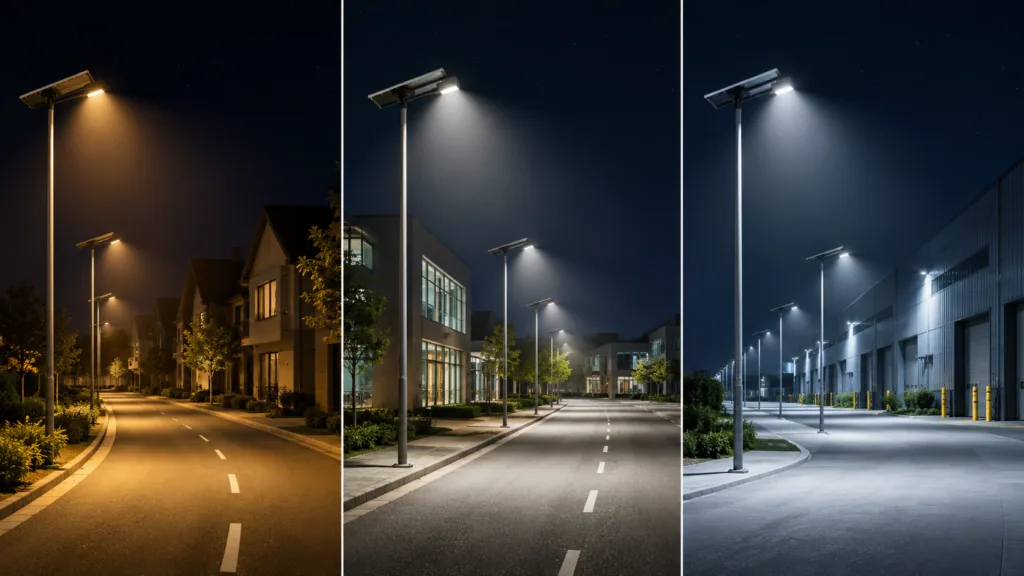
Soft White vs Daylight for Solar Street Lights
Solar street lights add another layer to the decision. The LED color is only one part of the system. The solar panel, battery, charge controller, LED module, optics, pole, dimming profile, and installation spacing all affect the final night performance.
For a small residential road, warm white or neutral white may be a better choice because people want the area to feel safe but not harsh. For a public road or campus, 4000K often gives a clean and balanced result. For an industrial park, parking lot, logistics area, or perimeter road, 5000K may be selected for stronger perceived visibility.
But choosing 5000K does not fix a weak solar lighting design. If the system has poor optics, low battery capacity, wrong pole spacing, or an aggressive dimming schedule, the road can still look uneven. In solar projects, a better lens, correct mounting height, proper battery autonomy, and a suitable lighting schedule can matter more than simply choosing a cooler CCT.
For project planning, Inlux Solar offers different system structures for different applications, including luzes de rua solares tudo-em-um, luzes de rua solares all-in-two, e iluminação pública solar do tipo split. If you are still comparing project requirements, start from the main luz de rua solar page and then narrow the choice by road type, pole height, autonomy days, and lighting control mode.
Solar Street Light Color Temperature: Procurement Checklist
Before comparing 3000K, 4000K, 5000K, or 6500K quotations, ask for these project inputs and outputs:
- target road or area classification;
- road width, pole height, pole spacing, and mounting angle;
- required illuminance, luminance, uniformity, and glare limits;
- LED power, lumen output, light distribution, and relevant IES/LDT files;
- operating hours, dimming profile, motion-sensor settings, and rainy-day autonomy;
- solar-panel capacity, battery capacity, controller protection, and expected maintenance conditions;
- the selected CCT and the reason it fits the surrounding environment and local requirements.
Color temperature should appear in the tender or RFQ specification, but it should not be the only lighting requirement. A 5000K fixture with poor spacing or uncontrolled glare can perform worse than a well-designed 4000K system.
A Verified Inlux Product Example
The current POLARIS all-in-one solar street light specification lists a 3000K–6500K color-temperature range and Type II / Type III lighting distribution options. This shows that a solar street light system can be configured across several CCT options; it does not mean that every project should use the highest Kelvin value. The final selection still depends on the application, photometric design, pole layout, operating profile, and local requirements.
When Soft White Is the Wrong Choice
Soft white is comfortable, but it is not always practical.
It may be the wrong choice when the area needs strong visual clarity, fast recognition, or detailed work. A warehouse entrance, truck loading area, inspection zone, large parking lot, or security perimeter may need a clearer white light. In these cases, 4000K or 5000K often works better than 2700K or 3000K.
Soft white can also make a space feel under-lit if the actual lumen output is low. If the problem is not color temperature but insufficient lighting level, switching from soft white to daylight may only change the appearance, not solve the lighting design problem.
When Daylight Is the Wrong Choice
Daylight is useful, but it is often overused.
It may be the wrong choice when the space should feel calm, warm, or comfortable. Bedrooms, dining rooms, hotels, patios, resorts, parks, and residential streets can feel cold under very cool light. Outdoors, daylight can also make glare more noticeable if the fixture is badly aimed or poorly shielded.
For public outdoor spaces, “brighter-looking” is not always better. People need to see clearly, but they also need comfortable contrast, controlled glare, and an environment that does not feel over-lit.
Common Mistakes When Comparing Soft White and Daylight
1. Thinking daylight means more lumens
Daylight may look brighter, but lumens measure actual light output. Always compare lumen output separately from Kelvin.
2. Choosing one color temperature for every space
A bedroom, garage, restaurant, parking lot, and residential road should not all use the same CCT. The use case should decide the light color.
3. Using 6500K because it looks powerful
Very cool daylight can look sharp, but it can also feel harsh and bluish. It should be used carefully, especially outdoors.
4. Ignoring glare
Outdoor lighting is not only about brightness. If the fixture produces glare, people may feel uncomfortable even when the area is technically bright.
5. Ignoring optics and layout
For street lights and solar street lights, beam angle, pole height, spacing, and optical distribution can affect the result more than a small change in Kelvin.
Simple Buying Guide
Choose soft white if the space should feel warm, relaxed, and comfortable.
Choose daylight if the space needs clear visibility, task focus, or a stronger security feeling.
Choose 3000K for residential outdoor areas, parks, resorts, and walkways where comfort matters.
Choose 4000K for public roads, campuses, commercial streets, and general outdoor projects where balance matters.
Choose 5000K for parking lots, industrial yards, logistics roads, and security areas where visibility is the priority.
Be careful with 6500K. It may be useful in selected task areas, but it can feel harsh in many living, hospitality, and public outdoor spaces.
For a complete solar lighting project, do not choose by color temperature alone. Review pole height, road width, installation spacing, optical distribution, dimming schedule, battery autonomy, and local project requirements. For more planning support, visit the Inlux Solar street lighting guides.
What to Include in a Color Temperature RFQ
If you are sourcing LED or solar street lights, send the supplier more than a preferred Kelvin value. Include the application, road or area dimensions, pole height, spacing, operating hours, dimming requirement, rainy-day autonomy, target CCT, required IES/LDT files, destination country, and any local lighting standard. These inputs allow the supplier to check whether the proposed wattage, optics, solar panel, battery, and layout work together.
For a project-specific recommendation, request a solar street light proposal from Inlux Solar and include the CCT range you are considering. The proposal should confirm the lighting distribution and system design instead of treating color temperature as a standalone product choice.
PERGUNTAS FREQUENTES
What is the difference between soft white and daylight LED lights?
Soft white LED lights have a warm yellow-white appearance, usually around 2700K to 3000K. Daylight LED lights have a cooler blue-white appearance, usually around 5000K to 6500K. Soft white feels more relaxed, while daylight feels clearer and more alert.
Is soft white or daylight better?
Neither is better for every situation. Soft white is better for relaxing spaces such as bedrooms, living rooms, restaurants, patios, and hotels. Daylight is better for task areas such as garages, workshops, offices, warehouses, and security lighting.
Is daylight brighter than soft white?
Daylight often looks brighter because it is cooler and whiter, but actual brightness is measured in lumens. A soft white LED and a daylight LED can have the same lumen output and still look different because of color temperature.
Which is better for eyes, soft white or daylight?
Soft white is usually more comfortable for relaxing spaces and evening use. Daylight can be better when people need to see fine details. The best choice depends on the activity, glare control, and how long people stay under the light.
What color temperature is soft white?
Soft white is usually around 2700K to 3000K. It has a warm, yellow-white appearance that feels close to traditional incandescent lighting.
What color temperature is daylight?
Daylight is usually around 5000K to 6500K. It has a cooler, whiter, sometimes slightly bluish appearance.
Is 3000K soft white or warm white?
3000K is usually considered soft white or warm white, depending on the manufacturer. It looks warm, but cleaner than very yellow 2700K lighting.
Is 4000K daylight?
4000K is usually not called daylight. It is closer to neutral white or bright white. It is a balanced choice for many commercial, public, and outdoor lighting applications.
Is 5000K too bright for home?
5000K may feel too sharp for bedrooms, living rooms, and dining rooms, but it can work well in garages, offices, bathrooms, workshops, and task areas. The result also depends on lumen output and fixture design.
What is the best color temperature for outdoor lighting?
For relaxed outdoor areas, 2700K to 3000K often feels better. For public roads and commercial outdoor spaces, 4000K is a balanced choice. For parking lots, industrial yards, and security areas, 5000K may be suitable when glare is controlled.
What is the best color temperature for street lights?
Residential streets often work well with 3000K to 4000K. Public roads commonly use around 4000K. Parking lots, logistics areas, and industrial roads may use 5000K when higher visual clarity is needed.
What is the best color temperature for solar street lights?
The best CCT for solar street lights depends on the project. Residential roads and parks may use 3000K. General roads often use 4000K. Parking lots and industrial areas may use 5000K. The final choice should also consider optics, pole height, spacing, dimming schedule, and battery autonomy.
Does color temperature affect solar street light battery life?
Color temperature itself is not the main factor in battery life. Battery life depends more on LED power, working hours, dimming schedule, solar panel size, battery capacity, local sunshine hours, and system efficiency.
Can I mix soft white and daylight?
You can, but it should be done carefully. Mixing very warm and very cool lights in the same small space can look uneven. In larger projects, different CCTs may be used in different zones when each area has a different function.
Should outdoor security lights be daylight?
Daylight or cool white can help security areas look clearer, but the fixture still needs good optics and glare control. A poorly aimed daylight fixture can create discomfort and dark shadows instead of improving safety.
Final Thoughts
Soft white and daylight are not just two colors on a product label. They change how a space feels and how people see at night.
Soft white is warm, calm, and comfortable. Daylight is cool, sharp, and clear. For homes, the choice often comes down to mood and activity. For outdoor lighting, roads, parking lots, and solar street lights, the choice should be based on the application, lighting layout, glare control, and long-term performance.
If you are choosing lighting for a room, start with how the room is used. If you are planning a road, campus, parking lot, park, or municipal solar lighting project, start with the site conditions. The right color temperature should support the lighting design, not replace it.
For project-grade outdoor lighting, explore Inlux Solar’s sistemas solares de iluminação pública or read the technical guide to CCT, CRI, and beam angle selection.