When a buyer asks for a solar street light with pole and battery, the request sounds complete. In practice, it can still describe three very different quotations: a luminaire kit mounted on a buyer-supplied pole, a supply-only package containing the main hardware, or a delivered and installed lighting system with local civil work.
Those are not interchangeable scopes. The difference affects price, freight, installation time, foundation responsibility and what happens if the equipment does not fit together on site.
The useful question is therefore not simply, “Does it include a pole and battery?” It is: Which components, engineering documents and site responsibilities are included in this quotation?
Scope note: This guide explains how to define a complete project package. It does not represent one fixed Inlux model, pole height, battery size or installation price. Final equipment and responsibilities must be confirmed in the project quotation.
What should a complete hardware package contain?
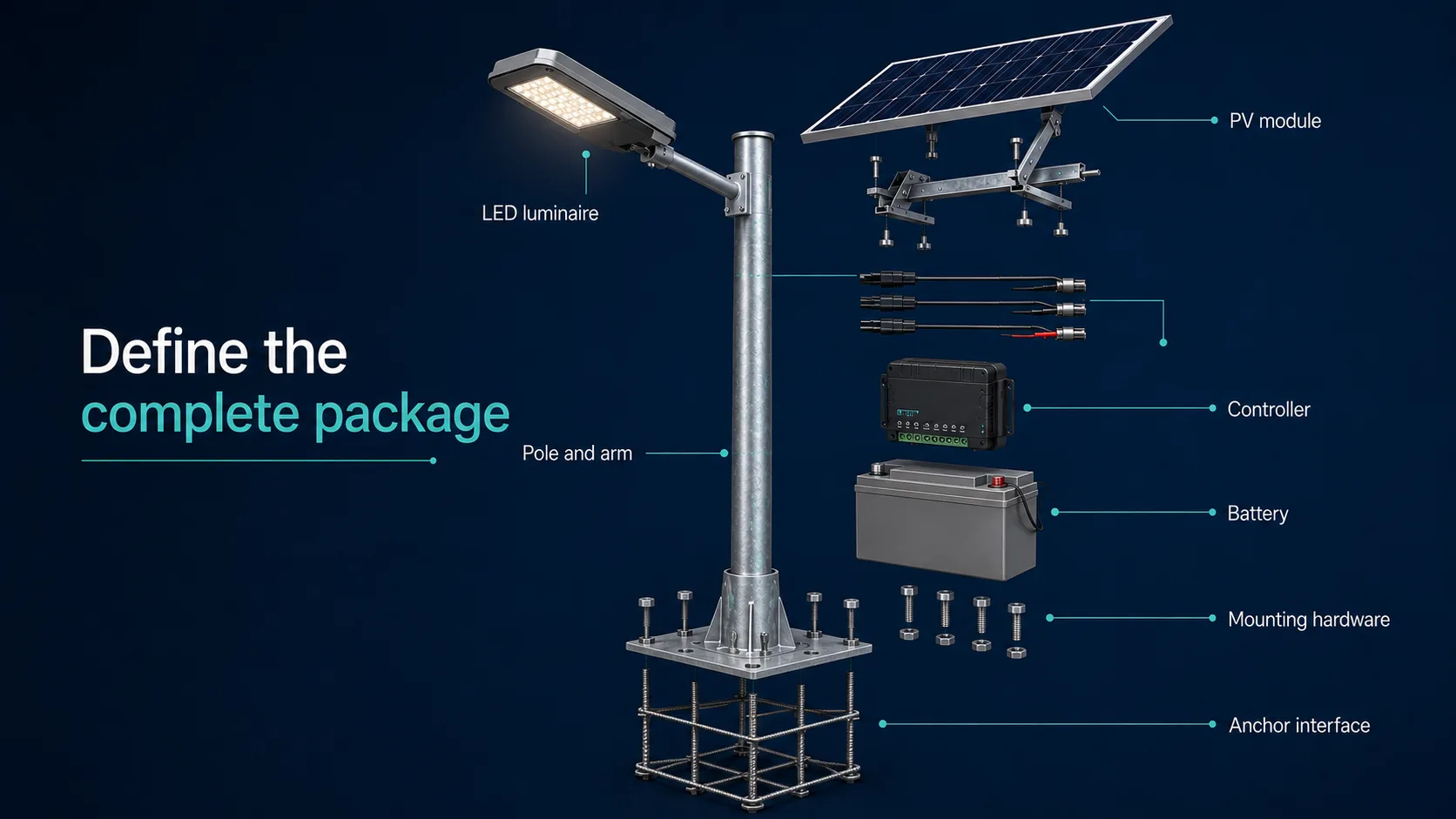
At minimum, a stand-alone solar street-light point needs an LED luminaire, a PV module, energy storage, a charge/lighting controller and a support structure. The package also needs the small interfaces that make those major parts work together: brackets, fasteners, cables, connectors and an agreed mounting arrangement.
A complete solar street light with pole and battery should therefore be reviewed as one energy, lighting and structural system—not as a lamp with two optional accessories. The U.S. Department of Energy’s PV system design overview makes the same underlying distinction: PV modules generate electricity, but they are only one part of a complete photovoltaic system.
For a project buyer, the following table is a better starting point than a single “complete set” label.
| Package item | What should be stated | Why the detail matters |
|---|---|---|
| LED luminaire | Input power, optical distribution, mounting interface and control profile | A wattage label alone does not prove the required road or area result |
| الوحدة الكهروضوئية | Electrical rating, dimensions, mounting orientation and bracket | Panel size affects wind area, pole loading and energy harvest |
| البطارية | Chemistry, nominal voltage, usable energy basis, enclosure and BMS limits | Ah cannot be compared without voltage and usable-capacity assumptions |
| المراقب المالي | Charging method, lighting schedule, protections and optional communication | The controller links the PV, battery and night-time operating profile |
| Pole | Height, material, sections, finish, door/opening, arm and design assumptions | A generic pole may not match the panel, luminaire, wind or foundation loads |
| Mounting hardware | Arms, panel frame, clamps, bolts, cable entries and connectors | Missing interfaces often become installation delays |
| Foundation interface | Base plate, anchor cage/bolts and required design information | Hardware supply does not automatically include excavation, concrete or local design approval |
| Engineering pack | Drawings, wiring diagram, photometric file, energy basis and packing list | The buyer needs evidence that the quoted parts form one reviewable system |
The term “complete” should be followed by a bill of materials. If an item is not listed, do not assume it will arrive in the shipment.
The pole is not just an accessory
The pole carries the luminaire, and in many configurations it also carries a PV module with a significant projected area. That changes the structural problem. Height, arm geometry, panel position, equipment mass, local wind conditions, terrain, corrosion environment and foundation assumptions all belong in the same review.
A standard street-light pole may be compatible with a solar package when its structural and mounting details are checked. Inlux also has a separate مصابيح الأعمدة الشمسية category in which vertical PV surfaces are integrated with the pole. That is a specific product architecture; it is not a generic name for every solar street light supplied with a pole.
Before approving the pole, request:
- pole height, section geometry and material/finish;
- base-plate and anchor arrangement;
- luminaire arm length and angle;
- PV mounting position and projected area;
- equipment masses and cable-entry route;
- stated wind and foundation design assumptions; and
- the party responsible for local structural approval.
This turns the pole from a line item into an engineering interface.
“With battery” still requires an energy design
A battery included in the box does not prove that the light will meet the requested operating schedule. Its capacity needs to match the night-time load profile, autonomy target, system voltage, permitted usable capacity, site temperature and the PV system’s ability to recharge it.
The companion Solar Street Light Battery Sizing guide explains that calculation boundary in detail. For this package-level check, ask the supplier to show at least:
- the proposed night-time operating profile;
- the resulting daily energy demand in Wh;
- nominal battery voltage and usable-energy assumption;
- autonomy and low-battery control behavior;
- PV recharge assumptions for the stated site; and
- battery location, enclosure and service method.
This is particularly important when comparing an integrated unit with a split system. The components may be arranged differently, but the energy balance still has to close.
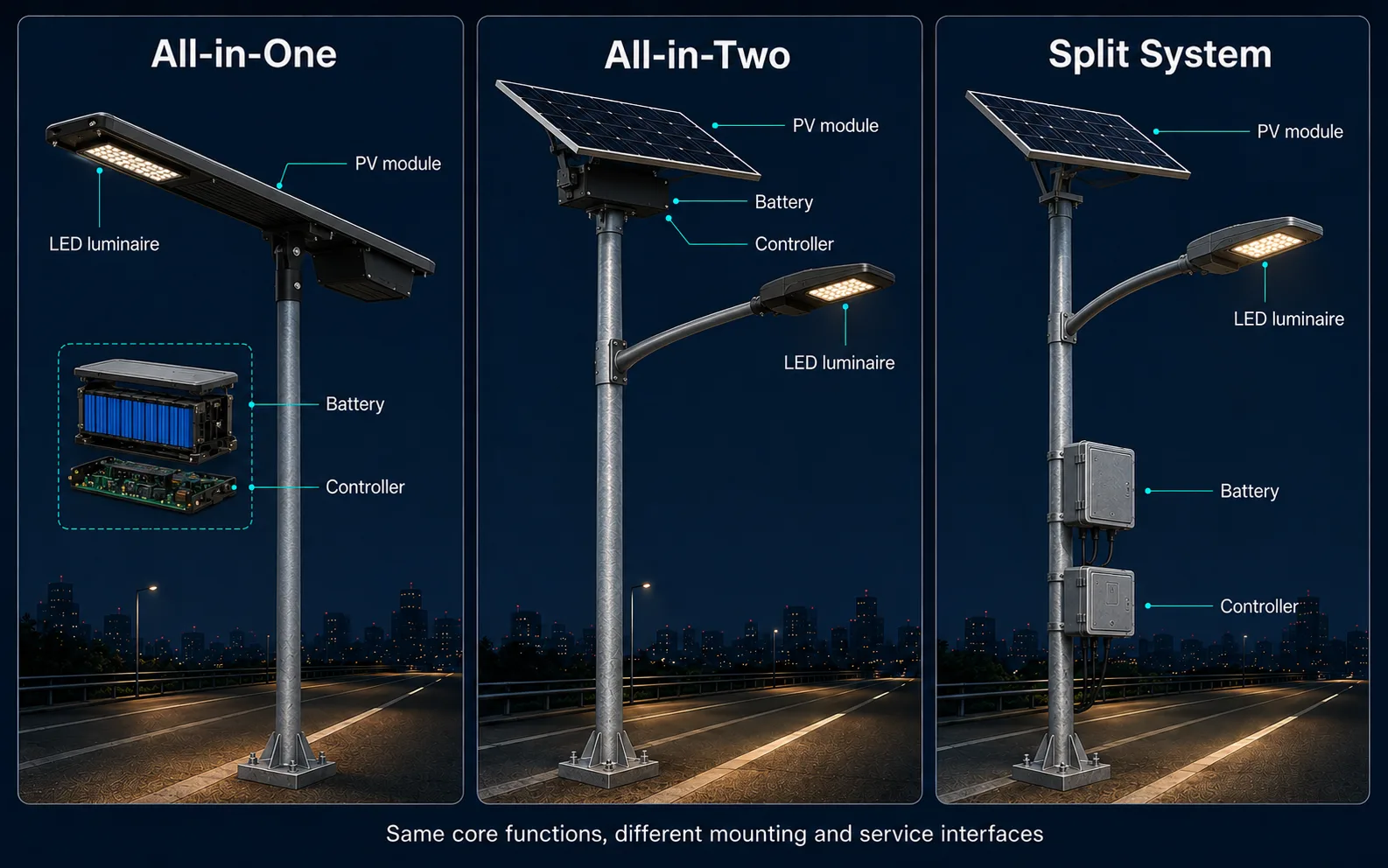
Three common system layouts
“Solar street light with pole and battery” does not identify where the battery and panel are installed. The project may use one of several architectures.
All-in-one system
The PV module, battery, controller and LED assembly are consolidated around the luminaire body, which is then mounted on the pole. This can simplify the visible component count, but the buyer still needs to confirm the pole, bracket, wind exposure, thermal conditions and future service access. See the مصابيح الشوارع بالطاقة الشمسية الكل في واحد category for the applicable product route.
All-in-two system
The luminaire, battery and controller are commonly grouped while the PV module remains separate. This gives more flexibility in panel orientation and equipment arrangement. The package needs a clear panel bracket, cable path and compatibility drawing. See مصابيح الشوارع بالطاقة الشمسية الكل في اثنين.
Split system
The PV module, luminaire, controller and battery are housed or mounted as distinct components. This can support serviceable project layouts, but it creates more interfaces to specify: battery enclosure, cable lengths, connector types, panel frame, arm and mounting positions. See Split-Type Solar Street Lights.
The existing All-in-One vs All-in-Two vs Split comparison goes deeper into architecture selection. This page remains focused on what must be included when the buyer requests a complete pole-and-battery package.
Supply-only is not the same as installed
Many international projects separate factory supply from local civil and installation work. That can be entirely appropriate, but the responsibility split must be explicit. A solar street light with pole and battery can still be a supply-only package unless the quotation says otherwise.
The International Chamber of Commerce explains that Incoterms® rules allocate specified transport costs, risks and formalities between seller and buyer. They do not replace the need to state who handles local foundations, erection, commissioning and acceptance.
| Scope item | Factory/supplier package may include | Must be separately confirmed |
|---|---|---|
| Main equipment | Luminaire, PV module, battery, controller and pole | Exact model/configuration and quantities |
| Mounting interfaces | Arms, brackets, anchor cage/bolts and hardware | Whether every fixing and consumable is included |
| Technical documents | Drawings, wiring information, photometric/energy files and packing list | Local authority format, stamps or third-party review |
| Packing and freight | Export packing and an agreed Incoterm/destination | Duties, port charges, inland delivery and unloading |
| Foundation work | Base/anchor information may be supplied | Soil data, final foundation design, excavation, reinforcement and concrete |
| التركيب | Instructions or remote guidance may be available | Local labor, lifting equipment, traffic management and commissioning |
| القبول | Factory documents and agreed inspections | Field measurement method, responsible party and handover criteria |
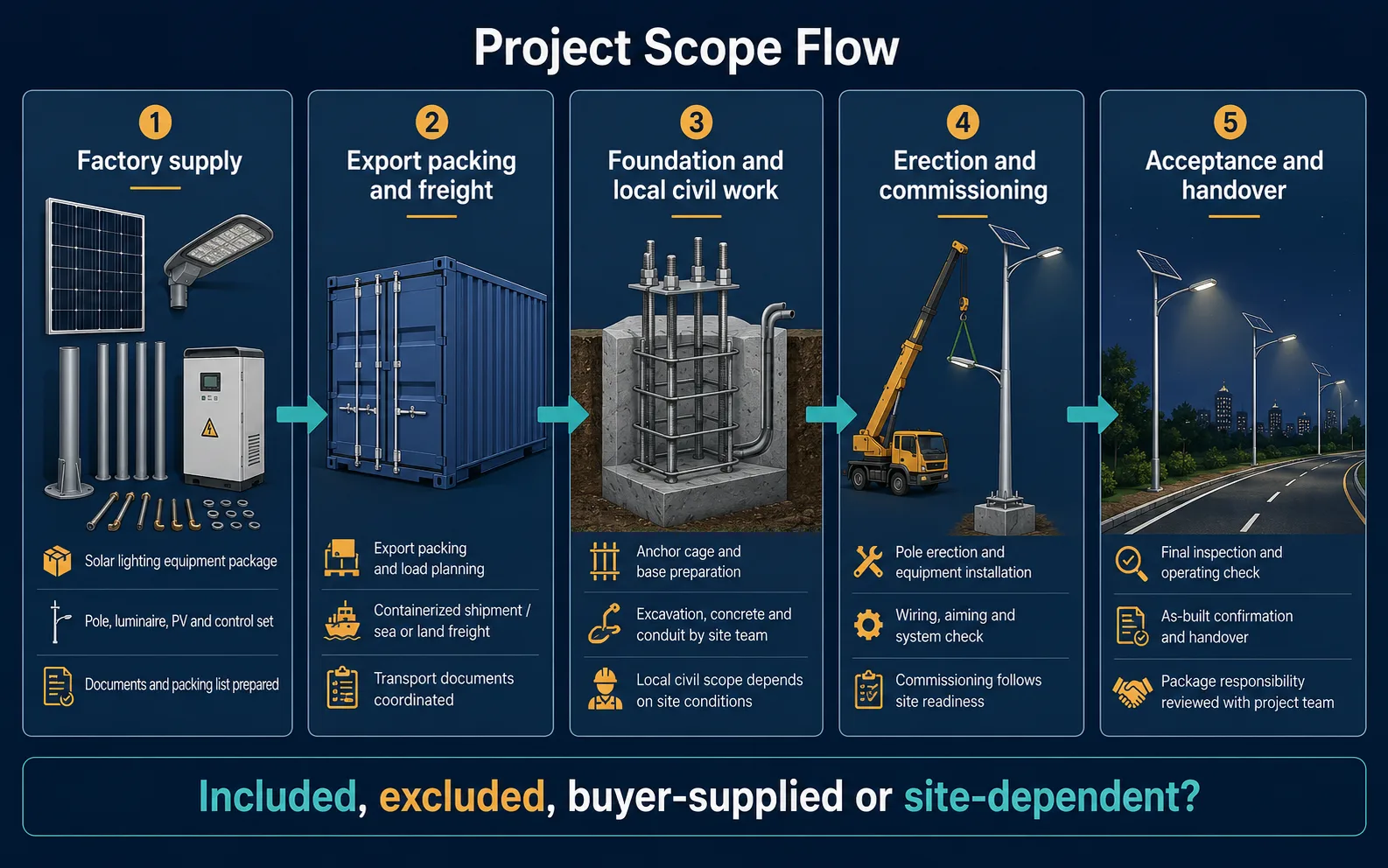
A clean quotation uses words such as included, excluded, buyer-supplied و site-dependent. Ambiguous phrases such as “all accessories” or “installation available” should be converted into named line items before the purchase order.
Freight can change the best package format
Poles and PV modules are not small accessories. Pole section length, package dimensions, pallet/crate arrangement, container loading, battery transport documentation and the unloading method can affect the delivered project cost.
A pole supplied in sections may reduce transport length but introduces a field joint and assembly requirement. A single-piece pole may simplify the shaft but change container and inland-haul constraints. Neither option is automatically better; the correct choice depends on the approved structural arrangement and logistics route.
The buyer should request a preliminary packing list before the commercial comparison is finalized. It should identify package count, dimensions, weights, battery classification/document needs and whether poles, PV modules and luminaires are packed separately.
إن Solar Street Light Price Guide can help organize the wider cost discussion. For this page, the key point is simple: fixture price is not the delivered cost of a complete pole-and-battery system.
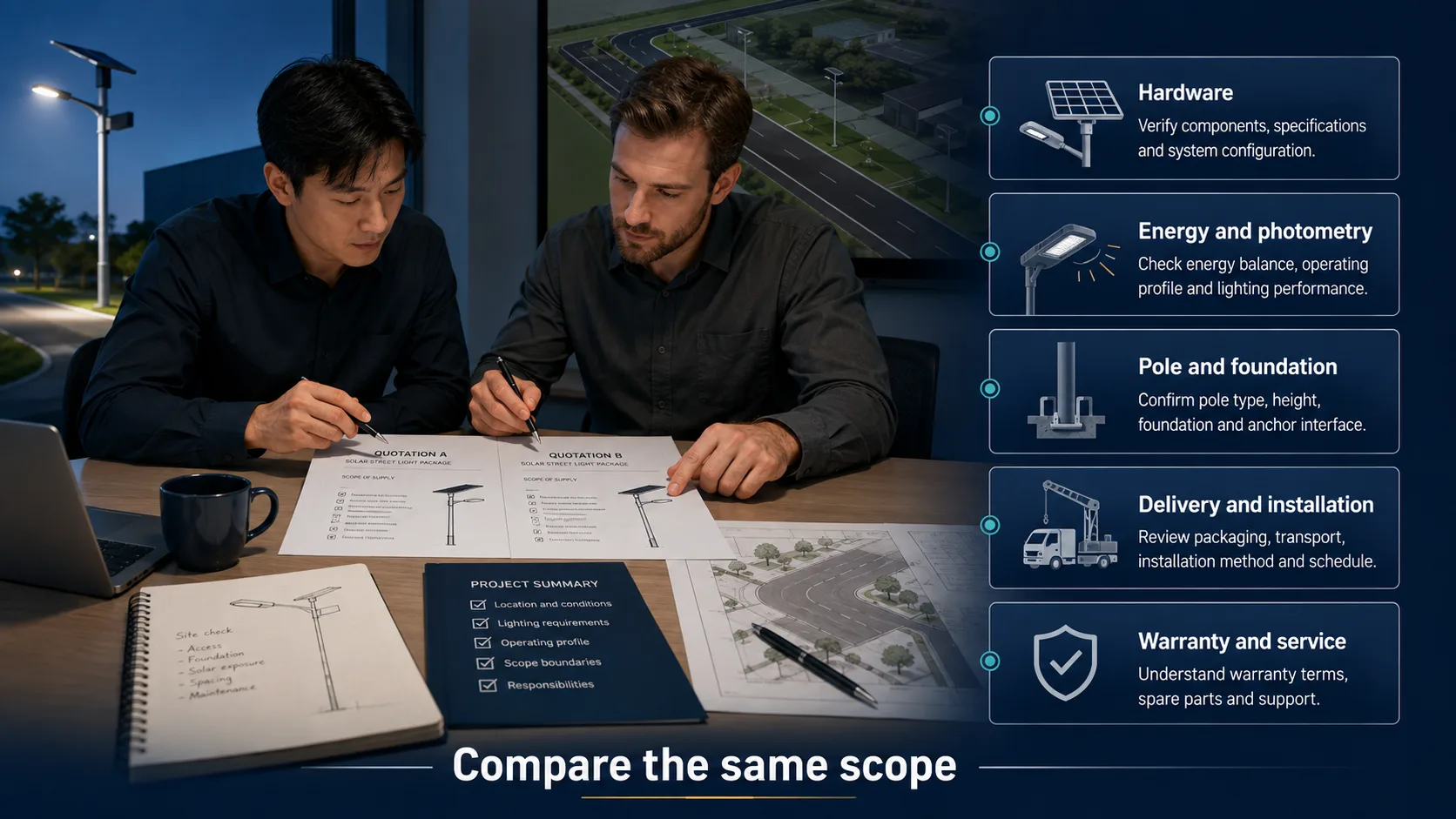
A better way to compare two quotations
Put both offers into the same scope table. Do not compare the bold total until the component and responsibility rows match.
Hardware
- luminaire and optical configuration;
- PV module and mounting frame;
- battery, enclosure and BMS basis;
- controller and operating profile;
- pole, arm, base plate and anchor arrangement;
- cables, connectors, fasteners and surge/earthing provisions where specified.
Engineering
- site assumptions and solar-resource basis;
- energy balance and autonomy definition;
- photometric file or project lighting calculation;
- pole/foundation input data and structural responsibility;
- drawings, wiring information and commissioning criteria.
Commercial and delivery
- Incoterm, destination and unloading responsibility;
- packing list and battery transport documents;
- installation, supervision and local civil work;
- warranty scope, exclusions and service route;
- spare parts and replacement access.
Inlux Solar’s standard warranty is five years. A project quotation should still define the covered equipment and service process; the warranty headline does not fill gaps in the bill of materials or local scope.
Information to send with an RFQ
To receive a package that can be compared and installed, send more than a requested wattage. Include:
- project location or coordinates;
- road/area geometry and intended use;
- required lighting result or applicable project criteria;
- proposed pole height, spacing and arrangement if known;
- nightly operating profile and autonomy target;
- environmental conditions, including wind, temperature, corrosion, dust or flood exposure;
- quantity, destination, Incoterm preference and installation responsibility;
- available soil/foundation information; and
- documents required for tender review, approval and handover.
ابدأ بـ Commercial Solar Street Lights category if the system type is still open. When the project inputs are ready, use للتواصل مع إنلكس سولار to request a reviewed equipment and responsibility schedule.
Questions buyers usually ask
Does a solar street light normally include the pole and battery?
It depends on the quotation. Some products are luminaire kits intended for an existing pole; others are quoted as hardware packages with a pole and battery. Require a bill of materials instead of relying on the product name.
Is installation included in a complete solar street-light package?
Not automatically. Factory supply, freight, local delivery, foundations, erection, wiring, testing and commissioning may be separate responsibilities. The quotation should identify each one as included, excluded, buyer-supplied or site-dependent.
Can I choose the battery by Ah alone?
No. Ah must be read with voltage, usable capacity, operating profile, autonomy, temperature, controller/BMS limits and PV recharge conditions. Ask for the energy basis in Wh.
Can any street-light pole carry a solar panel?
Do not assume so. The pole and foundation need to be reviewed for the luminaire, arm, PV module, equipment mass, projected wind area, local conditions and mounting interfaces.
What is the difference between a solar pole light and a solar street light supplied with a pole?
On the Inlux site, Solar Pole Lights refers to a specific vertical-PV product category. A solar street light supplied with a pole is a broader package description and may use all-in-one, all-in-two or split architecture.
What should I request before comparing prices?
Request the bill of materials, system architecture, operating profile, energy basis, pole and foundation inputs, drawings, packing list, delivery boundary, installation responsibility, warranty scope and acceptance method.