Solar lights work by converting sunlight into DC electricity, storing that energy in a rechargeable battery, and releasing it through an LED after dark. A controller manages charging, protects the battery, and switches or dims the light according to a sensor or programmed schedule.
The basic energy path is:
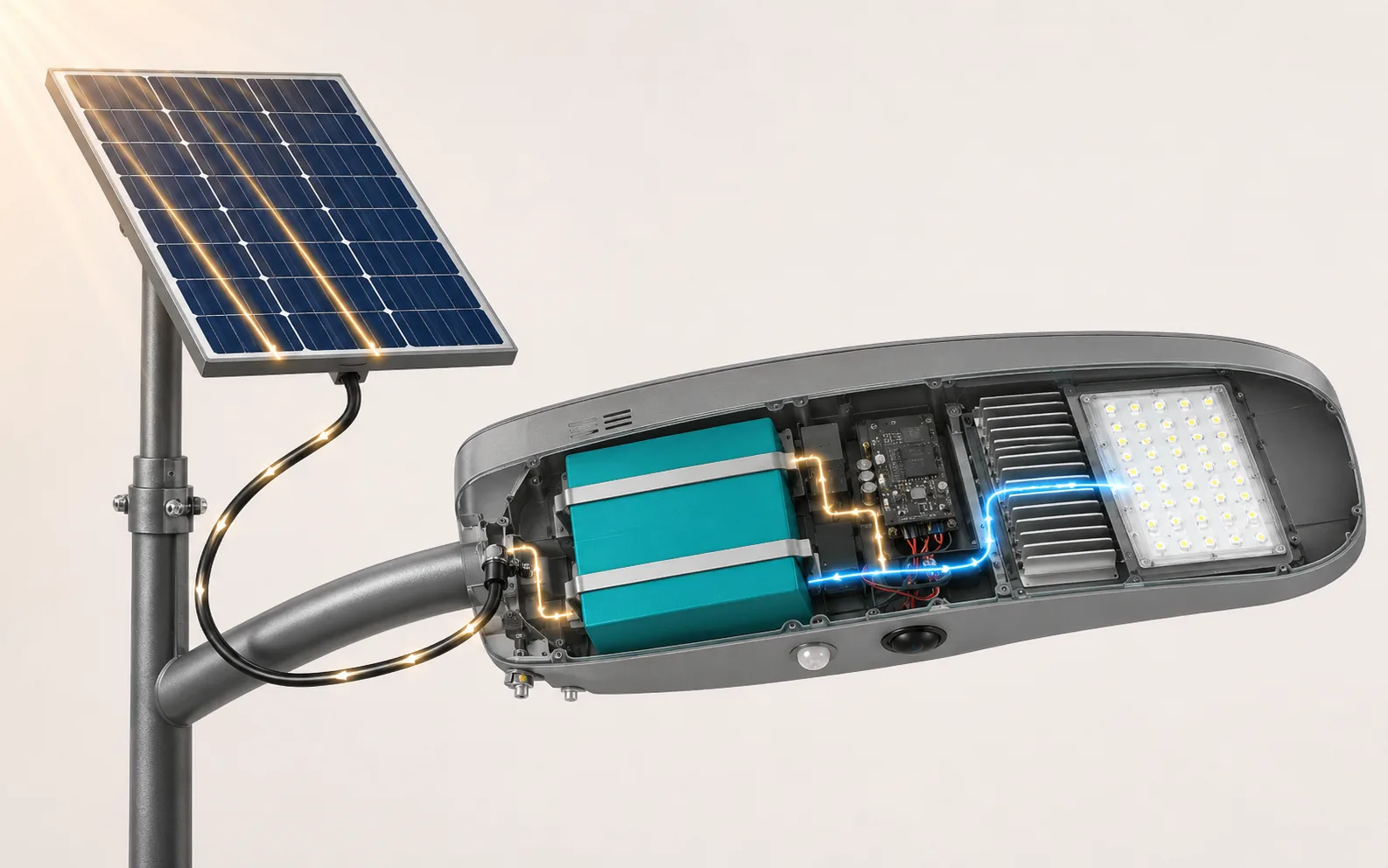
sunlight → photovoltaic panel → controller → battery → LED
That sequence is the same in a small garden light and a commercial solar street light. What changes is the engineering: panel size, battery capacity, LED output, optics, controls, operating schedule, and the number of low-sun nights the system must survive.
The 30-Second Answer
During the day, photovoltaic cells in the solar panel generate electricity. The controller sends that electricity to a rechargeable battery and limits charging when necessary. At dusk, the controller detects darkness through panel voltage, a photocell, or a programmed clock. It then powers the LED from the battery. At dawn, it turns the LED off and starts the charging cycle again.
A solar light therefore does not run directly from sunlight at night. It runs from energy collected earlier and stored in its battery.
The Five Parts Inside a Solar Light
| Parte | What it does | What happens if it is undersized or poor quality |
|---|---|---|
| Photovoltaic panel | Converts sunlight into DC electricity | The battery does not recover enough energy during the day |
| Charge/load controller | Manages charging, battery protection, switching, and dimming | Overcharge, deep discharge, unstable switching, or inefficient operation |
| Rechargeable battery | Stores energy for nighttime use | Short runtime, early dimming, or failure after several cloudy days |
| LED module and optic | Converts electrical energy into controlled light | Low efficacy, glare, dark areas, or wasted light |
| Sensor or control input | Detects day/night or movement and applies the operating schedule | Light turns on at the wrong time or uses more energy than planned |
The U.S. Department of Energy explains that photovoltaic technology converts sunlight into electrical energy using semiconductor PV cells. Individual cells are connected into modules or panels. In a solar light, the generated DC electricity can usually be stored and used directly without the grid-connected inverter required by many building-scale PV systems.
LEDs are used because a limited battery must produce useful light for many hours. DOE states that residential LEDs use at least 75% less energy and can last up to 25 times longer than incandescent lighting. A project-grade solar light still needs a suitable optic: high lumen output in the wrong direction does not create a well-lit road.
How Solar Lights Work Step by Step
1. The panel receives sunlight
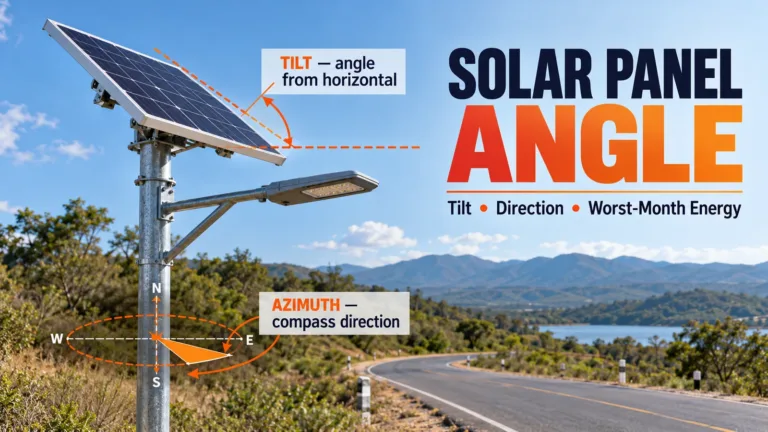
Photons reaching the photovoltaic cells create an electrical response in the semiconductor material. The connected cells produce direct-current electricity. Output changes with irradiance, panel temperature, orientation, shading, dirt, and the electrical operating point selected by the controller.
2. The controller regulates charging
The panel is not connected blindly to the battery. A controller manages voltage and current, prevents damaging overcharge, and may use PWM or MPPT logic. In commercial systems, the controller can also record operating data and apply different lighting schedules by time period.
For a deeper technical comparison, see the MPPT vs PWM solar charge controller guide.
3. The battery stores the daytime energy
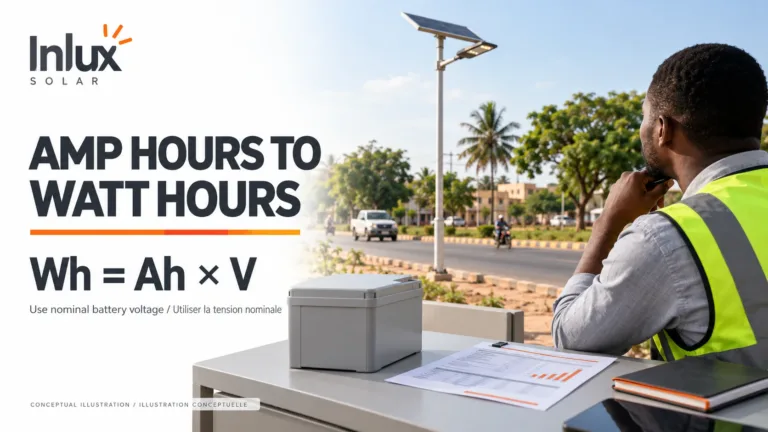
The battery converts incoming electrical energy into stored chemical energy. Battery capacity is commonly expressed in amp-hours, but watt-hours are more useful when comparing systems with different voltages:
Nominal battery energy (Wh) = battery voltage (V) × capacity (Ah)
Nominal energy is not the same as safely usable energy. The design must account for the permitted depth of discharge, temperature, conversion losses, battery aging, and the reserve required for low-sun weather.
4. The controller detects dusk
Many small solar lights infer darkness when panel voltage falls. Others use a separate photocell. Commercial controllers may combine light sensing with an astronomical timer, fixed time blocks, motion detection, or remote commands.
The important point is that the sensor does not create energy. It only decides when and how quickly the stored energy is used.
5. The battery powers the LED
After dark, the controller connects the battery to the LED driver or regulated load. The LED converts electrical power into light, while the optic distributes that light across a path, road, parking area, wall, or landscape.
6. The cycle resets at dawn
At sunrise, the controller turns off the LED and begins another charging cycle. If the previous night consumed more energy than the next day can replace, the battery state of charge falls. Repeated energy deficits are why an apparently bright solar light can work for a few nights and then begin shutting down early.
How Does a Solar Light Know When to Turn On?
Solar lights normally use one or more of these methods:
- Panel-voltage sensing: falling PV voltage indicates dusk; rising voltage indicates dawn.
- Photocell sensing: a separate light sensor measures ambient brightness.
- Timer control: the controller follows a fixed or astronomical schedule.
- Motion sensing: the light stays dim or off until movement is detected.
- Remote control: commercial systems can receive schedules, commands, or monitoring data.
Nearby artificial light can confuse a simple photocell. A porch light or streetlight may make the controller think it is still daytime. Conversely, heavy storm clouds can briefly reduce sensor input. Better controllers use delays or thresholds so the light does not switch repeatedly during short changes in brightness.
Why Solar Lights Need Batteries
The solar panel produces the most energy during daylight, while the LED is needed after dark. The battery separates generation time from use time.
Without storage, a standalone solar light would turn off when sunlight disappeared. The battery also smooths short-term variation caused by clouds and allows the system to deliver a controlled output instead of following every change in panel power.
Battery condition is therefore central to performance. Common signs of battery decline include:
- the light charges but runs for only one or two hours
- runtime becomes much shorter than it was when new
- brightness falls rapidly after switch-on
- the system works after a sunny day but fails after one cloudy day
- the controller repeatedly enters low-voltage protection
For project systems, battery chemistry, usable depth of discharge, temperature range, enclosure design, and replacement access matter more than a large advertised amp-hour number. See the LiFePO4 battery lifespan guide for the design factors that affect service life.
What Changes on Cloudy Days, in Shade, or in Winter?
Solar panels can generate electricity from available daylight without direct sun, but lower irradiance means less daily energy. Several low-sun days can create a cumulative deficit even when the light still turns on each evening.
The practical result depends on four things:
- how much energy the site produces during the design season
- how much energy the LED consumes each night
- how much usable energy the battery stores
- how the controller reduces output when energy is limited
A small decorative light may tolerate shorter runtime. A road-lighting system cannot simply become dark before dawn. It must be sized for the location, minimum-season solar resource, operating schedule, and required backup nights.
For placement tests and practical shade fixes, use the separate guide on whether solar lights need direct sunlight. That page covers charging conditions; this page focuses on the system mechanism.
Garden Lights vs Commercial Solar Street Lights
The same energy chain can serve very different products.
| Design question | Garden or pathway light | Commercial solar street light |
|---|---|---|
| Primary objective | Decorative or local guidance light | Defined roadway, area, or security-lighting performance |
| Solar input | Small integrated panel | Site-sized PV module based on design solar conditions |
| Batería | Small replaceable or sealed battery | Engineered capacity with temperature, aging, and autonomy reserve |
| Control | Basic dusk-to-dawn or motion mode | Multi-stage dimming, time control, motion, monitoring, low-voltage strategy |
| Light distribution | Simple local beam | Photometric optic selected for road geometry, pole height, and spacing |
| Aceptación | Does it turn on and look bright enough? | Illuminance or luminance, uniformity, glare, runtime, structural and electrical requirements |
| Failure consequence | Short decorative runtime | Dark zones, safety complaints, battery damage, or project-wide maintenance cost |
This difference is why a consumer claim such as “12 hours of light” cannot be transferred directly to a municipal or EPC specification. The commercial system must prove the relationship between solar resource, nightly load, battery reserve, optics, pole geometry, and the required operating profile.
The Energy Budget That Decides Whether a Light Lasts All Night
A solar light works reliably only when harvested energy and stored usable energy can support the load.
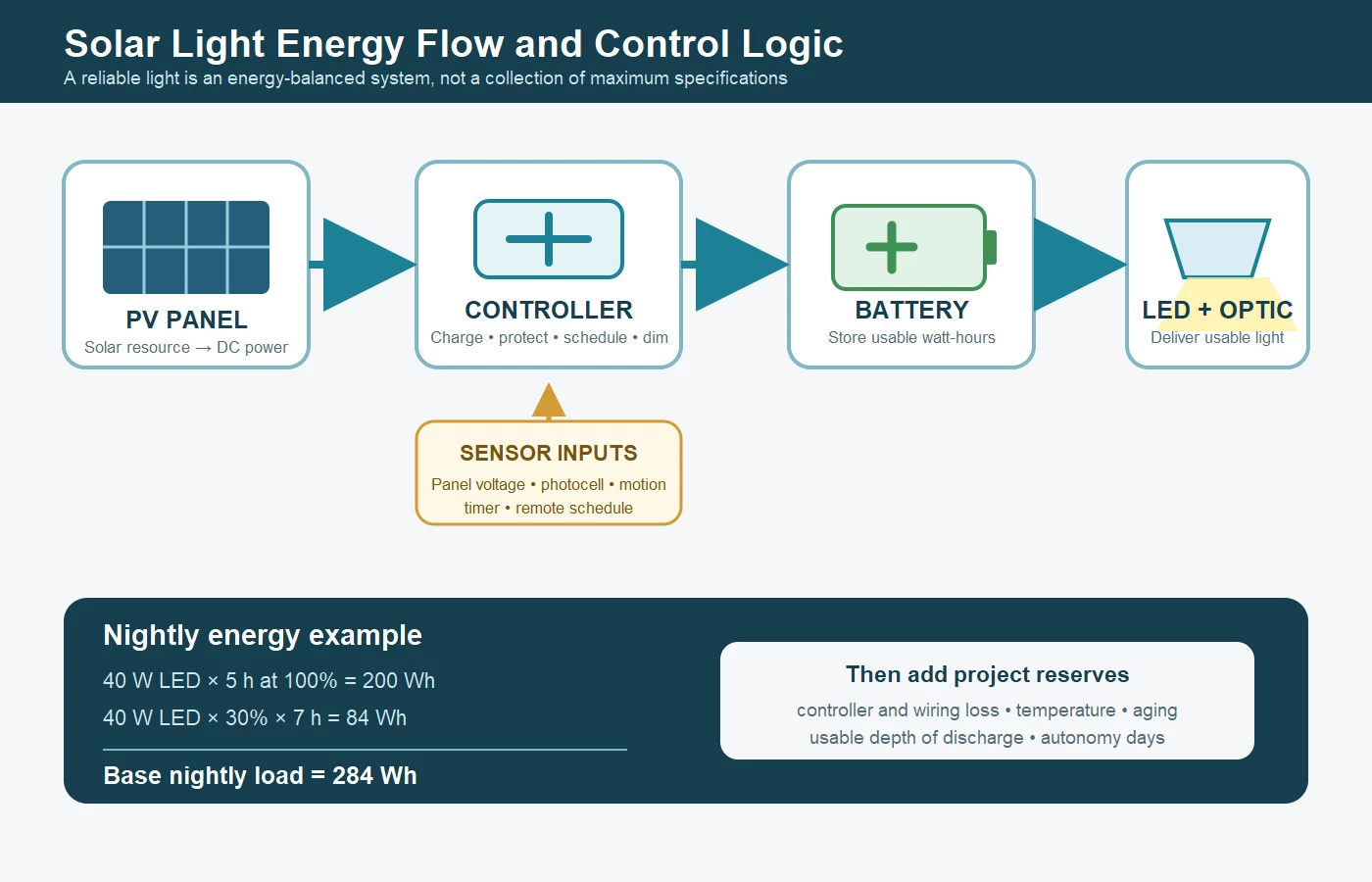
Start with nightly LED demand:
Nightly load (Wh) =
LED power (W) × hours at each dimming level
Illustrative example:
40 W × 5 hours at 100% = 200 Wh
40 W × 30% × 7 hours = 84 Wh

Base nightly load = 284 Wh
This is not yet the required battery size. A project design must then add controller and wiring losses, temperature effects, battery aging, permitted depth of discharge, and the required autonomy.
For three nights of backup, the load alone would be:
284 Wh/night × 3 nights = 852 Wh
The battery’s usable energy must exceed that value after all reserves and limits are applied. The PV module must also be able to replace the expected daily consumption during the relevant design season, not only on an ideal clear day.
Utilice el Calculadora de autonomía de farolas solares to organize the load and backup-night assumptions. A final procurement design should use reliable location data and the actual component curves, not a global average for “sunny hours.”
What the Solar Charge Controller Actually Does
The controller is the energy manager. Depending on the system, it may:
- regulate charging voltage and current
- prevent battery overcharge
- disconnect or reduce the load before damaging deep discharge
- detect dusk and dawn
- apply staged dimming
- respond to motion or traffic
- compensate charging limits for temperature
- record panel, battery, and load data
- communicate alarms or status to a remote platform
MPPT can improve energy harvesting under suitable conditions by operating the panel closer to its maximum power point. That does not make an undersized panel or battery adequate. Controller type, conversion efficiency, voltage architecture, standby consumption, and low-voltage strategy must be evaluated as part of the whole system.
For small garden lights, these functions may sit on one inexpensive circuit board. For commercial lights, controller behavior should be documented because it determines what happens during a cloudy sequence, a battery fault, or an abnormal load.
Why Solar Lights Stop Working
| Symptom | Likely causes to check first | Practical test |
|---|---|---|
| Does not turn on at night | Switch off, shipping tab, sensor sees nearby light, disconnected battery, failed controller | Cover the panel or sensor, confirm switch and connectors |
| Turns off after 1-2 hours | Insufficient daily charge, aged battery, high-power mode, dirty or shaded panel | Give one full-sun charge day and compare runtime |
| Works only after sunny days | Panel/battery reserve too small for the site | Compare state of charge or runtime after clear and cloudy days |
| Light is dim | Low battery voltage, conservative dimming mode, LED/driver issue, dirty optic | Check mode, battery voltage, lens, and programmed schedule |
| Flashes or cycles | Low-voltage protection, loose connection, sensor instability, controller fault | Inspect wiring and measure battery voltage under load |
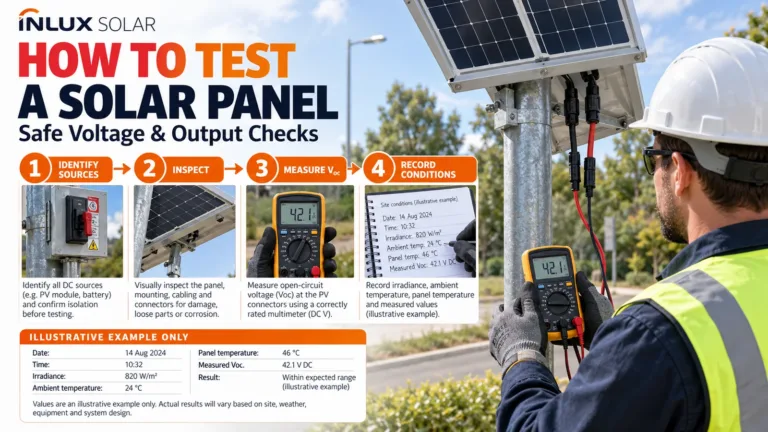
| Stays on during the day | Covered panel, failed photocell, wiring or controller problem | Expose the sensor fully and check panel voltage |
| One unit fails in a larger project | Local shade, connector, battery, LED driver, or controller fault | Swap or compare components with a known-good unit |
| Many units fail at similar times | Design margin, component batch, environmental or schedule issue | Review logs, charging data, operating profile, and common conditions |
Do not replace the battery before confirming that the panel and controller can charge it correctly. A new battery placed into the same energy-deficit system will eventually show the same symptom.
How to Choose a Solar Light That Will Work at Your Site
For a small outdoor light, check:
- whether the panel can see open sky
- whether the panel is separate from the fixture
- battery replaceability
- realistic runtime by operating mode
- motion and low-output settings
- ingress protection and corrosion resistance
- access for cleaning and battery service
For a road, parking, industrial, campus, or community project, add:
- coordinates and minimum-season solar resource
- road or area geometry
- pole height and spacing
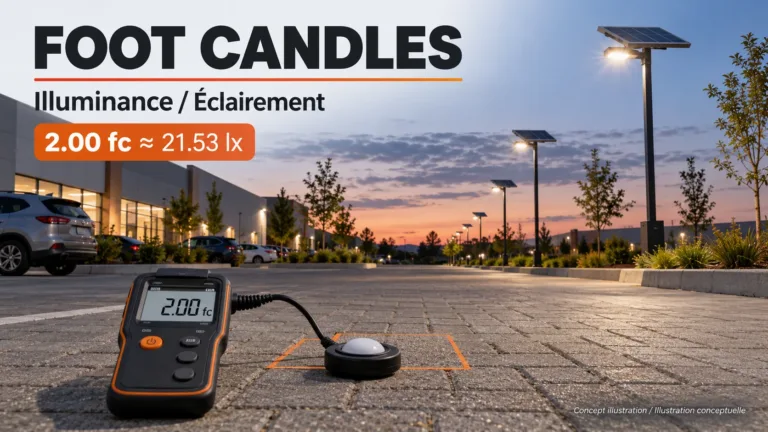
- target illuminance or luminance, uniformity, and glare limits
- IES or LDT photometric file
- nightly operating and dimming schedule
- required autonomy days
- minimum and maximum temperature
- wind, corrosion, dust, flood, and lightning conditions
- battery, controller, surge-protection, and monitoring requirements
- installation, commissioning, acceptance, warranty, and spare-parts scope
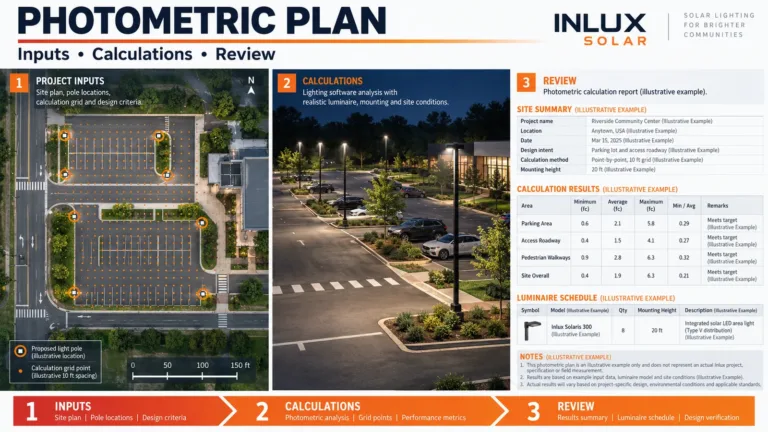
El IES and DIALux project checklist explains how to connect the electrical design to actual lighting performance.
Preguntas frecuentes
How do solar lights work at night?
They use electricity stored in a rechargeable battery during the day. At dusk, a controller or sensor switches the LED on and regulates its output until dawn or until the programmed schedule ends.
Do solar lights charge when they are turned off?
Many products can charge while the lighting load is switched off, but the design varies. Turning the light off can help a depleted battery recover because the panel can charge it without the LED using energy that night. Check the product instructions before assuming the switch affects only the LED.
Do solar lights need batteries?
Standalone solar lights need energy storage if they must work after sunset. The battery stores daytime solar energy and releases it at night. A panel alone cannot provide nighttime power.
How do solar lights know when it is dark?
They commonly sense falling panel voltage or use a photocell. Commercial systems may combine light sensing with timers, motion detection, and remote schedules.
Do solar lights work on cloudy days?
Yes, but the panel normally produces less energy than under strong direct sun. Runtime depends on the daily energy harvested, nightly load, battery reserve, and controller strategy.
How many hours do solar lights work?
Runtime is not fixed. It depends on battery state of charge, LED power, dimming schedule, weather, temperature, shading, panel cleanliness, and battery condition. A defensible commercial specification should show the energy calculation behind the claimed runtime.
How do solar street lights work?
They use the same panel-controller-battery-LED chain as small lights, but the system is sized for a location, lighting requirement, pole layout, nightly schedule, and autonomy target. The optic and photometric design are as important as the electrical components.
Why does my solar light turn off before morning?
The system is spending more energy than the battery can deliver. Common causes are insufficient charging, shade, a dirty panel, an aged battery, high output settings, or a system that was not sized for the season.
From a Simple Solar Light to a Project-Grade System
The working principle is simple. Reliable project performance is not.
Inlux Solar has delivered more than 300,000 total units across 60+ countries and completed 1,000+ projects. The standard warranty is five years. These experience signals do not replace a site-specific design, but they support a workflow based on real location, lighting, structural, battery, and operating inputs.
Explore commercial solar street light systems y el Inlux Solar manufacturing capability, or send the project coordinates, road geometry, pole layout, operating schedule, autonomy target, and quantity for configuration.
Request a project-grade solar lighting design