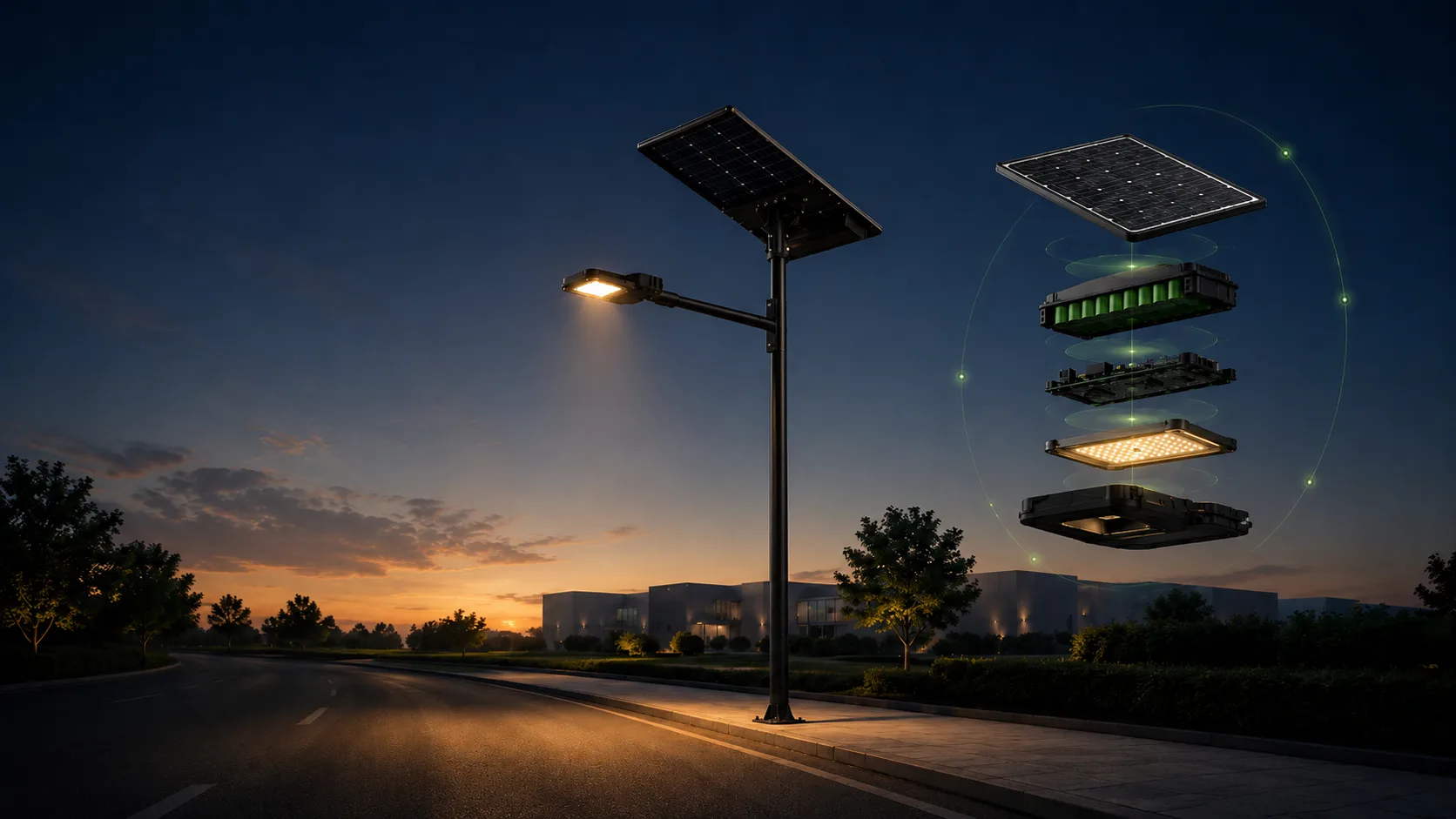
A solar light does not have one universal expiration date. Its panel, battery, LED module, controller, seals, housing, and pole age at different rates. In a serviceable system, the battery or electronics may be replaced while the panel and structure remain in use. Product quality, climate, operating profile, maintenance, and replaceability decide the real service life.
The Short Answer
The most accurate answer is that solar-light service life is determined by the first critical component that can no longer meet the required performance or be repaired economically.
Low-cost sealed garden lights may be discarded when a small battery, switch, or enclosure fails. A project-grade solar street light should instead be designed as a maintainable asset: inspect the system, replace the failed module, verify charging and lighting performance, and keep the rest of the installation in service.
That is why a claim such as “this solar light lasts 10 years” is incomplete unless the supplier also states:
- which component the claim covers
- the test or calculation behind it
- temperature, charging, dimming, and battery-use conditions
- what performance threshold defines end of life
- whether the battery, controller, driver, and LED module are replaceable
- what the warranty actually covers
First, Separate Nightly Runtime from Service Life
Two different questions are often hidden inside “How long do solar lights last?”
Nightly runtime asks how many hours the light operates after one day’s charge. It depends on solar input, battery state of charge, LED load, dimming, weather, temperature, and battery condition.
Service life asks how many months or years the product remains useful before repair, component replacement, or retirement. It depends on component aging, corrosion, sealing, thermal management, electrical protection, maintenance, and spare-parts access.
If your light switches off after two hours or does not reach dawn, use the separate guide on how long solar lights last at night. This page focuses on multi-year service life.
What Usually Reaches End of Life First?
There is no universal order, but the battery and exposed electrical or sealing parts normally deserve attention before the photovoltaic panel or pole.
| System part | What “end of life” can mean | Evidence to request | Can it usually be serviced? |
|---|---|---|---|
| Solar panel | Output has degraded, cells or connections are damaged, glass or backsheet has failed | Module specification, warranty, degradation terms, inspection and output data | Yes, if mechanically and electrically replaceable |
| Batería | Usable capacity or power is no longer enough for the required operating schedule | Chemistry, rated cycles, test temperature, depth of discharge, charge limits, warranty | Yes in a serviceable design |
| LED source | Light output has declined below the design threshold | LM-80 data and a valid TM-21 projection at relevant temperature and current | Often, if the LED module is replaceable |
| LED driver/controller | Unstable output, protection trips, communication failure, charging fault | Efficiency, thermal limits, protection functions, qualification reports, logs | Often |
| Sensors/connectors | False switching, intermittent operation, moisture or corrosion damage | Ingress design, connector rating, inspection record | Often |
| Housing/seals | Water or dust ingress, gasket aging, corrosion, damaged lens | Material, coating, IP test scope, corrosion requirements, field inspection | Depends on construction |
| Pole/mounting | Corrosion, fatigue, loosened fasteners, impact or foundation issue | Structural calculation, material/coating, wind assumptions, inspection | Usually repairable or replaceable by section |
This table is more useful than a single whole-product number because it shows what must be measured when performance declines.
Solar Panel: Long-Lived, but Not the Whole System
The U.S. Department of Energy reports that the average operational lifespan of a solar panel increased to about 25-35 years in 2025 (DOE source). That is a useful reference for the PV module, but it is not evidence that an entire solar light will operate for 25-35 years without service.
A panel can remain physically intact while its daily energy contribution becomes inadequate because of:
- dirt, bird droppings, leaves, snow, or local shade
- cell cracks or damaged interconnections
- delamination, backsheet damage, or moisture ingress
- loose or corroded connectors
- a new obstruction that reduces solar access
- normal output degradation combined with an already marginal system design
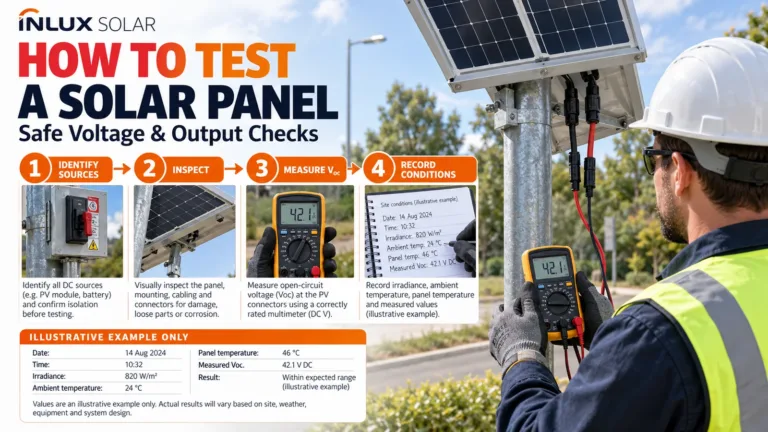
The correct test is not simply “Does the panel produce voltage?” A technician should compare current and power under known conditions, inspect the module and connectors, and confirm that the controller is operating the panel correctly.
The panel may be the longest-lived electrical component, but the system still needs battery, controller, LED, sealing, and structural maintenance.
Battery: The Most Common Planned Replacement
Battery life is often presented as a fixed number of years. That is unreliable without operating conditions.
Battery aging depends on:
- cell chemistry and manufacturing consistency
- operating temperature
- average and maximum depth of discharge
- charging voltage and current limits
- time spent at very high or very low state of charge
- daily load and dimming schedule
- low-sun sequences and autonomy strategy
- cell balancing and battery-management behavior
- enclosure ventilation, sealing, and heat transfer
A cycle-life figure must state the depth of discharge, test temperature, charge/discharge rate, and remaining-capacity threshold. A high cycle count under mild laboratory conditions cannot be transferred directly to a hot roadside enclosure or a system that reaches deep discharge every night.
For procurement, request:
- battery chemistry and cell supplier
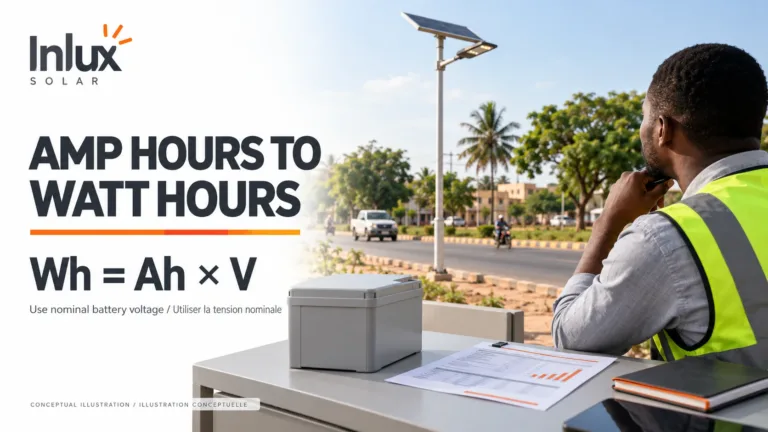
- rated capacity in watt-hours, not only amp-hours
- cycle test conditions and end-of-life capacity threshold
- charge and discharge limits programmed in the controller
- minimum and maximum operating temperature
- battery warranty and replacement procedure
- evidence that a replacement battery can be sourced without replacing the complete luminaire
El LiFePO4 battery lifespan guide explains how temperature, depth of discharge, cell quality, and charging strategy change the result.
Signs that a solar-light battery needs investigation
- runtime is much shorter than the commissioning baseline
- brightness drops quickly after switch-on
- the light works after a clear day but not after a cloudy sequence
- low-voltage protection appears repeatedly
- battery voltage collapses under load
- the battery swells, leaks, overheats, or shows connector corrosion
Do not install a new battery until the panel, controller, wiring, and energy balance have been checked. An undersized or incorrectly charged system can damage the replacement in the same way.
LED Module: Lumen Maintenance Is Not Complete Luminaire Life
LED lifetime claims are often misunderstood.
IES LM-80 and TM-21 provide a test-and-projection framework for LED-source lumen maintenance. The Illuminating Engineering Society states that TM-21 projections should not exceed six times the duration of the collected LM-80 data and warns that LED lumen-maintenance life should not be the sole metric for complete luminaire lifetime.
This creates three important buyer checks:
- Is the claim about the LED source or the complete luminaire?
A chip-level projection does not include the driver, controller, connectors, seals, optics, thermal interface, or housing. - Does the test condition match the product?
LED current and case temperature affect lumen maintenance. A report at a lower current or temperature may not represent the installed luminaire. - What does the threshold mean?
In the IES lifetime-prediction context, L70 means projected output has declined to 70% of initial output. It does not mean the LED suddenly switches off at that hour.
A project can fail its lighting requirement before the LEDs go dark. Dirt, optic yellowing, thermal stress, driver faults, or poor road-light distribution can reduce usable illumination even when the LED source still operates.
Controller, Driver, Sensors and Wiring
The controller decides how the panel, battery, and load interact. The LED driver regulates the light source. Sensors, connectors, and wiring carry small signals and significant power through heat, moisture, dust, vibration, and electrical transients.
There is no defensible universal life number for these parts. Buyers should instead review:
- charging algorithm and battery-voltage limits
- low-voltage protection and recovery behavior
- driver efficiency and operating temperature
- surge and reverse-polarity protection
- standby consumption
- connector sealing and strain relief
- replaceable modules and diagnostic access
- event logs, remote monitoring, or fault codes
A controller can protect battery life through correct limits and dimming, or shorten it through poor charging and repeated deep discharge. The MPPT vs PWM controller guide explains controller architecture, but controller type alone does not prove long service life.
Housing, Seals, Fasteners and Pole
Mechanical parts often receive less attention because they do not appear in an electrical specification. In the field, they determine whether the electronics remain dry, cool, connected, and correctly aimed.
Check the actual environment:
- coastal salt and industrial corrosion
- airborne sand and dust
- heavy rain, flooding, or snow
- high daytime enclosure temperature
- repeated thermal cycling
- wind-induced vibration
- insects or birds entering openings
- cleaning chemicals
- vehicle impact or vandalism
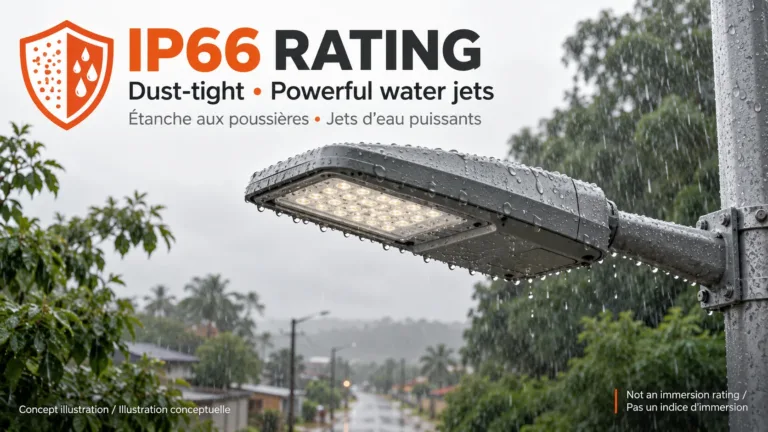
An IP rating describes a defined ingress test; it is not a lifetime guarantee. A corrosion-resistant alloy or coating must also match the site. Gaskets, cable glands, connectors, fasteners, and drainage paths need inspection because a small sealing failure can damage otherwise healthy electronics.
For poles and brackets, service life depends on material, coating, wind assumptions, fatigue, foundation, installation quality, and inspection. Do not infer structural life from the luminaire warranty.
Why Solar Lights Fail Earlier Than Expected
The energy budget was marginal from the start
If the panel and battery were sized for an ideal sunny day, the battery may operate at excessive depth of discharge during the design season. The light can appear successful at commissioning and then deteriorate after repeated low-state-of-charge cycles.
The operating profile changed
Increasing brightness, extending full-power hours, disabling dimming, or adding communication equipment raises nightly consumption. The original panel and battery may no longer support the load.
Heat was underestimated
High temperature accelerates battery aging and stresses drivers, controllers, seals, and LEDs. Air temperature alone is not enough; the battery and electronics can become much hotter inside a sun-exposed housing.
Water entered through a small interface
The main casting may be strong while a gland, connector, lens seal, or service cover leaks. Moisture can create corrosion and intermittent faults before total failure.
The product cannot be serviced
A sealed product with a proprietary battery or potted electronics may be difficult to repair. In that case, the life of one inexpensive component becomes the life of the entire light.
Maintenance was not assigned
Solar lighting is low-maintenance, not no-maintenance. Panels, optics, fasteners, vegetation, connectors, seals, batteries, and operating data still require scheduled attention.
Repair, Replace a Component, or Replace the Whole Light?
| Observation | First action | Replace the whole light only when |
|---|---|---|
| Short runtime but normal daytime charging | Capacity-test battery and review energy logs | Battery is non-serviceable or repeated system faults make repair uneconomic |
| Low charging current | Clean and inspect panel, shade, connectors, and controller | Panel and electronics are both damaged or incompatible with available spares |
| LED output is low but stable | Clean optic, verify driver current and thermal condition | LED/optic/driver assembly cannot meet photometric requirements after service |
| Intermittent switching | Inspect sensor, wiring, connectors, and controller logs | Moisture or corrosion is widespread through a sealed assembly |
| Water inside housing | Identify entry point, dry safely, inspect all electronics and seals | Structural or electrical damage cannot be restored reliably |
| Pole or bracket corrosion | Obtain a structural inspection | Remaining capacity is inadequate or repair cannot meet the design requirement |
| Spare parts unavailable | Compare compatible modules and lifecycle cost | No safe, documented, economically reasonable repair path exists |
The decision should consider safety, photometric performance, energy performance, spare-parts compatibility, labor, access equipment, and the risk of repeat failure. A functioning LED is not enough if the light no longer meets the road or area requirement.
How to Compare Lifespan Claims Before You Buy
Use this evidence ladder:
Stronger evidence
- named standard and complete test report
- model-specific component data
- operating temperature and current matching the offered configuration
- battery-cycle conditions and remaining-capacity threshold
- documented protection settings
- replaceable modules with spare-parts commitments
- warranty scope, exclusions, and response process
- field references in a comparable climate and operating profile
Weaker evidence
- a single large hour or year number
- “premium cells” without cell supplier or test conditions
- LED-chip life presented as whole-luminaire life
- panel warranty presented as complete solar-light warranty
- cycle count without depth of discharge and temperature
- IP rating presented as proof of long-term corrosion resistance
- a project photo without commissioning or follow-up performance data
El solar street light manufacturer sourcing checklist can be used to compare factories, engineering evidence, warranty support, and replacement planning before an RFQ is awarded.
A Condition-Based Lifecycle Plan for Projects
A useful lifecycle plan does not guess an exact battery replacement year for every site. It sets baselines, inspection intervals, performance triggers, and spare-parts responsibilities.
At commissioning
- record panel open-circuit voltage and operating current
- record battery voltage, state of charge, and configured limits
- confirm the dimming schedule and load power
- measure lighting performance at representative points
- photograph seals, connectors, orientation, and surrounding shade
- record controller firmware and configuration
During routine inspection
- clean panel and optic when site conditions require it
- check new shade, vegetation, soiling, corrosion, loosened fasteners, and water entry
- compare runtime and brightness with the commissioning baseline
- review low-voltage events, charging trends, and communication faults
- inspect battery condition and temperature exposure
Trigger service when
- usable battery capacity can no longer support the required schedule and reserve
- charging performance remains below baseline after cleaning and shade correction
- lighting output or uniformity falls below the project requirement
- repeated protection events indicate a component or design problem
- sealing, corrosion, or structural damage threatens safety or reliability
Keep the project maintainable
- standardize replaceable modules where practical
- retain configuration files, photometric files, and bills of materials
- define compatible spare parts
- assign who approves firmware or schedule changes
- budget for access equipment and labor, not only component cost
This approach turns service life into a managed engineering outcome rather than a marketing promise.
Garden Lights vs Project-Grade Solar Street Lights
| Question | Small garden/pathway light | Project-grade solar street light |
|---|---|---|
| End-of-life decision | Often replace the complete product | Diagnose and replace the failed module where practical |
| Batería | Small, sometimes proprietary or sealed | Specified chemistry, capacity, limits, enclosure, and replacement path |
| Lighting requirement | Decorative or local guidance | Defined illuminance/luminance, uniformity, glare, and operating schedule |
| Evidence | Warranty and replaceability may be the best available indicators | Component reports, calculations, photometric files, commissioning data, logs |
| Mantenimiento | Cleaning and occasional battery replacement | Planned inspection, data review, electrical, photometric, and structural checks |
| Failure consequence | Local inconvenience | Dark zones, safety complaints, project-wide maintenance and contractual cost |
For a commercial project, review sistemas de alumbrado público solar as engineered configurations rather than choosing by advertised wattage or one lifespan number.
Preguntas frecuentes
How many years do outdoor solar lights last?
There is no reliable universal number. A sealed decorative light may be retired when its battery or enclosure fails, while a serviceable system can remain useful through component replacement. Check battery conditions, LED evidence, sealing, spare parts, and warranty scope rather than accepting one whole-product claim.
What part of a solar light usually needs replacement first?
The battery is a common planned replacement because its usable capacity changes with cycles, temperature, charging, and depth of discharge. Connectors, seals, controllers, and drivers can also fail earlier depending on environment and design.
Do solar panels last longer than solar-light batteries?
Usually, yes. DOE reports an average solar-panel operational lifespan of about 25-35 years in 2025, while batteries are electrochemical components whose usable capacity depends strongly on operating conditions. The panel figure does not establish the life of the complete light.
Does a high LED-hour claim mean the whole solar light lasts that long?
No. An LED lumen-maintenance projection does not include the battery, controller, driver, seals, optics, wiring, or housing. Ask for LM-80 data and a valid TM-21 projection at relevant conditions, then evaluate the complete luminaire separately.
Is a five-year warranty the same as a five-year lifespan?
No. Warranty is a contractual coverage period with defined terms and exclusions. Service life is the period during which the system meets its required function, including any planned maintenance or component replacement.
Can replacing the battery extend solar-light life?
Yes, when the panel, controller, LED, housing, and wiring remain suitable and the replacement battery is compatible. First confirm that incorrect charging, shade, undersizing, or a controller fault did not cause the original problem.
How often should solar lights be maintained?
The interval depends on dust, rain, vegetation, corrosion, traffic exposure, temperature, and the consequence of failure. Establish a commissioning baseline and inspect often enough to detect charging loss, water entry, corrosion, loosening, and battery decline before service is interrupted.
How long do solar street lights last?
Treat a solar street light as a collection of serviceable components. Its useful life depends on whether it continues to meet electrical, photometric, structural, and runtime requirements and whether failed modules can be replaced safely and economically.
Plan for Service Life, Not a Marketing Number
The best solar-light lifespan claim is not the largest number. It is the claim that defines the component, test conditions, performance threshold, maintenance plan, replacement path, and warranty responsibility.
Inlux Solar has delivered more than 300,000 total units across 60+ countries and completed 1,000+ projects. The standard warranty is five years. Those facts do not replace site-specific lifecycle engineering, but they support a procurement process built around serviceable components, documented configuration, environmental inputs, and planned support.
Review Inlux Solar manufacturing capability or send the project location, lighting requirement, operating schedule, autonomy target, environment, quantity, and maintenance expectations for a lifecycle-oriented configuration.
Request a solar lighting lifecycle and RFQ review