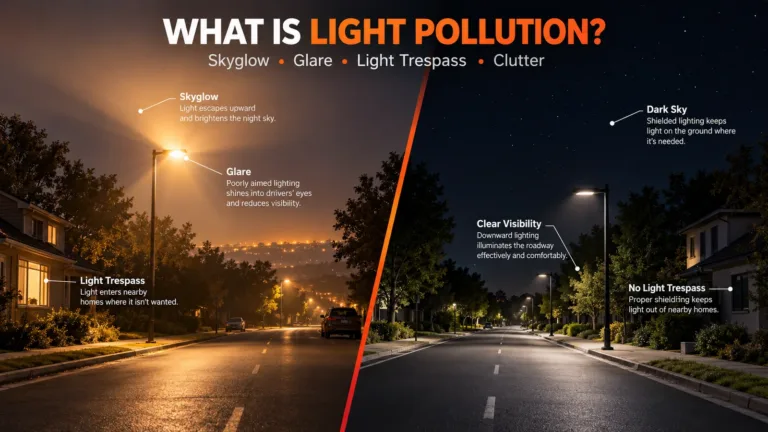
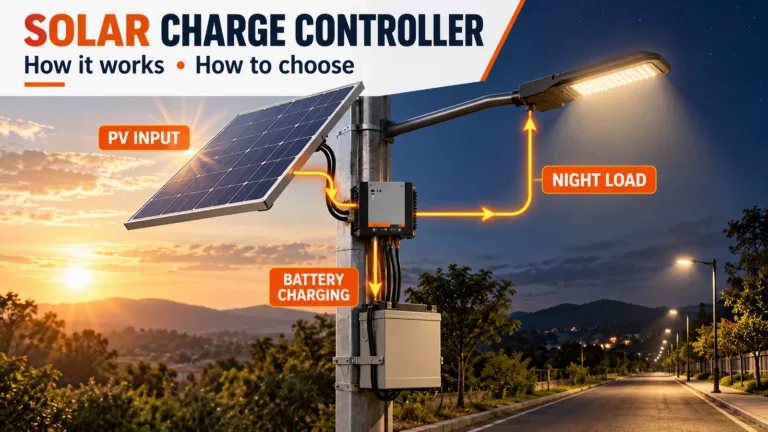
If you’re running a municipal or contractor tender, the fastest way to avoid “apples-to-oranges” bids is to standardize project inputs first. We’ve published a tender-ready Project Input Sheet you can send to any supplier.
Open the Project Input Sheet (Download Page) →
Why this matters
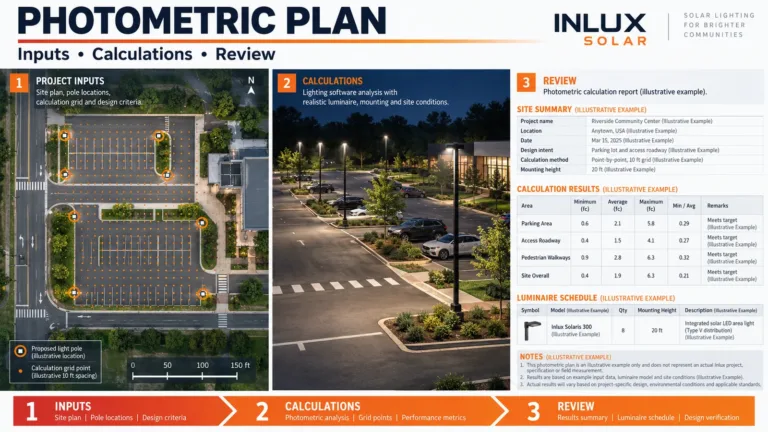
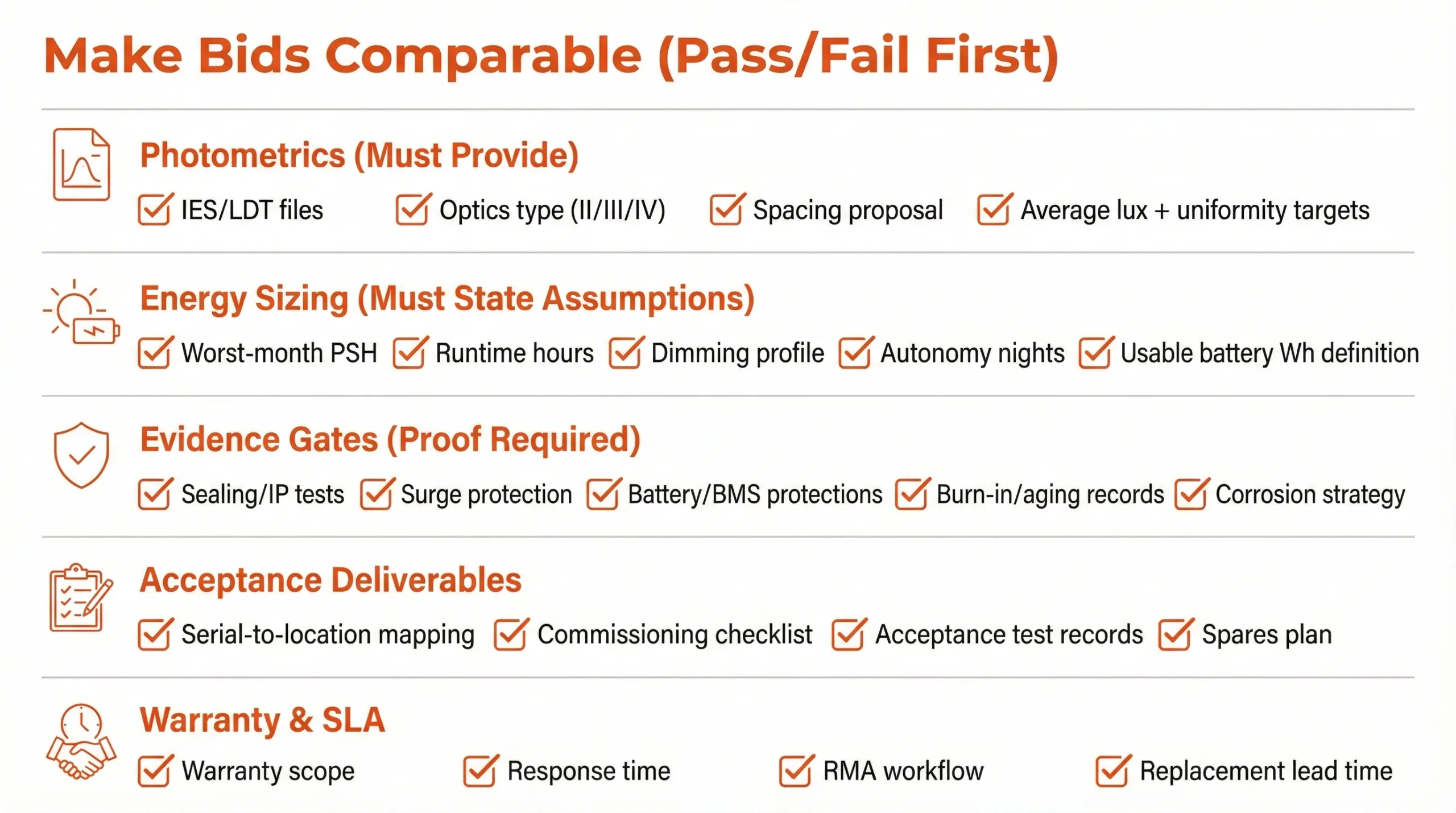
- Photometrics: without IES/LDT inputs, spacing and uniformity become guesswork.
- Energy sizing: without worst-month assumptions, “runtime” claims are not comparable.
- Acceptance evidence: without clear deliverables, you can’t defend decisions or manage warranty risk.
What’s included
- Project Input Sheet (PDF + DOCX): location, road geometry, pole height/spacing, targets, runtime, dimming, PSH, autonomy, environment.
- A clear checklist of what to request (IES/LDT + layout proposal + evidence pack).
How to use it (3 steps)
- Download the template and fill the minimum fields: location, road type, road width, pole height, runtime, worst-month PSH (or location so it can be estimated).
- Send it to suppliers and request tender-ready deliverables: datasheet + model mapping, IES/LDT, spacing/layout proposal, and evidence pack.
- Score bids defensibly using standardized terms and pass/fail evidence gates.

Recommended next steps
- Centro de información para compradores — pick a scenario and run a tender-ready bundle.
- Centro de recursos — engineering library: templates, definitions, and evidence.
- Kit de solicitud de cotización y presupuesto — clauses, BOQ line items, and scoring rubric.
- Centro IES & DIALux — inputs and deliverables for layout validation.
- Definiciones de especificaciones — Normalizar Wavg, Wh útil, autonomía, IP/IK, pruebas de aceptación.
- Calidad y pruebas de evidencia — qué pruebas solicitar (no afirmaciones de mercadotecnia).
- 16-point supplier evaluation checklist — vendor vetting framework that pairs with this tender pack (battery, panel, photometric, warranty, after-sales).
Want a sizing + IES/LDT + spacing proposal?
Send the completed input sheet and your target lux/uniformity to our team.