Quick answer: Type III is a distribution category, not a layout approval
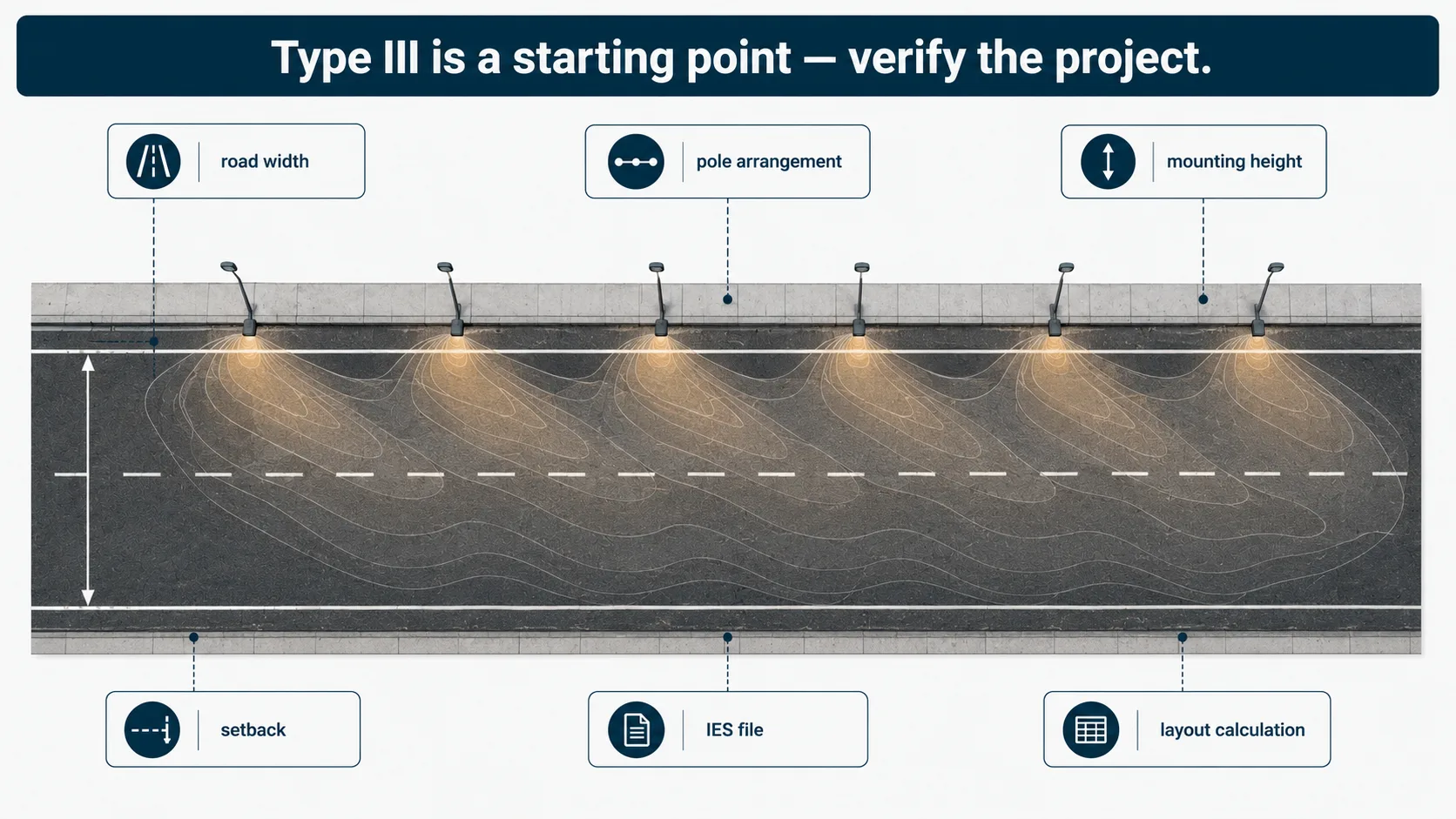
Type III light distribution is a commonly used roadway-lighting distribution category. In a solar street-light project, it can be a useful starting point for discussing how a luminaire sends light across and along the roadway. It is not, however, evidence that a proposed system will achieve the required illuminance, uniformity, glare control, pole spacing, or code outcome on a specific site.
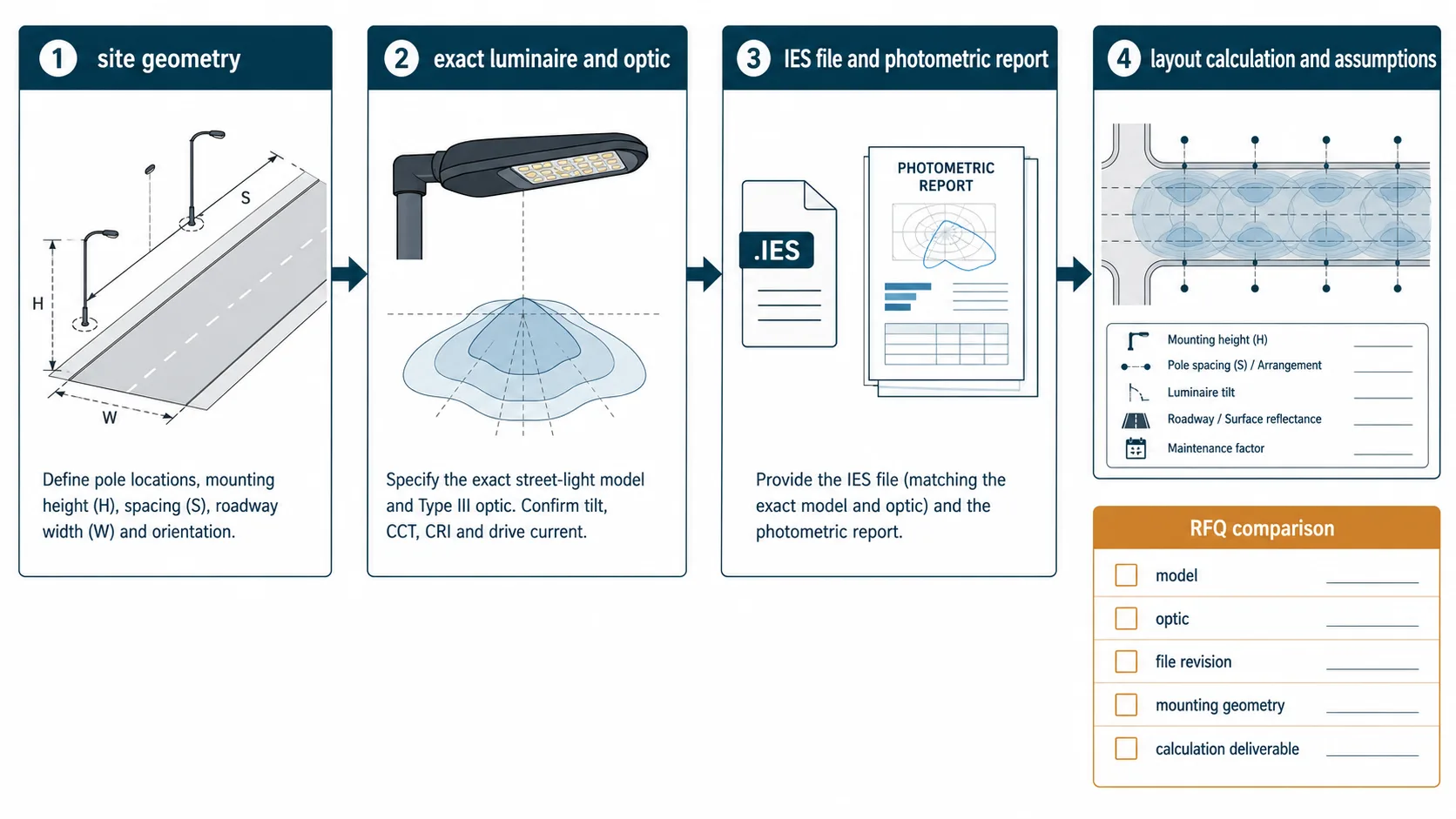
The project decision should follow this sequence: define the road or area geometry, identify the exact luminaire and optic, obtain the matching IES file and photometric report, and run a lighting calculation using the actual mounting and layout assumptions. The Illuminating Engineering Society explains that an .ies file is a standardized digital representation of a luminaire’s light-distribution characteristics and is used by software to predict lighting performance. IES: Información sobre los archivos IES is a useful independent reference.
| Do not decide from the label alone | Decide from the evidence package |
|---|---|
| “Type III” in a quotation | Exact offered model and optic |
| A generic beam illustration | IES file and matching photometric report |
| A spacing claim without inputs | Calculation with road geometry and mounting assumptions |
| One product photo | Layout outputs reviewed against the project criteria |
For a file-level review, use the existing how to read an IES file guide. This page focuses on the decision before that review: what Type III can and cannot tell a project buyer.
What “Type III” means in a project conversation
Roadway distribution names are a way to describe how a luminaire distributes light. They help an engineering team discuss optical intent, but they do not replace the underlying photometry. The IES roadway and parking-facilities practice covers design techniques and criteria for streets, roadways, parking lots, intersections, and related outdoor facilities. ANSI/IES RP-8-25 + E2 shows why the layout context matters: a road, parking facility, intersection, and work zone do not share one universal design condition.
In practical RFQ language, a Type III request should lead to questions such as:
- Which exact luminaire and optic are proposed?
- What is the road width, number of lanes, curb/sidewalk condition, and pole side or arrangement?
- What mounting height, arm length, overhang, tilt, and setback are assumed?
- Which IES file revision and photometric report match the quotation?
- What lighting calculation and assumptions will be delivered for review?
Without those answers, “Type III” remains a category label. It does not prove how much light reaches the critical area, whether dark zones appear between poles, or whether the installation can be accepted by the project authority.
Why the same Type III label can produce different field results
Two luminaires described with the same distribution family can still perform differently in a layout. Their measured luminous-intensity pattern, total output, optic variation, mounting position, and control setting can all differ. The IES notes that IES files contain intensity data by angle and are interpreted by lighting software to predict light levels in the built environment. That is why a label must be checked against a file for the actual offered configuration, not a generic image or a file from a related model.
| Variable | Why it changes the layout decision | What to put in the RFQ |
|---|---|---|
| Exact luminaire and optic | A family name does not identify the measured configuration. | Model, optic, LED/driver setting, and IES-file revision. |
| Road or area geometry | The target pavement and adjacent areas define where light is needed. | Width, lane count, sidewalks, medians, crosswalks, curbs, and conflict areas. |
| Disposición de los postes | Single-sided, opposite, and staggered layouts create different coverage tasks. | Pole-side arrangement, set-back, arm/overhang, and mounting height. |
| Spacing and tilt | These affect overlap, hot spots, dark zones, and spill. | Proposed spacing, tilt, aiming, and all calculation assumptions. |
| Project criteria | The required result may include more than average light level. | Applicable authority/client criteria and calculation outputs required for review. |
El street-light spacing guide explains why height and spacing cannot be used as a fixed formula. Use it for the spacing discussion; use a project calculation to validate any actual layout.
Type III versus Type II, IV, and V: ask a layout question, not a “best optic” question
Type II, III, IV, and V are common outdoor distribution categories. They are not a universal ranking from weak to strong or narrow to wide. A useful procurement exercise is to connect each label to the geometry that has to be served and the evidence that must be reviewed.
| Distribution question | What the buyer should clarify before choosing | Evidence needed |
|---|---|---|
| Is the roadway or paved strip relatively narrow, broad, curved, or irregular? | Define the actual surface and the critical zones, rather than selecting by product-family name. | Site plan with dimensions and target areas. |
| Are poles on one side, on both sides, or staggered? | Pole arrangement changes the path the luminaire must cover. | Pole layout, setback, mounting height, arm and tilt. |
| Is the objective roadway coverage, a parking area, an intersection, a perimeter, or a pedestrian path? | Different applications can require different optical priorities and criteria. | Project criteria and a calculation built for that application. |
| Is the Type III optic being offered for a named product? | Confirm that the label refers to an available, tested configuration. | Exact IES file, photometric report, datasheet, and quote match. |
For example, a wide road, a parking area with drive aisles, and a perimeter route may each have different geometry and glare/spill constraints. Do not assume a Type III designation is automatically the correct answer for all three. If the site includes parking areas, review the application requirements through luces solares para estacionamientos; if it is a road project, see road and street lighting. The final selection still requires an exact photometric file and project calculation.
The minimum evidence package for a Type III solar street-light proposal
Solar street lights add system-level questions—energy availability, operating schedule, controls, and installation configuration—but the optical evidence must still correspond to the actual luminaire configuration. A useful comparison pack contains the following items.
1. An IES file that identifies the offered configuration
The IES describes IES files as digital representations of luminaire light-distribution characteristics. Request a file that names or can be traceably matched to the quoted model, optic, light-source configuration, and tested setting. Do not accept a file from a different wattage, optic, product revision, or non-solar fixture as proof for the offered system without a clear engineering explanation.
2. A matching photometric report and data sheet
The file should be accompanied by a report or documentation that makes it possible to check identity and scope. The purpose is not to create paperwork for its own sake; it is to prevent a visually similar but different optic or configuration from being substituted after the layout is approved.
3. A calculation with disclosed assumptions
The calculation should state the roadway or area geometry, pole layout, mounting height, spacing, arm/overhang, tilt, and any relevant target criteria. The existing IES & DIALux resource center lists the inputs and deliverables that make a road-lighting calculation auditable. A calculation cannot be meaningfully reviewed when those inputs are absent.
4. A configuration and installation check
Confirm that the offered installation has the same mounting orientation, arm, pole height, optic, tilt, and controls assumed in the calculation. A correct IES file can still be used incorrectly if the field installation changes the geometry used in the layout.
A copy-and-paste Type III RFQ clause
Use the following wording as a procurement starting point. It must be checked against the project’s applicable codes, authority requirements, and engineering specification.
For each offered outdoor solar street-light luminaire, the supplier shall identify the exact model, optic/distribution designation, tested configuration, and IES file revision. The supplier shall provide a matching photometric report and a project-specific lighting calculation based on the stated road or area geometry, pole arrangement, mounting height, arm/overhang, setback, spacing, tilt, and applicable project criteria. Any change to the luminaire, optic, LED/driver setting, mounting configuration, or control setting after calculation approval requires an updated IES file and calculation for review.
This clause does not require a project to choose Type III in advance. It requires the supplier to make the proposed optical choice reviewable and comparable.
How to compare two quotations that both say “Type III”
If two bids both list Type III, compare the documents and assumptions—not only the words in the specification column.
| Bid-comparison field | Supplier A | Supplier B | Buyer decision note |
|---|---|---|---|
| Exact model and optic | A label without a model/optic cannot be traced. | ||
| IES file name and revision | Confirm it matches the quoted configuration. | ||
| Photometric-report reference | Check scope and traceability. | ||
| Road/area geometry used | The calculation must use the real layout. | ||
| Pole and mounting assumptions | Compare height, spacing, setback, arm and tilt. | ||
| Calculation output and criteria | Check what was evaluated, not just a pass statement. | ||
| Change-control commitment | Require an updated file/calculation if configuration changes. |
This comparison is particularly important when moving from a concept layout to a purchase order. A solar street-light system should be reviewed as a project configuration, not reduced to an optic name. For the system-level selection path, see the solar street-light system overview.
From a Type III question to an engineering-ready request
Start with a basic site package: plan dimensions, road/area use, pole locations, mounting constraints, site photos, desired operation schedule, local environmental conditions, and any authority/client criteria. Then ask for the exact luminaire/optic, matching IES data, and a calculation whose assumptions can be checked. This keeps Type III in its proper role: a useful optical starting point, not a substitute for engineering evidence.
If you are preparing a roadway, parking, municipal, industrial, or perimeter-lighting RFQ, contact Inlux Solar with the site plan and required deliverables. Request an evidence-led comparison for the quoted configuration instead of a generic promise about coverage or spacing.
Preguntas frecuentes
Is Type III light distribution good for solar street lights?
It can be a relevant distribution category, but it is not a universal product recommendation. The appropriate optic depends on the actual roadway or area geometry, pole arrangement, mounting conditions, project criteria, and the photometric performance of the exact offered configuration. Request the matching IES file and a calculation before deciding.
Does Type III tell me the correct pole spacing?
No. A distribution label does not establish a fixed spacing. Pole height, road width, setback, arm/overhang, tilt, output, the actual intensity distribution, and project criteria all affect a layout. Treat a spacing claim without its photometric file and calculation assumptions as unverified.
What should an IES file match in a quotation?
It should be traceable to the exact offered luminaire, optic, tested configuration, and relevant operating setting. Also request a matching photometric report and verify that the model, optic, file revision, mounting assumptions, and calculation inputs are consistent with the quotation.
Is Type III the same as a DIALux calculation?
No. Type III is a distribution category; a DIALux calculation is a project model that uses photometric data and site inputs to predict results. A calculation is only useful when its geometry, mounting conditions, luminaires, file revisions, and criteria are disclosed and match the proposed installation.
Can two Type III fixtures produce different results?
Yes. The Type III label does not establish identical intensity patterns, output, mounting assumptions, or site geometry. Compare the exact IES data, photometric report, luminaire configuration, and project-specific calculation rather than treating the category name as proof of equivalent performance.