An MC4 connector is part of Stäubli’s photovoltaic DC connection family; MC4 is a protected trademark, not a universal name for every black solar plug. Before buying a replacement or approving a solar-light cable assembly, identify both mating parts, their permitted cable and their installation conditions. Two connectors that click together are not automatically an approved pair.
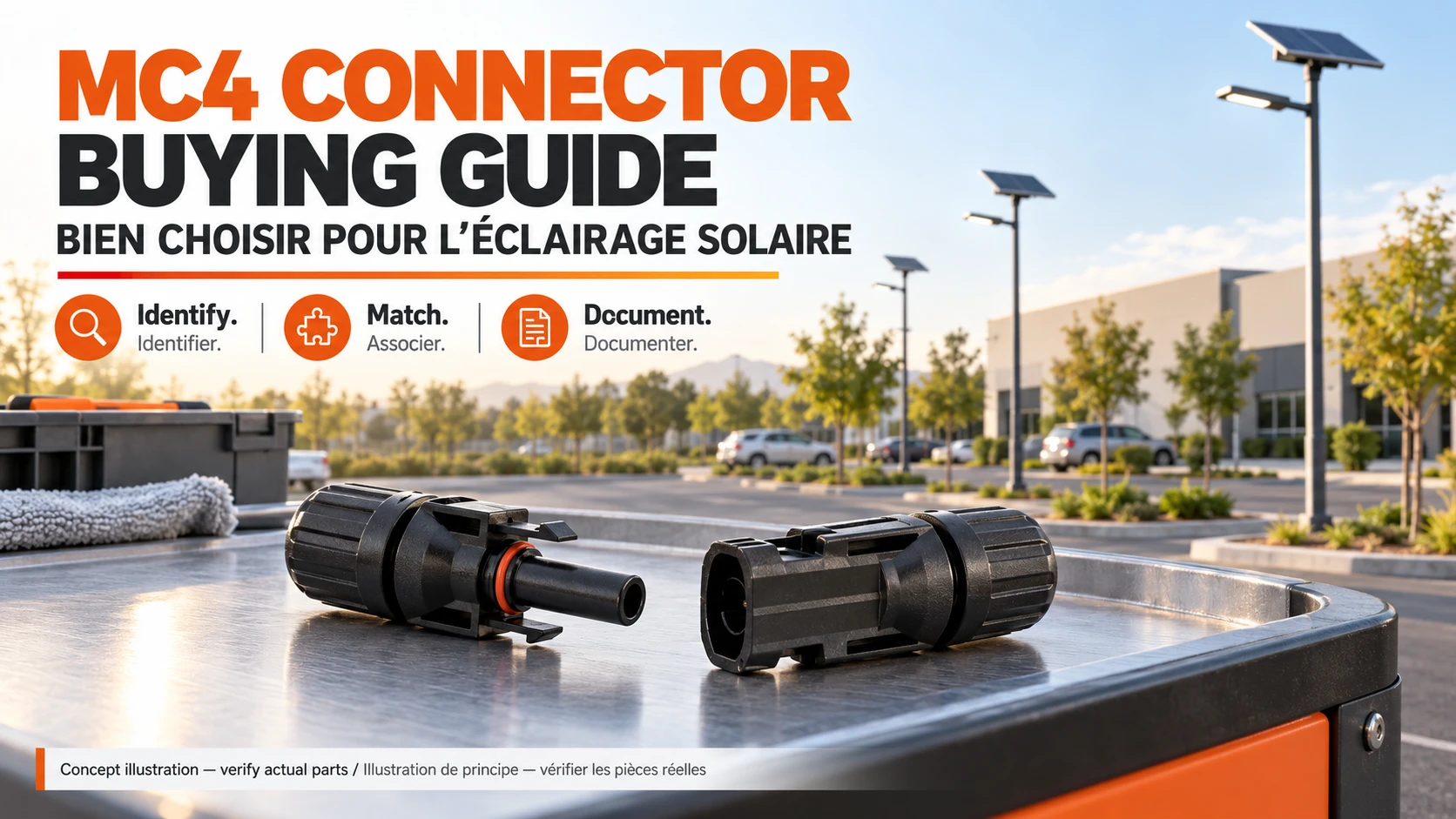
What is an MC4 connector—and what does the name not prove?
PV connectors join parts of a solar DC circuit through a specified contact and housing system. For a buyer, the important distinction is between an identifiable component and a description such as “MC4 type” or “MC4 compatible.” A familiar outline is not a manufacturer reference, and an online product photograph is not a compatibility statement.
The source for the name and family is Stäubli’s Original MC4 product explanation. It identifies the trademark and its product family. This guide is independent procurement guidance: it does not claim that Inlux uses Stäubli parts in every product or that one connector suits every solar panel.
MC4 connector types: identify the family before ordering
A cable coupler, a branch connector and a panel-mounted receptacle do different jobs. Do not order by appearance alone. Ask for the manufacturer, product family and exact references of both sides of the intended connection, including the supplied contacts and sealing parts where applicable.
Product families also develop over time. Stäubli’s published range includes Original MC4, MC4-Evo 2, MC4-Evo ready and MC4-Evo 2000. These names are not interchangeable purchasing descriptions. The supplier should identify the selected version and the manufacturer-documented mating combination, rather than assume that a newer name means a universal upgrade.
| What is being bought? | Identify before approval | Unhelpful shortcut |
|---|---|---|
| Cable-to-cable connection | Both connector references and their permitted cable assembly | “Two MC4-looking plugs” |
| PV extension lead | Both ends, installed route length, cable specification and assembly source | “A longer solar wire” |
| Branch connector | Exact model and the system designer’s approved circuit arrangement | “It has enough sockets” |
| Panel or equipment receptacle | Equipment-side interface and the approved mating lead | “The housing fits the opening” |
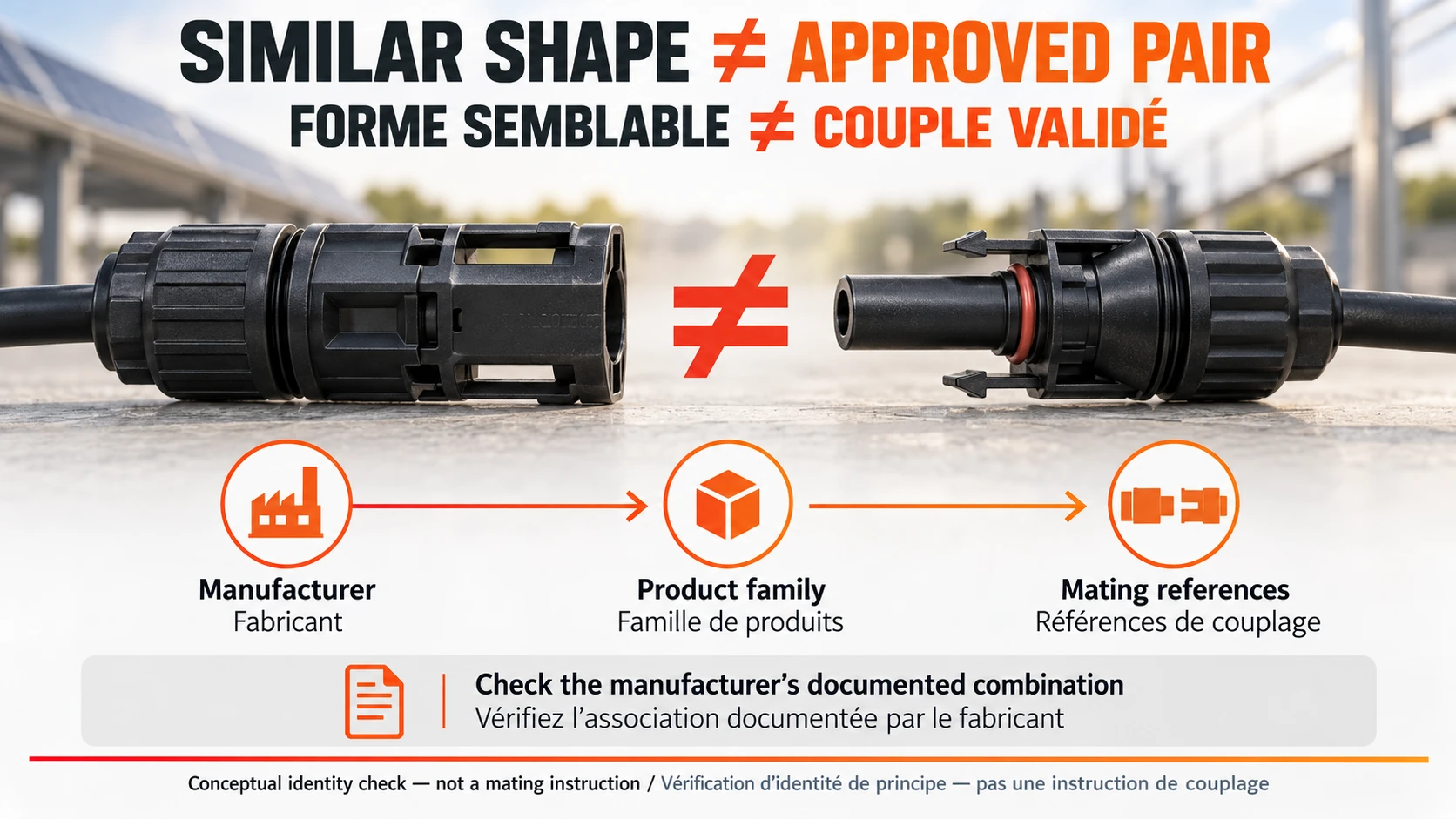
A similar shape is not permission to cross-mate
Stäubli’s warning is specific: do not cross-mate its connectors with another manufacturer’s products advertised as compatible. Read the manufacturer’s cross-connection safety explanation. Physical engagement alone does not resolve contact design, materials, tolerances or the applicable product approval.
Conversely, “always the identical model name” is too simplistic. The original manufacturer may document approved combinations within its own family. Obtain that specific evidence and keep it with the equipment record. Do not extend it to lookalike parts, another manufacturer or an unidentified replacement found in stores.
For a municipal or EPC order, make substitutions visible. If the factory-fitted panel lead, extension lead or equipment-side connector changes, the purchase record should show which interface changed and who approved the resulting combination. Keeping the original line description while quietly changing one half is not a like-for-like replacement.
Cable cross-section and jacket diameter are two separate checks
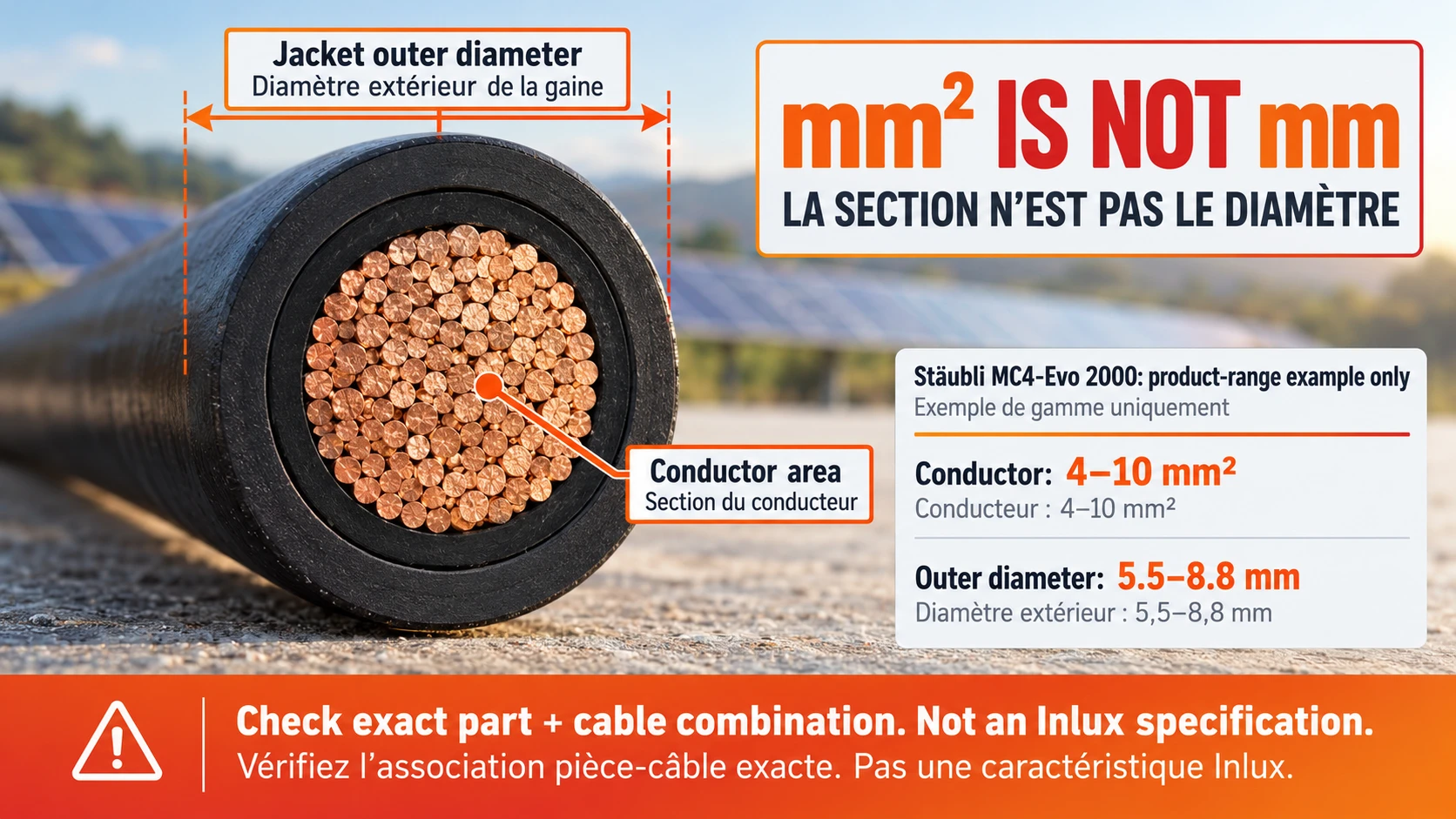
Cable cross-section describes conductor area, normally in mm². Outer diameter describes the outside of the cable jacket, in mm. Both can matter when selecting contacts and a permitted seal arrangement. A cable described only as “4 mm² solar cable” does not fully identify the connector-and-cable combination.
A documented example appears in the Stäubli PV DC connector range: the MC4-Evo 2000 section lists PV wires of 4–10 mm² and outer diameter 5.5–8.8 mm. These are product-range figures for that named family, not a universal MC4 rule, an Inlux specification or permission to combine any cable and part within those ranges.
The purchasing task is to obtain the exact selected part’s permitted cable specification. Do not infer an acceptable cable from the connector name, and do not replace a specified seal or contact with a visually similar item. Assembly details, tools and tightening requirements belong to the current instructions for the actual product, not a generic web chart.
Read the rating for the complete installed connection
A headline voltage or current is not the whole specification. Ask which cable size, temperature conditions and assembly arrangement support the declared rating. The system designer must also check the module, controller, cable route and other relevant limits. A connector with a higher advertised rating does not approve the rest of the circuit.
Water protection needs equally specific boundaries: identify the mating pair, cable entry, permitted state of assembly and exposure conditions. An unused end awaiting installation is not the same situation as a completed connection. Protection during transport, installation and service should be assigned, not left to the installer to improvise.
For the wider enclosure question, consult the Inlux IP66 rating guide for outdoor lighting. Connector selection remains a separate interface decision. Do not transfer a lamp-head enclosure claim to a joint under the panel or to an unverified replacement lead.
Bring the connector question back to the solar street light
Not every solar panel or solar street light uses the same field connection. Inlux’s current All-in-Two solar street-light collection lists FALCON, JAGUAR and BISON. That identifies real product families to discuss; it does not establish that they all use MC4 or share a cable assembly.
Ask how the selected configuration connects its separate PV module, lighting head, controller and battery assembly. The interface and access requirements can differ between the Inlux integrated All-in-One collection e Inlux Split Type solar street lights. Confirm the quoted model rather than choosing an architecture from a connector photograph.
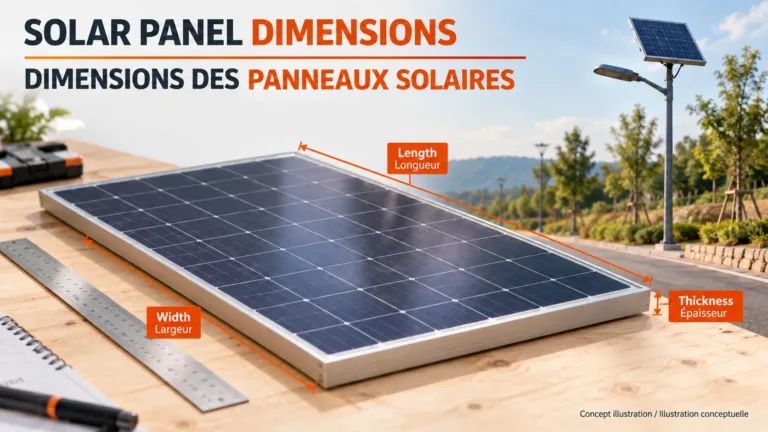
If a panel is being changed, connector approval is only one part of the decision. The module’s electrical characteristics and physical fit still need review. The solar-panel wattage buying guide e solar-panel dimensional-fit guide cover those separate checks.
What to put on the cable-assembly order and handover record
| Purchase record | Useful answer | Decision it supports |
|---|---|---|
| Both end identities | Manufacturer, family and exact references, including the existing equipment-side part | A documented mating combination rather than a visual guess |
| Cable assembly | Cable designation, conductor area, jacket diameter, required route length and assembly source | A complete specified lead rather than loose, unidentified parts |
| Installed conditions | Routing, support, access and the manufacturer’s applicable electrical and environmental conditions | Suitability of the connection in the actual configuration |
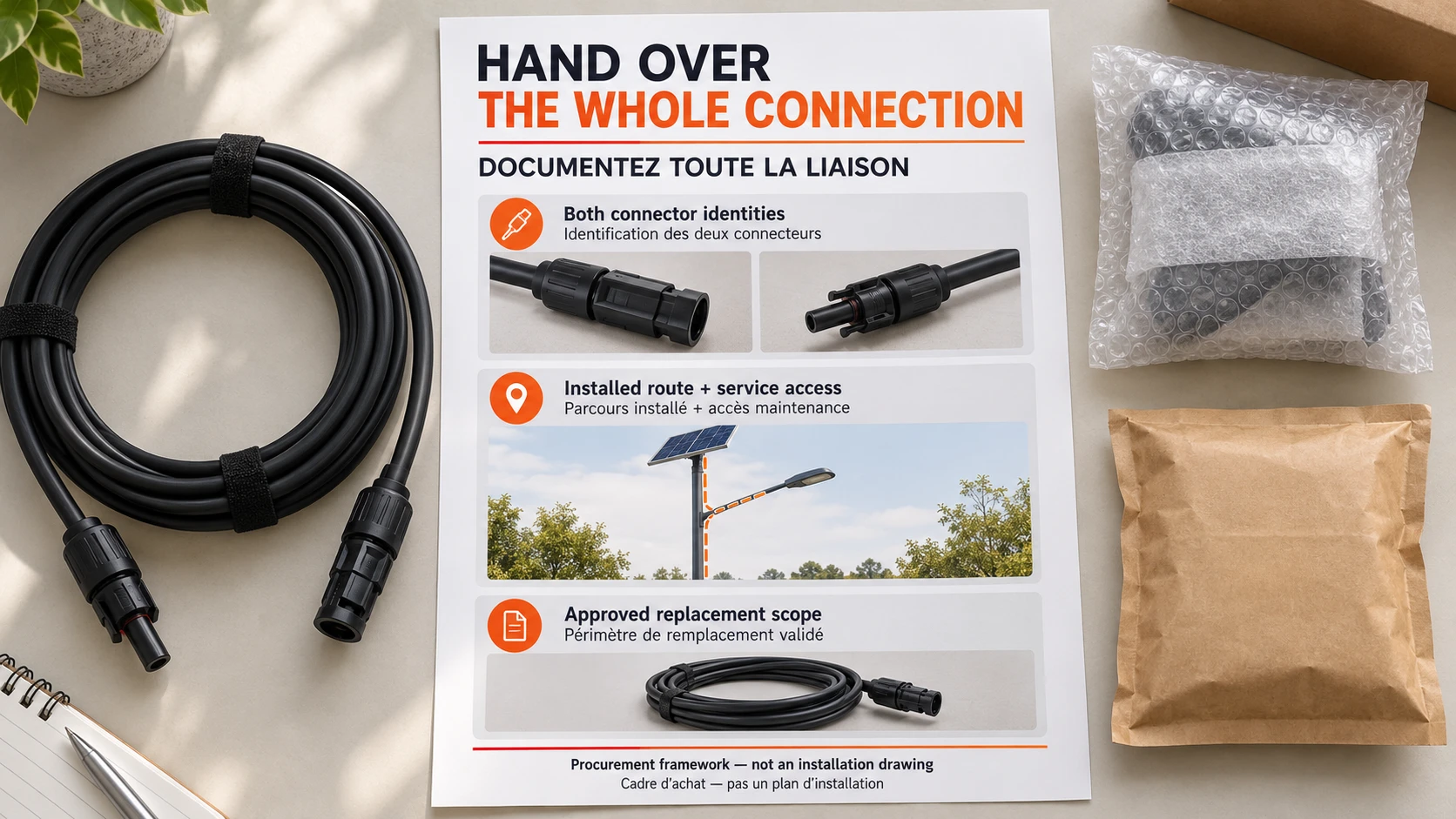
| Replacement responsibility | Approved replacement scope, identification record and qualified service route | Whether the order is for one part, a complete lead or a larger assembly |
Keep replacement parts traceable to the installed equipment. A complete, supplier-approved lead may be a different service proposition from loose housings and contacts requiring field assembly. Ask who supplies, assembles and checks the connection and what the receiving team must identify at handover. Do not assume a component bag resolves all of those responsibilities.
Connection work must be carried out by qualified personnel under the applicable product manuals and site procedures. This article is not a crimping, polarity-testing or live-disconnection procedure. Do not use fit, colour or an assumed male/female convention as a substitute for the equipment’s documented electrical identification.
Ask for a matched lighting assembly, not just a connector price
For a new road or parking project, send the site location, selected product family, intended panel arrangement and service-access constraints. For an existing installation, supply accessible equipment labels and part references without opening sealed or energized equipment. Ask the supplier to define the complete connection and replacement scope before comparing offers.
For complete-system selection, browse the Inlux solar street-light collection. For parking projects, compare the Inlux commercial solar parking-lighting collection. To discuss a complete project or an identified replacement requirement, request an Inlux solar-lighting proposal. MC4 is Stäubli’s protected trademark; this guide is not a component distribution offer or a statement of brand affiliation.
Perguntas frequentes
Do all solar panels use MC4 connectors?
No. Check the exact module and equipment documentation. A PV connector, a battery lead and a lighting-control interface are not interchangeable categories. For an Inlux quotation, confirm the selected model’s actual connection arrangement rather than assuming a connector from the product family’s name.
Can I mix MC4-looking connectors from different brands?
Do not treat a physical fit or “MC4 compatible” claim as approval. Stäubli warns against cross-mating its products with other manufacturers’ connectors. Specify an identified, manufacturer-approved mating combination and have any proposed substitution reviewed before supply.
Are Original MC4 and MC4-Evo versions the same part?
No. They are named products within a portfolio, with version-specific selection and assembly information. The manufacturer may document intermateability within its family, but that does not erase differences in ratings, cables or assembly requirements. Check both references and their current documentation.
Which MC4 plug is positive?
Do not assign polarity from an informal description of the housing as male or female. Use the exact equipment’s markings, connection identification and manufacturer instructions. Qualified personnel must follow the approved verification and isolation procedure; this guide does not establish a universal polarity convention.
Does “MC4” mean I should buy 4 mm² cable?
No. Select the cable from the specific connector’s permitted specification and the system design, not from the name. Conductor cross-section in mm² and jacket outer diameter in mm are separate measurements. The approved contact, seal and cable combination must all match.
Can an MC4 connector be used for a street-light battery lead?
Do not assume that a PV connector is approved for a battery connection. The circuit duty, equipment interface, protection arrangement and manufacturer’s intended use need review. Keep the battery lead specified for the complete lighting assembly; changing its connector is a system change, not a cosmetic choice.