A motion sensor can make a solar flood-light installation more useful—or it can make the lighting plan unreliable. The difference usually comes down to one question: is the sensor being used to add light at a low-activity access point, or is it being asked to replace predictable working light across a site?
For a small gate, a service entrance or an intermittent perimeter route, a sensor-triggered boost can conserve stored energy and provide a clear response when someone arrives. For a loading area, vehicle circulation route or safety-critical task zone, a sudden light-up is often the wrong operating model. Those places need a defined lighting plan first; motion control may be an additional layer, not the whole answer.
Scope note: This guide explains how to specify a motion-control requirement for a commercial solar flood-light project. It does not state that every Inlux Solar flood-light configuration includes a motion sensor. Confirm the quoted control function, operating profile and site conditions for the exact model and project.
Start with the lighting task, not the sensor feature
“Motion sensor” is often treated as a product checkbox. On a commercial site, it changes the operating profile. That profile affects energy storage, switch-on behavior, aiming, maintenance expectations and whether people can safely use the area before the sensor reacts.
Separate the site into tasks before choosing a control mode:
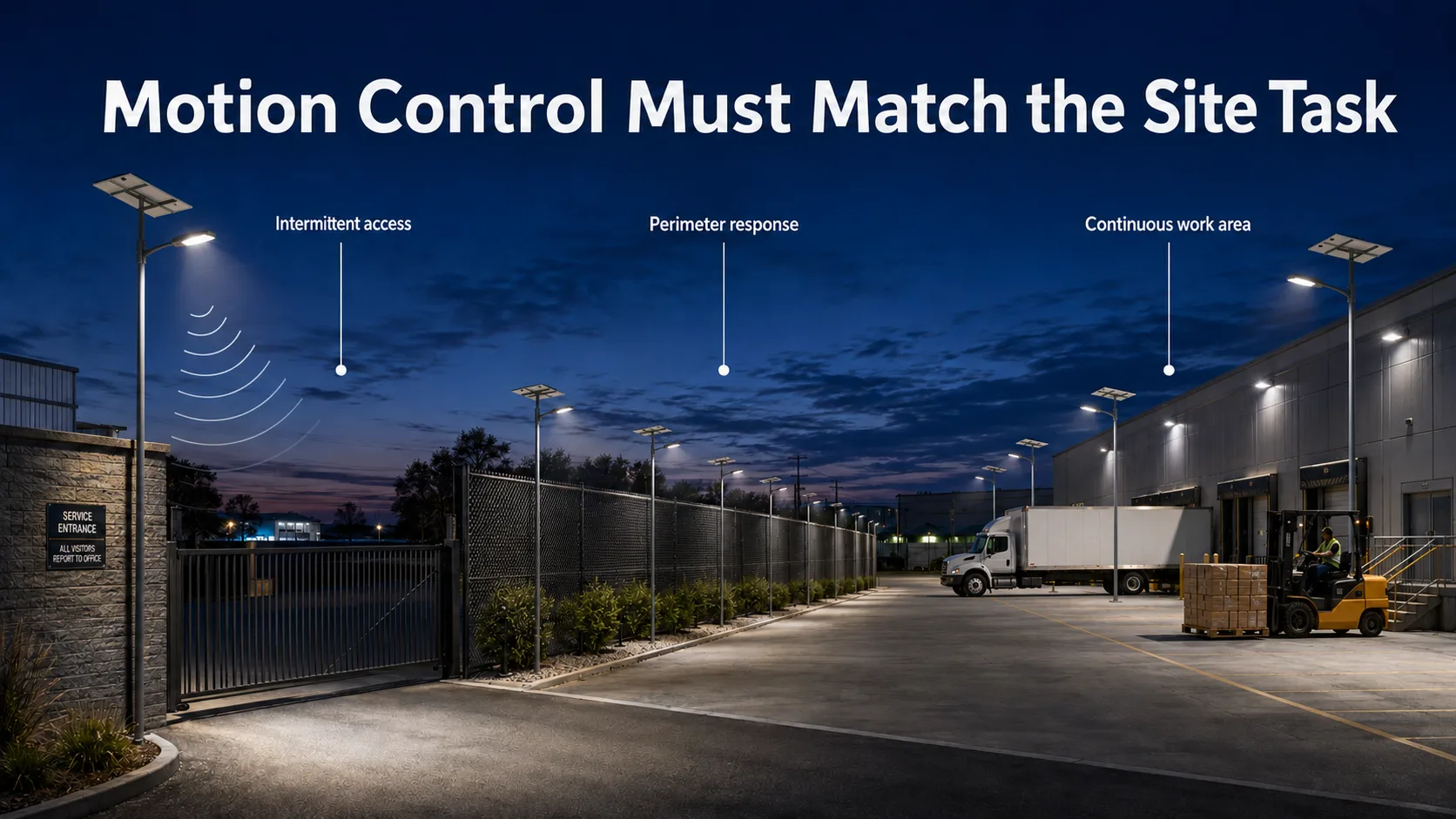
- Intermittent access: gates, equipment yards entered occasionally, secondary doors and low-use perimeter points can be candidates for sensor-triggered light.
- Predictable activity: loading bays, guard stations, walkways with regular use and scheduled work areas normally need a defined base level of light.
- Safety-critical movement: vehicle routes, crossings, steps, ramps and emergency paths should not be left to a generic sensor setting without a site-specific lighting and safety review.
The sensor is therefore part of the control logic. It is not a substitute for deciding what must remain visible throughout the operating period.
Three questions that change a solar motion-light specification
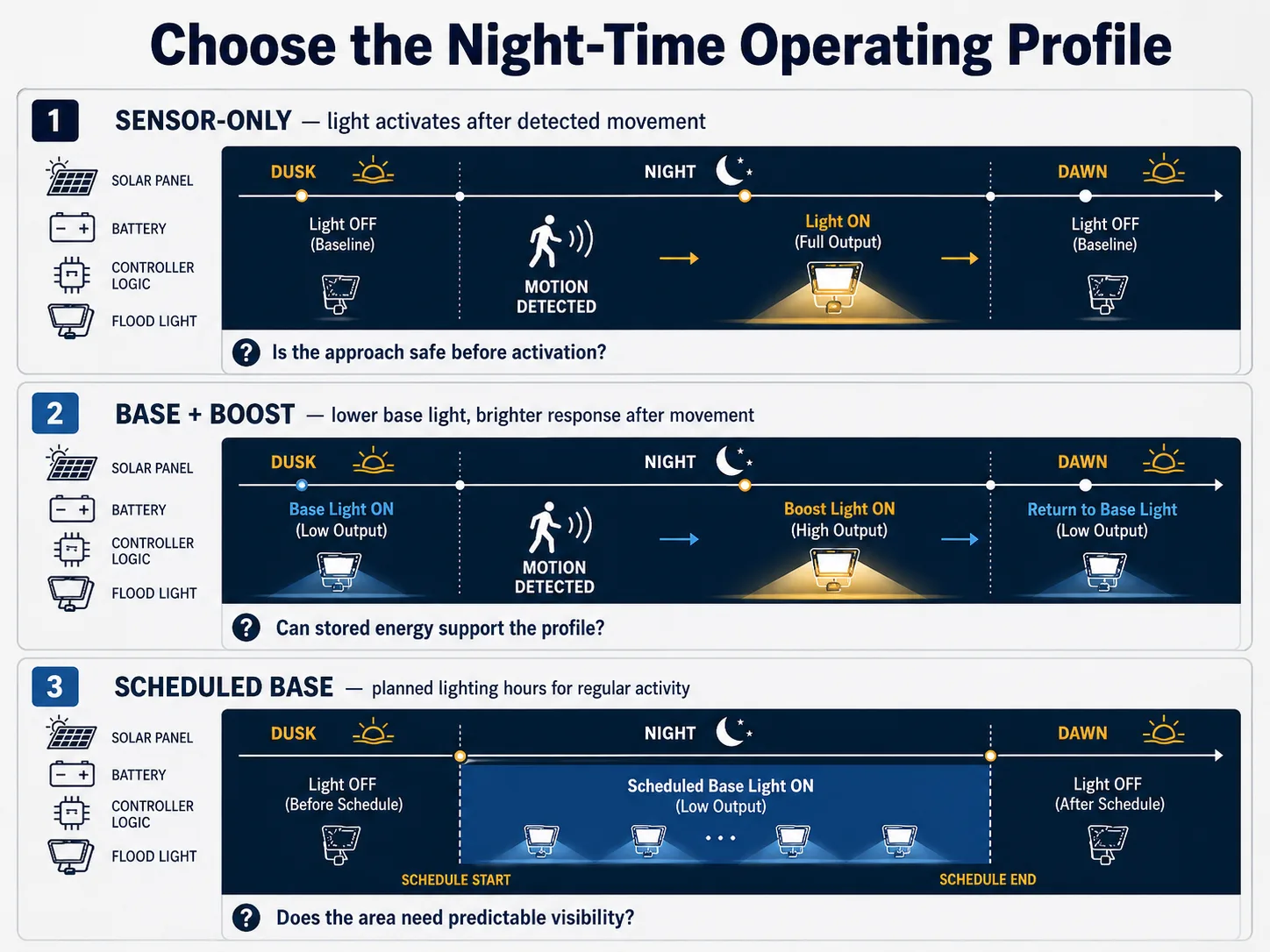
1. What should happen before motion is detected?
There is a practical difference between a light that remains off until activation and a light that maintains a lower background level before increasing output. The correct choice depends on the task, the likely approach path and the amount of stored energy the project needs to preserve overnight.
Do not assume “off until motion” is automatically more efficient in a useful way. If people or vehicles need to see the approach before entering the detection zone, a completely dark route may simply move the problem further away from the luminaire.
2. What movement should trigger it?
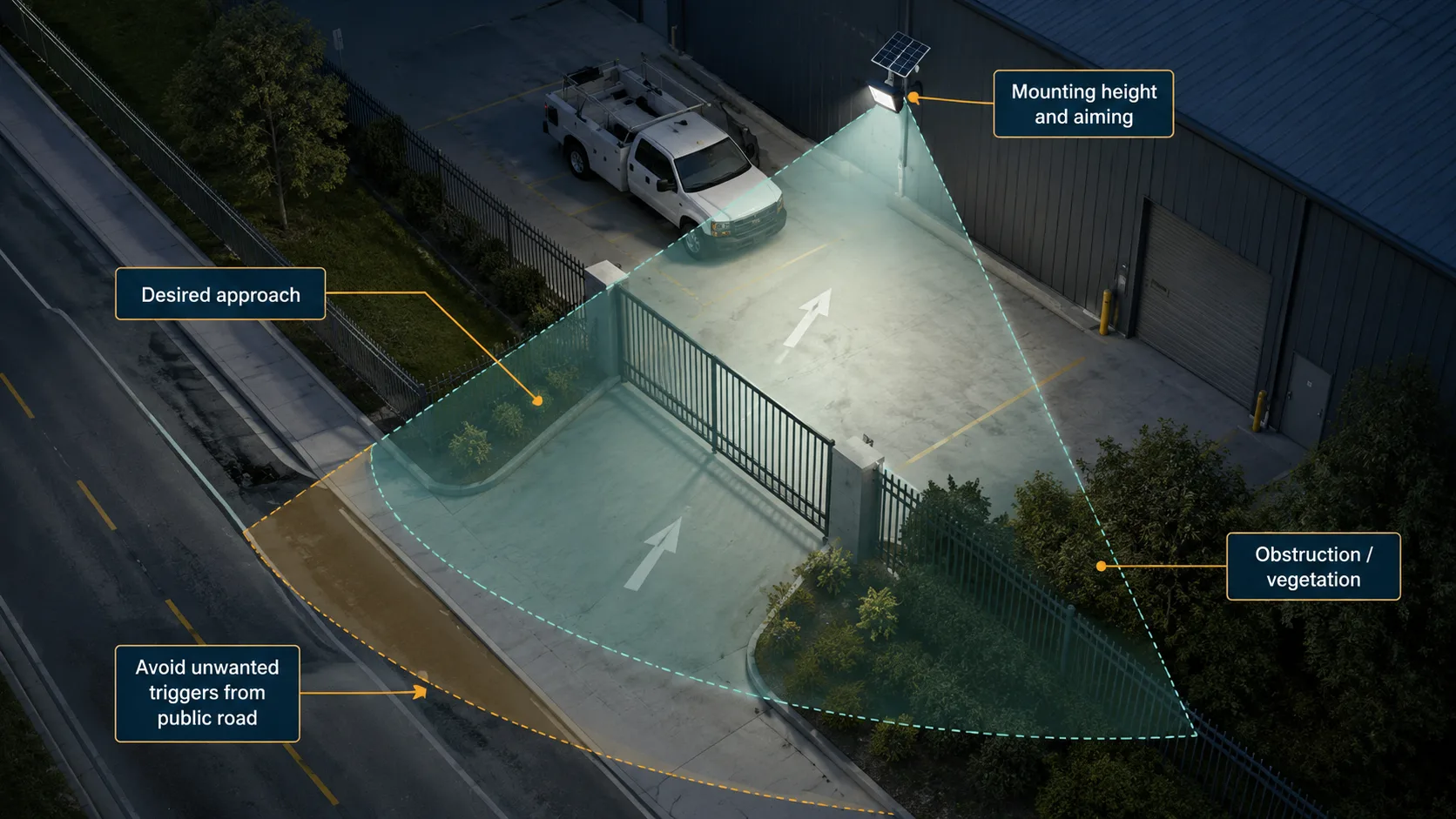
A sensor requirement needs a coverage intention: pedestrian approach, vehicle approach, activity at a gate, or a particular zone within a yard. Mounting height, orientation, obstructions, nearby vegetation, adjacent roads and the desired detection direction all change how a trigger should be evaluated.
The procurement brief should describe the protected area rather than ask for an undefined “wide-angle sensor.” A wide field can be useful; it can also create unwanted activations from public footpaths, passing traffic or moving branches if the layout is not considered.
3. What happens after the trigger?
Ask for the post-trigger behavior in plain language: required brightness level, hold time, return mode, restart conditions and any scheduled operating window. Those details are more meaningful than a generic “smart sensor” label.
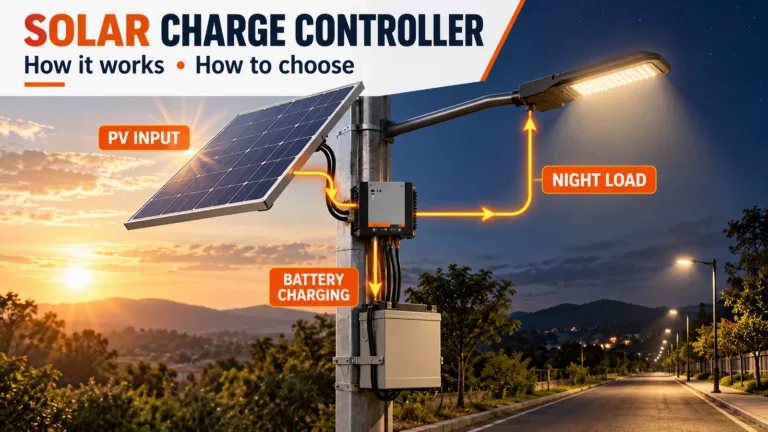
For a solar system, the profile has to be checked alongside local solar resource, panel position, battery capacity, seasonal conditions, selected output and expected overnight duty. A motion-control idea that works in a short demonstration may not support the actual night-time operating requirement.
When motion control is a good fit—and when it is not
Motion control can fit low-traffic auxiliary areas where a temporary lighting increase is useful and predictable. Examples may include an infrequently used service entrance, a controlled equipment yard or a perimeter point that needs a visible response to arrival.
It is a weaker fit where people need continuous visual orientation, where a vehicle route has regular movement, or where the exact activation behavior creates a safety concern. A site can use more than one profile: continuous or scheduled lighting for the main task area, and sensor-assisted operation for a secondary edge of the property.
This is why a product page cannot settle the decision alone. Use the Commercial Solar Flood Lights path for the lighting-system scope, then define the control requirement against the actual site plan. For an enclosing boundary or access-security objective, review Perimeter Security Lighting as a separate application decision.
Do not confuse motion detection with dusk-to-dawn control
A photocell, timer, astronomical schedule and motion sensor answer different questions. A dusk-to-dawn setting decides when a lighting system is available. A sensor decides what happens when detected activity meets its trigger conditions. A schedule can determine a period when one or both behaviors apply.
The right sequence is usually: define the hours the area needs lighting, define the required base level, then decide whether motion should create a boost or an activation. The Dusk-to-Dawn Outdoor Lighting guide explains the different control logics and why solar systems must also account for stored daytime energy.
What to include in an RFQ
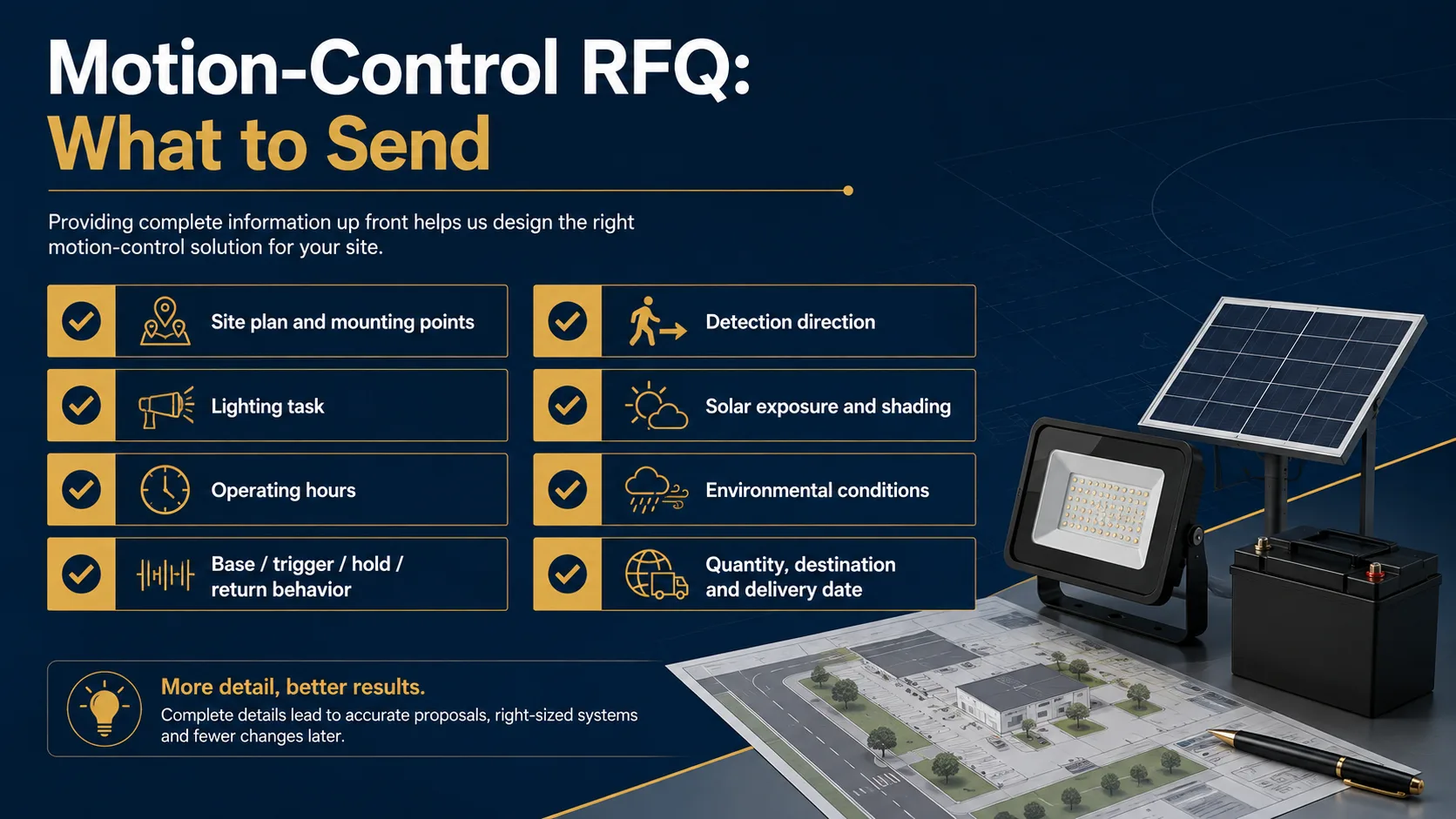
An RFQ should make a supplier evaluate a real operating requirement, not guess from the word “sensor.” Include:
- site plan, task areas and intended mounting locations;
- use pattern: pedestrian, vehicle, security response or scheduled work;
- required operating hours and any seasonal change;
- desired base mode, trigger mode, hold time and return mode;
- detection direction, likely obstructions and unwanted-trigger risks;
- target light level/coverage, mounting height and aiming constraints;
- local solar exposure, shading risks and environmental conditions;
- required documents, quantity, installation country and delivery date.
The public Inlux Solar catalog has a Commercial Solar Flood Lights solution path for areas, yards and project lighting. Confirm the exact control feature against the quoted configuration rather than assuming it from a generic image or a consumer listing.
Common questions
Can a motion sensor make a solar flood light last longer at night?
It can reduce full-output run time in a suitable control profile, but the real outcome depends on the required base mode, trigger frequency, battery capacity, solar charging conditions and seasonal operating demand. It is not a substitute for system sizing.
Should a commercial driveway be motion-activated?
That depends on how often it is used, what vehicles and pedestrians need to see, and whether a delay or sudden change in light is acceptable. Regular vehicle circulation normally needs a defined lighting plan rather than a generic sensor-only approach.
Can one sensor cover an entire yard?
Do not assume so. Mounting position, field of view, obstructions, approach direction and the layout of the task area all need review. The system may need multiple lighting/control zones.
Is a motion sensor the same as a dusk-to-dawn photocell?
No. A photocell responds to ambient light; a motion sensor responds to detected activity. A project can use both, but they perform different control jobs.
Does Inlux Solar supply every motion-sensor configuration shown online?
No assumption should be made from a generic web image. Send the site plan and required operating behavior so the requested control feature can be confirmed against the quoted model and project scope.
Need a solar flood-light control plan for a site?
Send the site plan, mounting locations, lighting task, operating hours, solar exposure, desired base/boost behavior, environmental conditions, quantity and destination. The Inlux engineering team can review the solar flood-light scope and its relationship to the wider road and street lighting or perimeter-lighting package where relevant.