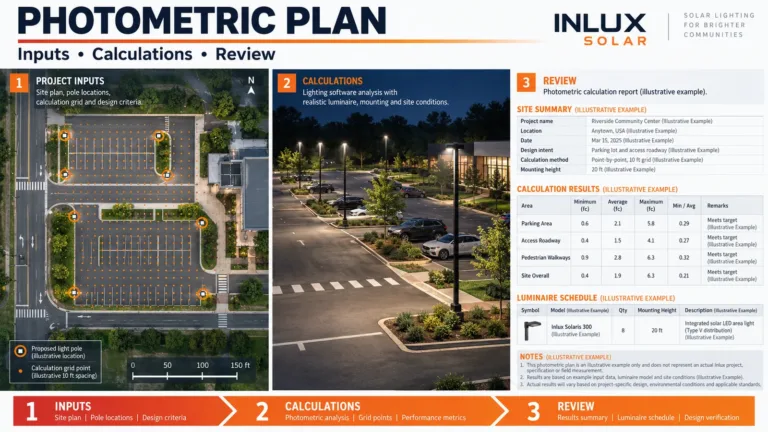
When people search for “luz de rua,” they may be asking about a lamp, a pole, a complete roadway system, or simply why the lights came on early last night. Those are different questions, and treating them as one product is how poor lighting specifications begin.
This guide explains the parts that actually affect a street-lighting decision: application, mounting height, pole spacing, optics, light output, controls, and power source. It also explains where solar street lights fit—and where connecting to the grid is still the more sensible choice.
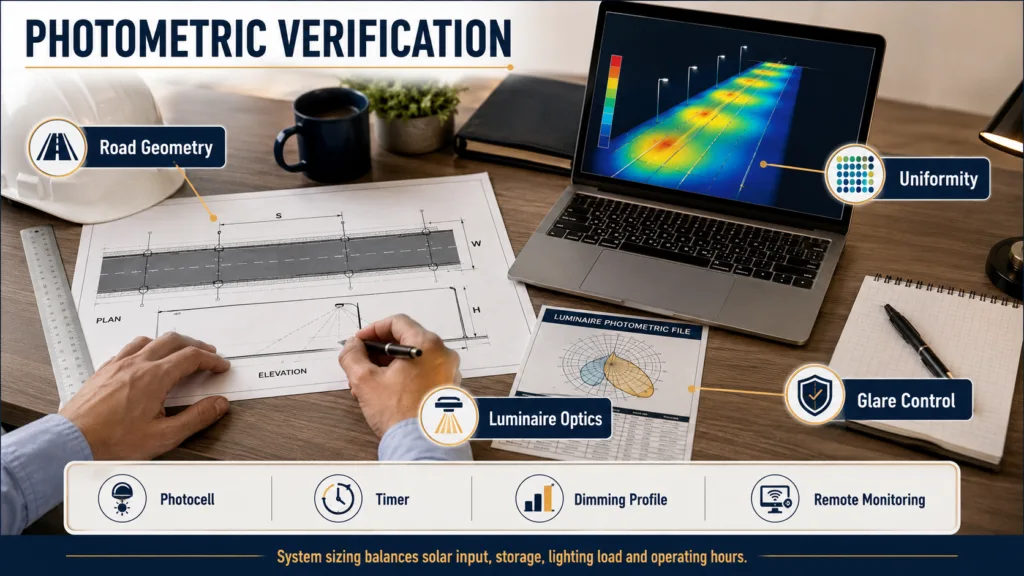
The short version is simple: there is no universal street-light height, wattage, or spacing number. A sound design starts with the road or site, then verifies the result with photometric calculations and local requirements.
Key Takeaways
- Conventional roadway lighting commonly uses mounting heights of about 9–15 m, while high-mast systems can reach 25–55 m or more, according to the FHWA Lighting Handbook.
- Pole spacing is a calculation result, not a fixed rule. Height, optics, road width, pavement, uniformity, and glare all change the answer.
- Solar street lights make the most sense where trenching, grid connection, or long-distance power distribution creates a real project constraint.
- For a tender or RFQ, the useful inputs are location, road class, width, height, spacing, target lighting level, runtime, autonomy, environment, quantity, and required documentation.
What is a street light?
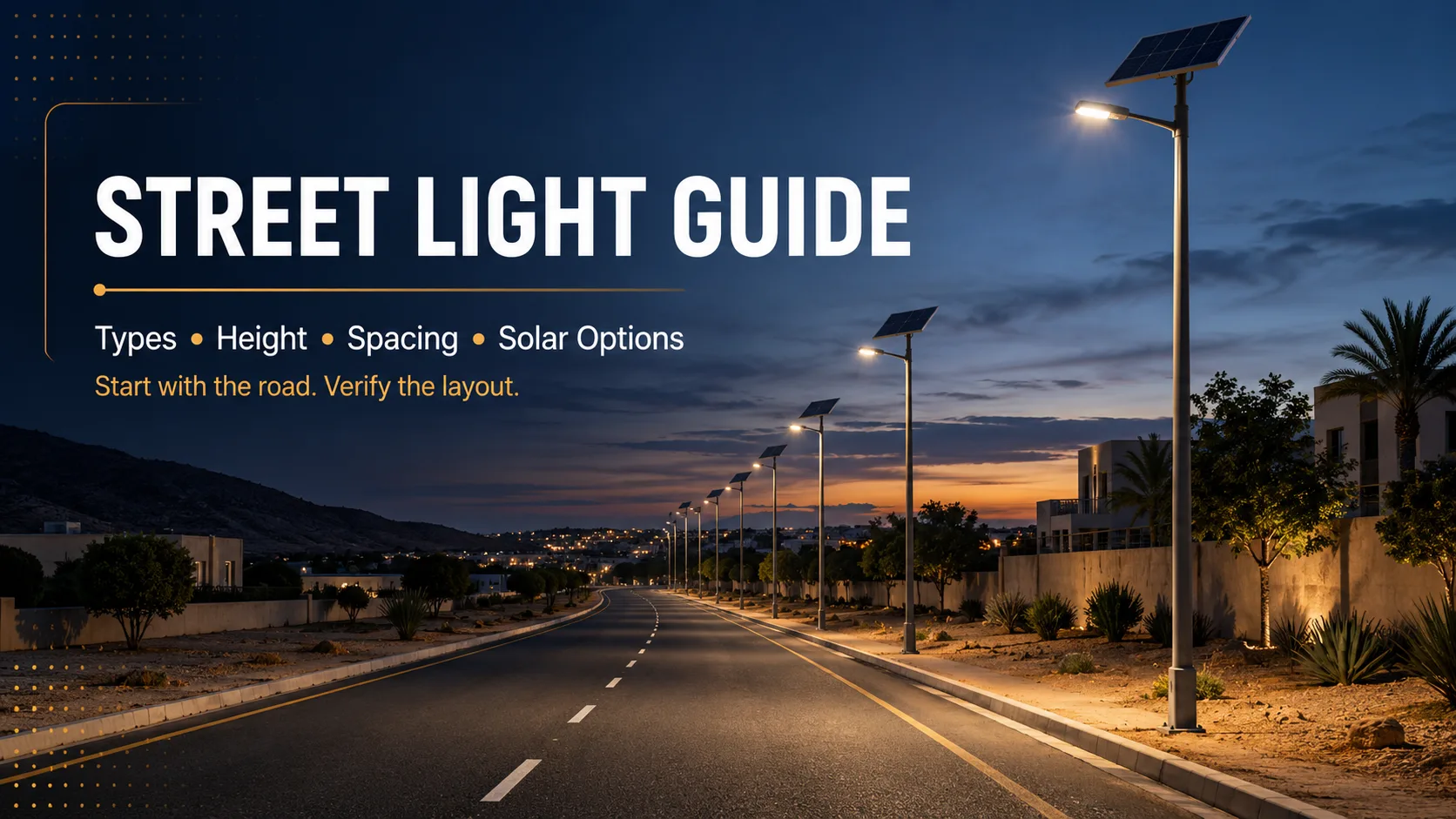
A street light is a luminaire installed beside or above a road, path, parking area, or public space to improve visibility after dark. In a complete system, the luminaire is only one part. The pole, outreach arm, foundation, electrical supply, controls, optics, and maintenance plan affect the result just as much.
The terms are easy to mix up:
| Prazo | Usually means | Por que é importante |
|---|---|---|
| Street light / streetlamp | The light fixture used to illuminate a road or public area | The fixture determines optical distribution, output, glare, and maintenance access |
| Light pole / street light pole | The vertical structure that supports the fixture | Height, material, foundation, wind load, and arm geometry affect the layout |
| Roadway lighting system | The full lighting arrangement for a road or site | It includes spacing, controls, power, photometry, and compliance—not just wattage |
| Solar street light | A street-lighting system supplied by PV and battery storage | Solar sizing adds energy balance, autonomy, battery, and weather assumptions |
This distinction is useful when reviewing supplier quotations. A quotation that says “100 W street light” tells you very little by itself. It does not tell you the delivered light distribution, pole height, mounting arrangement, battery autonomy, expected runtime, or whether the design has been checked on the actual road geometry.
For a technical definition, the FHWA roadway lighting glossary distinguishes terms such as mounting height, lux, luminance, and overhang. Those terms are not interchangeable. A buyer who asks only for watts may be comparing electrical input while missing the lighting result.
What are the main types of street lights?
Street lights are best classified by where they are used and how they are designed, rather than by a single universal list. The same fixture family may serve a local road, a parking lot, or a pedestrian area with different mounting heights, optics, and controls.
| Street-light type | Typical use | Main design question |
|---|---|---|
| Roadway or cobrahead lighting | Urban roads, collectors, arterials, and highways | Can the optics produce the required road luminance and uniformity? |
| Pedestrian-scale lighting | Sidewalks, parks, paths, and residential areas | Can people see comfortably without excessive glare or spill light? |
| High-mast lighting | Interchanges, ports, yards, wide junctions, and large open areas | Can a small number of tall poles cover a large area while remaining maintainable? |
| Decorative street lighting | Avenues, promenades, historic districts, and public spaces | Can appearance and pedestrian comfort be balanced with useful illumination? |
| Solar street lighting | Roads and sites where independent power is valuable | Can the PV, battery, controls, and lighting load meet the worst operating period? |
| Smart street lighting | Networks that need dimming, alarms, monitoring, or remote control | Does the control system solve a real operating problem, or only add complexity? |
The practical difference is not the name on the catalogue page. It is the relationship between road width, pole height, optical distribution, mounting arrangement, target lighting level, and operating schedule.
O FHWA roadway-lighting guidance makes the same point from a design perspective: pole height, fixture count, optics, orientation, wattage, and photometrics must be considered together. That is why a “one fixture for every road” product list is rarely a useful engineering answer.
Inlux’s current road and street lighting solution groups its work by roadway, residential, intersection, crosswalk, highway, and solar applications. That is a more useful way to start a project than choosing a product type before defining the site.
How tall should a street light be?
Most conventional roadway lights are mounted around 9–15 m high, while high-mast systems commonly use poles from about 25 m to 55 m or more. These are planning ranges, not universal prescriptions. The final height depends on road width, fixture optics, spacing, glare, wind, maintenance access, and the lighting class required by the project.
The FHWA describes conventional roadway mounting heights of approximately 9–15 m and high-mast systems of approximately 25–55 m or more. Inlux’s current planning guide presents smaller ranges for local roads and parks, then higher ranges for urban roads, highways, and high-mast areas. The two sources are compatible because they are describing different applications.
| Aplicativo | Preliminary height range | What usually drives the decision |
|---|---|---|
| Paths, parks, and residential streets | 3–4 m | Pedestrian scale, glare, trees, and visual character |
| Rural and local roads | 4–6 m | Road width, traffic speed, pole access, and budget |
| Urban roads, parking lots, and commercial areas | 6–9 m | Coverage, fixture output, spacing, and uniformity |
| Rodovias e estradas principais | 9–15 m | Multiple lanes, traffic speed, optics, and wider spacing |
| High-mast areas | 15 m and above | Large-area coverage, pole locations, maintenance, and glare |
The common mistake is to select a taller pole because it appears to cover more area. It may. It may also create a different glare pattern, require a stronger foundation, change the wind-load calculation, and make maintenance more expensive. A shorter pole with the right distribution can be the better answer on a narrow road.
Inlux’s live street-light height guide gives a useful preliminary range, but it also states that height should be checked against road width, spacing, wattage, optical distribution, glare control, wind load, and local rules. That qualification is more important than the headline number.
How far apart should street lights be?
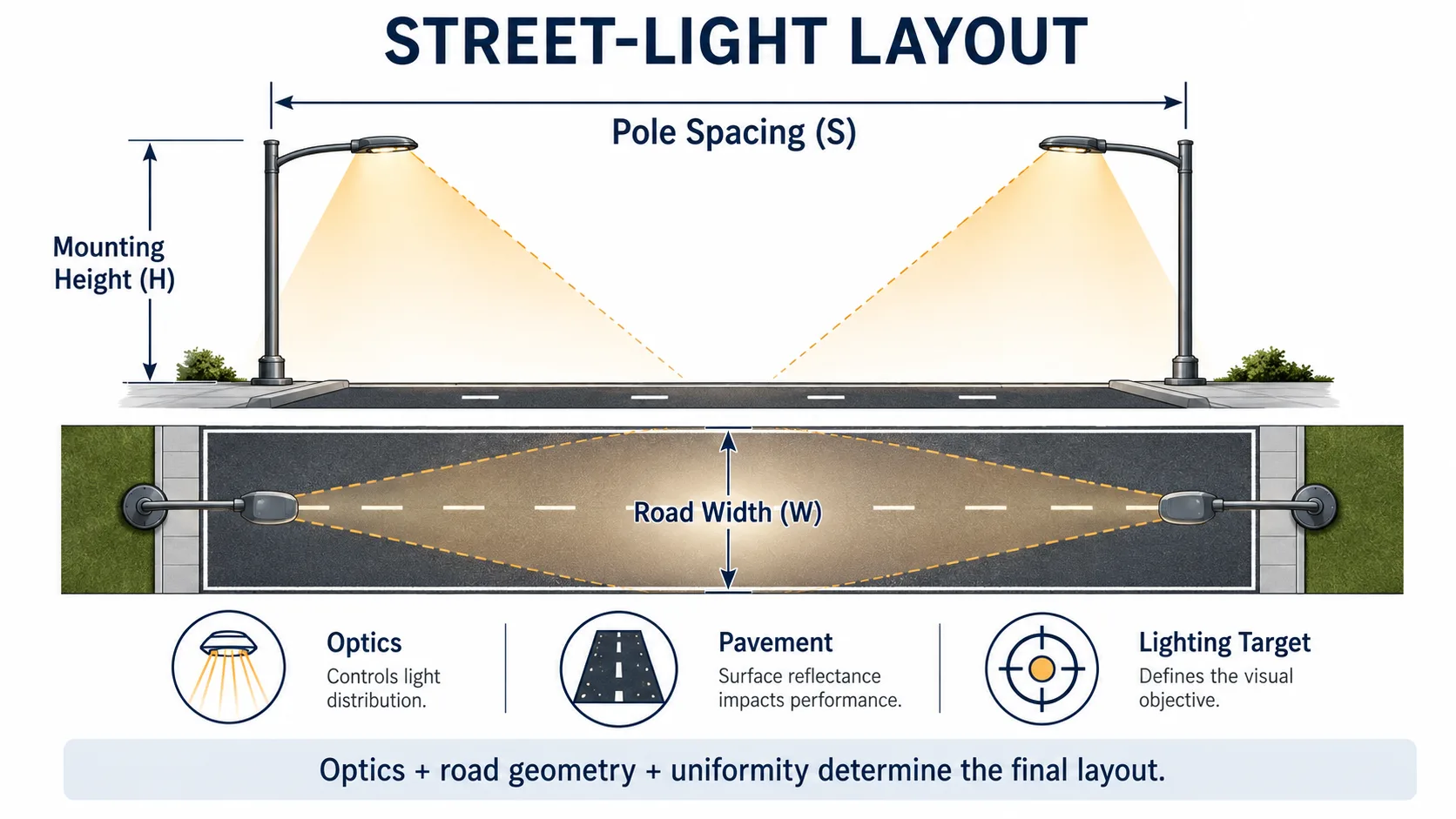
There is no single standard distance that works for every street. A preliminary layout may use pole height as a rough starting point, but final spacing should be confirmed through photometric calculations using the actual road width, fixture distribution, mounting arrangement, pavement, target class, and uniformity requirement.
The FHWA explains that pole spacing is established through lighting calculations and then adjusted to suit road geometry, driveways, utilities, and other site constraints. Inlux uses a preliminary planning range of roughly three to five times pole height on its spacing guide, then recommends DIALux or equivalent verification.
That rule is useful for a first conversation, not for a final bill of materials. For example, a 10 m pole might lead to an early spacing discussion around 30–50 m. The final answer could be different once the designer tests the actual optic, tilt, road width, pavement class, and uniformity target.
The layout also depends on the arrangement:
- Single-side layout: poles sit on one side of the road. This can simplify foundations and utilities, but it may create more demanding uniformity conditions.
- Opposite layout: poles sit on both sides at similar stations. This can help wide roads but may increase the number of foundations and conflict points.
- Staggered layout: poles alternate from one side to the other. It can balance coverage and reduce some dark zones, but it needs a real calculation.
- Median layout: poles are placed in the central reservation. The pole, arm, setback, and crash-safety requirements become especially important.
O Inlux street-light spacing guide is useful for preliminary planning. It should not replace a project layout. If a supplier gives you a spacing number without asking for road width, pole height, optics, and target lighting levels, ask what assumptions were used.
How many lumens does a street light need?
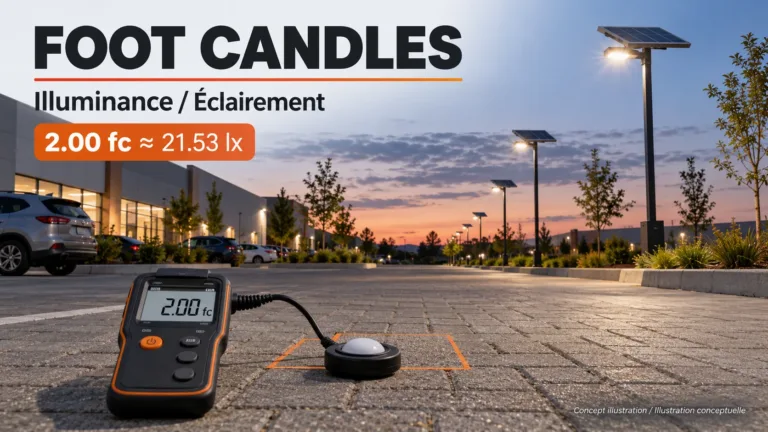
There is no honest universal lumen number for a street light. Lumens describe the light emitted by a source; lux describes light arriving on a surface; luminance describes how bright a surface appears to an observer. Roadway design uses these measures with optics, geometry, pavement, uniformity, and glare—not as isolated catalogue figures.
A wattage chart is attractive because it looks decisive. It is also where many weak tenders begin. Two 100 W fixtures can produce different results because their LED efficacy, optical distribution, mounting height, tilt, maintenance factor, and control profile are different.
For a road project, ask for these items instead of relying on watts alone:
- LED power and delivered lumens.
- Photometric file, such as IES or LDT.
- Optical distribution and beam classification.
- Mounting height, arm length, and tilt.
- Road width, lane arrangement, and pole layout.
- Average lighting level and uniformity target.
- Glare or disability-glare requirement where applicable.
- Maintenance factor and dimming schedule.
- Calculation report for the actual site.
- Test and acceptance method after installation.
O FHWA lighting handbook explains why luminance can be more informative than pavement illuminance for driving tasks: it considers the light reflected from the pavement toward the observer. That does not mean every project must use the same method. It means the selected method should match the road class and local standard.
For pedestrian areas and crossings, vertical or semi-cylindrical illuminance may matter because people need to recognize faces and movement, not simply see a bright patch on the pavement. This is one reason a road, a crosswalk, and a parking lot should not share an untested lighting schedule.
Do solar street lights work on public roads?
Solar street lights can work well on public roads when the site benefits from independent power and the system is sized for the worst operating period. They are not automatically the cheapest choice everywhere. Their value is strongest where trenching, grid connection, unreliable electricity, or long cable runs create a material project risk.
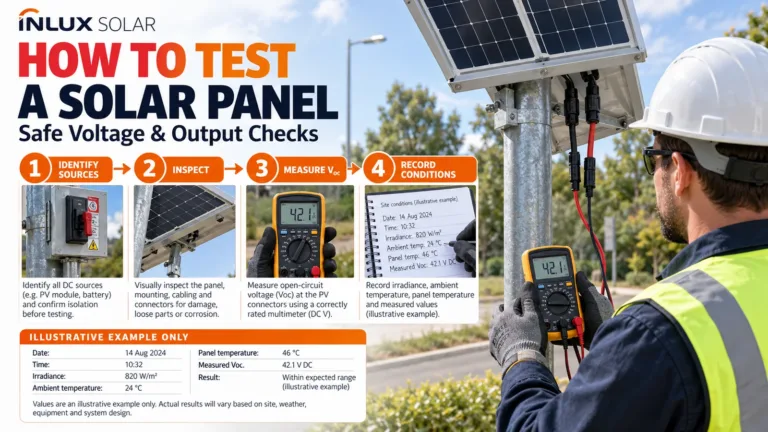
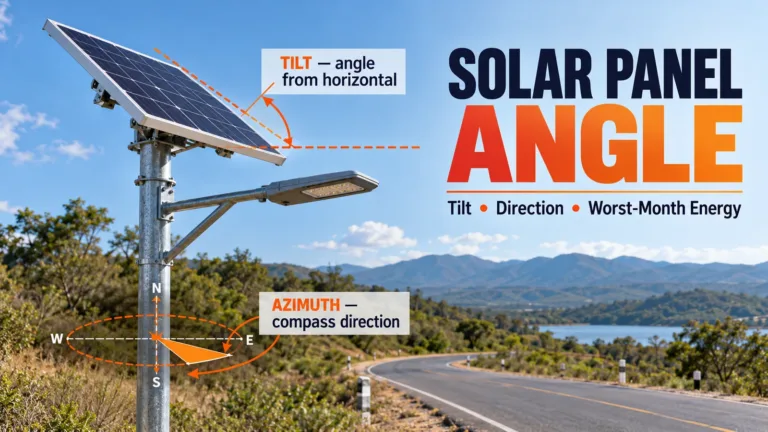
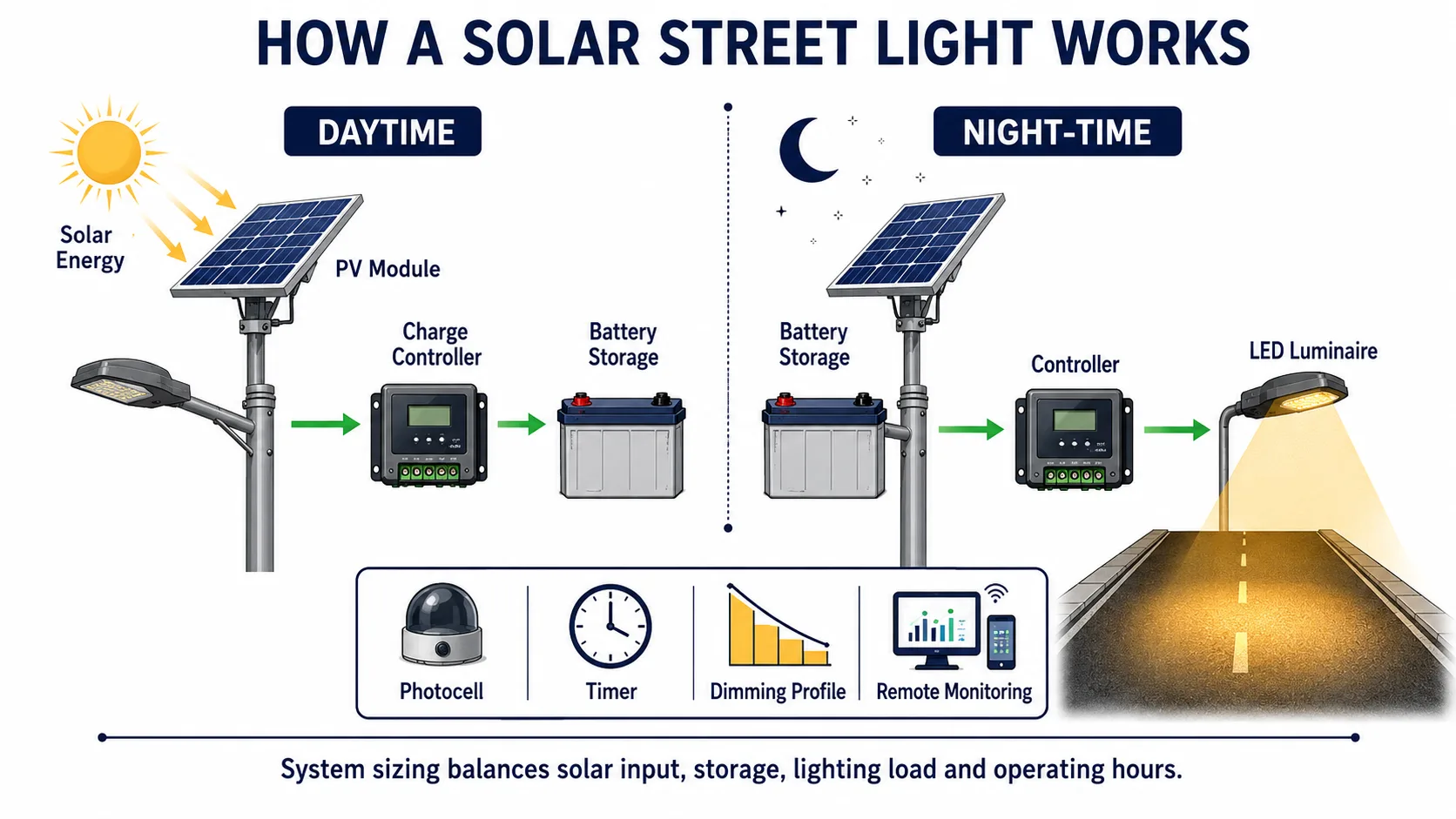
A solar street light normally combines a PV module, battery, LED luminaire, charge controller, pole or mounting structure, protection devices, and control logic. The system must balance energy collected during the day with energy used at night, including cloudy periods, seasonal variation, battery losses, temperature, dirt, and the selected dimming profile.
NASA’s POWER project provides global solar and meteorological data from satellite observations and models. NREL’s PVWatts calculator provides a separate way to estimate PV energy production. These tools are useful inputs, but a supplier still needs to translate the location data into a lighting configuration, battery autonomy, and operating schedule.
Solar is a particularly strong candidate when:
- the road is remote or the grid extension is expensive;
- the project needs independent operation at dispersed locations;
- trenching would disturb a finished road, park, or public area;
- local authorities want lower dependence on grid availability;
- the project can support realistic maintenance and battery replacement planning.
Grid-connected LED lighting may still be better when the site already has reliable power, the lighting load is continuous and high, or the project requires a network and performance profile that is difficult to support with standalone storage.
The best comparison is not “solar versus grid” in the abstract. Compare the full project: poles, foundations, cable, trenching, utility connection, energy cost, battery replacement, maintenance access, outage risk, and required lighting performance.
Inlux’s published project pages show why context matters. A World Bank Sahel project lists 1,095 JAGUAR all-in-two solar street lights for highways, roads, and streets, with IoT monitoring described as part of the solution. A separate UNDP Libya project lists 2,500 solar street lights for highways and roads, with the page describing foundation, wind, battery, optics, and commissioning considerations. These are first-party project records, not universal performance guarantees, but they demonstrate the kind of evidence a buyer should request.
See the Burkina Faso solar street-light project e o Libya solar street-light project for the published project context.
For a visual project example, watch the Libya Solar Streetlight Project video. It is a project-level example, not a substitute for a site-specific photometric or energy calculation.

How do street lights turn on and off?
Most modern street lights turn on in response to ambient light or a programmed schedule, rather than at one fixed clock time. Common control methods include photocells, astronomical timers, time-based dimming, and central smart-control systems. Solar street lights typically combine a light sensor with a controller and a programmed night profile.
Weather, season, latitude, shading, sensor placement, and maintenance can change the apparent switching time. A cloudy afternoon may trigger a photocell earlier. A dirty or shaded sensor can create a false reading. A smart system may also dim or restore output according to traffic patterns or a municipal schedule.
O Inlux guide to when street lights turn on explains the difference between photocell control, astronomical timers, and smart controls. For a project specification, the important questions are not only “when does it turn on?” but also:
- Is the light level controlled locally or remotely?
- Is dimming scheduled by time, motion, or traffic data?
- What happens after several cloudy days?
- Can faults, battery condition, and controller alarms be viewed remotely?
- What is the manual override and maintenance procedure?
Controls are useful when they reduce energy use or maintenance uncertainty. They should not be added simply because a brochure lists them.
What should a buyer include in a street-lighting RFQ?
A useful RFQ describes the site before it asks for a fixture price. The minimum information is location, road or site type, geometry, target lighting level, operating schedule, environmental conditions, quantity, and required documentation. Without those inputs, supplier quotations are often impossible to compare.
| RFQ section | Information to provide |
|---|---|
| Localização | City, country, latitude/longitude if available |
| Aplicativo | Highway, urban street, local road, park, parking lot, industrial area, or path |
| Geometry | Road width, lanes, median, sidewalk, intersections, and obstacles |
| Pole layout | Height, spacing, arrangement, arm length, and foundation constraints |
| Lighting target | Lux or luminance target, uniformity, glare, CCT, and CRI if specified |
| Operating profile | Hours per night, dimming schedule, motion control, or smart-control requirements |
| Sistema de energia | Grid, solar, hybrid, PV location, battery autonomy, and backup expectations |
| Meio ambiente | Coastal salt, desert dust, monsoon, cold, heat, flood risk, and lightning exposure |
| Quantity and delivery | Number of sets, packaging, destination, Incoterms, and deadline |
| Approval documents | IES/LDT, DIALux report, drawings, BOM, certificates, warranty, O&M, and acceptance checklist |
Inlux’s Solar Street Light Buyer’s Guide uses a similar project-input approach. It asks for road type, width, pole height, spacing, arrangement, target illuminance, optics, runtime, worst-month PSH, autonomy, environment, IP/IK, surge protection, quantity, and delivery information.
That is the level of detail that turns a generic product enquiry into an engineerable RFQ. If you have a road plan or tender file, send it with the project location and the required lighting class. A supplier should be able to explain what is known, what is assumed, and what still needs to be calculated.
Perguntas frequentes
What is the usual height of a street light?
Conventional roadway lights are commonly planned around 9–15 m, while smaller local roads and pedestrian areas may use approximately 3–6 m. High-mast systems can use 25–55 m or more. These ranges come from FHWA guidance and Inlux planning references; the final height must be checked against road geometry, optics, glare, wind, and local requirements.
What is the standard distance between street lights?
There is no single standard distance. Inlux uses roughly three to five times pole height as an early planning range, but final spacing depends on the fixture, mounting arrangement, road width, pavement, lighting target, and uniformity. A DIALux or equivalent photometric calculation should confirm the layout before procurement.
Are solar street lights suitable for highways?
They can be suitable when the system is designed for the road class, traffic conditions, solar resource, runtime, autonomy, and maintenance plan. Inlux publishes a World Bank Sahel project with 1,095 solar street-light sets for highways, roads, and streets. That project is an example, not a universal specification for every highway.
Are lumens or watts more important when comparing street lights?
Neither number is sufficient alone. Watts describe electrical input, while lumens describe emitted light. The project result also depends on optics, mounting height, pavement, spacing, uniformity, glare, and maintenance. Request the photometric file and a site-specific calculation instead of comparing wattage only.
What information should I send to a solar street-light supplier?
Send the project location, road or site type, width, pole height if known, spacing, layout, required runtime, autonomy, environment, quantity, delivery destination, and any lighting standard. Inlux’s buyer guide also asks for optics, target illuminance, worst-month PSH, IP/IK, surge protection, and required tender documents.
Conclusion: choose the lighting system around the site
The right street light is not the one with the highest wattage or the longest catalogue list. It is the system that produces the required visibility, uniformity, comfort, reliability, and maintainability for the actual site.
Start with the road or area. Define the geometry. Set the lighting target. Then test fixture, pole, spacing, optics, controls, and power source together. For solar projects, add the worst-month solar resource, battery autonomy, environmental conditions, and long-term maintenance plan.
If you are preparing a municipal, highway, industrial, rural-road, or public-space project, send the location, layout, quantity, and target requirements to the Inlux Solar engineering team. A useful proposal should show the assumptions, the photometric evidence, the BOM, and the documents you will need for approval—not just a unit price.
Sources and further reading
- Federal Highway Administration, FHWA Lighting Handbook — Policy and Guidance, retrieved 2026-08-01: https://highways.fhwa.dot.gov/safety/other/visibility/fhwa-lighting-handbook-august-2012/policy-and-guidance
- Federal Highway Administration, FHWA Lighting Handbook — Lighting Application, retrieved 2026-08-01: https://highways.fhwa.dot.gov/safety/other/visibility/fhwa-lighting-handbook-august-2012/7-lighting-application
- Federal Highway Administration, FHWA Lighting Handbook — Vision and Fundamental Concepts, retrieved 2026-08-01: https://highways.fhwa.dot.gov/safety/other/visibility/fhwa-lighting-handbook-august-2012/3-vision-and-fundamental-concepts
- NASA, NASA POWER Solar and Meteorological Data, retrieved 2026-08-01: https://power.larc.nasa.gov/
- National Renewable Energy Laboratory, PVWatts Calculator, retrieved 2026-08-01: https://pvwatts.nrel.gov/
- Inlux Solar, Iluminação de ruas e estradas, retrieved 2026-08-01: https://www.inluxsolar.com/road-and-street-lighting/
- Inlux Solar, How Tall Are Street Lights?, retrieved 2026-08-01: https://www.inluxsolar.com/how-tall-are-street-lights/
- Inlux Solar, Qual é a distância padrão entre os postes de iluminação pública?, retrieved 2026-08-01: https://www.inluxsolar.com/standard-distance-between-street-lights/
- Inlux Solar, Solar Street Light Buyer’s Guide, retrieved 2026-08-01: https://www.inluxsolar.com/solar-street-light/resources/buyers-guide/
- Inlux Solar, Smart Solar Street Lighting for the Sahel, Burkina Faso, retrieved 2026-08-01: https://www.inluxsolar.com/key-projects/light-up-burkina-faso-with-iot-technology/
- Inlux Solar, UNDP Stabilization Facility for Libya, retrieved 2026-08-01: https://www.inluxsolar.com/key-projects/stabilization-facility-for-libya-sfl-project/