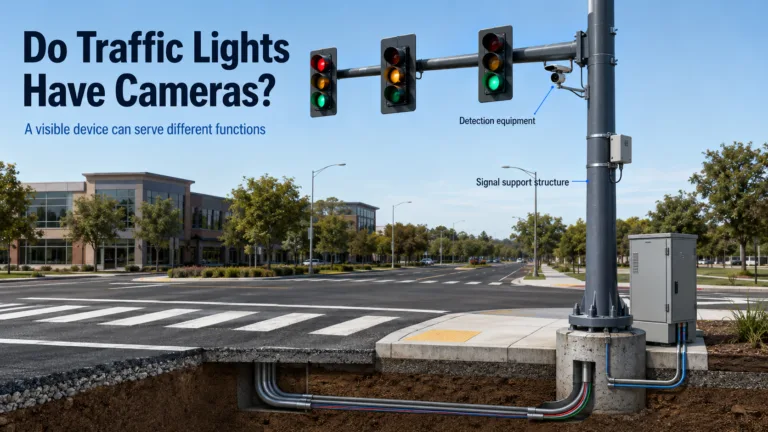
A traffic light can weigh very little or a great deal depending on what you mean by “traffic light.” A single 12-inch signal housing may weigh only a few pounds. A complete three-section signal head is often closer to the 9-22 lb range before brackets, backplates and cables. Once the pole, mast arm, anchor bolts and foundation are included, the installed assembly is an engineering load, not a simple product weight.
That distinction matters for procurement. If you are replacing one signal head, the housing and mounting hardware may be the main concern. If you are designing a new intersection, the pole, arm, wind area, foundation and local standard control the real load.
For the related dimensions question, see How Big Are Traffic Lights?. This page isolates component and installed-assembly weight, rather than repeating the size guide.
The Short Answer
For a typical vehicle traffic signal:
| Item | Typical weight clue | What it means |
|---|---|---|
| One 8-inch polycarbonate signal housing | about 2 lb | A single empty section, not a full signal head |
| One 12-inch polycarbonate signal housing | about 4 lb | A common lightweight section size |
| One 12-inch aluminum signal housing | about 8 lb | Heavier than polycarbonate, before full assembly items |
| Three-section 12-inch polycarbonate signal head | about 9-10 lb in one LED-ready catalog example | A common red/yellow/green head, before site-specific mounting |
| Three-section 12-inch aluminum signal head | about 22 lb in one LED-ready catalog example | Heavier housing material and assembly |
| Complete pole, mast arm and foundation | project-specific | Must be calculated from drawings, wind load and local standard |
McCain lists individual signal housing weights for empty sections: 12-inch polycarbonate at 4.2 lb and 12-inch aluminum at 7.8 lb, with 8-inch housings lighter: McCain traffic signal housings. A North American Signal catalog page gives a 12-inch three-section LED-ready signal weight of 9.33 lb for polycarbonate and 22.20 lb for aluminum: 12-inch aluminum and polycarbonate vehicle signals.
Use those numbers as configuration examples, not universal guarantees. Traffic signal heads change weight with material, number of sections, visor type, backplate, terminal block, brackets, LED modules and mounting hardware.
What Counts as the Traffic Light?
People often use “traffic light” to mean different things:
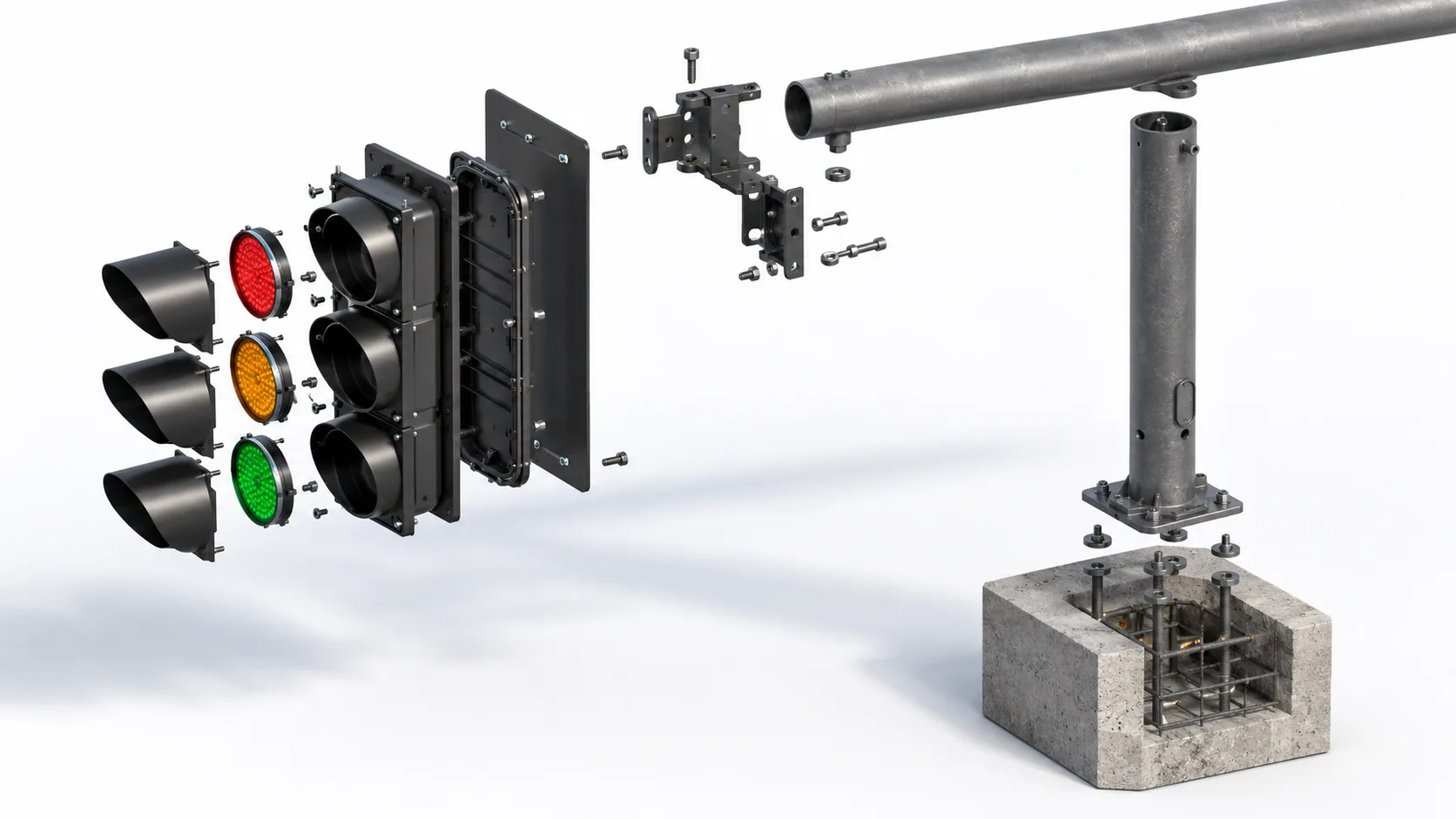
- the signal head only
- the red/yellow/green sections inside that head
- the backplate and visors around the signal
- the mast arm or bracket that holds it
- the full pole, arm, anchor bolts and foundation
The weight answer changes with each definition. A technician replacing one housing section may care about a 4-8 lb part. A city engineer checking an overhead signal support must care about the full assembly load, wind area, arm length and anchor-base design.
This is why many product datasheets treat dimensions and weights as approximate. Econolite’s vehicle signal face datasheet covers 8-inch and 12-inch signal faces in aluminum and polycarbonate housings and notes that dimensions and weights can vary by configuration: Econolite vehicle signal faces.
Why 12-Inch Signal Heads Are Common
Modern traffic signals are not random sizes. The FHWA MUTCD 11th Edition states that 12-inch signal indications shall be used for all circular signal indications in new signal faces, except for specified cases where 8-inch indications may be used: MUTCD 11th Edition Part 4.
That helps explain why many weight examples focus on 12-inch signal heads. A three-section 12-inch red/yellow/green head is a common reference point, especially for vehicle traffic signals. Smaller 8-inch housings exist, but they are not the default answer for many new road applications.
Why Traffic Light Weight Varies
The same traffic signal can become much heavier when the configuration changes.
Material do compartimento
Polycarbonate is lighter. Aluminum is heavier but familiar in many agency specifications. McCain lists 12-inch polycarbonate housing weight at 4.2 lb and 12-inch aluminum housing weight at 7.8 lb for a single empty section. When that difference is multiplied across three or five sections, material choice becomes visible.
Number of sections
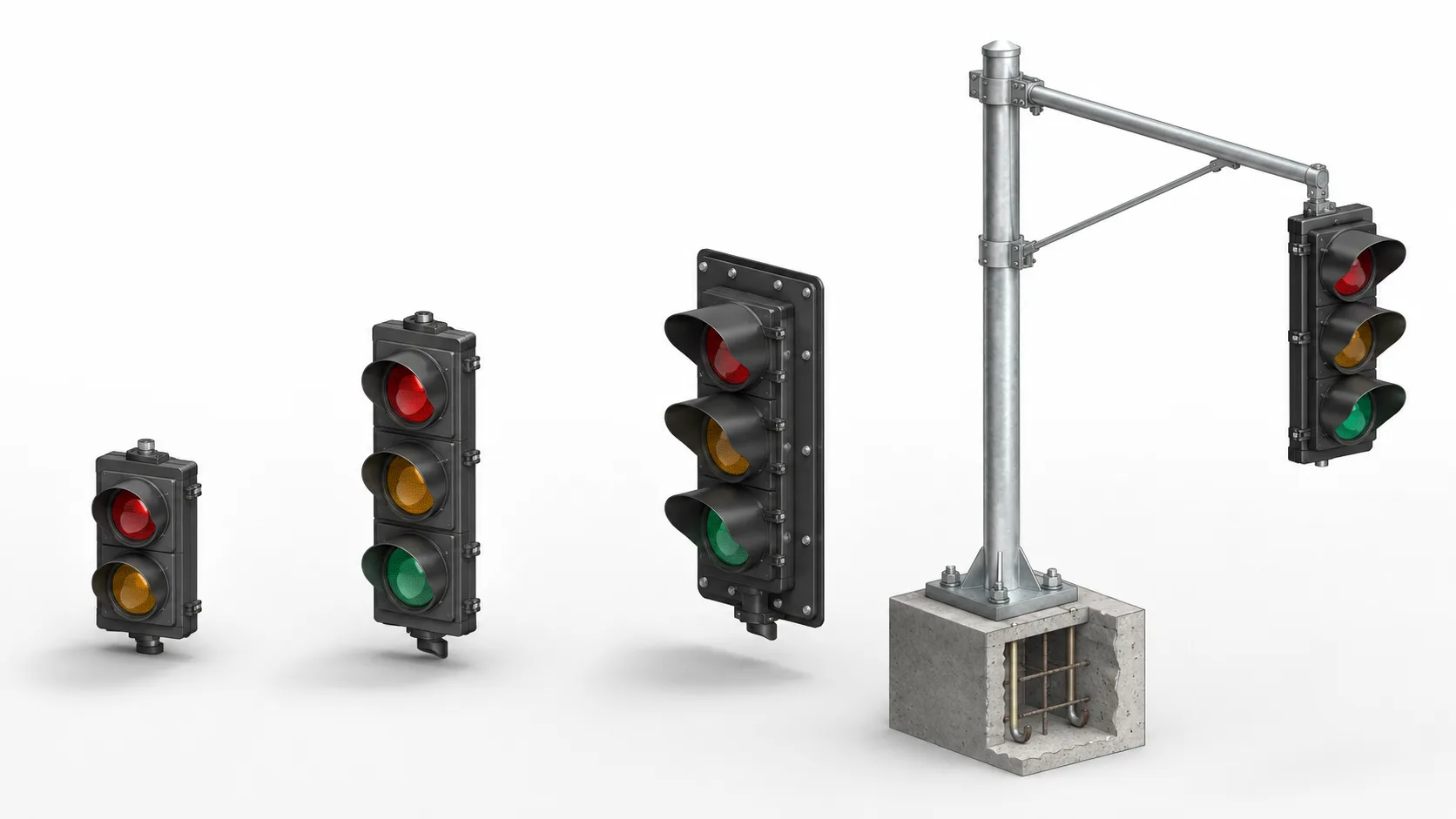
A single flashing beacon, a three-section red/yellow/green signal and a five-section protected-turn signal do not weigh the same. More sections mean more housings, lenses, doors, gaskets, fasteners, wiring and support load.
Backplates and visors
Backplates improve contrast and visibility. Visors reduce sun washout and unwanted viewing angles. Both add material and wind area. A signal head with a louvered backplate and tunnel visors should not be treated like a bare housing.
LED modules and internal parts
Modern LED modules are generally efficient and compact, but the signal still includes lensing, terminal blocks, wiring, gaskets and mounting hardware. If a catalog weight says “housing only” or “empty section,” it does not include every installed part.
Mounting orientation
Vertical and horizontal signal heads can use different brackets and support frames. Span-wire, side-of-pole, mast-arm and overhead mounting each changes the support problem. The head weight may be similar, but the structural load is not.
Signal Head Weight vs Pole Weight
The signal head is usually not the heaviest part of the installed system. The pole, mast arm, anchor bolts and reinforced concrete foundation can dominate the project.
For a new installation, do not ask only “how heavy is the traffic light?” Ask:
- What is the signal head configuration?
- Is it polycarbonate or aluminum?
- Are backplates, visors or louvers included?
- Is the signal mounted on a mast arm, side bracket or span wire?
- What is the arm length and pole height?
- What wind speed and exposure are used?
- What foundation and anchor-bolt pattern are specified?
The same logic applies when comparing traffic infrastructure with street lighting infrastructure. If your project involves lighting poles rather than traffic signal poles, start with the actual pole family, mounting height and fixture wind area. Inlux’s street light pole e luz solar para mastro alto pages are the more relevant starting points for lighting projects.
Quick Weight Estimation Method
Use this sequence before you compare quotes:
- Identify whether the number is for one section, one full signal head or the full pole assembly.
- Confirm signal size: 8-inch or 12-inch indications.
- Confirm housing material: polycarbonate or aluminum.
- Count sections: one, three, four or five.
- Add accessories: visors, backplates, terminal blocks, brackets and mounting frame.
- Separate product weight from installed structural load.
- Ask for the drawing, not only a catalog number.
For a simple online answer, a three-section 12-inch signal head may be around 9-22 lb depending on material and configuration. For a real installation, that answer is incomplete until the support structure is included.
Procurement Checklist
When asking a supplier, contractor or engineering team for traffic signal weight, request these fields:
| Field | Por que é importante |
|---|---|
| Signal size | 8-inch and 12-inch sections differ in housing size and weight |
| Number of sections | One, three and five-section assemblies are different loads |
| Material do compartimento | Polycarbonate and aluminum weights differ |
| Included accessories | Backplates, visors, louvers and brackets change both weight and wind area |
| Weight basis | Housing only, LED-ready signal head, packed shipping weight or installed assembly |
| Mounting method | Mast arm, side bracket, span wire and pole top mounting need different support checks |
| Pole and arm drawing | Required for structural review |
| Foundation and anchors | Needed before installation, especially for overhead assemblies |
If a quote gives only one number without saying what is included, it is not ready for engineering comparison.
Inlux Perspective for Lighting Projects
Traffic signal heads and solar street lights are different products. Inlux Solar does not need to pretend a traffic signal head is the same as a solar street light. The useful overlap is structural: poles, mounting height, wind load, foundation, corrosion protection, service access and project drawings.
Inlux Solar’s locked project baseline is 300,000+ total units delivered across 60+ countries and 1,000+ projects. That experience is relevant when a public lighting buyer needs to move from a simple equipment-weight question to a practical pole, foundation and installation review.
For road lighting or public-area lighting projects, the question is usually not “how much does a traffic light weigh?” It is closer to:
- What pole height and arm length does the lighting layout require?
- What is the luminaire weight and wind area?
- Is the project using grid-connected or solar lighting?
- Does the site need high mast lighting, road lighting or standard street lighting?
- What foundation and anchor-bolt detail is appropriate for the local wind and soil?
For lighting-specific planning, use Inlux’s road and street lighting e luz de rua solar pages. For height context, see how tall are street lights. For traffic signal dimensions rather than weight, see Qual o tamanho dos semáforos?.
Perguntas frequentes
How heavy is one traffic signal head?
A common three-section 12-inch vehicle signal head can be roughly 9-22 lb depending on whether the housing is polycarbonate or aluminum and what accessories are included. Always check the datasheet for the exact configuration.
Is aluminum heavier than polycarbonate?
Yes. In the McCain housing example, a 12-inch aluminum housing is listed heavier than a 12-inch polycarbonate housing. A complete assembly also depends on sections, backplates, visors and mounting hardware.
Does the pole weigh more than the signal?
Usually yes for a full installation. The pole, mast arm, anchor bolts and concrete foundation can outweigh the signal head by a large margin, but the exact number depends on the drawing and local design standard.
Can I use signal head weight to size the foundation?
No. Foundation design depends on total structural load, wind exposure, arm length, pole height, soil and local codes. Signal head weight alone is not enough.
Are traffic lights and street lights the same thing?
No. Traffic lights control vehicle and pedestrian movement at intersections. Street lights illuminate roads and public spaces. They can share structural concerns, but they are different systems.
Technical Sources
- FHWA: MUTCD 11th Edition Part 4
- McCain: Traffic Signal Housings
- Econolite: Traffic Signals Vehicle Signal Faces
- North American Signal: 12-inch Aluminum and Polycarbonate Vehicle Signals
Need a Pole or Lighting Load Review?
If your project is about road lighting, solar street lighting, high mast lighting or pole-mounted luminaires, send Inlux Solar the pole height, arm length, luminaire weight, wind-speed requirement, installation location and foundation assumptions. The Inlux engineering team can review the lighting-side load path before you lock the BOQ.
Comece com o street light pole page or send the project details through Entre em contato conosco.