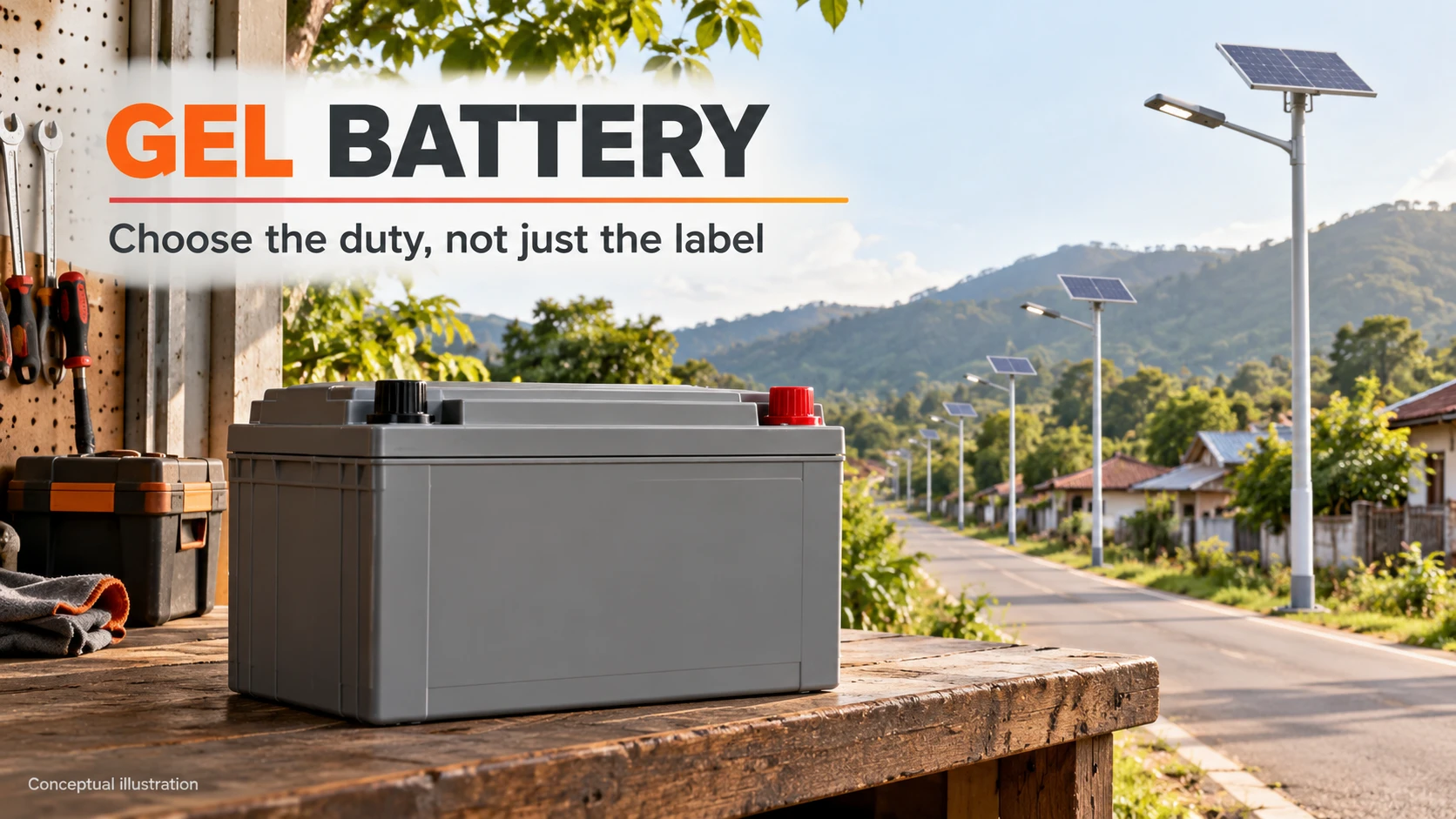
A gel battery is a valve-regulated lead-acid battery whose electrolyte is immobilised with silica. It is not a lithium battery, and it is not simply another name for AGM. For a solar street-light project, the GEL label is only the starting point: the battery must be intended for the duty, its capacity must be stated at a known discharge rate, and its charging requirements must match the controller. A low purchase price or a large amp-hour number cannot establish that the light will reach dawn and recover the next day.
What the gel-battery label actually tells you
Discover Battery’s technology explanation identifies GEL as lead-acid storage with a silica-gelled electrolyte. Its description also distinguishes constructions intended for different applications. The name does not identify a particular plate design, cycle capability or renewable-energy duty. Ask for the manufacturer and exact model, not only a photograph of a case marked “maintenance-free”.
GEL and AGM are both part of the VRLA family: valve-regulated lead-acid. They immobilise electrolyte differently. AGM uses an absorbent glass mat, while GEL uses a gelled electrolyte. “Sealed”, “SLA” or “VRLA” alone therefore does not establish which construction is inside. This matters when an installer selects a charging programme or when procurement accepts a proposed substitute.
| Term on the offer | What it identifies | What still needs confirmation |
|---|---|---|
| بطارية GEL | Lead-acid with silica-gelled electrolyte | Exact model, duty and approved charge requirements |
| AGM battery | Lead-acid with electrolyte held in glass mat | Exact model, duty and approved charge requirements |
| VRLA / sealed lead-acid | A broader valve-regulated lead-acid description | Whether the offered battery is GEL, AGM or another stated construction |
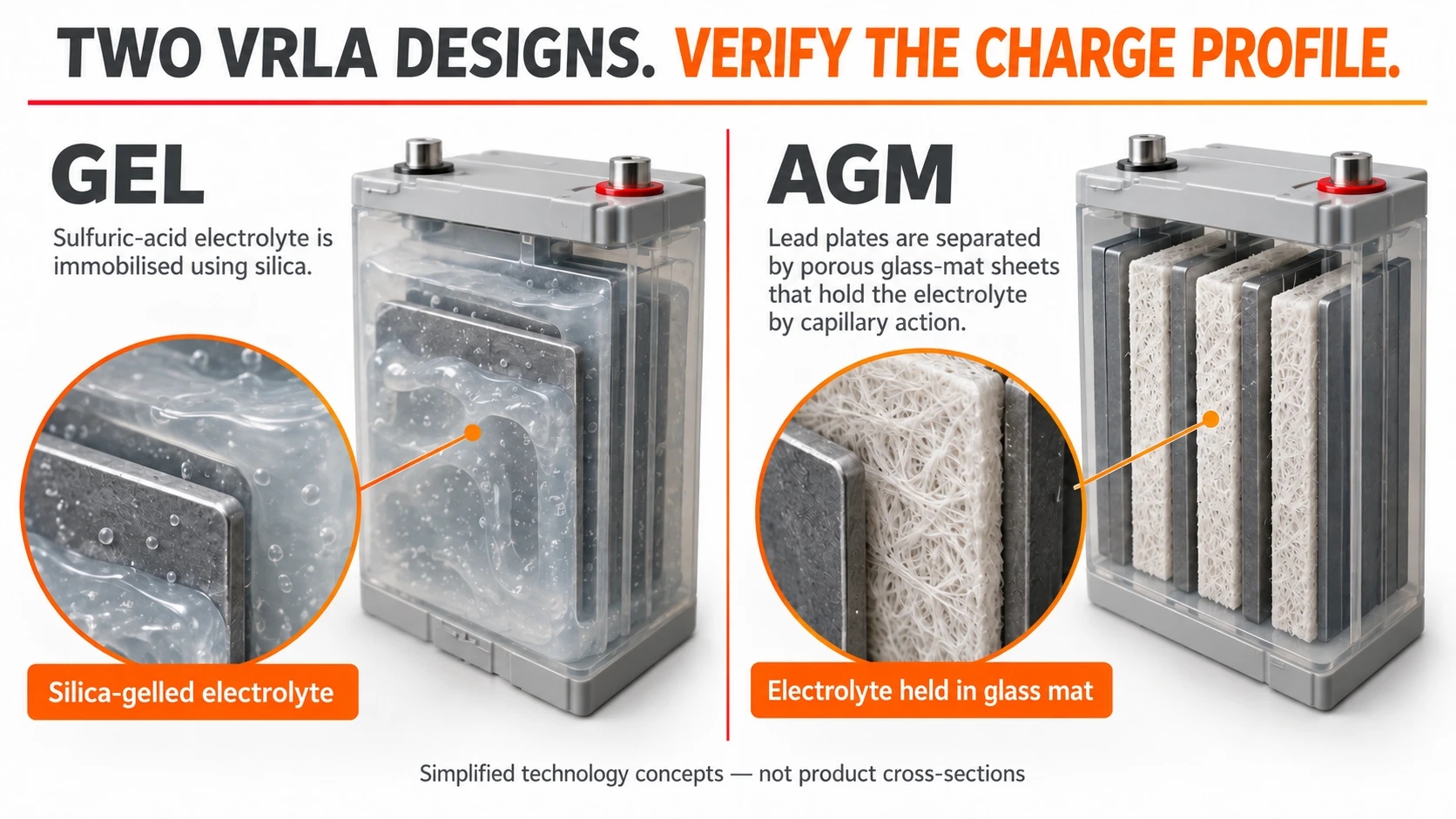
Maintenance-free usually concerns electrolyte upkeep; it does not remove the need to check condition, connections, enclosure and charging. Do not open a sealed gel battery or add water. A solar installation also needs a safe enclosure and access arrangement, not a decision based only on whether liquid can spill.
Can a gel battery suit solar street lighting?
Yes, an appropriately specified deep-cycle gel battery can be considered for solar storage. The useful distinction is daily cycling versus occasional standby, not “solar” printed on a label. A backup battery may spend most of its time charged and discharge rarely. A street-light battery supplies energy every night and may have a limited recharge window. Require the intended cyclic duty and operating conditions to be stated explicitly; do not transfer a standby-life figure into a daily-cycling service-life promise.
The installation matters as much as the label. A separate battery enclosure changes handling, access, cable routing and environmental exposure. Its weight, mounting and service method must fit the site. Compare these arrangements in the separate-component solar street light collection. For compact designs, review the Inlux All-in-One range. Compare the Inlux All-in-Two range on the same complete-system basis; neither range is a housing that will accept any replacement battery.
The missing detail on many quotes: capacity at what rate?
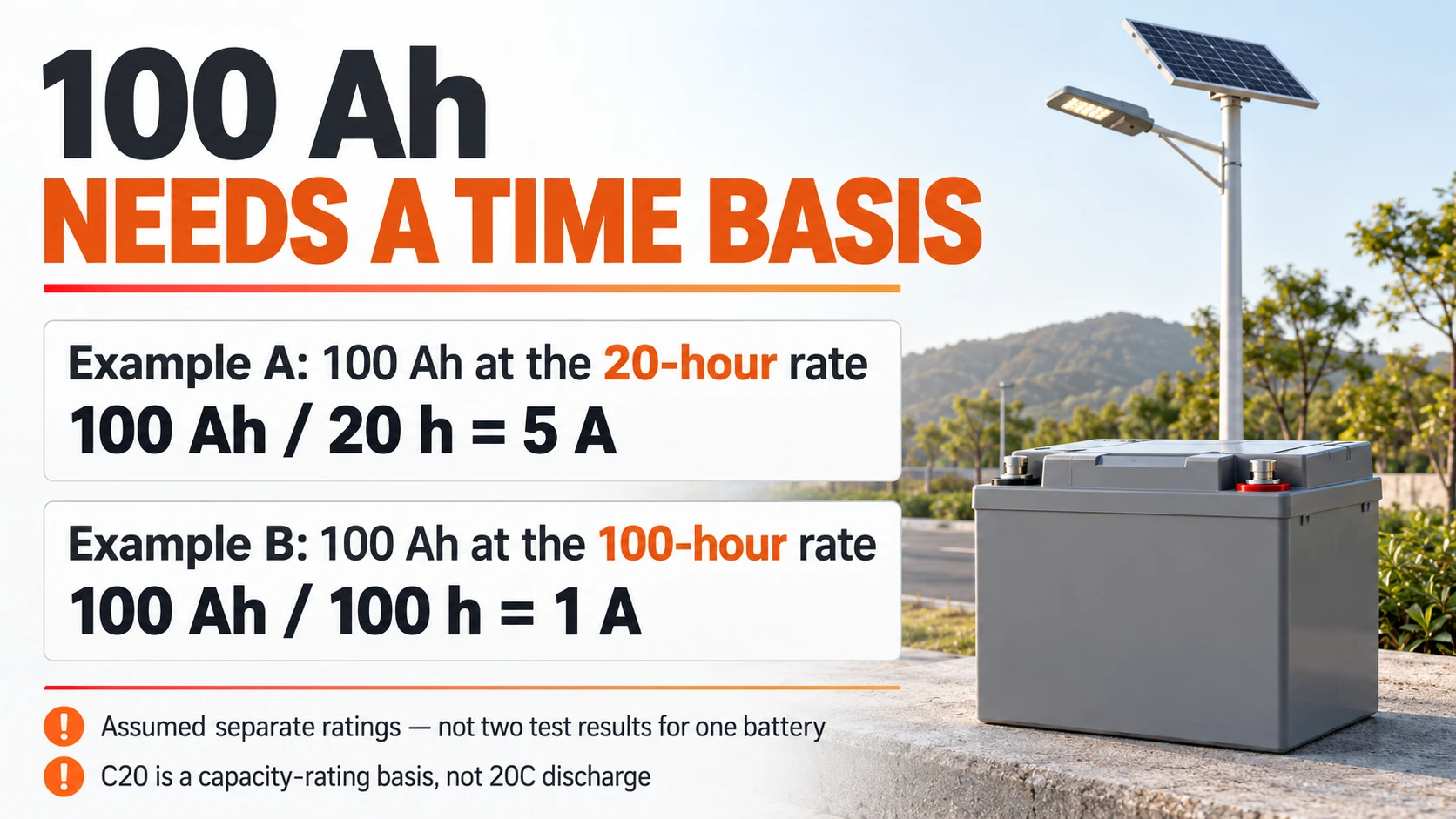
A capacity statement needs its test basis. In C20 or a 20-hour rating, the declared amp-hours refer to a specified discharge test over 20 hours, with stated temperature and end voltage. It is not a claim that the battery should be emptied in normal service. The Rolls discharge-rate explanation shows why capacity changes with discharge conditions. Use the actual offered model’s discharge data rather than a generic lead-acid correction factor.
| Separate illustrative ratings | Declared capacity | Test duration | Implied constant test current |
|---|---|---|---|
| Example A: 20-hour basis | 100 Ah | 20 h | 100 Ah ÷ 20 h = 5 A |
| Example B: 100-hour basis | 100 Ah | 100 h | 100 Ah ÷ 100 h = 1 A |
These are assumed ratings for two examples, not measured results for one battery. The arithmetic establishes test current only. It does not show that either battery can deliver 100 Ah at a different current, temperature or cut-off. C20 is also not the same notation as a 20C discharge rate. If two bidders use different hour ratings, ask for both models’ capacity at the same relevant basis before comparing price per amp-hour.
A nominal-voltage conversion to watt-hours is useful for an initial description, but it is not a usable-energy test. Allowed discharge, load, temperature and protection thresholds still apply. The battery Ah-to-Wh conversion guide keeps that unit conversion separate from the energy actually available to the light.
Start with the night, then check storage and recharge
Suppose a luminaire draws 40 W for the first 5 hours and 20 W for the following 7 hours. These are assumed electrical input powers, not a promise that a dimming percentage halves power. Energy equals power multiplied by time. Calculate each operating stage rather than multiplying the highest power by the entire night or treating an amp-hour label as a runtime.
| Assumed operating stage | Electrical input power | Time in this operating stage | Energy at luminaire input |
|---|---|---|---|
| First lighting stage | 40 W | 5 h | 200 Wh |
| Later lighting stage | 20 W | 7 h | 140 Wh |
| Complete illustrative night | Two stated power levels | 12 h | 340 Wh |
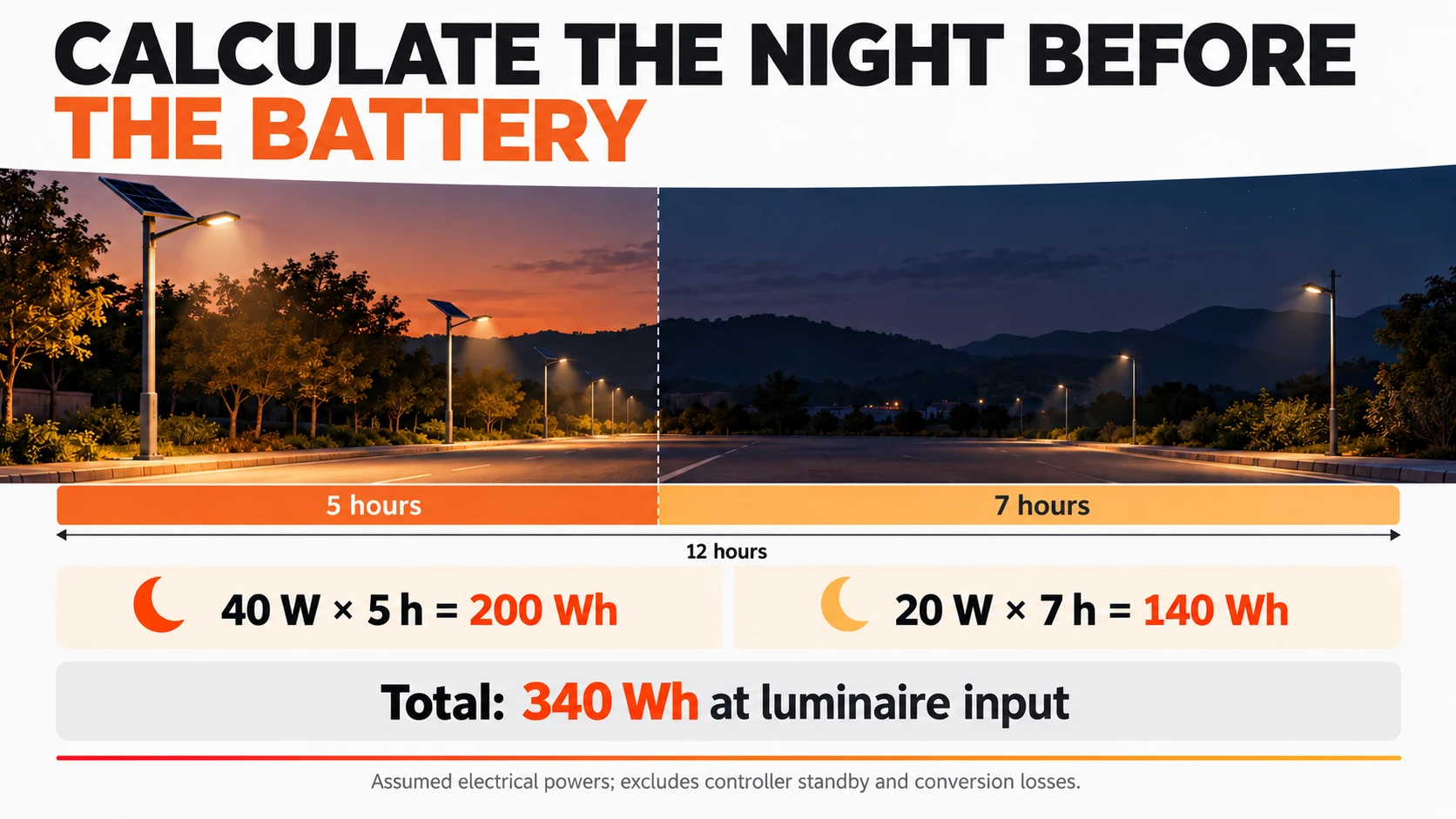
The total is 340 Wh at the luminaire input. The battery-side requirement must also include controller standby and the relevant conversion and cable losses. Reserve for low-sun periods is another requirement, not free energy inside the nameplate capacity. Use the project battery-sizing method to connect the load with usable storage and the site’s solar resource.
Then ask whether the charging system can restore that energy within the available daylight window and complete the required charge process. Surviving one night is not the same as recovering after several poor-sun days. Increasing battery size without reviewing PV input and charging time can leave a larger bank persistently undercharged. Evaluate normal operation and recovery as separate cases.
A controller marked GEL still needs a compatibility check
A preset name is not an approved charging specification. Confirm the battery model’s voltage stages, current limits, charge duration, temperature compensation and operating restrictions with the controller’s available settings. The Rolls GEL charging guidance gives requirements for its own product line; those values must not be copied into an unrelated battery. No universal GEL charging voltage is prescribed here.
Sealed does not mean safe in any airtight box. Rolls explicitly requires ventilation for its sealed OPzV GEL line. The installation designer must follow the offered battery’s manual and local safety rules for ventilation, protection and enclosure design. Do not drill or modify an enclosure on the strength of a general article, because changes can introduce water entry or compromise electrical and structural protection.
Battery handling, isolation, testing and configuration changes belong to qualified personnel. Do not apply generic desulphation, high-voltage equalisation or “revival” routines to a sealed gel battery. A swollen, leaking, abnormally hot or damaged battery requires a safe service assessment, not continued use to see whether the night improves. The solar charge-controller selection guide addresses the control side of the configuration.
Compare the offered system, not a chemistry slogan
GEL is not automatically better than AGM, and lithium is not one uniform product. Compare identified batteries at the required duty, battery temperature, permitted discharge, usable energy and recharge conditions. Include installed weight, enclosure, service access and the replacement route. For the separate choice between lead-acid and LiFePO4 in street lighting, use the existing solar street-light battery chemistry comparison rather than assuming this GEL definition settles the purchase.
Request one consistent purchase record: manufacturer and model; chemistry; nominal voltage; capacity and hour rating; discharge table with temperature and end-voltage basis; approved charge requirements; intended cycle duty; dimensions and terminals; and warranty scope. Attach the nightly schedule and recovery requirement to it. A supplier substitution should be reviewed against the same record, not approved solely because the replacement case says the same Ah.
Compare installed lifecycle cost as well as unit price. Access equipment, labour, transport, downtime and end-of-life handling can change the decision. Do not insert an automatic replacement year into a tender without evidence for that model and duty. A warranty period, a standby-life number and a cycle-test result describe different things.
FAQs about gel batteries
Does a gel battery need water?
No. Do not open a sealed GEL battery or add water to it. Its electrolyte is immobilised internally. Maintenance instead concerns safe inspection, connections, the enclosure and correct charging under the manufacturer’s instructions.
Is a gel battery better than AGM?
Not in every application. Both are VRLA lead-acid designs, but construction and intended duty differ. Compare the exact models at the same relevant capacity basis, temperature, cycling and charging conditions. Do not choose by the chemistry label alone.
Is a gel battery better than lithium for a solar light?
There is no universal answer from those names. Identify the lithium chemistry and complete pack, then compare usable energy, charging compatibility, environment, serviceability and lifecycle cost against the actual GEL model. A change of chemistry needs a system review, not a drop-in assumption.
What are the disadvantages of a gel battery?
For project buyers, the constraints to examine are weight and enclosure space, rate-dependent capacity, approved charging requirements and the available recharge window. Their importance depends on the model and site. A maintenance-free label does not remove those design and service obligations.
Can a normal battery charger charge a gel battery?
Only if its complete charging programme is approved for the exact battery and conditions. A nominal-voltage match or a GEL switch is not enough by itself. Use the battery and charger manuals; do not copy voltage or recovery settings from a different product.
How many years will a gel battery last in street lighting?
A defensible figure needs the identified model, temperature, discharge depth, charge completion and duty. Standby life cannot be read as daily-cycling life. Set condition and performance review triggers, and confirm warranty and replacement support rather than relying on a generic year count.
Turn a battery offer into a reviewable lighting configuration
Inlux Solar’s standard warranty is five years; that company-level term is not a blanket service-life rating for every GEL battery. Keep the offered component coverage in the quotation. Review the Inlux solar street-light systems. For parking projects, compare solar lighting for commercial parking areas against the required night and maintenance arrangements.
Share the site location, quantity, nightly schedule, reserve target, battery installation constraints and any existing battery/controller identification. For replacement work, include the fault history rather than guessing a new capacity. Request a project-based battery and lighting review to compare a complete configuration instead of a loose Ah claim.