Solar panel types are usually introduced as monocrystalline, polycrystalline and thin-film. That is a useful starting point, but it does not explain the full description on a supplier’s quotation. A module can also be N-type, bifacial, half-cut and dual-glass at the same time. Those words describe different attributes; they are not four alternatives competing for the same place in your solar street light.
For a road, village or commercial parking project, the useful question is not “Which label sounds newest?” It is “What exactly is being offered, and what would change if we accepted a substitute?” This guide separates the labels and shows how to turn an incomplete panel description into a configuration that a buyer can actually compare.
Solar panel types: start with the material family
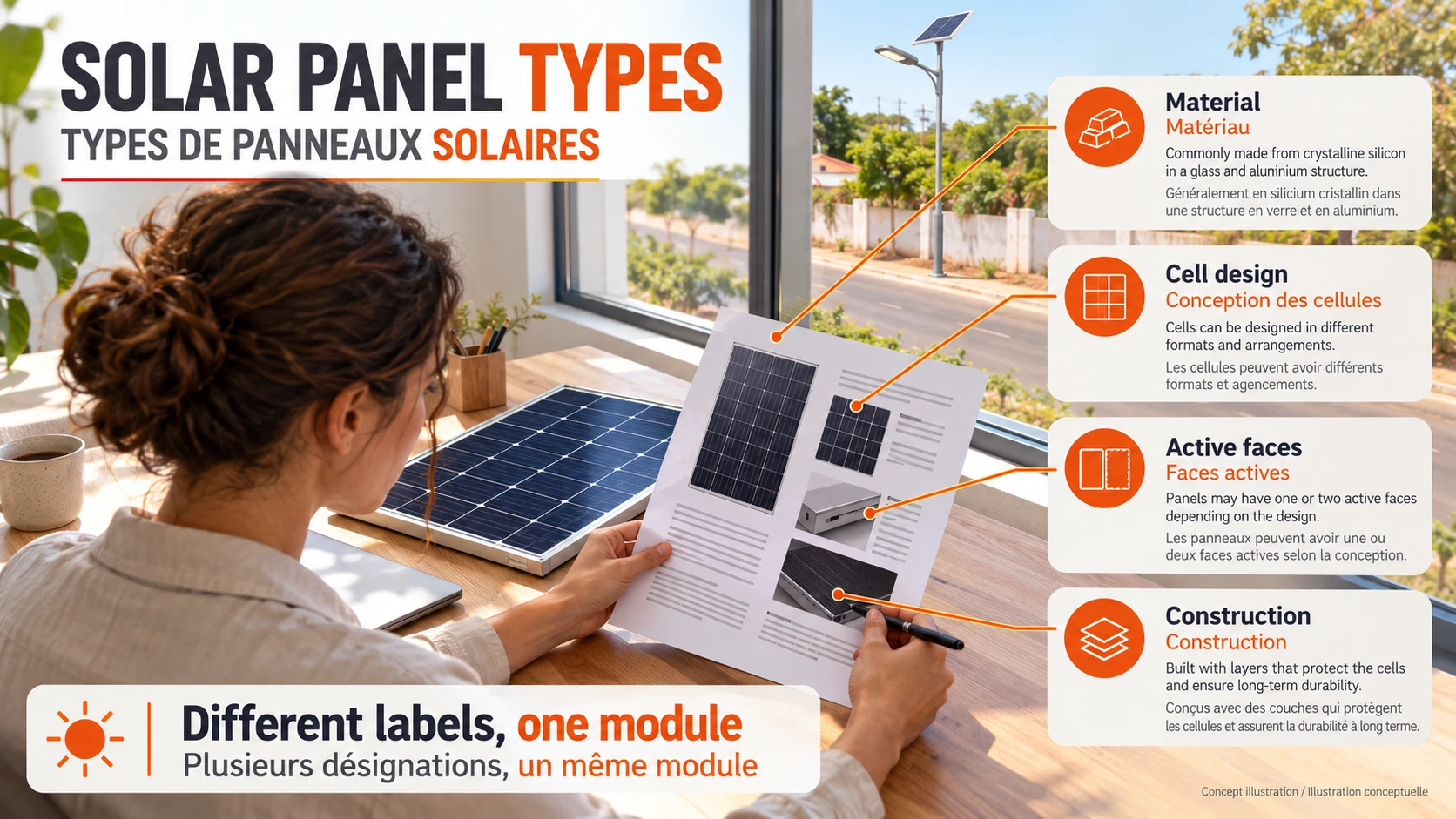
Monocrystalline and polycrystalline panels use crystalline silicon cells. The distinction concerns the crystal structure, not whether the panel is rigid, bifacial or suitable for a particular controller. Thin-film describes a different approach: photovoltaic material is deposited in thin layers on a supporting surface. The U.S. Department of Energy identifies CdTe and CIGS among commercial thin-film materials in its PV cell overview.
| Material family | What the name tells you | What it does not establish |
|---|---|---|
| Monocrystalline silicon | Cells based on a single-crystal silicon structure | Exact module power, dimensions or complete system suitability |
| Polycrystalline silicon | Cells based on multiple silicon crystals | An automatically cheaper installed lighting solution |
| Thin-film PV | Thin deposited photovoltaic layers; identify the actual material | That every module is flexible or interchangeable with silicon |
The crystal definitions are also explained in the DOE’s PV Cells 101 primer. For a direct comparison of the two silicon options in a lighting tender, use our monocrystalline vs polycrystalline guide. Here, the task is broader: checking that every bidder is describing the same attributes before a selection is made.
Five layers hidden inside one panel description
A long product title is not necessarily a detailed specification. Separate it into the following fields. A missing field is a question for the supplier, not permission to fill the gap from a product photograph. Dark cells, a transparent-looking rear surface or a large frame do not identify the complete construction.
| Specification layer | Examples found in descriptions | Procurement meaning |
|---|---|---|
| Material / crystal structure | Mono, poly, CdTe, CIGS | Identify the PV technology rather than the packaging |
| Cell description | N-type, P-type; cell-design labels such as TOPCon or HJT | Ask for the exact declared cell technology; do not infer a performance guarantee |
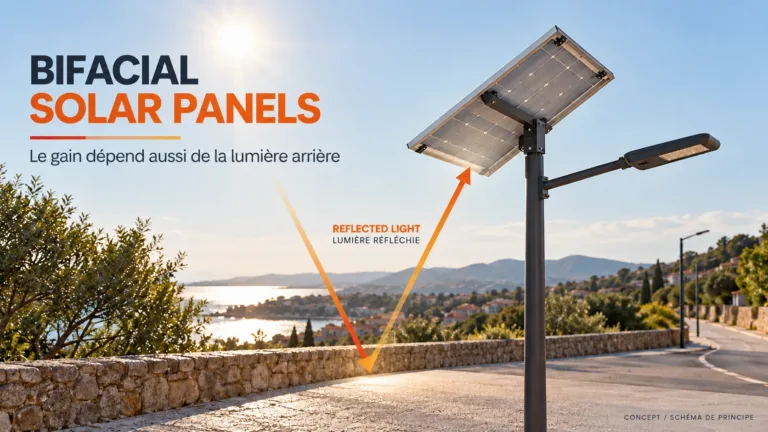
| Light collection | Monofacial or bifacial | Identify whether rear-side light can contribute |
| Module construction | Glass-backsheet or dual glass; cell layout such as half-cut | Identify the physical build separately from active faces |
| Physical format | Rigid, flexible or foldable | Identify the installation format and its mounting restrictions |
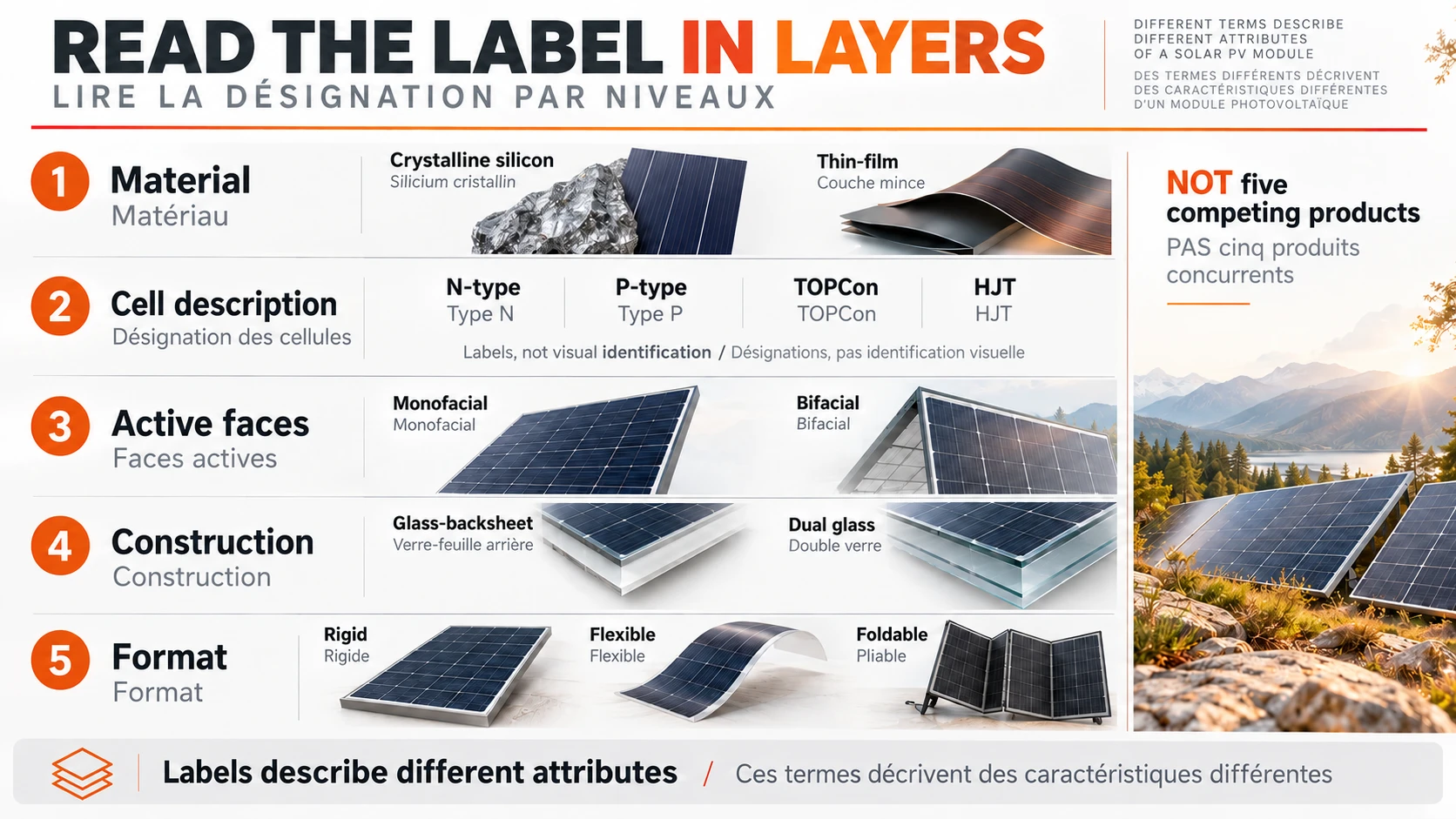
These combinations are not just wording invented for a checklist. The current JinkoSolar datasheet directory lists N-type half-cell bifacial dual-glass modules, but also monofacial dual-glass modules. Its certificate directory separately lists bifacial single-glass and dual-glass categories. That is a practical warning: “dual glass” alone does not prove “bifacial,” and “bifacial” alone does not specify the glass construction. These are external examples, not Inlux configurations or an endorsement of a particular module.
Three offers that cannot yet be ranked
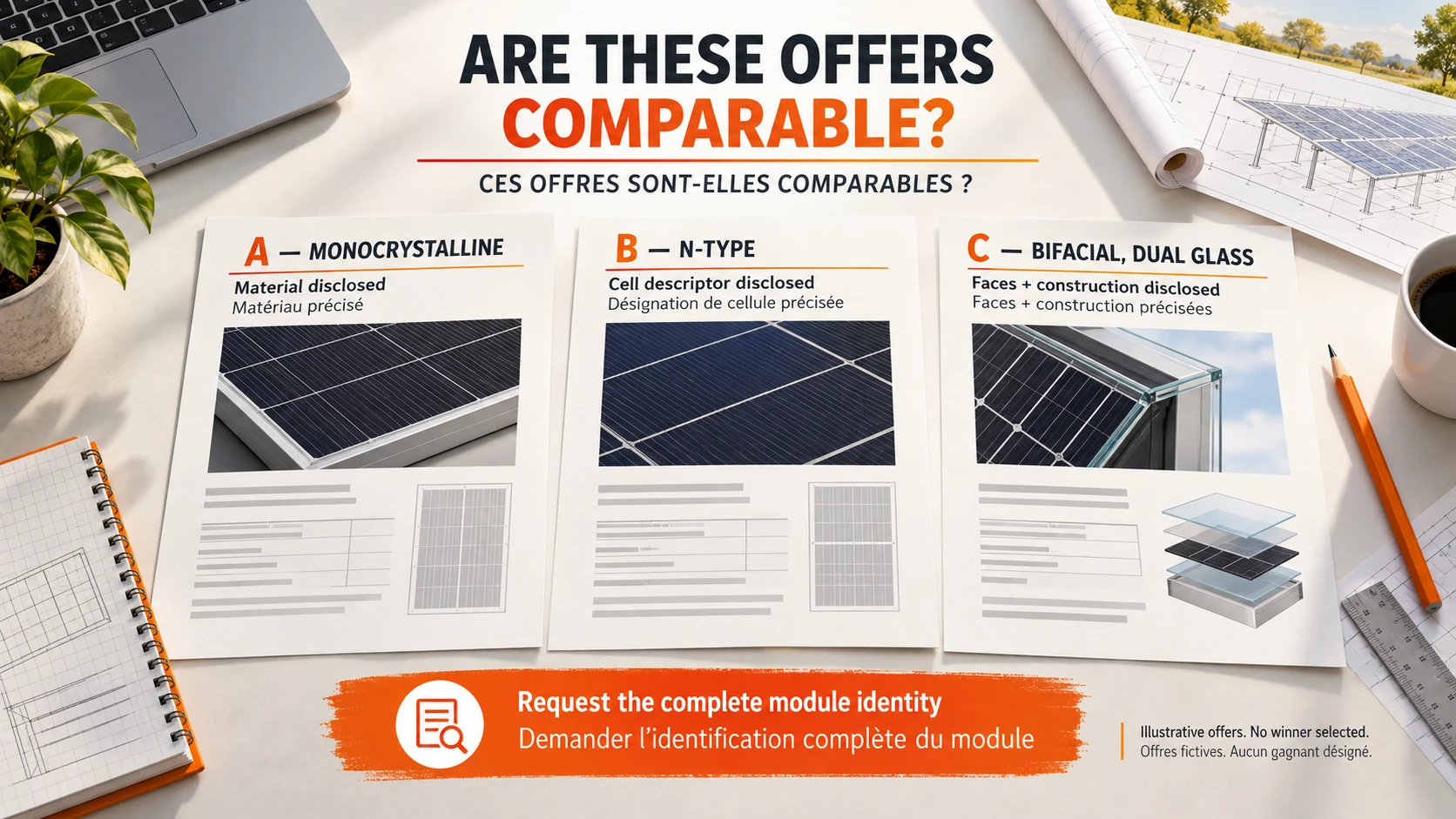
Imagine three responses to the same solar street-light enquiry. Offer A says “monocrystalline panel.” Offer B says “N-type panel.” Offer C says “bifacial dual-glass panel.” A purchasing team could easily interpret B and C as upgrades over A. In reality, the descriptions are incomplete in different places. They might even describe overlapping characteristics of the same underlying product.
| Illustrative offer | Known from the wording | Clarification before comparison |
|---|---|---|
| A: monocrystalline | Crystal structure | Cell technology, active faces, build and exact module reference |
| B: N-type | A cell descriptor | Material declaration, faces, construction and exact module reference |
| C: bifacial, dual glass | Active faces and glass construction | Cell technology, complete reference and configuration approval |
Do not award a technical advantage merely because one quotation contains more fashionable terms. First ask each bidder to complete the same identification line. Only then compare the declared module and its place in the lighting system. A bidder who supplies a precise reference can be evaluated; a bidder who repeats “premium solar panel” has not answered the question.
Write one identity line, then control substitutions
A useful purchase record reads: manufacturer; exact module model and datasheet revision; material and declared cell technology; active faces; construction and cell layout; physical format; declared power and electrical values; dimensions and mass; mounting restrictions; and the lighting configuration to which approval applies. Keep the supplier’s terminology, but place it in the correct field.
For example, a proposed replacement from “mono” to “N-type bifacial” is not a complete change request. Require the replacement model, the attributes that actually differ and the consequences for the approved assembly. A technology label cannot show whether an integrated housing still closes correctly, a connector pair remains approved, or the controller accepts the replacement module’s electrical envelope.
Keep two distinct decisions in the approval record: “module identity accepted” and “module accepted in this lighting configuration.” The first stops ambiguous descriptions. The second prevents a well-documented panel from being installed in an unsuitable assembly. If a field changes after a sample is approved, the supplier should identify that change before shipment rather than describing it as an equivalent upgrade.
Choosing a panel for an actual lighting configuration
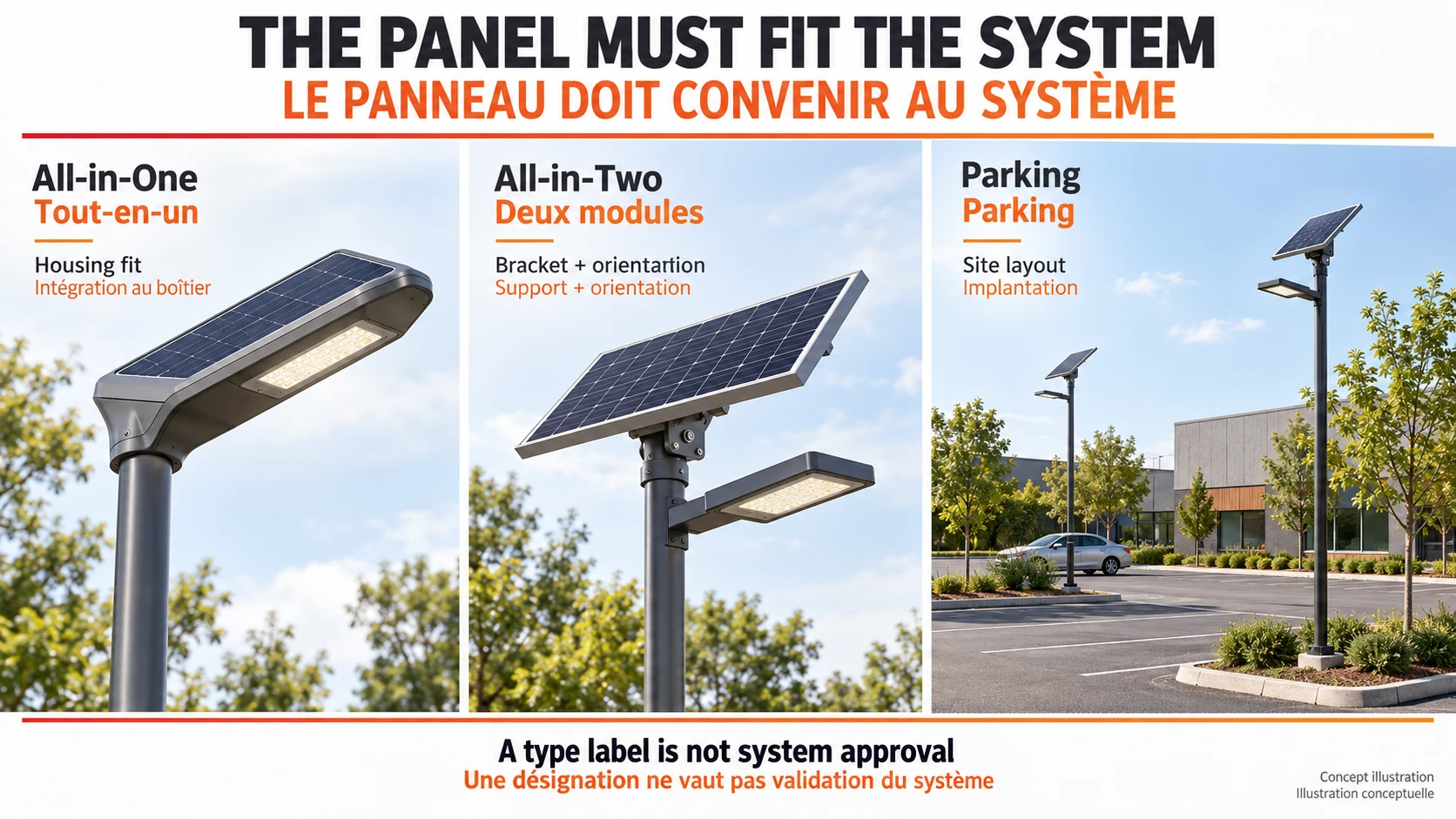
For a project using an integrated All-in-One solar street light, the panel is part of a closely integrated assembly. Treat a change of format, thickness, fastening or connection as a configuration question. The ability to buy a higher-rated panel elsewhere does not mean it can be substituted into an existing luminaire.
With an separate-panel All-in-Two solar street light, a separate panel offers a different mounting arrangement, not unlimited freedom to mix components. Check the specified bracket, orientation and electrical interface for the offered configuration. “Flexible” or “foldable” is not evidence that a portable module is approved for permanent pole installation.
For a project using solar parking lot lighting, review the locations as well as the equipment schedule. One panel type does not remove shading from a building or determine the lighting layout. Identify the configuration assigned to each site condition instead of approving a technology name for the whole project.
Where the Inlux material description fits
The PV section of the Inlux Material Excellence page describes mono cells, half-cut architecture and optional bifacial architecture. This is useful evidence of how several descriptors can coexist. It is not a statement that every current Inlux model uses every option, nor a substitute for the configuration named in your quotation.
Use the specialist guides when the decision becomes more specific: solar panel wattage for reading a power claim, solar panel dimensions for the physical envelope, and bifacial solar panels for assessing a rear-side contribution. Those are separate checks, not reasons to rename the same module as several competing types.
FAQ: solar panel types in procurement
Are there three or four main solar panel types?
It depends on the classification. A common introductory grouping is monocrystalline, polycrystalline and thin-film. Lists that add bifacial as a fourth item mix material or crystal structure with light collection. Ask what the list is classifying before treating its entries as mutually exclusive choices.
Is N-type automatically better than P-type for a street light?
No cell descriptor alone settles a system purchase. Compare the actual declared modules and their approved configurations. A buyer still needs the electrical characteristics, physical fit and project design basis. Do not turn a cell-technology preference into a guarantee of longer nightly lighting.
Does dual glass mean the panel is bifacial?
No. Dual glass describes the module construction. Bifacial describes active light collection from both sides. Official manufacturer directories include monofacial dual-glass products, so the quotation must state both attributes rather than leaving the buyer to infer one from the other.
Are flexible panels always thin-film?
The words answer different questions. Flexible describes physical format; thin-film describes the photovoltaic material approach. Verify the actual cell material and the mounting instructions. Neither a flexible appearance nor a thin profile establishes approval for a fixed street-light installation.
Can a higher-power panel replace the original one?
Not on the power label alone. The replacement needs approval for its electrical limits, dimensions, mass, fastening and connection within the existing configuration. Ask the equipment supplier to identify the exact replacement reference and the changes requiring review before ordering or installation.
What should a buyer put in the panel enquiry?
Give the project location, lighting application, intended equipment family and whether this is a new system or a replacement. Ask for an exact module identification and a configuration-specific answer, not a generic statement that one panel type is best. For replacement work, include the original equipment reference and its available identification details.
Get a configuration-specific answer
Browse the Inlux solar street light range to identify the equipment family, then send your project enquiry with the panel description or proposed substitute. Ask the quotation to identify the complete module and the lighting assembly it belongs to. That gives the purchasing team something to approve, rather than another label to interpret.