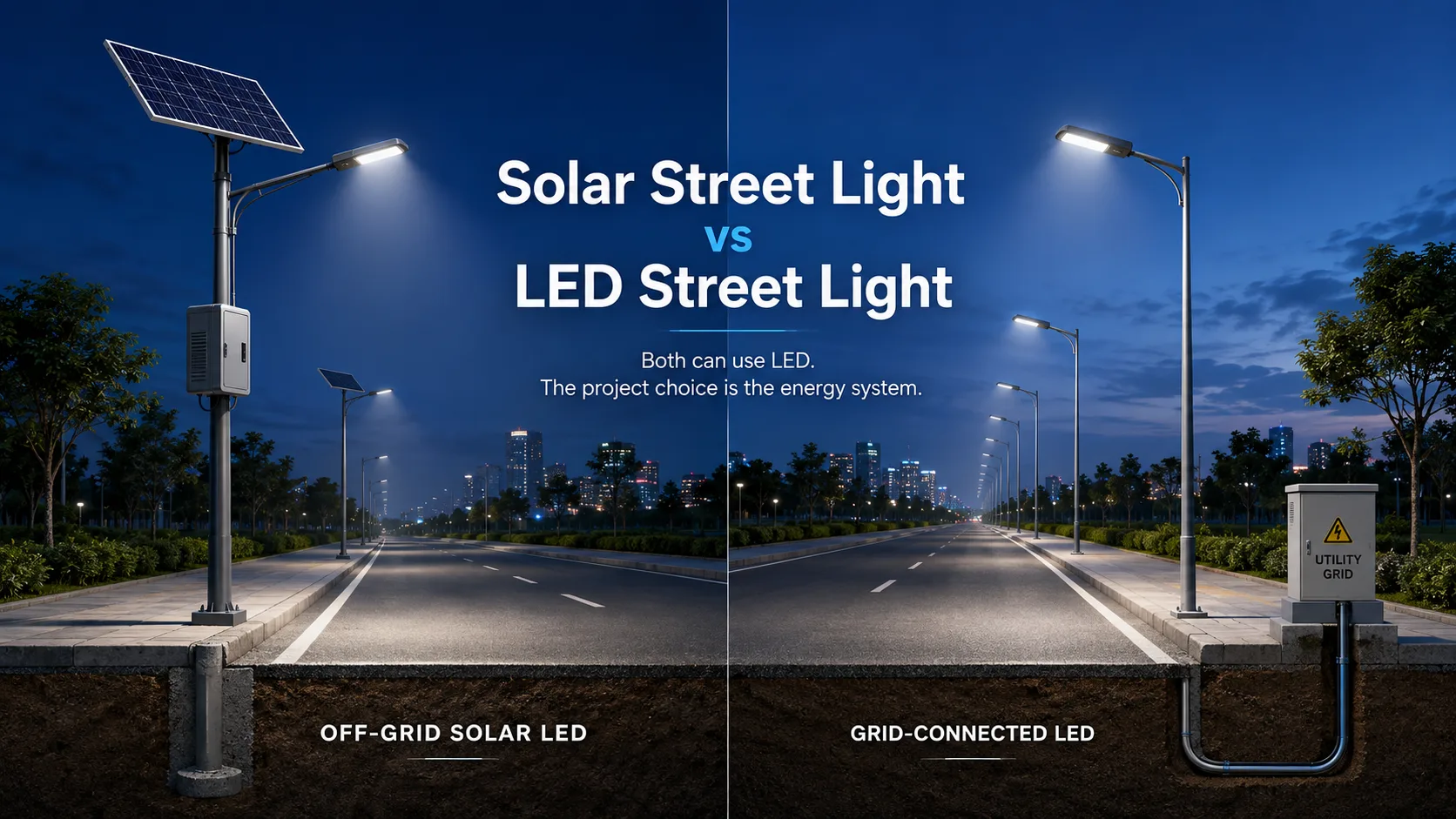
The phrase “solar street light versus LED street light” hides a small but important mistake: most modern solar street-light systems use LED luminaires too. LED describes the light source and optical system. Solar describes the energy system that powers it.
The project choice is usually between an off-grid solar LED lighting system and a grid-connected LED street-light system. Once that is clear, the decision becomes practical. Can the site be connected to the grid at a reasonable scope? Is the solar resource reliable through the operating season? What level of light is required, for how many hours, and who will maintain the system over its life?
Scope note: This is a project-selection guide, not a claim that one system is always better. A final choice needs the site plan, required lighting performance, grid-connection scope, solar conditions, operating schedule, maintenance plan and local approvals.
First, compare the right two systems
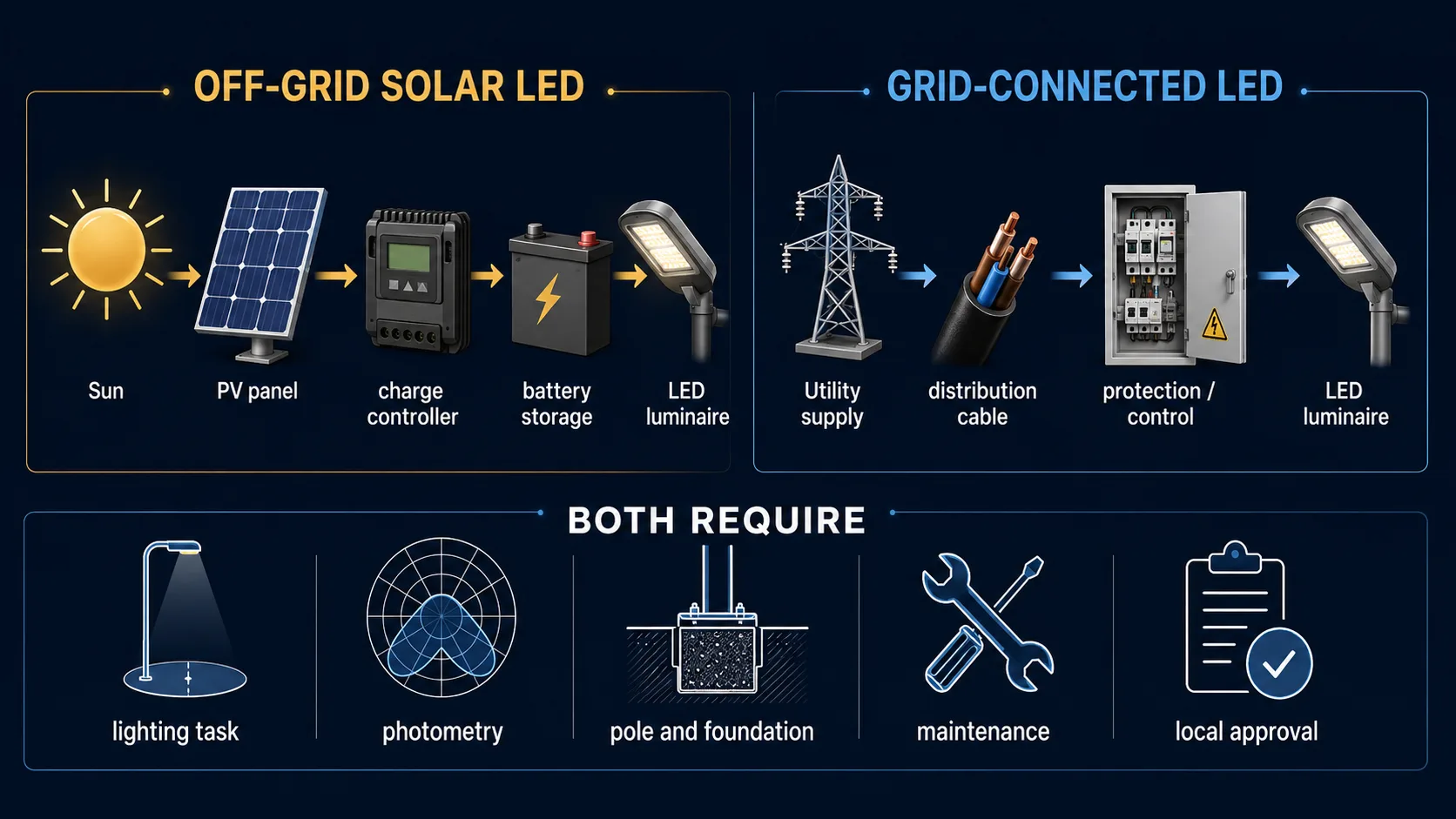
A grid-connected LED street light receives power through the electrical network and uses LED optics to distribute light. A solar street light captures energy locally, stores it, controls discharge and also commonly uses LED optics at night. The key comparison is not LED versus non-LED; it is central-grid energy versus local solar generation and storage.
| Question | Off-grid solar LED system | Grid-connected LED system |
|---|---|---|
| Where does night-time energy come from? | Solar collection and stored energy at or near the lighting point. | Electrical network and the project’s distribution infrastructure. |
| What needs early engineering attention? | Solar exposure, shading, storage, operating profile, pole/system layout. | Grid extension, cable route, trenching, supply capacity, protection and connection approvals. |
| What can change the cost picture? | Energy-system sizing, local conditions, installation logistics and future component service. | Civil works, cable distance, utility connection, energy use and maintenance access. |
| What remains necessary in both cases? | Lighting task, photometry, pole/foundation engineering, safety, maintenance and local approval. | Lighting task, photometry, pole/foundation engineering, safety, maintenance and local approval. |
The right answer may be different within the same project. A remote access road can favor an off-grid system where trenching is difficult. A dense urban corridor with an available utility supply and a demanding night-time profile can favor a grid-connected LED system. Treating the whole site as one automatic choice often produces a poor brief.
When solar street lighting deserves serious consideration
Solar is worth evaluating when the project has suitable solar exposure and the alternative requires long cable runs, difficult trenching, costly road reinstatement or a utility connection that cannot be delivered on the project timetable. It can also suit roads, compounds, public areas or remote infrastructure where a self-contained lighting point is operationally useful.
That does not mean every sunny site is a solar site. A PV panel that is shaded by trees, structures, dust, nearby towers or seasonal conditions is not a paper detail. The operating schedule and required light level must be supported by the actual energy available to the quoted system.
For the solar-system route, start with the existing Commercial Solar Street Lights path. It leads into the current system categories rather than pretending every solar project has the same panel, battery, pole or optical arrangement.
When a grid-connected LED street light may be the cleaner choice
An available and dependable grid supply can make a conventional LED route straightforward, particularly where the road already has electrical infrastructure, long night-time operation is required or the lighting plan calls for a profile that is difficult to support with the available solar resource.
The grid is not “free” simply because it is present nearby. The project still needs to account for route surveys, excavation, ducting, cable, switchgear, connection responsibility, reinstatement, energy billing and future maintenance. Those costs are often hidden when the brief starts and only become visible after civil work is planned.
For the grid-connected luminaire route, use the مصباح الشارع LED path. It is a different system boundary from an off-grid solar quotation, even when both use similar LED optical principles.
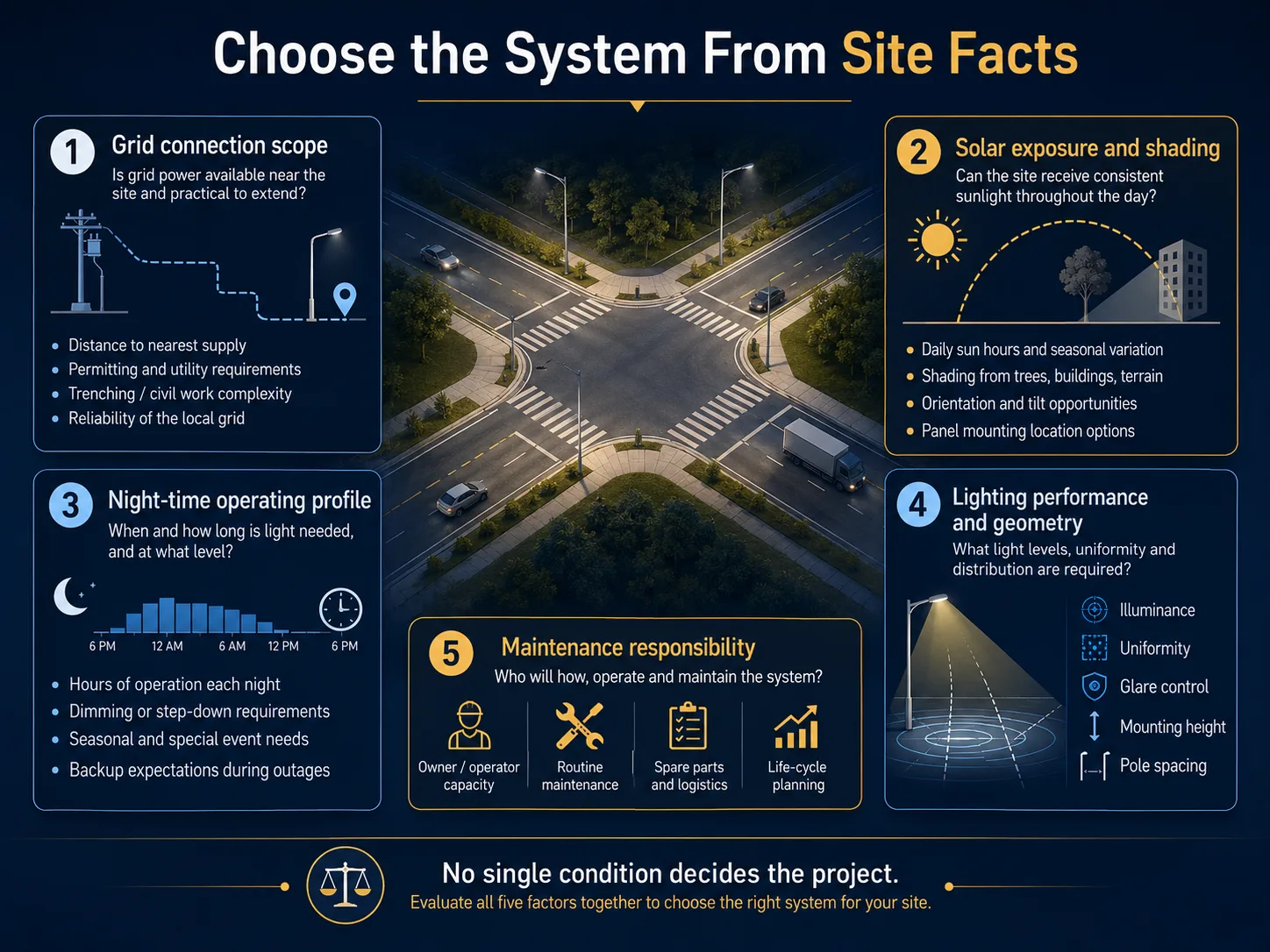
The decision should be made on five site facts
1. Grid connection scope
Ask where the actual connection point is, who owns it, whether capacity is available and what civil work is required between that point and each lighting location. “The grid is nearby” is not yet a cost or delivery plan.
2. Solar exposure and seasonal risk
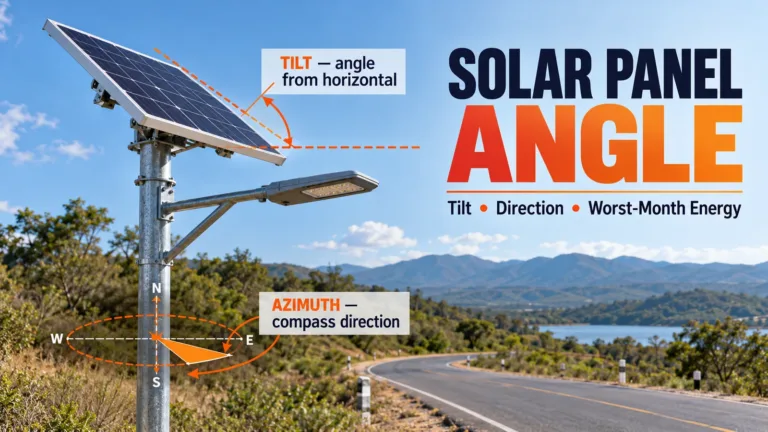
Record shading, local climate, mounting constraints, panel orientation and the season that creates the hardest operating condition. A system should be assessed against the project’s worst credible energy period, not only a clear-day image.
3. Night-time operating profile
Define the hours of required lighting, any dimming schedule, security or activity peaks and the areas that cannot tolerate reduced availability. A well-designed profile can be more valuable than chasing a generic maximum wattage.
4. Lighting performance and geometry
Road width, pole spacing, mounting height, obstructions, glare control, pedestrian activity and the required visual task apply to both routes. An energy source does not replace a lighting calculation.
5. Maintenance responsibility
Set out who can inspect, clean, service and replace components, and how a fault will be identified. The practical maintenance route matters more than a broad claim that one system is “maintenance free.”
Compare whole-project cost, not a single product price
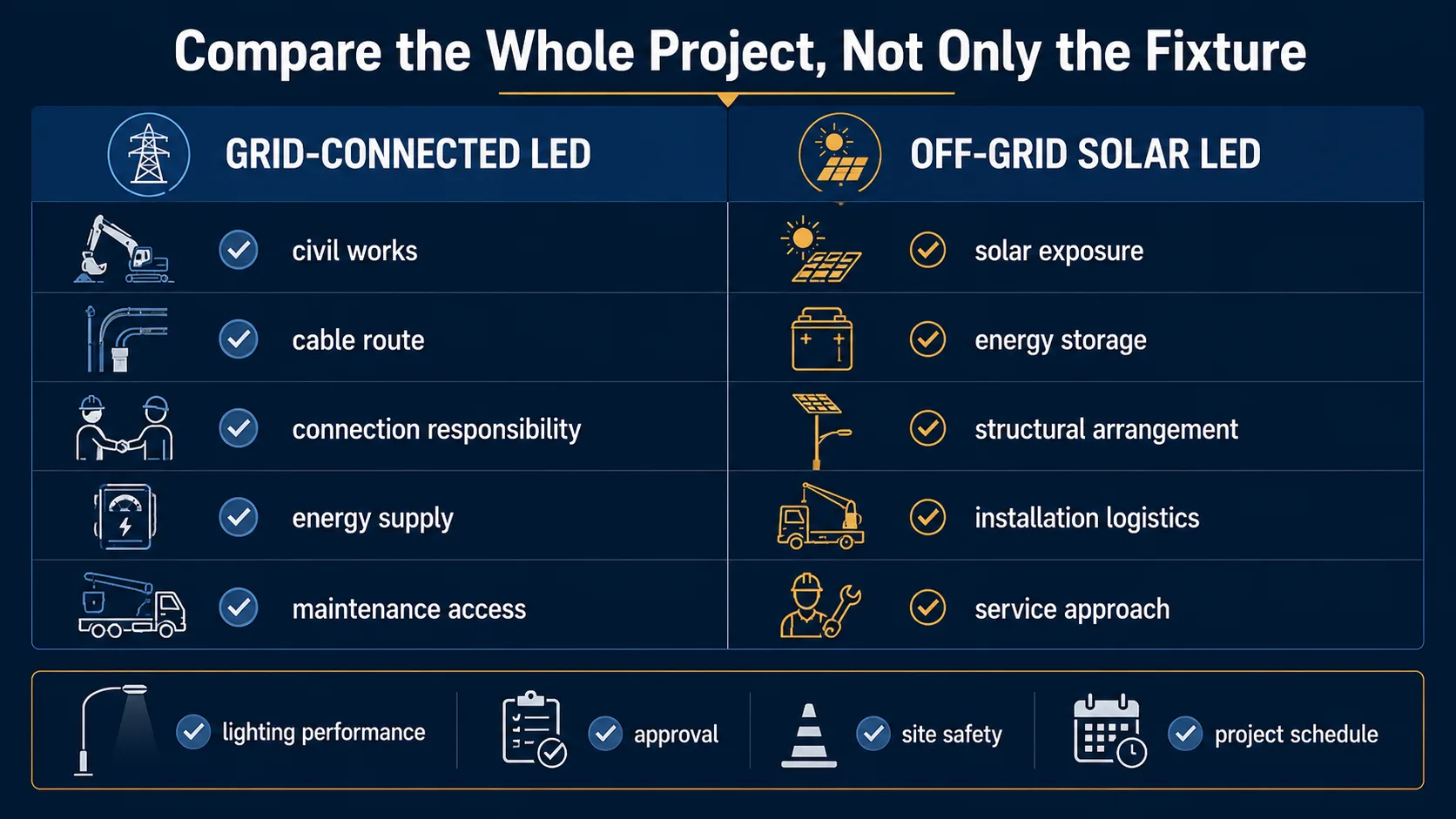
Both routes can look attractive if only the luminaire price is compared. The useful comparison includes the components and work that make the system function on site.
For a grid-connected option, list civil works, distribution, connection, metering/energy responsibility and future electrical maintenance. For a solar option, list the integrated or separate energy-system components, structural arrangement, installation logistics, expected service approach and the site conditions that affect energy availability.
Neither list produces one universal winner. It produces a cleaner RFQ and makes it easier to see whether a low initial quote is quietly excluding essential site work. For price-structure questions, use the Solar Street Light Price Guide as a project-input guide rather than a substitute for a site-specific quotation.
A useful project split: use both systems where the site calls for it
Projects do not always need one technology across every zone. An access road, a parking area, a main public street and a remote perimeter can have different electrical and operating constraints. A hybrid site strategy can be more sensible than forcing solar into a shaded, high-demand location—or excavating a long cable route solely for a few isolated points.
The decision should still be made with one lighting plan and one responsibility matrix. Mixing technologies without a clear operating and maintenance boundary can create more problems than it solves.
Do not confuse this comparison with HPS vs LED
Solar vs LED is about the energy-system route. HPS vs LED is about the light source and luminaire technology. They can be related in a project, but they are not the same question. If a project is replacing older sodium lighting, see HPS vs LED Street Lights for that separate comparison.
Questions project teams ask
Are solar street lights LED lights?
Many modern solar street-light systems use LED luminaires. “Solar” refers to how the system is powered and stores energy; it does not automatically describe a different light-source technology.
Is solar always cheaper than grid-connected LED lighting?
No. The answer depends on grid-extension scope, civil works, solar conditions, operating profile, required performance, maintenance and local project requirements. Compare complete project inputs, not only the fixture price.
Can a solar system provide the same lighting result as a grid-connected system?
That must be assessed from the site geometry, required lighting task, solar resource, storage design and operating profile. Do not approve an equivalence claim without project-specific photometric and energy evidence.
What information should a project send before choosing solar or grid power?
Send the site plan, road/area geometry, intended mounting points, required hours, grid-connection information, solar/shading conditions, environmental conditions, quantity, destination and applicable approval requirements.
Can Inlux Solar quote both solar and LED road-lighting routes?
Inlux’s public site contains separate Commercial Solar Street Lights و مصباح الشارع LED paths. Send the project inputs so the applicable system scope can be reviewed; this article does not pre-approve one route for every site.
Need a side-by-side project review?
Send the site plan, road geometry, grid-connection information, solar exposure/shading notes, operating hours, required lighting task, environmental conditions, quantity and destination. The Inlux engineering team can help separate the solar-system and grid-connected LED scopes before a quotation is compared.